

US CPI Rises 0.1% in July 2026 as Expected; Core Inflation Eases to 2.5%
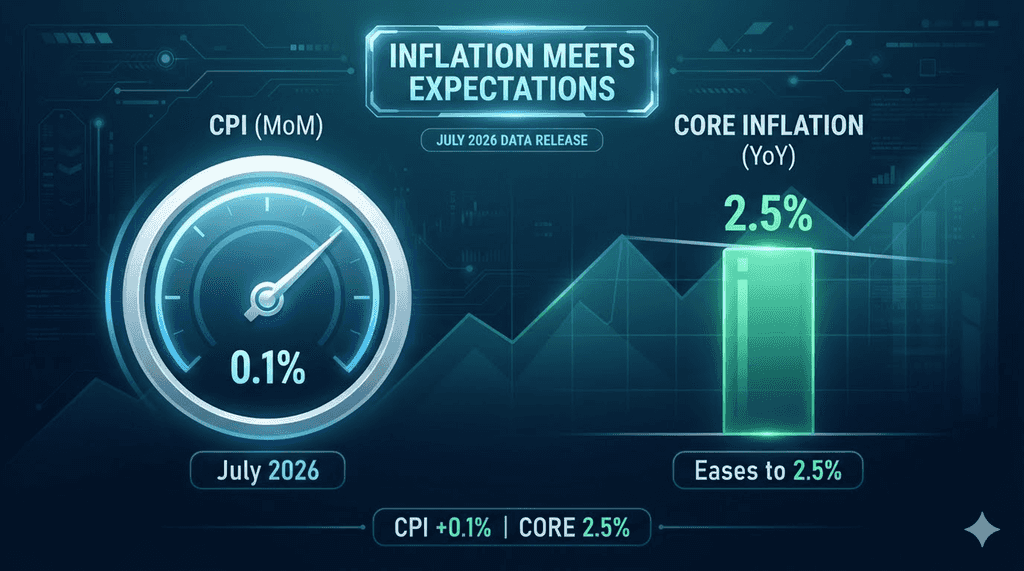
The global financial landscape continues to experience significant macroeconomic shifts. On August 12, 2026, the U.S. Bureau of Labor Statistics (BLS) released its highly anticipated Consumer Price Index (CPI) report for July 2026. The data revealed that headline CPI rose 0.1% month-on-month, matching the consensus estimates of Wall Street economists. Meanwhile, core inflation, which strips out the volatile food and energy sectors, eased slightly to an annual rate of 2.5%.
For cryptocurrency traders and Web3 investors, these macroeconomic indicators are a primary focus. This July report presents a picture of an economy experiencing a measured cooling trend. It provides a crucial cushion of liquidity data for a crypto market navigating post-halving dynamics, shifting regulatory landscapes, and evolving macroeconomic correlations.
What Does the July 2026 CPI Report Tell Us?
Headline vs. Core Inflation: A Balanced Cooling Trend
To understand the trajectory of the U.S. economy, it is essential to break down the primary metrics provided by the BLS. The July 2026 report reflects stability, showing that the elevated inflation of previous years has significantly matured into a controlled disinflationary cycle.
-
Headline CPI Year-on-Year (YoY): The annual headline inflation rate came in at 3.4%, down slightly from the 3.5% recorded in the previous month. This marks a steady retreat from the 4.2% peak observed in May 2026, which was driven by temporary geopolitical disruptions.
-
Headline CPI Month-on-Month (MoM): Consumer prices increased by a modest 0.1% in July, climbing slightly from the -0.4% contraction seen in June, but remaining entirely within expected parameters.
-
Core CPI Year-on-Year (YoY): Core inflation eased to 2.5%, down from 2.6% in June. This remains the lowest level since March 2021, showcasing long-term structural stabilization.
-
Core CPI Month-on-Month (MoM): On a monthly basis, core prices edged up by 0.2%, satisfying market consensus and proving that underlying price pressures are predictable.
The Winners and Losers Driving the Index
The headline stability masks a diverse internal tug-of-war among various economic sectors. While certain commodities experienced sharp declines, structural services remained stubborn.
| Economic Category | July Month-on-Month (MoM) | July Year-on-Year (YoY) | Key Drivers and Market Structural Context |
| Gasoline & Energy | -2.90% | 0.24% | Energy acted as the primary deflationary force in July. A localized diplomatic breakthrough in Middle Eastern conflicts eased shipping anxieties across the Strait of Hormuz, bringing crude prices down from their Q2 highs. |
| Shelter (Housing) | 0.10% | 3.20% | Shelter costs grew modestly by 0.1% over the month. However, due to its heavy weighting in the CPI basket, it still accounted for nearly two-thirds of the total monthly increase. A 2.8% drop in lodging away from home offset a 0.3% rise in Owners' Equivalent Rent (OER). |
| Core Services | Mixed | 3.00% | Services remained sticky. Airline fares experienced a sharp summer rebound of 2.2% MoM, and medical care services increased by 0.4%, proving that labor-dependent industries still face high overhead costs. |
| Food & Commodities | 0.10% | 3.00% | Food indexes were balanced. Grocery store prices rose minimally, though individual items saw extreme variance: ground beef rose 9.0% YoY due to supply constraints, while lettuce dropped 16.4% YoY following a demand shock tied to a localized cyclospora outbreak. |
The Macroeconomic Context and Fed’s Next Move
Economic Slowdown or Soft Landing?
The July CPI report cannot be viewed in isolation. It arrived on the heels of a July nonfarm payrolls report released in early August, which shocked markets by revealing a net loss of 23,000 jobs in the United States.
Furthermore, the macro data highlights a widening gap in consumer purchasing power. While nominal wage growth slowed to an annual rate of 3.2% in July, it officially lagged behind the headline inflation rate of 3.4%. For the average American household, this means real wages are technically shrinking, dampening consumer aggregate demand. On a positive note, market concerns that the administration's proposed import tariffs on specialized goods like consumer drones would trigger immediate inflationary pressure have not materialized, as core commodity prices remained flat at 0.2%.
Will the Fed Pivot? Analyzing the CME FedWatch Data
With inflation matching expectations and employment showing visible signs of weakening, the Federal Reserve faces an intricate policy dilemma. The central bank's primary mandate is balancing price stability with maximum employment, and the scale is tipping toward protecting jobs.
According to the CME FedWatch Tool, the probability of the Federal Reserve raising interest rates at the upcoming September 15–16 policy meeting dropped from 48.4% prior to the release down to roughly 38%. The market consensus has firmly shifted toward a prolonged pause, with an increasing number of analysts predicting an outright dovish pivot or rate cuts later in the year if employment numbers worsen.
This internal tension was palpable during the Fed's July meeting, where the FOMC voted 9-to-3 to hold rates steady. The three dissenting regional bank presidents, including Dallas Fed President Lorie Logan, pushed hard for a rate hike, citing the stubbornness of the 2.5% core inflation rate. Consequently, global macro analysts and crypto asset allocators are shifting their focus to the upcoming Jackson Hole Economic Symposium, where Fed officials are expected to clarify their policy framework for the final quarter of 2026.
Macro Liquidity vs. Crypto Assets
For the cryptocurrency market, the relationship with CPI data functions through the transmission mechanism of global liquidity. Cryptocurrencies, primarily Bitcoin and Ethereum, behave as high-beta, risk-on assets that thrive in environments of abundant capital and low capital costs.
When CPI inflation meets expectations and the labor market cools, the justification for the Federal Reserve to maintain an aggressive, restrictive monetary stance dissolves. Anticipation of an end to the rate-hike cycle depresses the U.S. Dollar Index (DXY) and lowers U.S. Treasury yields. When fixed-income yields drop and the dollar weakens, capital naturally flows out of defensive, low-yield safe havens and migrates back into risk asset networks. A predictable interest rate environment reduces the cost of capital for institutional trading desks, directly translating into increased net liquidity inflows for the crypto spot and derivatives markets.
While a 2.5% core inflation rate is a structural victory for the Federal Reserve, it remains fundamentally above the central bank’s long-term target of 2.0%. More importantly, the structural reality of negative real wage growth (3.2% wage growth vs. 3.4% price growth) underscores the ongoing challenge to consumer purchasing power.
This specific macroeconomic friction strengthens the core value proposition of Bitcoin as "hard money" or "digital gold." Unlike fiat currencies, which are subject to supply expansion and policy adjustments by central banking authorities, Bitcoin features a mathematically hard-capped supply of 21 million coins. As institutional investors navigate the long-term impact of inflation on traditional capital, the narrative of Bitcoin as a non-sovereign, programmatic store of value continues to gain traction. The July CPI report highlights this trend: inflation is stabilizing at a level that consistently affects the real yield of cash, making fixed-supply digital assets increasingly attractive for long-term capital preservation.
Market Reactions
Following the BLS announcement, Bitcoin experienced a brief flash of volatility, characteristic of high-frequency algorithmic trading executing on macro data releases.
From a technical and structural standpoint, the removal of an "inflation shock" risk gives institutional spot ETFs a green light to resume steady accumulation. With the macro outlook turned predictable, Bitcoin is well-positioned to retest major psychological resistance zones. Ethereum exhibits a similar consolidation pattern; a reduction in macroeconomic headwinds allows investors to focus on fundamental metrics, such as network transaction fee stabilization and the steady integration of layer-2 scaling solutions.
High-Beta Altcoins and the Return of Risk Appetite
When macroeconomic anxiety recedes, capital allocators typically move further down the risk curve into alternative digital assets. The stabilizing core inflation rate serves as a green light for altcoin liquidity.
-
Layer-1 Ecosystems: Major smart contract platforms tend to experience rapid capital inflows as ecosystem development and decentralized application (dApp) volumes scale up in a stable rate environment.
-
Artificial Intelligence (AI) Tokens: The decentralized AI sector, which relies on tech sector correlations, stands to benefit significantly from a softer dollar and stabilizing yields.
-
DeFi Blue Chips: Protocols offering tangible revenue generation and yield opportunities become competitive again when traditional risk-free treasury yields begin to plateau or decline.
How to Trade the CPI Volatility on KuCoin
Capitalize on Spot Volatility with Automated Bots
Macro events like the CPI release invariably create short-term localized price swings before a definitive trend emerges. Rather than manually chasing these volatile candles, traders can deploy the KuCoin Trading Bot.
By utilizing the Spot Grid Trading strategy, users can establish automated buy-and-sell parameters within a specific price band. When the market spikes or dips in response to macro headlines, the bot executes trades automatically, capturing micro-profits from the fluctuations without exposing the trader to emotional decision-making.
Manage Leverage in Futures Trading
The derivatives market frequently witnesses significant liquidation events directly before and after major economic announcements, as market makers clear out over-leveraged long and short positions. When trading on KuCoin Futures during macro weeks, risk management must take absolute priority. Traders should consciously lower their effective leverage ratios to withstand sudden wick expansions.
Long-Term Accumulation via DCA
Through the KuCoin Dollar-Cost Averaging (DCA) feature, users can automate fixed purchases of Bitcoin or Ethereum at set intervals (daily, weekly, or monthly). This systematic approach reduces the psychological stress of trying to time macro market tops and bottoms, effectively smoothing out the entry price over time as the macroeconomic cycle pivots toward long-term liquidity expansion.
Conclusion
The July 2026 U.S. CPI report delivers a degree of market predictability, with headline inflation rising a modest 0.1% month-on-month and core inflation easing to 2.5%. While this alignment with consensus expectations reduces the immediate probability of restrictive rate hikes from the Federal Reserve, the simultaneous softening of the labor market introduces broader questions regarding economic growth and recession risks.
While cash purchasing power erosion maintains the relevance of fixed-supply digital assets as structural alternatives, sustainable liquidity hinges on a potential economic soft landing. The market outlook remains stable but highly sensitive, with focus shifting to the Jackson Hole symposium and upcoming Core PCE data for clearer signs on future monetary policy.
KuCoin Offers A More Stable Option in A Volatile Market
If you worry about the frequent ups and downs in the market, and pursue a more stable option to earn money passively, KuCoin is the right place to come:
Simple Earn: Deposit and withdraw tokens anytime, earning stable returns.
Kucoin Earn: Earn stable profits with professional asset management.
Hold to Earn: Earn rewards by holding assets in Funding, Trading, Margin, Futures, Mining, and Unified Accounts.
Staking: Unlock the earning potential of on-chain assets.
Advanced Investments: Advanced Investments offer a variety of structured products to help your money grow in any market.
Shark Fin: Principal Protection and Guaranteed Gains
Dual Investment: Buy low and sell high with transparent return calculations.
Snowball: High yields, with price protection.
Discount Buy: Buy crypto at discount prices.
KCS Loyalty: Level up to enjoy exclusive perks by staking ≥ 1 KCS.
KuCoin Wealth: Discover future value and begin your smart investing journey.
KCS Benefits: Hold and stake KCS to access benefits across the platform.
KCS Staking 2.0: Participate in KCS on-chain governance to earn yield.

FAQs
How did the July 2026 CPI report impact Federal Reserve interest rate expectations?
With headline CPI at 3.4% and core inflation at 2.5%, the data met consensus estimates. Combined with recent labor weakening, this significantly lower threat of aggressive rate hikes shifted the market toward a prolonged policy pause.
Why does negative real wage growth support the narrative for Bitcoin?
Because nominal wage growth (3.2%) lagged behind inflation (3.4%), consumer purchasing power is shrinking. This friction enhances Bitcoin’s appeal as "hard money" and a programmatic store of value against ongoing fiat currency debasement.
Which crypto sectors are expected to benefit most from this macro setup?
Declining Treasury yields and a weaker DXY boost risk appetite. High-beta altcoins—particularly high-performance Layer-1 platforms, decentralized AI tokens, and DeFi blue chips offering real protocol revenue—are well-positioned for capital inflows.
What futures risk management strategies are recommended for macro weeks?
Traders should lower effective leverage ratios to withstand sudden market wicks. Deploying strict Stop-Loss and Take-Profit orders is vital to shield capital from cascading liquidations during sudden market reversals.
Disclaimer
The information provided on this page may originate from third-party sources and does not necessarily represent the views or opinions of KuCoin. This content is intended solely for general informational purposes and should not be considered financial, investment, or professional advice. KuCoin does not guarantee the accuracy, completeness, or reliability of the information, and is not responsible for any errors, omissions, or outcomes resulting from its use. Investing in digital assets carries inherent risks. Please carefully evaluate your risk tolerance and financial situation before making any investment decisions. For further details, please consult KuCoin’s Terms of Use and Risk Disclosure.