

Traditional-Asset Perpetual Futures Hit $1.32 Trillion as Crypto Exchanges Expand Into TradFi
2026/08/08 11:12:00
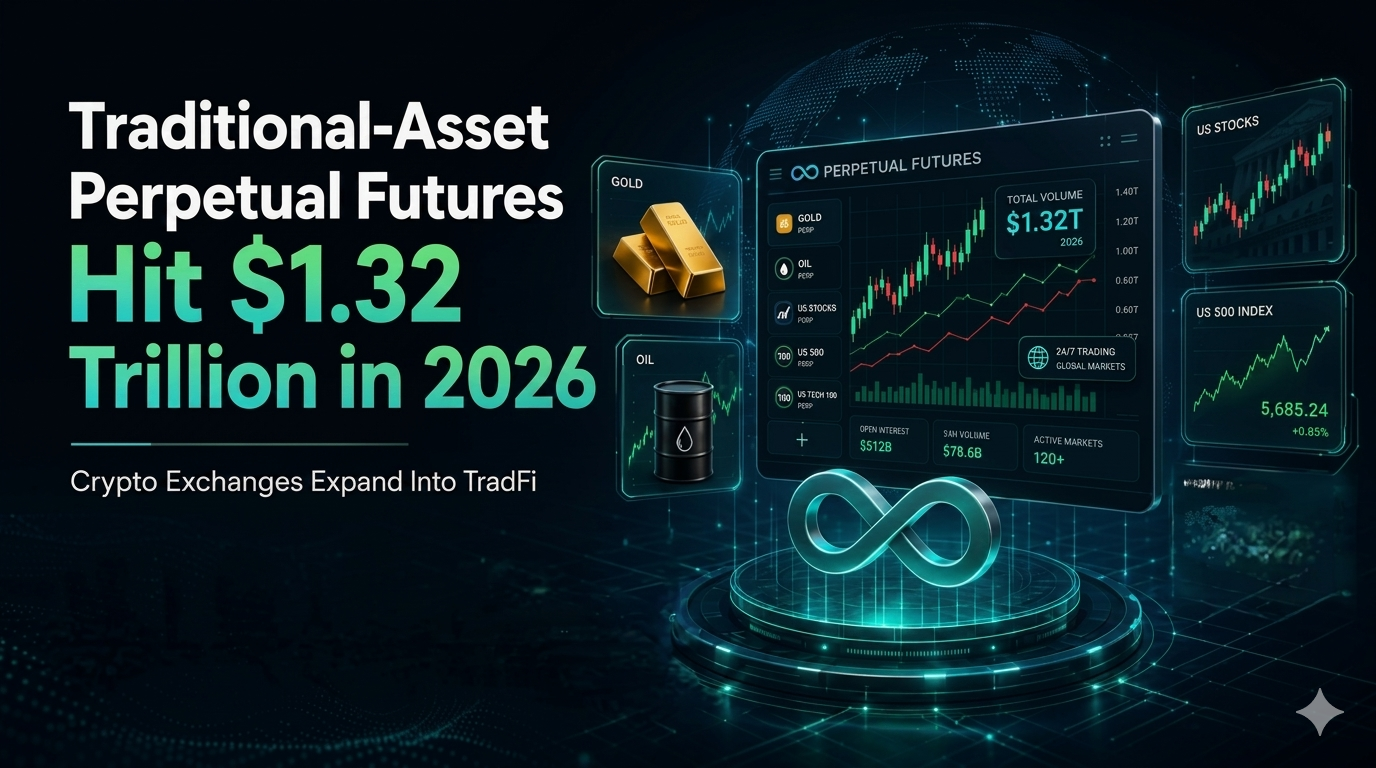
Traditional-asset perpetual futures have become one of the most closely watched areas of crypto derivatives trading in 2026. Crypto exchanges processed more than $1.32 trillion in volume between January and May, driven by contracts linked to technology stocks, precious metals, energy products, equity indices and private companies. The trend shows how crypto platforms are expanding beyond Bitcoin and altcoins by offering stablecoin-settled exposure to traditional financial markets. However, these products are derivatives rather than direct investments in shares, commodities or index funds, meaning traders must consider funding costs, liquidation risk, reference pricing and regulatory availability before opening a position.
Traditional-Asset Perpetual Futures Reach $1.32 Trillion as Crypto Exchanges Expand Beyond Digital Assets
-
TradFi Perpetual Futures Volume Accelerates Across Crypto Exchanges
The scale of traditional-finance perpetual trading increased sharply in early 2026. Monthly volume reached approximately $347.17 billion in May, while the cumulative total for the first five months of the year was more than twelve times the $104.21 billion recorded during all of 2025. This acceleration was supported by a broader range of contracts, stronger exchange competition and growing interest from crypto traders seeking exposure to traditional markets without moving funds into a separate brokerage account.
The rapid increase should still be interpreted carefully. A trader can repeatedly open and close leveraged positions using the same pool of collateral, meaning reported volume can grow much faster than deposits or open interest. Nevertheless, the increase suggests that traditional-asset perpetuals are moving beyond experimental listings and becoming a more established part of crypto futures markets.
Important indicators behind the growth include:
-
Greater platform competition encouraged both centralised and onchain exchanges to introduce products outside the conventional crypto market.
-
Improved order books, price feeds and risk-management systems made it easier to support non-crypto reference assets.
-
Professional market participants increasingly explored hedging, arbitrage and cross-asset strategies involving TradFi perpetuals.
-
Crypto Exchanges Evolve Into Multi-Asset Trading Platforms
The expansion of traditional-asset perpetual futures shows that crypto exchanges are attempting to become broader financial marketplaces. Instead of depending entirely on Bitcoin, Ethereum and altcoin trading cycles, platforms can now generate activity from gold, silver, oil, technology shares and stock-market indices. This diversification may help exchanges maintain user engagement during periods when spot crypto volumes weaken or when investor attention shifts towards macroeconomic events, commodity markets and corporate earnings.
Stablecoin settlement is central to this model. Traders can use assets such as USDT or USDC as collateral and move between crypto and traditional-market contracts without repeatedly converting funds into fiat currency. The structure may be particularly attractive to international users who face limited access to foreign shares, commodities or conventional derivatives platforms. It also allows crypto-native investors to manage several types of market exposure through one interface, although eligibility and product availability remain dependent on local regulations.
The multi-asset exchange model may offer several practical advantages:
-
Traders can access different asset classes without maintaining several separately funded accounts.
-
Long and short positions can often be opened through the same perpetual-futures interface.
-
Stablecoin collateral may be used across eligible markets, improving capital flexibility.
-
Continuous trading may allow users to respond to developments outside normal stock-market hours.
-
Unified risk dashboards can make it easier to monitor crypto, commodity and equity-linked positions together.
Despite these benefits, traditional-asset perpetuals do not normally provide direct ownership. A trader buying an Nvidia, gold or S&P 500 perpetual generally receives synthetic price exposure rather than company shares, physical metal or units in an index fund. The contract’s performance depends on the exchange’s pricing methodology, funding system, collateral requirements and liquidation rules.
-
Derivatives Demand Outpaces Spot Tokenised Asset Adoption
Traditional-asset perpetual futures generated substantially more activity than spot tokenised real-world assets during the first five months of 2026. Perpetual volume was reportedly more than eight times higher, indicating that many crypto traders currently prefer flexible derivative exposure over direct ownership of tokenised stocks or commodities. This difference reflects the established popularity of perpetual contracts within crypto markets, where traders are already familiar with margin, funding rates and leveraged long or short positions.
Spot tokenised assets can involve more complex legal and operational structures. A platform offering a token linked to a real share may need a regulated custodian, proof that the underlying security is held, clear redemption arrangements and rules governing dividends or shareholder rights. Perpetual futures avoid many of these ownership-related processes because they settle price differences rather than transferring the referenced asset. This can make it easier for exchanges to introduce across multiple markets, although traders may face greater exposure to platform, oracle and counterparty risk.
The gap between derivatives and spot adoption may narrow if regulated tokenised securities gain stronger custody standards, clearer legal recognition and deeper secondary-market liquidity. For now, however, the $1.32 trillion milestone suggests that crypto exchanges are finding their strongest traditional-finance opportunity in continuously traded derivatives rather than direct onchain ownership. Future growth will likely depend on whether platforms can maintain reliable price tracking, sufficient liquidity and regulatory access as competition across crypto and traditional finance intensifies.
Why Stock, Commodity and Index Perpetual Futures Are Growing in 2026
The expansion of stock, commodity and index perpetual futures in 2026 is being supported by more than the general growth of crypto derivatives. Each category responds to a different source of investor demand: equity contracts capture interest in corporate earnings and artificial intelligence, commodity perpetuals reflect changing expectations around inflation and geopolitical risk, and index products provide broader exposure without requiring traders to select individual companies. Together, these markets are giving crypto investors new ways to express macroeconomic views, hedge existing portfolios and trade developments that extend beyond digital assets.
AI Stocks, Commodity Volatility and Macro Events Create New Trading Demand
Stock perpetual futures have benefited from intense interest in semiconductor companies, artificial-intelligence infrastructure and crypto-linked public businesses. Shares such as Nvidia, Tesla and Micron can experience sharp price movements around earnings reports, product announcements and changes in technology spending. Perpetual contracts allow traders to take directional positions on these themes while using familiar crypto derivatives tools. Pre-IPO contracts linked to companies such as OpenAI or SpaceX have also attracted attention, although their pricing may be less transparent because the underlying businesses do not trade continuously on public stock exchanges.
Commodity perpetuals are responding to a different set of market forces. Gold and silver contracts can become more active when investors are concerned about inflation, interest rates, currency weakness or financial instability, while oil contracts may react to production decisions, supply disruptions and geopolitical tensions. Index perpetuals offer a broader alternative by tracking benchmarks such as the S&P 500, reducing dependence on the performance of one company. This combination allows traders to choose between concentrated exposure to a particular stock, sensitivity to a commodity price or diversified participation in a wider equity market.
Better Liquidity and Cross-Market Strategies Support Perpetual Futures Adoption
The market is also becoming more usable as exchanges, liquidity providers and data companies improve the infrastructure behind traditional-asset perpetual futures. Reliable reference prices are essential because contracts must remain connected to markets operating under different hours and settlement systems. Exchanges are increasingly using multiple price sources, licensed benchmarks, related futures markets and mark-price controls to reduce extreme deviations. Stronger market-making activity may also narrow spreads and improve order-book depth, although liquidity can still weaken significantly during weekends or periods when the underlying market is closed.
More developed liquidity is opening the door to cross-market trading strategies rather than simple directional speculation. Professional traders may compare prices between crypto exchanges, regulated futures venues and conventional securities markets, looking for temporary differences that can be hedged or arbitraged. Others may use an index perpetual to offset equity risk, a gold contract to manage macro uncertainty or a short stock position to balance exposure to a related crypto asset. These strategies could support more consistent demand, but their effectiveness depends on funding costs, execution quality and the reliability of the exchange’s pricing system. As the market develops, sustainable growth is likely to depend less on the number of new listings and more on whether contracts can maintain deep liquidity and accurate pricing during volatile conditions.
How TradFi Perpetual Futures Work
TradFi perpetual futures are derivative contracts that track the price of traditional assets such as stocks, commodities, currencies and market indices without requiring traders to own the underlying asset. Unlike standard futures, these contracts have no fixed expiry date, allowing positions to remain open as long as margin requirements are met. Understanding how crypto futures trading works is therefore important because the same basic mechanics: margin, funding, long and short positions, and liquidation also apply to many traditional-asset perpetual contracts.
-
Reference price tracking: Exchanges use price indices, oracle feeds or data from traditional markets to calculate the value of the underlying stock, commodity or index. When the main market is closed, a platform may rely on related futures, the latest available official price or its own fair-value methodology.
-
Funding-rate payments: Long and short traders exchange periodic payments to reduce large differences between the perpetual contract and its reference price. Funding costs can change as positioning becomes more concentrated on one side of the market.
-
Stablecoin collateral: Traders commonly deposit assets such as USDT or USDC as margin, allowing gains, losses and fees to be settled without conventional banking rails.
-
Long and short positions: A long position may benefit when the referenced asset rises, while a short position may gain when its price falls. Traders can therefore use the contracts for speculation, portfolio hedging or managing exposure to macroeconomic events.
-
Margin and liquidation: Leveraged positions require sufficient collateral. If losses reduce the available margin below the exchange’s maintenance requirement, the position may be partially or fully liquidated. Reviewing common futures leverage risks is especially important because thin liquidity and sudden price gaps can accelerate losses.
How to Trade TradFi Perpetual Futures on KuCoin
KuCoin offers selected USDT-margined stock-index perpetual contracts to eligible users in supported countries and regions. These contracts provide synthetic exposure to the referenced asset’s price rather than ownership of real company shares. Availability, leverage limits and contract specifications may differ by product and jurisdiction.
-
Confirm availability: Log in to KuCoin, open the Futures section and check whether stock-index perpetual contracts are accessible in your region.
-
Fund the futures account: Transfer USDT into the relevant futures account because these contracts generally use USDT for margin, profit-and-loss calculations and settlement.
-
Select a contract: Choose an available stock-index perpetual and review its reference asset, funding interval, fees, maximum leverage and trading hours before placing an order.
-
Choose the position settings: Select isolated or cross margin, set a cautious leverage level and place a buy order to open a long position or a sell order to open a short position. Isolated margin limits a liquidation loss to the margin assigned to that position, while cross margin can use a wider portion of the futures-account balance.
-
Monitor and close the trade: Track the mark price, funding rate, unrealised profit or loss and liquidation price. Traders can reduce or close the position manually and may use take-profit or stop-loss orders to manage risk.
Join KuCoin 9th Anniversary Trading Campaign
KuCoin is celebrating its 9th anniversary with a special platform campaign filled with exclusive rewards, trading activities, and limited-time offers. Don’t miss the chance to participate and enjoy the benefits as the exchange marks nine years of growth and innovation. Visit the official campaign page now:
Conclusion
The rise of traditional-asset perpetual futures shows how quickly crypto exchanges are evolving into broader multi-asset trading platforms. More than $1.32 trillion in volume during the first five months of 2026 indicates strong demand for stablecoin-settled exposure to stocks, commodities and indices, particularly among traders who value continuous access, leverage and the ability to open both long and short positions.The market’s next stage will depend on more than headline trading volume. Exchanges will need to provide reliable reference prices, transparent funding calculations, sufficient liquidity and clear treatment of corporate actions. Regulators may also examine whether certain stock- and index-linked products fall within existing securities or derivatives frameworks. Traditional-asset perpetuals could remain an important bridge between crypto and conventional finance, but their growth is likely to be uneven across platforms, asset classes and jurisdictions.
FAQs
Are profits from TradFi perpetual futures taxable?
They may be taxable, but the treatment differs by country and can depend on whether the activity is classified as investing, trading or derivatives dealing. Stablecoin settlement does not automatically remove tax obligations. Traders may need records of entry prices, exits, funding payments, fees and the local-currency value of each transaction.
Do stock perpetual futures pay dividends?
Stock perpetual holders do not normally receive cash dividends because they do not own the underlying shares. An expected dividend may instead be reflected through adjustments to the reference index, funding calculation or contract price. The treatment varies between exchanges, so traders should review the contract specifications before holding a position across a dividend date.
What happens to a stock perpetual during a share split or merger?
Exchanges may adjust the contract size, reference price, position quantity or settlement terms following a stock split, merger, spin-off or delisting. In some cases, a contract may be temporarily suspended or closed at a platform-determined settlement price. Corporate-action policies should be checked before trading contracts linked to companies undergoing major structural changes.
Why can a TradFi perpetual price differ from the real stock or commodity price?
Differences can develop because the perpetual trades on a separate order book and may remain active while the underlying market is closed. Funding expectations, low liquidity, trader positioning and delayed reference data can also create a temporary premium or discount. Arbitrage may reduce the gap, but exact price convergence is not guaranteed at every moment.
What is the difference between mark price and last traded price?
The last traded price is the value of the most recent transaction on the exchange. The mark price is a calculated fair-value estimate commonly used to measure unrealised profit, margin requirements and liquidation risk. Using a mark price can reduce liquidations caused by a single unusual trade, although its accuracy still depends on the platform’s data sources and methodology.
Disclaimer
The information provided on this page may originate from third-party sources and does not necessarily represent the views or opinions of KuCoin. This content is intended solely for general informational purposes and should not be considered financial, investment, or professional advice. KuCoin does not guarantee the accuracy, completeness, or reliability of the information, and is not responsible for any errors, omissions, or outcomes resulting from its use. Investing in digital assets carries inherent risks. Please carefully evaluate your risk tolerance and financial situation before making any investment decisions. For further details, please consult KuCoin’s Terms of Use and Risk Disclosure.