

Ritual Mainnet Launches: RITUAL Tokenomics, Supply, and Airdrop Details
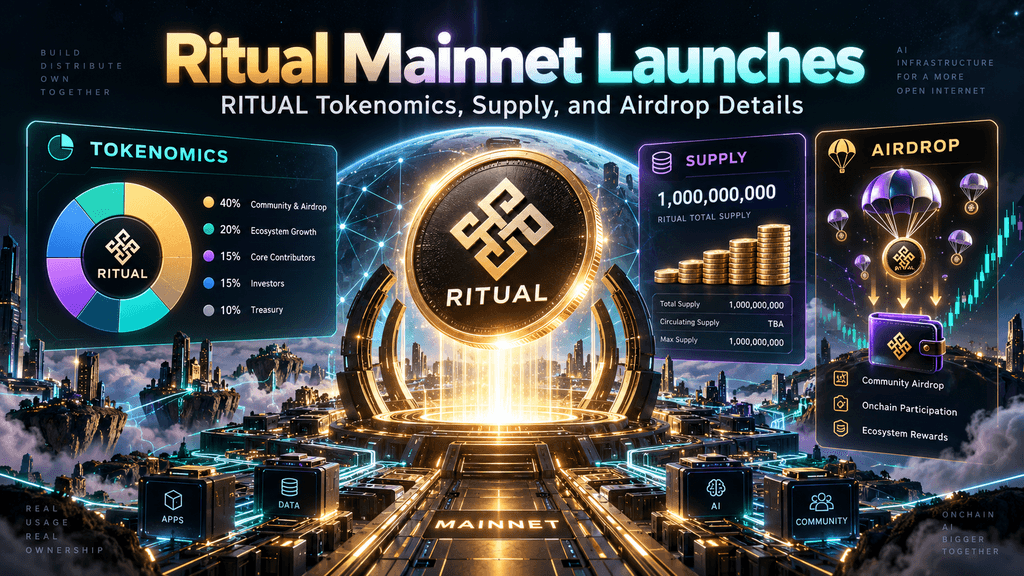
Ritual launched its public mainnet on October 26, 2026, marking a major milestone for a blockchain project designed to bring artificial intelligence (AI) inference, autonomous agents, and onchain settlement into a unified execution environment. The launch also puts RITUAL, the network’s native token, at the center of a new economic model in which AI agents can pay for computing resources, execute tasks, and interact with blockchain applications. Coinbase scheduled RITUAL spot trading for October 26, subject to liquidity conditions, while MEXC announced its RITUAL/USDT spot listing for the same day. These developments have brought renewed attention to the project’s tokenomics, initial supply, and community airdrop.
RITUAL has an initial supply of 10 billion tokens, with 1.8 billion unlocked at mainnet launch. The project also allocated 50 million RITUAL, equivalent to 0.5% of initial supply, to early contributors and community participants. However, the launch is only the beginning of the network’s economic development. Future adoption will depend on real AI workloads, developer activity, staking participation, token issuance, and fee burning. Understanding these factors is essential for evaluating the project beyond its initial market attention.
Key Takeaways
-
Mainnet launch: Ritual’s public mainnet went live on October 26, 2026, focusing on AI-native blockchain infrastructure and autonomous agents.
-
Initial supply: RITUAL has an initial supply of 10 billion tokens, with 1.8 billion, or 18%, unlocked at launch.
-
Token allocation: Core contributors receive 29% of initial supply, while ecosystem growth and research account for another 25%.
-
Community airdrop: The project allocated 50 million RITUAL, or 0.5% of initial supply, to eligible early node operators, Frenrug users, and long-term community contributors.
-
Token utility: RITUAL supports staking, AI computing payments, transaction fees, and the network’s planned governance system.
-
Main risk: The token has no fixed maximum supply. Its long-term supply dynamics depend on issuance, fee burning, network adoption, and the release of locked allocations.
What Is Ritual? Understanding the AI-Native Blockchain
Ritual is a blockchain infrastructure project built for applications that combine AI computation with autonomous onchain execution. Rather than treating AI as an external service that smart contracts can only access through separate infrastructure, Ritual aims to make AI inference, external data access, scheduling, and settlement native components of its network. Its mainnet launch follows earlier development work on Infernet, a system designed to connect AI inference and computation with smart contracts. According to the Ritual Foundation, the broader objective is to provide infrastructure for autonomous software agents that can perform tasks and transact within a blockchain environment.
How Ritual Connects AI and Blockchain
Traditional smart contracts execute predefined logic, but complex AI workloads often require substantial offchain computation. Running large AI models independently on every blockchain validator can be expensive and impractical. Ritual instead uses AI executors to handle inference, HTTP requests, and other computing tasks within trusted execution environments (TEEs). Hardware attestation mechanisms are intended to provide evidence that approved software is running in the designated environment. The network can then connect the resulting computation to onchain payments and application logic.
This architecture could support autonomous agents that obtain information, call AI models, perform scheduled operations, and execute transactions according to predefined rules. For example, an agent might monitor external information, request an AI-generated analysis, and submit a transaction when specified conditions are met. Such workflows could be useful for decentralized finance, automated services, and machine-to-machine payments. However, the security and reliability of these applications will depend on implementation quality, data integrity, execution verification, and the safeguards developers establish around autonomous actions.
Why Mainnet Adoption Matters
A mainnet launch moves a project beyond a development or testing environment, allowing real network activity and economic transactions to take place. Ritual’s challenge is now to attract developers, AI service providers, validators, and users who generate sustained demand for its infrastructure. The Foundation reported that its earlier testnet attracted more than 2,000 deployed agents and processed over 90 million transactions before mainnet launch. These figures indicate prior development activity, but they should not be treated as proof of equivalent usage on the live network.
The distinction matters for RITUAL holders because a blockchain’s long-term economics depend on more than the number of tokens traded after listing. If developers build applications that consume computing resources and pay network fees, the token may gain a functional role in the ecosystem. If activity remains limited or relies heavily on incentives, sustained demand could be weaker than early market interest suggests. Post-launch monitoring should therefore focus on actual AI workloads, fees paid, validator participation, and the number of applications that remain active over time.
RITUAL Tokenomics: Initial Supply, Allocation, and Unlock Schedule
RITUAL is the native asset of the Ritual network. Its initial supply is 10 billion tokens, and the project does not specify a fixed maximum supply. At mainnet launch, 1.8 billion tokens, equivalent to 18% of the initial supply, became unlocked. The remaining allocations are subject to category-specific lockups and release schedules, which means the quantity available to the market can change as additional tokens unlock.
RITUAL Token Allocation
The official allocation gives the largest shares to core contributors and ecosystem growth. Core contributors receive 29% of initial supply, while ecosystem growth and research and development account for 25%. Network participation and future incentives receive 14%, followed by investors, the Foundation, treasury allocations, research grants, and a private sale allocation. These categories indicate how the project intends to fund development, attract contributors, and support network participation, although allocation percentages alone do not demonstrate how effectively the tokens will be used.
| Allocation category | Share | Tokens |
| Core Contributors | 29% | 2.90 billion |
| Ecosystem Growth + R&D | 25% | 2.50 billion |
| Network Participation & Future Incentives | 14% | 1.40 billion |
| Labs Investors | 11.30% | 1.13 billion |
| Ritual Foundation | 10% | 1.00 billion |
| Labs Treasury | 5% | 500 million |
| Frontier AI Grants | 4.70% | 470 million |
| Foundation Private Sale | 1% | 100 million |
| Total | 100% | 10 billion |
Source: Ritual Foundation official tokenomics documentation.
The allocation structure has several implications. First, core contributors and ecosystem growth together represent 54% of initial supply, placing substantial resources under development-related categories. Second, the 14% network participation and future incentives allocation provides a reserve for later programs, but only 0.5% of total supply is designated for the launch airdrop. Third, the long-term market impact of these allocations will depend on when tokens unlock, how recipients use them, and whether the ecosystem creates enough demand to absorb additional circulating supply.
Initial Circulating Supply and Unlocks
Initial supply, unlocked supply, and circulating supply are related but distinct concepts. Initial supply refers to the 10 billion tokens established in the project’s tokenomics. Unlocked supply includes tokens that are no longer subject to the applicable lockup restrictions. Circulating supply is the amount that market-data providers classify as circulating under their own methodology. Ritual’s official documentation states that 1.8 billion RITUAL was unlocked at launch, with the unlocked portion coming from ecosystem growth and research, the Foundation treasury, and the community airdrop allocation.
Insider allocations are locked for at least one year from mainnet launch, and locked tokens cannot be staked. The detailed schedule differs by category: some allocations begin unlocking after the first year and continue monthly, while others follow longer schedules extending through the fourth year. This staged approach reduces the amount released immediately, but it does not eliminate future supply pressure. Market participants should track actual unlock dates and transfers rather than assuming that all locked tokens will be sold or that none will enter the market.
Issuance, Fee Burning, and Long-Term Supply
RITUAL’s supply can change after launch through both issuance and fee burning. The Foundation describes an initial annualized issuance rate of approximately 5%, subject to actual block times, with rewards supporting validators, AI executors, and delegators. Ritual also follows an EIP-1559-style fee model in which the base fee for each transaction is burned, permanently removing those tokens from supply. The net supply change depends on how much is issued compared with how much is burned.
This design links the token’s supply dynamics to network activity, but it does not guarantee deflation. If issuance exceeds the amount burned, total supply will increase. If usage generates enough fee burning to offset a larger share of issuance, net supply growth may slow. The critical variables are therefore actual transaction activity, AI compute demand, staking rewards, and the share of fees removed from circulation. Any claim that RITUAL is inherently deflationary would be premature without sustained data showing that burns exceed issuance.
RITUAL Airdrop: Eligibility, Allocation, and Claim Information
Ritual allocated 50 million RITUAL to eligible early contributors, representing 0.5% of initial supply. According to the Foundation, the distribution is intended to reward people who performed verifiable work for the network before the token launch rather than users who simply increased activity shortly before an expected airdrop. The allocation is fully unlocked at launch and has no additional vesting period.
Who Is Eligible for the RITUAL Airdrop?
The official tokenomics document identifies three main participant groups. The first consists of Infernet node operators, whose eligibility considers uptime and workloads served. The second includes Frenrug users who held keys and interacted with the early onchain AI agent. The third includes long-term community members, including consistently active Discord participants and ambassadors who helped develop the project’s community. The Foundation also states that it reviewed activity for signs of automated or Sybil behavior, and that eligible allocations can stack across the different participation categories.
These criteria mean that historical contribution matters more than simply holding a token or completing a newly created task. A user who operated a qualifying node or participated in the early agent may have a different allocation from someone who joined the community shortly before mainnet. However, the published criteria do not guarantee that every participant in these groups qualifies. Individual eligibility and reward amounts must be determined through the project’s official process.
How to Check or Claim RITUAL Airdrop Tokens
Users should begin with the official Ritual tokenomics page and the project’s official communication channels. The Foundation’s documentation says eligible participants can claim through a dedicated claim page, while additional details about the claim process are to be provided by the project. The existence of an announced airdrop should not be interpreted as confirmation that every user’s claim is already available or that a particular deadline has been established.
Airdrop scams are especially common around new token launches. Users should independently verify the official domain before connecting a wallet, avoid links sent through unsolicited direct messages, and never disclose a recovery phrase or private key. If a claim page requests a signature or transaction, users should examine the request and confirm that it is consistent with the intended action. A claim that requires transferring assets to an unknown address or entering a recovery phrase into a website should be treated as suspicious.
RITUAL Market Launch: Listings, Liquidity, and Valuation
RITUAL’s mainnet launch coincided with exchange-listing announcements that increased its visibility among cryptocurrency traders. Coinbase announced that RITUAL-USD spot trading was scheduled to go live on October 26, subject to liquidity conditions and regional availability. MEXC separately announced a RITUAL/USDT spot listing for October 26, followed by a planned withdrawal opening on October 27. Because exchange schedules and trading availability can change, users should verify current market status directly with each platform before relying on a listing announcement.
Understanding Market Capitalization and FDV
Two valuation metrics are particularly relevant to a newly launched token. Market capitalization is generally calculated by multiplying the token price by the reported circulating supply. Fully diluted valuation (FDV) estimates the value of the entire initial or fully diluted token supply at the same price. For RITUAL, the difference between these figures is significant because only 18% of initial supply was unlocked at launch, while the remaining tokens are subject to future release schedules.
A higher FDV relative to circulating market capitalization does not automatically mean a token is overvalued, but it highlights the importance of understanding future supply. If demand grows alongside ecosystem usage, the market may absorb additional tokens more easily. If demand remains limited while more tokens unlock, holders may face greater dilution or selling pressure. These are possible outcomes, not guaranteed price movements, and neither a listing nor a short-term price increase establishes long-term value.
What Could Influence RITUAL’s Market Performance?
RITUAL’s market development will depend on several factors: exchange liquidity, investor demand, token unlocks, staking participation, and the volume of AI-related activity conducted on the network. Exchange listings can improve access, but early trading may also be affected by limited order-book depth, volatile price discovery, and the behavior of a relatively small number of holders. Market prices and trading volumes should therefore be cited with a clear timestamp rather than presented as permanent facts.
For longer-term analysis, actual network usage may be more informative than listing-day performance. Relevant metrics include AI inference requests, compute fees paid in RITUAL, active agents, validator participation, the amount of tokens staked, and the balance between issuance and fee burning. These indicators can help determine whether the token is developing utility beyond trading and whether demand is broadening as the ecosystem matures.
What Comes Next for Ritual Mainnet?
Ritual’s next stage depends on whether its AI-native infrastructure attracts sustained developer and user activity. The network’s design aims to bring model inference, external data access, scheduling, and settlement into a single environment for autonomous applications. If developers use these capabilities to build services that generate recurring compute demand, RITUAL may become an integral part of how those applications pay for execution and participate in network security. However, the transition from infrastructure launch to a functioning ecosystem requires reliable execution, useful applications, competitive costs, and safeguards against faulty or malicious agent behavior.
The project’s governance plan is also designed to evolve over time. At launch, the Foundation and core developers retain protocol decision-making authority while a public proposal process is established. The published roadmap targets non-binding staker input around months six to twelve and binding staker votes from approximately month twelve onward, depending on the readiness of the preceding stages. These are targets rather than guaranteed deadlines. The extent to which governance becomes more decentralized will depend on implementation, participation, and the distribution of voting power among stakeholders.
Conclusion
Ritual’s October 26, 2026, mainnet launch marks an important step in the effort to connect AI computation with blockchain-based execution and settlement. RITUAL has a clear set of intended functions: paying transaction and compute fees, securing the network through staking, and supporting the planned governance system. Its initial supply is 10 billion tokens, 18% was unlocked at launch, and 50 million RITUAL was allocated to eligible early contributors through the community airdrop.
The main question now is whether real network demand can develop alongside the token’s supply schedule. AI workload growth, active developers, staking participation, fee burning, and future unlocks will all influence the network’s economics. For readers researching the RITUAL token, the most useful approach is to distinguish confirmed tokenomics from market speculation and to verify listing status, airdrop eligibility, and current prices through official sources. Mainnet is the starting point; long-term adoption remains to be demonstrated.
FAQs
Is RITUAL the same asset on the native Ritual chain and on other networks?
RITUAL is the native asset of the Ritual chain. The official tokenomics page also identifies bridged representations on BNB Smart Chain and Base using the same token contract address. The Foundation states that bridged tokens are locked on the Ritual chain, so these representations do not add to total supply. Users should verify the network and bridge route before transferring tokens, because sending assets to an incompatible network or address can result in loss.
Does RITUAL have a fixed maximum supply?
No. Ritual’s initial supply is 10 billion RITUAL, but the project does not specify a fixed maximum supply. New tokens are issued to support staking and network participation, while base transaction fees are burned. The total supply over time depends on the relationship between issuance and burning.
Can RITUAL holders participate in governance immediately?
Not with binding voting rights at launch under the published roadmap. Initially, the Foundation and core developers make protocol decisions while a public proposal process is developed. The project plans to introduce staker input in stages, with non-binding signals targeted for months six to twelve and binding votes targeted from around month twelve onward, subject to implementation readiness.
What risks should developers consider before building AI agents on Ritual?
Developers should assess the reliability of AI outputs, the security of external data sources, the limits of trusted execution environments, and the consequences of autonomous transactions. AI agents may produce incorrect or unexpected results, and cryptographic verification of an execution environment does not guarantee that the underlying model’s output is factually correct. Applications should incorporate appropriate authorization controls, spending limits, monitoring, and failure-handling procedures.
Does a successful mainnet launch guarantee long-term demand for RITUAL?
No. Mainnet availability creates the conditions for real network activity, but sustained token demand depends on whether users and developers adopt the network’s services. Active AI workloads, compute payments, staking participation, and the relationship between fee burning and issuance are useful indicators to monitor. Exchange listings and early trading activity alone cannot establish long-term adoption or investment performance.
Disclaimer: This article is for informational and educational purposes only and does not constitute financial or investment advice. Token prices, liquidity, exchange availability, airdrop eligibility, and protocol plans can change. Verify information through official sources before taking action. Cryptocurrency assets are volatile, and losses can be substantial.