

ORCA Price Surges 80%: Can the 10% Fee Buyback Proposal Sustain ORCA's Rally?
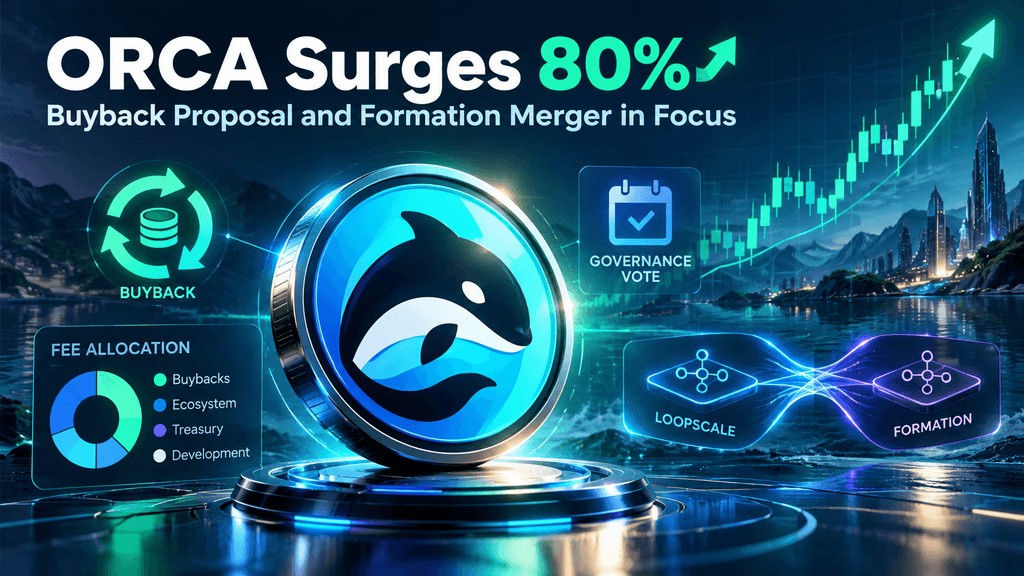
ORCA surged more than 80% in early October 2026 as Orca’s proposed 10% buyback plan, changes to xORCA rewards and its Loopscale merger drew fresh market attention. With Orca now preparing a revised governance vote for October 11–16, the key question is whether stronger protocol growth and future ORCA purchases can support the rally after the initial surge.
ORCA Price Surges More Than 80% as Orca’s Buyback Plan Reshapes Token Economics
ORCA's sharp October rally developed as traders began pricing in a broader overhaul of Orca's token economics and growth strategy. On October 7, the token was reported near $2.90 after gaining more than 80% over the preceding seven days. The move has since cooled: the latest DefiLlama snapshot puts ORCA near $2.59, still up about 56.7% over seven days and 85% over 30 days, with a circulating market capitalization of roughly $158 million. The pullback matters because the 80% figure describes the earlier peak of the rally rather than ORCA's current weekly return. It also shows how quickly short-term percentage gains can change after a token experiences a sharp repricing over only a few trading sessions.
ORCA Rally Accelerated as the Governance Proposal Drew Attention
Orca published its Resourcing Orca for Its Next Phase proposal on September 29, setting out changes to how protocol-fee revenue, treasury assets and future ORCA purchases would be managed. The plan would replace the existing fee structure with a 10/10/80 allocation, including one 10% share for programmatic ORCA purchases distributed through xORCA and another 10% for team-managed open-market buybacks. The remaining 80% would fund development, operations and growth. The proposal therefore affects both tokenholder incentives and how much capital Orca can retain for expansion, making it broader than a conventional buyback announcement. It also shifts the economic debate from how much revenue should be distributed to tokenholders today toward how much should instead be reinvested to expand the protocol.
That proposal gave the market a new token-value narrative, but it would be too strong to attribute the entire rally to the buyback plan. The price move unfolded alongside acquisition expectations and reports of large ORCA purchases discussed in Orca's governance forum. Those transactions may have added short-term demand, but the available evidence does not establish that they caused the rally or that the buyers had access to non-public information. The more defensible explanation is that several catalysts converged as liquidity and speculative interest in ORCA increased. The timing also suggests that traders were reacting to expectations around Orca's broader strategic direction, not simply calculating the immediate impact of a 10% fee allocation. That makes the rally a combination of tokenomics expectations, strategic developments and market positioning rather than a single-catalyst move.
The Buyback Headline Hides a More Complicated Tokenomics Change
The proposal is not simply adding a new 10% ORCA buyback. Orca had already increased the share of protocol-fee revenue directed to programmatic xORCA purchases from 20% to 40% in January 2026. Under the new structure, that automatic allocation would fall to 10%, while a separate 10% would move to a discretionary buyback account controlled by the development team. Purchased tokens from that account could be burned, deposited into the xORCA pool or used for long-term contributor grants. As a result, the proposed system gives Orca considerably more flexibility over how purchased ORCA is ultimately deployed, while reducing the portion that flows automatically through the existing xORCA mechanism.
This distinction is important when assessing the rally. Orca generated about $1.38 million in protocol revenue over the latest 30-day period, alongside roughly $8.07 billion in DEX trading volume, according to DefiLlama. A larger revenue base could make even a smaller percentage allocation meaningful, but the proposed structure also directs more of Orca's economics toward operating and expansion capital rather than automatic tokenholder rewards. That means the long-term effect depends not only on how much ORCA is bought in the market, but also on whether Orca can use the larger operating allocation to grow trading activity, fees and protocol revenue over time. A higher revenue base could eventually compensate for the smaller automatic allocation, but that outcome depends on growth rather than the fee percentages alone.
The changes are not yet approved. Orca cancelled the original governance vote on October 8 after xORCA holders raised concerns about their ability to participate without first unstaking. A replacement vote is scheduled for October 11 through October 16, followed by a two-day cooldown if the proposal passes. That leaves ORCA trading around expectations for a tokenomics overhaul that tokenholders have not yet formally approved. Until the replacement vote concludes, part of the current valuation therefore reflects anticipated changes rather than an implemented fee and buyback system. The distinction increases event risk because the market can reprice quickly if the voting outcome or subsequent implementation differs from expectations.
Orca’s 10% Buyback Proposal Cuts xORCA Rewards and Redirects Protocol Fees
Orca’s proposed fee overhaul changes more than the size of its ORCA buybacks. The plan would replace the current protocol-fee allocation with a 10/10/80 structure, shifting a much larger share of revenue toward the development team while reducing the amount automatically used to reward xORCA holders. The proposal keeps ORCA purchases in the system, but it changes who controls those purchases, how the acquired tokens can be used and how much protocol revenue is automatically tied to xORCA. That distinction is central to understanding whether the new model strengthens ORCA’s long-term value accrual or simply reduces near-term staking incentives.
How the 10/10/80 Fee Split Changes xORCA Rewards
Under Orca’s current structure, 40% of protocol-fee revenue is directed to programmatic ORCA purchases for the xORCA pool, 10% goes to the community Fee Treasury and 50% supports the development team. The proposed model would cut the xORCA allocation from 40% to 10%, eliminating the separate 10% Fee Treasury allocation and increasing the operating share to 80%. In percentage terms, the portion of protocol fees automatically supporting xORCA would fall by 75%, making the staking system less dependent on aggressive revenue-funded purchases than it is today. Orca itself identifies reduced xORCA yield as one of the proposal’s main risks. For existing xORCA holders, this is one of the most immediate economic consequences of the proposal because it directly changes how protocol revenue reaches the staking pool.
The trade-off is that Orca would retain more revenue to fund engineers, audits, partnerships, product development and other operating expenses. The team argues that the existing economics restrict its ability to scale because half of protocol revenue currently leaves the operating business before it can be reinvested. That is a strategic choice rather than a guaranteed benefit for ORCA holders: lower automatic rewards could be offset if additional spending produces materially higher trading activity and protocol fees, but stronger growth has not yet been demonstrated under the proposed structure. For xORCA holders, the immediate change is therefore clear, while the potential benefit depends on future execution. The proposal effectively asks holders to exchange part of today's automatic revenue distribution for the possibility of a larger revenue base later.
Team-Managed ORCA Buybacks Add Flexibility but Are Not Automatic Burns
A separate 10% of protocol-fee revenue would flow into a Buyback Account controlled by Orca’s development team. Those funds are earmarked for open-market ORCA purchases, subject to a daily limit equal to 2% of ORCA’s 30-day average trading volume. Unlike the programmatic xORCA mechanism, however, the timing of those purchases would be discretionary. The team would decide when to execute them rather than having every allocation automatically converted into ORCA according to the existing staking mechanism. That flexibility could allow purchases to be spread across different market conditions, although it also means tokenholders cannot assume that the full allocation will translate into immediate buying pressure at any particular time.
Tokens purchased through this account would not necessarily be removed from circulation. Orca says acquired ORCA could be burned, deposited into the xORCA pool or used for contributor grants, with grants subject to at least a one-year cliff and four-year lock. This makes the proposed buyback economically different from a permanent token-burn program: market purchases can create ORCA demand, but their longer-term supply effect depends on what happens to the tokens afterward. Orca has also committed to semi-annual disclosures covering the number of tokens purchased, cost, average price and final disposition, giving holders a way to evaluate whether the discretionary buyback account is primarily supporting xORCA rewards, reducing supply or funding long-term compensation. Those disclosures will be important because the eventual destination of purchased tokens determines whether buybacks have a temporary demand effect or a more lasting impact on circulating supply.
Loopscale Merger Creates Formation and Expands Orca’s Growth Strategy
Orca’s October rally gained a second fundamental catalyst when the Solana-based decentralized exchange announced its merger with lending and vault platform Loopscale on October 7, 2026. The combined business will operate as Formation, bringing Orca’s trading and liquidity infrastructure together with Loopscale’s credit and vault products. Rather than replacing the existing protocols, Formation said Orca and Loopscale will remain foundations of the ORCA and xORCA token network. The merger broadens the story behind ORCA beyond DEX trading and buybacks, although the financial terms of the transaction were not disclosed.
Formation Combines Orca Liquidity With Loopscale Credit Infrastructure
The two protocols bring different parts of decentralized finance into the same organization. Orca says it has processed more than $550 billion in trading volume since 2021, while Loopscale reports more than $150 million in deposits and over $2 billion in loans facilitated. Formation plans to connect trading, lending, vault strategies, origination and distribution so that assets can move through more of their financial lifecycle within one infrastructure stack. The strategic logic is that liquidity alone may not be enough for newer assets that also need credit and financing markets. Whether those complementary businesses produce meaningful additional revenue for Orca remains to be demonstrated, but the merger gives Formation a broader product base than either protocol had independently. It could also reduce the separation between trading liquidity and credit markets if users can access more financial functions through the combined infrastructure. The scale of any resulting revenue benefit, however, will depend on actual adoption rather than the merger announcement itself.
Formation Targets Tokenized Assets and Frontier-Economy Financing
Formation says it intends to use the combined infrastructure to serve issuers and capital providers across areas including AI, energy, robotics and defense, while developing a path toward regulated U.S. capital markets. Over the next 12 months, the company plans to introduce additional issuer tools and capital-allocation strategies alongside its existing trading, lending and vault products. Formation also named Figure, Shinhan Asset Management, Superstate, R3 and Securitize among organizations it is already working with to bring assets to market or expand distribution. These plans remain forward-looking and subject to regulatory and execution risks, but they indicate that Orca’s growth strategy is moving beyond its traditional role as a Solana DEX toward tokenized finance and on-chain capital markets. Success would give Formation exposure to activity beyond conventional crypto-token swaps, but those new markets also introduce different regulatory and operational requirements. Investors therefore need to separate the announced strategy from revenue that has already been realized.
The Formation Strategy Adds a New Variable to ORCA’s Long-Term Value Case
For ORCA holders, the important question is not simply whether Formation becomes larger, but whether that growth ultimately increases economic activity connected to the ORCA and xORCA ecosystem. The merger announcement confirms that both tokens remain part of the combined network, but it does not establish that all future Formation revenue will automatically flow into ORCA buybacks or xORCA rewards. That distinction matters because the governance proposal simultaneously asks tokenholders to accept a larger allocation of protocol fees for operations and expansion. If Formation succeeds in increasing trading, lending and other fee-generating activity, a larger revenue base could strengthen the economics behind future ORCA purchases; if growth falls short, the merger itself does not guarantee additional token value accrual. Future disclosures on revenue sources and their relationship with ORCA tokenomics will therefore be more informative than the size of Formation's broader business alone. For tokenholders, value accrual matters more than expansion that remains economically disconnected from the token.
Can ORCA Sustain the Rally After the October Governance Vote?
ORCA can sustain part of its recent rally only if the expectations behind the move translate into measurable results after the governance vote. As of October 9, CoinGecko showed ORCA near $2.63, still up roughly 59% over seven days but below its recent seven-day high of about $3.33, showing that momentum has already become more volatile. Approval of Orca’s proposal could support sentiment by clearing the way for the revised fee structure and team-managed buybacks, but passage alone would not guarantee continued price gains. Investors will need to see how much ORCA is actually purchased, how those tokens are ultimately used and whether Formation can expand trading, lending and other fee-generating activity. Broader Solana market conditions will also influence ORCA once the immediate governance catalyst passes.
October 11–16 Governance Vote Is the First Test, Not the Final Catalyst
Orca’s replacement vote is scheduled to run from October 11 through October 16, after the original vote was cancelled so xORCA holders had more time to participate. The proposal needs at least 3 million ORCA voting Yes and more Yes votes than No votes, followed by a two-day cooldown through approximately October 18 before implementation can proceed. A successful vote would remove one source of uncertainty, but attention would then shift from the proposal itself to execution: the pace of open-market buybacks, future protocol revenue, the deployment of treasury assets and the performance of the newly formed Formation business following Orca’s merger with Loopscale. Those post-vote metrics are likely to provide a clearer test of whether ORCA’s recent repricing has fundamental support or was driven mainly by expectations surrounding the announcement cycle. Actual buyback disclosures and changes in protocol activity should provide more useful evidence than the vote result alone. A rejection or delayed implementation, meanwhile, could force traders to reassess assumptions already reflected in ORCA's recent price move.
Conclusion
ORCA's October rally reflects a broader shift in Orca's strategy rather than a straightforward 10% token-buyback story. The proposal would create a team-managed buyback account while cutting the automatic xORCA fee allocation from 40% to 10% and directing 80% of protocol-fee revenue toward operations and growth. The Loopscale merger adds another layer by giving Formation exposure to trading, lending, vaults and credit markets, but neither the merger nor approval of the governance proposal guarantees stronger ORCA price performance. The next test is execution: protocol revenue, Formation adoption, actual buyback activity, the eventual use of purchased tokens and the relationship between the combined business and ORCA value accrual. With the replacement vote scheduled for October 11–16, the market is moving from expectations toward measurable results, which should provide a clearer indication of whether ORCA's recent rally has lasting fundamental support.
🔥 Beyond the Headlines: What KuCoin 5.0 Means for You
Market news moves fast — but where you act on it matters just as much. This October, KuCoin launches KuCoin 5.0, transforming KuCoin into a rebuilt platform. Here's what actually changes for you:
-
One account for everything. Older platforms split your money across separate "spot," "margin," and "futures" accounts and expected you to understand why. KuCoin 5.0's unified account removes that entirely — deposit once, and everything is simply there (only available to VIPs for now).
-
Stocks, indices, and commodities. KuCoin 5.0 expands beyond crypto into global markets. When crypto chops sideways and equities rally (or the reverse), you rotate in minutes instead of opening a brokerage account and waiting days for fiat rails.
-
Real-world assets (RWA). Tokenized exposure to traditional assets like commodities, right inside your crypto account. One of the fastest-growing segments in global finance is no longer reserved for institutions — you access it from the same balance you trade with.
-
Earn while you learn. Not ready to trade? KCUSD lets your stablecoins earn daily, auto-compounding interest. The lowest-stress way to put your idle deposit to work for 4% yield.
-
An AI assistant in plain language. Ask questions, get market context, understand what you're looking at — built into the platform, no jargon required.
-
An app that doesn't overwhelm. Faster, cleaner, and consistent — intuitive from the first tap, not after a tutorial.
-
Safety you can check, not just trust. A MiCAR-licensed EU entity, Proof of Reserves you can verify yourself, and internationally certified security (SOC 2 Type II, ISO 27001:2022).
Create your account in minutes — and start on the platform built for where crypto is going, not where it's been.
FAQs
What is ORCA used for within the Orca ecosystem?
ORCA is the governance and incentive token connected to Orca, the Solana-based decentralized exchange. It is also used within the xORCA staking system, where eligible protocol-fee revenue is used to purchase ORCA and distribute value to participants.
What is xORCA and how is it different from ORCA?
xORCA is the staked form of ORCA used in Orca’s tokenomics system. Holders lock ORCA to receive xORCA and become eligible for rewards funded through protocol-fee-driven token purchases. ORCA itself remains the transferable token, while xORCA represents participation in the staking mechanism.
Does Orca’s new proposal automatically burn ORCA tokens?
No. The proposed team-managed buyback account would purchase ORCA on the open market, but those tokens would not automatically be destroyed. Orca says purchased tokens could be burned, added to the xORCA pool or used for long-term contributor grants.
How much ORCA is currently in circulation?
ORCA has a total supply of 75 million tokens following the previously approved 25 million ORCA burn. Around 60 million ORCA were circulating in early October 2026, although the exact circulating figure can change as token balances and vesting conditions evolve.
Why does the 14.2 million ORCA treasury transfer matter?
The proposal would move roughly 14.2 million ORCA into a strategic account controlled by the development team. That represents a significant portion of the token’s total supply, making treasury management, acquisition use and future disclosure important factors for holders assessing dilution, supply pressure and capital allocation.
Could higher Orca revenue offset lower xORCA rewards?
Potentially, but it is not guaranteed. The proposed structure reduces the percentage of protocol-fee revenue automatically directed to xORCA, so a sufficiently larger revenue base would be needed to compensate for the lower allocation. That makes future trading activity, lending usage and Formation’s broader business growth more important.
Disclaimer: This article is for informational purposes only and does not constitute investment advice. Crypto assets can be highly volatile, and market conditions, token liquidity and project developments may change rapidly. Readers should conduct their own research and assess their risk tolerance before making financial decisions.