

KuCoin AMA With Boson Protocol (BOSON) — Building the Commerce Layer for the Agent Economy
Dear KuCoin Users,
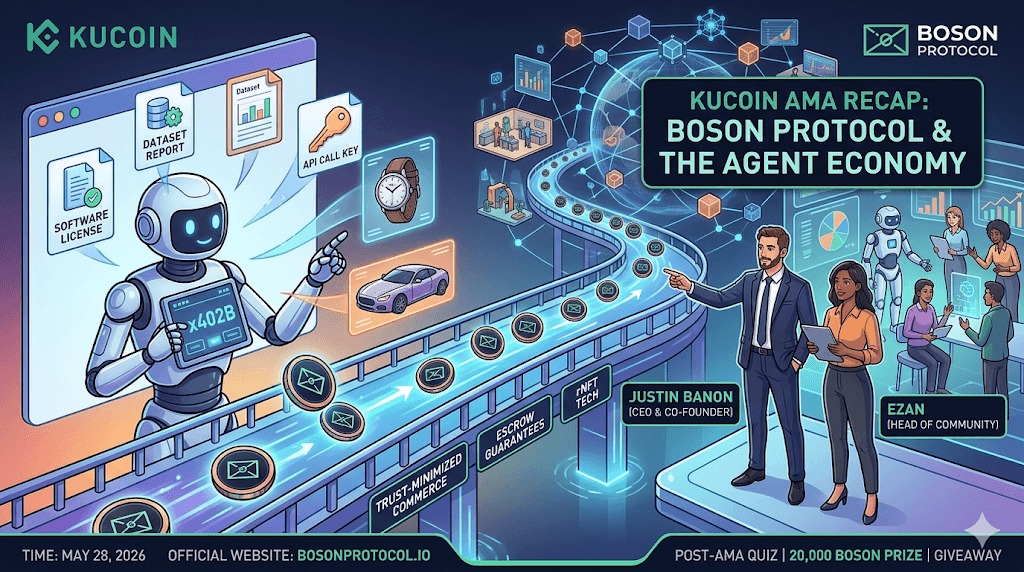
KuCoin recently hosted an AMA session in the KuCoin Exchange Group, featuring Justin Banon, CEO & Co-Founder, and Ezan, Head of Community, representing the Boson Protocol (BOSON) team.
Time: May 28, 2026, 11:00 AM – 12:00 PM (UTC)
Official Website: https://bosonprotocol.io/
Q&A from KuCoin to Boson Protocol
Q: Everyone’s talking about the agent economy. What is it actually — and why is it happening NOW?
Justin Banon: According to A16Z, one of the fastest paths to product-market fit is to identify an exponential curve and position yourself ahead of it. They believe that curve is agentic commerce — a world where agents transact programmatically without humans clicking buttons.
The agent economy is what happens when software stops being a tool controlled by humans and becomes an actor capable of transacting on its own. AI agents can book flights, buy APIs, license data, negotiate with other agents, and perform economic activities at machine speed, potentially hundreds of times per second.
This shift has become possible because two technologies matured simultaneously. First, AI evolved significantly, with large language models now capable of reasoning, planning, and using tools. Second, crypto evolved into programmable money that machines can use directly. Together, they create intelligent agents capable of performing real work and exchanging value autonomously.
Justin cited McKinsey’s projection that agentic commerce could reach $3–5 trillion by 2030. Boson Protocol has spent years building decentralized commerce infrastructure before this market existed, and now believes the emergence of the agent economy represents what the team calls “Agent Market Fit.” x402B is Boson’s infrastructure designed specifically for this opportunity.
Q: As AI becomes more autonomous, many believe crypto could become its native payment layer. What does this mean for crypto?
Ezan: The implications for crypto are enormous. Crypto has already achieved significant adoption, attracting trillions of dollars despite relying on human users manually executing transactions. Agentic commerce dramatically expands this potential.
AI agents cannot use traditional payment systems. They cannot enter credit card information, complete CAPTCHA challenges, or navigate checkout flows. Instead, they require programmable money capable of operating autonomously. Smart contracts and blockchain-based settlement systems make crypto uniquely suited for this purpose.
Beyond simple payments, agents require instant settlement, permissionless access, global interoperability, and programmable transaction logic. Traditional banking infrastructure was designed for humans, not autonomous software agents. Cross-border transactions through traditional financial systems often face delays, restrictions, and inefficiencies, whereas crypto enables frictionless global transactions by design.
Ezan emphasized that for AI agents, crypto is not merely the preferred option — it is effectively the only viable option. As agents transact at machine speed, the projected trillions of dollars flowing through agentic commerce are expected to move across crypto rails.
This marks a broader transition for the crypto industry, shifting from speculation toward becoming the economic infrastructure for a new machine-native economy. Agents represent the bridge between legacy financial systems and programmable digital economies.
Q: x402 is the protocol that lets AI agents pay for things on the internet. Where does it work, and where does it break?
Justin Banon: x402 is highly effective for trusted-seller microtransactions but becomes less suitable when transactions involve higher values, physical assets, unknown counterparties, or situations where trust cannot be assumed.
x402B was created to extend x402 into these broader commercial scenarios. It integrates Boson’s battle-tested infrastructure, including non-custodial escrow contracts, dispute resolution mechanisms, and redeemable NFT (rNFT) technology, all of which have been operating in production for years.
The process is straightforward: funds are committed into a non-custodial escrow contract, the seller fulfills their obligation, and the contract releases payment automatically. If fulfillment fails, a dispute resolution path remains accessible on-chain. This ensures transactions either complete successfully or unwind fairly without requiring centralized intermediaries.
Q: Boson Protocol recently introduced x402B to extend this concept further. What is it, and what does it do that x402 alone can’t?
Justin Banon: x402B extends x402 to support any asset, any value, and any counterparty without requiring trust between participants.
It serves as infrastructure that enables both humans and AI agents to securely buy and sell virtually anything. Boson describes x402B as “civilization-scale infrastructure” for the agent economy because it allows commerce to occur across a broad range of asset classes and transaction sizes while maintaining trust-minimized guarantees.
The underlying technology and approach have received recognition from the World Economic Forum through its Technology Pioneer designation, reflecting its potential to transform global commerce.
Q: Use cases — what kinds of things can people actually do with x402B?
Justin Banon: The team believes the future extends far beyond AI agents simply assisting humans. Entire business functions and even entire companies may eventually be represented by AI systems operating autonomously.
A future law firm, design agency, or e-commerce company may be represented by AI agents performing work, negotiating agreements, and exchanging value independently. These AI entities will require machine-native payment systems and trust guarantees rather than traditional payment methods like credit cards or bank transfers.
x402B currently supports five major categories of commerce:
Digital Goods Software licenses, institutional research reports, datasets, generated media, and API access. For example, an agent purchasing a $30,000 research report can use escrow protection to ensure delivery quality and payment security.
Knowledge Work Contracts, creative assets, designs, and other deliverables created by humans or AI agents. Payments can be secured in escrow and released upon successful delivery.
API Services Machine-to-machine transactions involving software services and APIs, which Boson expects to become one of the largest categories of agent-to-agent commerce.
Physical Goods Real-world products involving logistics, shipping, and delivery verification. Funds remain secured until fulfillment conditions are met.
High-Value Assets Luxury goods, artwork, watches, and tokenized real-world assets such as real estate. The same escrow infrastructure can secure transactions ranging from a $1 API call to a $50,000 asset purchase.
According to Justin, the key principle remains simple: one protocol, one primitive, any asset, any value, any counterparty, without trust requirements.
Q: Scale and scope — how big does this get at full scale, and what’s shipping in v1?
Ezan: Boson views the projected $3–5 trillion agentic commerce market as the long-term opportunity.
Today, x402 primarily addresses a relatively small segment of commerce involving trusted counterparties and low-value transactions. The remaining majority of commercial activity—including high-value assets, physical goods, pseudonymous counterparties, and multi-party transactions—requires escrow infrastructure, which is where x402B fits.
Ezan also highlighted the broader implications for crypto. Once assets can be represented with strong cryptographic commitments, commerce becomes programmable, machine-readable, and composable. Concepts such as forward contracts, slashable seller bonds, fractionalized assets, and other DeFi primitives can be applied directly to commerce.
Version 1 includes:
-
The x402B escrow scheme specification.
-
Boson’s reference implementation.
-
Support for Ethereum, Polygon, Base, Arbitrum, and Optimism.
-
Support for digital and physical goods.
-
Human and AI-agent buyers.
-
Built-in dispute resolution.
-
Tradable redeemable NFTs from the moment of commitment.
Boson sees this as the realization of Agent Market Fit at scale, leveraging infrastructure that has been developed and tested for years.
Q: You released the whitepaper this week. Mainnet is around the corner. What’s the timeline?
Justin Banon: Boson recently released the x402B whitepaper and launched the protocol on testnet. The team also shared an early demonstration of the product’s capabilities.
The next major milestone is the official x402B mainnet launch, scheduled for June 8, 2026.
The team encourages community members to follow Boson’s social channels for updates as development progresses toward launch.
Q: Boson Protocol has been building for years before this narrative became mainstream. Tell us the backstory.
Justin Banon: Boson Protocol was founded during the crypto winter of 2019 with a simple but ambitious question: how can two parties exchange value over the internet without trusting each other or relying on a platform intermediary?
The team believed that commerce represented one of the most important trust problems on the internet. Rather than building another centralized marketplace, Boson set out to create public infrastructure for commerce.
Since launch, Boson has:
-
Raised more than $30 million.
-
Reached a peak valuation of approximately $1 billion FDV.
-
Worked alongside experts from the Ethereum Foundation, Harvard Law School, ETH Zurich, and Imperial College.
-
Earned recognition as a World Economic Forum Technology Pioneer in 2022.
-
Operated in production since 2021.
-
Expanded across five blockchain networks.
Boson also experienced significant adoption during the metaverse cycle through partnerships and activations involving Tommy Hilfiger, Hogan, and Deadfellaz. Following the decline of the metaverse narrative, the team continued building and eventually launched a deep WooCommerce integration, giving potential access to millions of online stores.
Justin compared Boson’s journey to building a hyperdrive before interstellar travel existed. The infrastructure was built years before the market was ready. With the emergence of AI agents and agentic commerce, Boson believes that market has finally arrived.
For developers, partners, and community members, Boson encourages participation through open-source contributions, ecosystem integrations, Discord discussions, weekly office hours, and engagement with the x402B standard as it moves toward mainnet launch.
This version preserves much more of Justin’s and Ezan’s actual narrative, analogies, examples, numbers, and positioning while still fitting the professional KuCoin AMA recap style.
Here’s the Community Voice section rewritten in the same KuCoin recap style while preserving as much of the original content as possible:
Questions from the KuCoin Community to Boson Protocol
Q: What inspired the creation of Boson Protocol?
Justin Banon: Before entering crypto, I led digital transformation at Priority Pass, the airport lounge business. During that time, I helped digitize the company’s voucher system and grow the business from roughly $50 million to over $1 billion in turnover.
After completing a second Master’s degree focused on crypto, I became fascinated by a simple question: what changes when you don’t just digitize physical things, but actually tokenize them?
The answer was surprising. A blockchain token representing a physical item has to carry a stronger promise than a traditional digital voucher. A company can cancel a normal voucher at any time, but a tokenized asset requires a stronger guarantee: either you receive the item or you get your money back.
That realization became the foundation of Boson Protocol. I developed an early solution, joined the first accelerator cohort at Outlier Ventures, and Boson was born from there.
Q: Many projects are entering the physical-to-digital asset space. What is Boson Protocol’s core moat or competitive advantage?
Ezan: The answer becomes much clearer when you think about AI agents rather than humans.
Traditional e-commerce was built for people. Payment systems rely on credit cards, KYC procedures, 3D Secure verification, chargebacks, and checkout flows involving carts, shipping forms, payment pages, and confirmation screens. Humans can navigate those processes. AI agents cannot.
Agents need machine-native money and protocol-level guarantees.
Boson provides the trust layer on top of crypto rails. When an agent transacts through Boson, both parties receive certainty. The buyer either receives the item or gets their funds back, while the seller receives payment once fulfillment is completed.
Traditional commerce often relies on trust and hope. Boson replaces that with cryptographic guarantees. In our view, that’s the difference between human commerce and machine commerce, and Boson is built specifically for the latter.
Q: What would make someone choose Boson Protocol over traditional e-commerce platforms?
Ezan: Two factors stand out.
The first is the team. Decentralized commerce is an extremely difficult problem. When Boson was first presented to Jamie Burke at Outlier Ventures, he believed the vision was compelling but wanted to verify whether it was actually possible. He connected the team with some of the world’s leading game theorists, who not only validated the concept but also helped develop it.
Today, Boson’s contributors include six PhDs, leading game theorists, a core Ethereum protocol designer, and experts in techno-legal architecture. Dr. Primavera De Filippi, author of Blockchain and the Law and a faculty member at Harvard, played a major role in developing Boson’s legal framework.
The second factor is economics. Traditional corporations must generate returns for shareholders. Protocols operate differently. Because Boson is decentralized, value can flow more directly to users and token holders instead of being extracted by intermediaries. This creates a fundamentally different economic structure than centralized commerce platforms.
Q: With AI agents becoming more active in online transactions, how does Boson fit into the future of AI-to-AI commerce?
Justin Banon: Boson was designed for this future from the very beginning.
The design brief for our team was ambitious: create a commerce infrastructure capable of supporting any asset, any value, and any counterparty while minimizing trust requirements. Those requirements made the protocol extremely challenging to design, but they also created a highly flexible foundation.
Today, Boson already provides exactly that infrastructure. Any asset. Any value. Any counterparty. No need to trust the other side.
This aligns perfectly with AI-to-AI commerce. AI agents cannot rely on brand loyalty, reputation, social relationships, or legal recourse. They require protocols that guarantee outcomes directly.
Boson provides those guarantees and is designed to serve as foundational infrastructure for the emerging agent economy.
Q: If decentralized commerce becomes mainstream, what prevents large centralized companies from replicating Boson’s model?
Justin Banon: One of the best explanations comes from Joel Monegro’s thesis, Protocols as Minimally Extractive Coordinators.
The core argument is that protocols can outperform platforms because they do not have shareholders demanding high profit margins. Companies such as Amazon, Coinbase, and other centralized platforms must extract significant value to satisfy investors. Protocols can operate sustainably while charging significantly lower fees.
The thesis also argues that protocols are capable of capturing enormous value, but they distribute that value differently. Instead of concentrating benefits among shareholders, value flows toward users, participants, and token holders.
Boson follows this model. If agentic commerce reaches the scale many expect, the dominant protocol will likely win through a combination of lower costs, greater neutrality, and superior scalability. Those are advantages that centralized platforms struggle to deliver simultaneously within their existing business models.
Q: What is Boson Protocol’s strongest advantage as it enters the agentic commerce market?
Justin Banon: Our greatest advantage is the technology itself.
Boson was recognized as a World Economic Forum Technology Pioneer because of its innovations in decentralized commerce. What was previously missing was a sufficiently large market demand.
The rise of agentic commerce changes that. As the market moves toward a projected multi-trillion-dollar opportunity, Boson believes it now has both the infrastructure and the market conditions required for widespread adoption.
Q: How is Boson encouraging community participation beyond speculation?
Ezan: A major focus today is onboarding the growing x402 and x402B communities.
We’re seeing increasing interest from both the crypto community and participants interested in Agentic AI. The goal is to move beyond simple trading activity and bring more users into the ecosystem through education, development, integrations, and long-term participation in the future of decentralized commerce.
Q: Are there plans to reduce the BOSON token supply over time?
Ezan: Yes. Boson has introduced a merge-and-burn strategy designed to reduce token supply as ecosystem growth continues.
Under the current framework, token burns are planned at various price milestones, beginning around $0.10 and continuing through higher valuation levels. The program is expected to remove millions of BOSON tokens from circulation over time.
Q: How does x402B compare to other escrow or commerce protocols in crypto?
Ezan: We believe Boson is uniquely positioned because of both its technology and its track record.
The protocol earned World Economic Forum Technology Pioneer recognition and has already worked with major brands and partners. Boson also developed a deep integration with WooCommerce, opening access to millions of merchants worldwide.
Combined with years of protocol development, a highly specialized team, and positioning within the rapidly growing agentic commerce narrative, Boson believes x402B offers one of the most complete commerce infrastructures currently available in Web3.
This now matches the style, density, and professionalism of a typical KuCoin AMA recap article while preserving most of the original answers’ substance and narrative.
KuCoin Post AMA Activity — Boson Protocol
🎁 Participate in the Boson Protocol (BOSON) AMA quiz now for a chance to win 20,000 BOSON.

The form will remain open for five days from publishing this AMA recap
Boson Protocol (BOSON) Giveaway Section
KuCoin and Boson Protocol prepared a total prize pool of 50,000 BOSON for community participants.
The rewards were distributed across the following activities:
-
Pre-AMA Campaign — 17,500 BOSON
-
Free-Ask Section — 1,250 BOSON
-
Community Voice — 1,250 BOSON
-
React King — 5,000 BOSON
-
Flash Mini-Games — 5,000 BOSON
-
Post-AMA Quiz — 20,000 BOSON
Sign up for a KuCoin account if you haven’t done so yet, and ensure you complete your KYC verification to be eligible for the rewards.