

Janction (JCT): Introduction and Potential Analysis
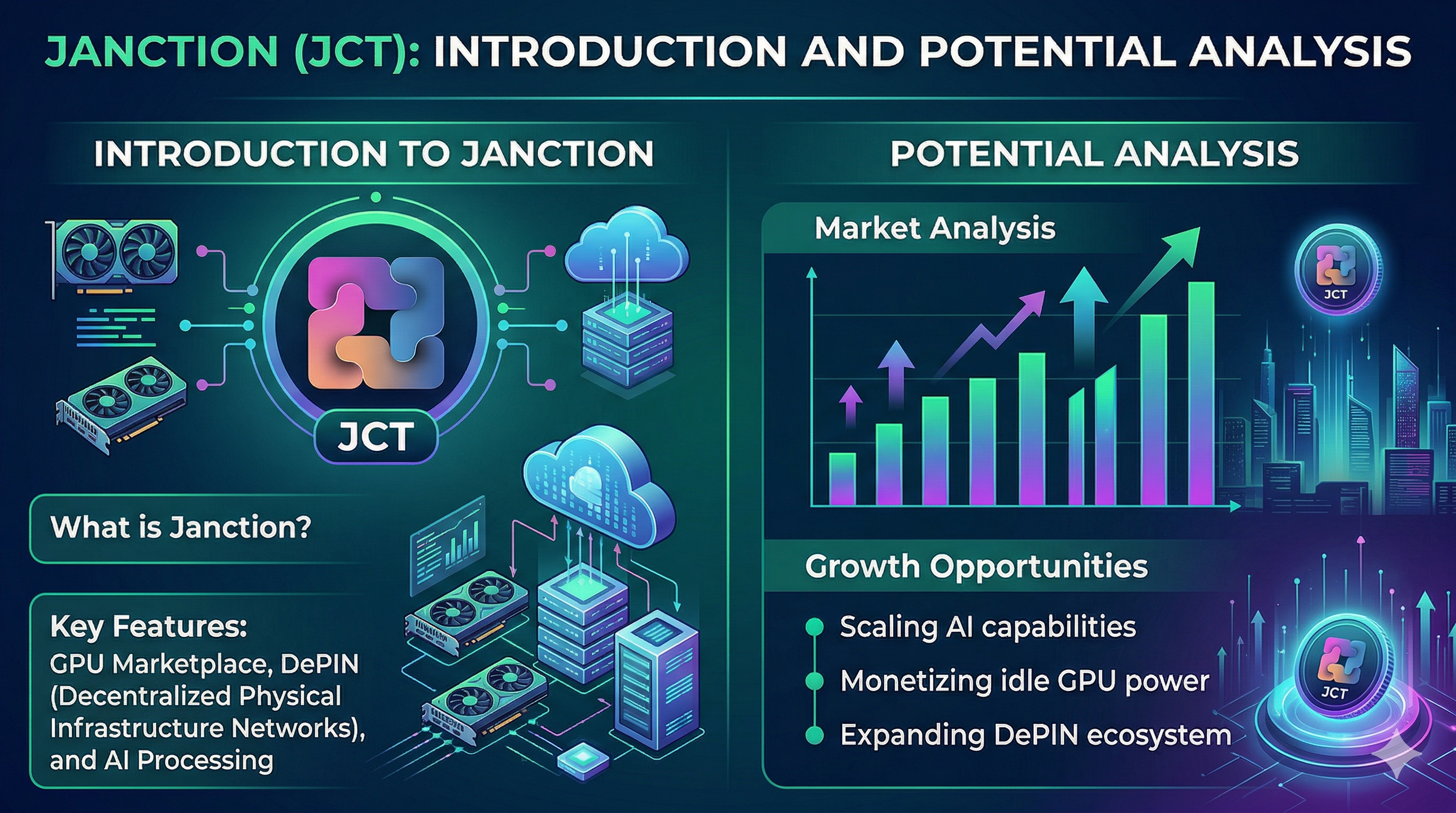
Janction (JCT) is a Layer‑2 blockchain project focused on creating a decentralized computing marketplace for AI workloads by leveraging idle GPU and compute resources. Its recent price performance, driven by exchange listings and growing interest in real‑world computational infrastructure (DePIN) narratives, reflects market excitement around practical blockchain solutions beyond pure speculative tokens. However, key considerations such as adoption utility, tokenomics, ecosystem partnerships, and regulatory clarity will determine its long‑term potential.
What Is Janction (JCT)?
Janction (JCT) is a blockchain‑based project designed to create a decentralized infrastructure network where unused computational power, such as GPUs, can be rented and utilized for artificial intelligence development, rendering, machine learning training, and other compute‑heavy tasks. Conceptually, it is part of the emerging DePIN (Decentralized Physical Infrastructure Network) trend, which seeks to aggregate real‑world physical resources (like computing devices) into decentralized, blockchain‑governed marketplaces.
Janction aims to lower barriers for developers seeking high‑performance computing by connecting them to a distributed pool of GPU resources. This approach tackles one of the biggest challenges facing the AI industry, the high cost and limited accessibility of GPU compute, by incentivizing operators to lease idle hardware through decentralized protocols. The Janction token (JCT) functions as the medium for transactions on this marketplace, serving utility purposes such as payment for compute, staking, governance participation, and network rewards for contributors who provide computational resources. As of the latest data, JCT has a circulating supply of ~11.49 billion tokens with a max supply of 50 billion, and trades in the micro‑cap segment with notable daily volume indicating active market interest.
Recent Price Performance and Market Position
Janction’s price has shown notable volatility but also periods of strong upward momentum since its launch. Live price tracking data from exchanges like KuCoin shows that JCT has traded around $0.0017 recently, with weekly moves of over +10% and significant trading volume that signals increased market attention. In late 2025, JCT even appeared among the 24‑hour top gainers on major exchanges, reflecting brief spikes in demand.
This performance must be contextualized: while JCT has climbed from cycle lows and shown periodic strength, it remains far below its all‑time high of ~$0.01058, suggesting that risk‑off conditions or profit‑taking have kept prices suppressed relative to early exuberance. The trading volume and market cap data indicate that, though still in the lower tiers by global crypto rankings, JCT is gaining traction with speculators and ecosystem participants alike.
A rise in price often correlates with trading activity on centralized exchanges like KuCoin and others, which boosts liquidity and accessibility for broader investor participation. Overall, while price rallies are promising, prospective participants should recognize that such moves are typically short‑term in nature and heavily influenced by sentiment, listings, and ecosystem news rather than long‑term adoption metrics alone.
Core Technology and Architecture
Janction operates as an EVM‑compatible Layer‑2 blockchain, meaning that it inherits the security properties of higher‑level mainnets while providing faster and cheaper transactions for users and developers. This technical setup allows it to scale more effectively than many Layer‑1 competitors by processing batches of transactions through a rollup mechanism that settles on its parent network (such as Jasmy Chain in some integrations).
The EVM compatibility also means developers can deploy familiar smart contracts, tools, and decentralized applications without significant retraining or tooling changes. Janction integrates a decentralized compute marketplace built on smart contracts that match supply (GPU providers) with demand (AI developers). The smart contract layer automates payments, task verification, and dispute resolution, bringing transparency and trustlessness to what would otherwise be centralized cloud computing contracts.
This model opens possibilities for a more inclusive infrastructure economy where independent operators, from hobbyists with idle hardware to professional data centers, can monetize unused capacity. If successful, such an ecosystem could disrupt traditional cloud compute markets by lowering costs and increasing access for AI experimentation and deployment.
However, much of this promise hinges on the effectiveness of its smart‑contract logic, real‑world partnerships, and developer adoption, components still growing as of early 2026.
The AI and DePIN Narrative Driving Interest
One of the strongest drivers behind Janction’s hype is its connection to the dual narratives of AI compute demand and decentralized physical infrastructure networks (DePIN). AI models, especially deep learning architectures, require vast amounts of GPU compute, a scarce and expensive resource in the centralized cloud model dominated by a few large providers.
Janction’s marketplace attempts to decentralize this compute layer by creating economic incentives for contributors to offer unused GPU power. This aligns with broader momentum in DePIN applications, which include decentralized storage, decentralized internet access, and other emerging real‑world infrastructure networks.
Community sentiment reflects this narrative; many investors see JCT as a bridge between tangible computing utility and blockchain economics, rather than a speculative token without utility. Such narratives can attract speculative interest, but they also indicate why some traders and analysts see potential beyond simple price bets.
If Janction’s marketplace achieves meaningful adoption among AI developers, its token economics could benefit from natural demand creation through usage fees, staking, and ecosystem rewards. However, these narratives require verification through measurable ecosystem growth, partnerships with developers, and sustained on‑chain activity, factors that remain in early stages for JCT relative to more mature blockchains.
Ecosystem Integration and Relationship with Jasmy
Janction is often discussed in relation to the broader ecosystem of its underlying blockchain infrastructure, notably the Jasmy network, which focuses on decentralized data privacy and blockchain services. Although official documentation on deep protocol integration remains limited, community discussions suggest architectural ties between JCT and JASMY tokens, wherein Janction may utilize Jasmy Chain for gas and data verification processes.
Some community members argue that Janction’s model could generate organic demand for Jasmy tokens through gas consumption, data sharing, and ecosystem coordination. However, these claims remain speculative until confirmed with transparent technical roadmaps or governance documents.
While a synergistic relationship could theoretically support both token economies, skeptics point out that such interdependencies risk creating circular value flows without clear external demand. In practice, positive integration requires explicit mechanisms for data licensing, consent management, and economic value capture, elements that require ongoing development and auditing before adoption scales meaningfully.
Thus, while the conceptual linkage with Jasmy provides narrative appeal, it also highlights risks inherent in complex token relationships that might dilute utility or confuse investor expectations.
Tokenomics and Utility of JCT
The JCT token serves multiple functions within the Janction ecosystem, including as payment for compute tasks, staking for network participation, governance rights, and reward distribution for contributing computational resources. With a total max supply of 50 billion, only a fraction is currently circulating, suggesting significant future dilution risks if vesting schedules release tokens too fast.
A portion of tokens is reserved for ecosystem incentives, which can help bootstrap usage but also introduces sell pressure if not managed carefully. Multi‑utility tokens like JCT derive value from real usage on the network; if developer activity and transactions grow, greater demand for tokens can emerge organically.
However, if adoption stalls or compute volume remains low, token demand may rely heavily on speculative trading rather than fundamental usage, a risk common to early‑stage crypto infrastructure projects.
Therefore, understanding JCT’s token distribution, vesting schedules, and utility mechanisms is key for long‑term assessment.
Developments and Exchange Listings
A major move for Janction’s recent attention was its listing on prominent exchanges like KuCoin, where JCT/USDT trading pairs gained visibility and liquidity. Listings on major exchanges often correlate with increased retail interest because they expand access to investors who prefer centralized platforms and professional trading tools.
Higher liquidity also tends to reduce slippage and improve price discovery. Additionally, community chatter about JCT performing well relative to some peers has kept the token on watchlists, particularly when broader crypto markets show mixed momentum.
However, exchange listings alone are not long‑term drivers; sustained demand depends on ongoing product development, partnership announcements, and real‑world usage metrics. Still, prominent listings can act as inflection points, drawing speculative capital that can fuel further narrative growth if supplemented with fundamental progress.
Potential Growth Scenarios
In an optimistic scenario, Janction’s compute marketplace could attract wide interest from AI developers seeking cost‑efficient GPU access, creating consistent demand for JCT and fostering ecosystem growth. Partnerships with AI platforms, data providers, and cloud infrastructure services could further validate its use case and bring enterprise adoption.
Successful adoption would likely reflect in on‑chain metrics, developer engagement, and third‑party integrations visible on data platforms and analytics dashboards.
However, even in moderate growth scenarios, JCT can benefit from narrative strength in DePIN and cross‑chain interoperability efforts that expand its integration with other Web3 ecosystems. Enhanced developer tooling, attractive staking or reward programs, and educational outreach could also drive incremental growth that compounds over time.
How to Buy Janction (JCT) on KuCoin — Step by Step
Buying JCT on KuCoin is straightforward and suitable for both new and experienced crypto users. First, create a free account on KuCoin by registering your email or phone and setting a secure password.
Next, secure your account by enabling Two‑Factor Authentication (2FA) and completing identity verification (KYC) to unlock full trading features and higher limits.
After verification, add a payment method, either by depositing stablecoins like USDT via Fast Trade, P2P, or transferring crypto from another wallet.
Once your account holds funds, navigate to the KuCoin Spot market and search for the JCT/USDT trading pair. Place a market order for instant purchase at current price or a limit order to buy at a specific price point.
After execution, your purchased JCT will appear in your trading account. From there, you can store JCT on KuCoin, transfer it to an external wallet for self‑custody, or use it in supported earning programs like staking and lending.
Community Sentiment and Speculation
Community discussions reflect mixed views about JCT’s prospects. Some enthusiasts highlight positive catalysts like airdrops of related tokens (e.g., Jasmy) and expanded exchange listings as reasons for excitement and speculation. Other participants caution that token utility and integration narratives are not yet backed by enough transparent technical or usage data, making sentiment more speculative than fundamental.
This variation underscores how early‑stage projects often trade on narrative momentum and community belief as much as, or more than, measurable adoption metrics.
Conclusion: How Should Investors Think About JCT?
Janction (JCT) is a compelling example of how blockchain projects are evolving beyond purely financial tools into infrastructure that aims to solve real‑world problems like decentralized compute access. Its positioning in the AI and DePIN narrative resonates with a broader move toward decentralized services with tangible utility.
Recent price movements and exchange listings indicate genuine market interest, but sustainable long‑term value will depend on real usage, adoption by developers, partnerships, and the project’s ability to deliver on its infrastructure promises. Prospective participants should balance optimism about emerging infrastructure use cases with a clear understanding of risks inherent in early‑stage crypto assets.
FAQs
Q1: What is Janction (JCT)?
Janction is a blockchain project that lets users rent and use unused GPU and compute resources for AI and other heavy computational tasks. Its token, JCT, is used to pay for services, staking, and governance.
Q2: Why did JCT price rise recently?
JCT saw a recent price increase due to exchange listings (like KuCoin), growing interest in decentralized compute networks (DePIN), and speculation from investors following the AI compute narrative.
Q3: Is JCT useful or just speculative?
JCT has utility within its decentralized compute marketplace. Developers can pay for compute, and contributors earn JCT for providing resources. However, short-term price moves can also be speculative.
Q4: How can I buy JCT?
You can buy JCT on KuCoin by creating an account, depositing funds (USDT or crypto), and purchasing via the JCT/USDT trading pair.
Q5: What are the risks of investing in JCT?
Risks include market volatility, low liquidity, early-stage adoption challenges, competition in the decentralized compute space, and regulatory uncertainty.