

Bitcoin Whale Addresses Hit 2026 Highs: Why Big Money Is Fleeing ETH for BTC
2026/05/20 15:00:00
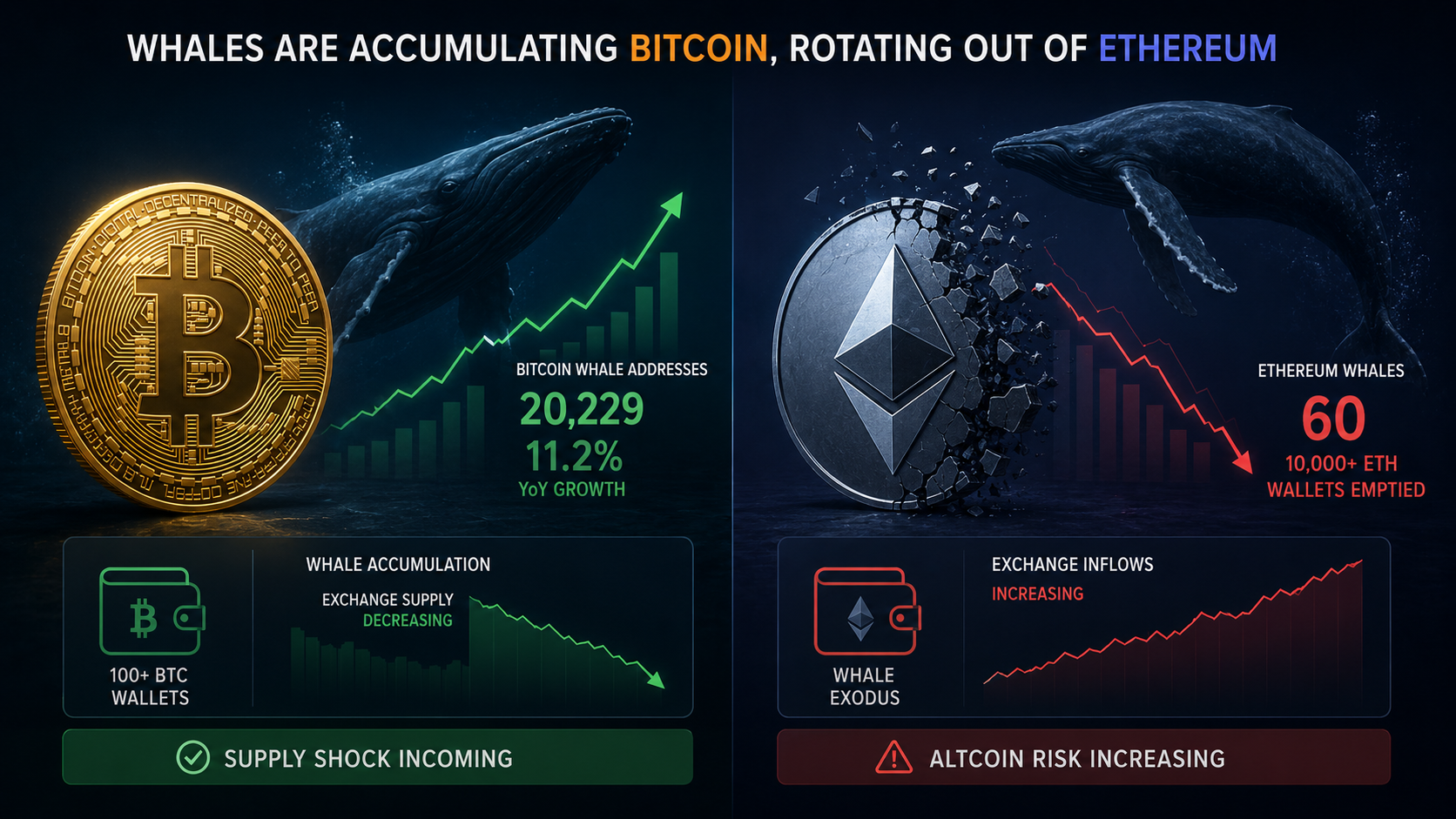
The global cryptocurrency market is experiencing a massive behavioral split between retail investors and institutional funds as macroeconomic pressures mount in mid-2026. On-chain metrics reveal a massive accumulation pattern among heavy-hitters, who are stepping in to buy up liquid supply while short-term holders capitulate during recent localized market drawdowns.
This definitive market analysis breaks down the explosive growth of Bitcoin Whale Addresses and examines why institutional money is rotating directly out of major altcoins to find shelter in digital gold.
Key Takeaways:
-
Bitcoin Whale Dominance: The number of Bitcoin Whale Addresses holding 100 or more BTC has reached a new 2026 milestone, underscoring intense institutional accumulation.
-
The Ethereum Exodus: Concurrently, on-chain data shows approximately 60 mega-whale wallets holding 10,000+ ETH have completely emptied or consolidated their balances, flashing a mid-term warning sign for altcoins.
-
Supply Shock Metrics: Massive whale accumulation across crypto exchanges is removing liquid supply from the open market, creating a structural setup for a supply shock.
-
Macro Environment Drivers: Rising U.S. Treasury yields and escalating geopolitical tensions are acting as the primary catalysts driving large-scale portfolio reallocation.
-
Psychological Price Floors: Market focus remains pinned on Bitcoin defending its $77,000 baseline, while Ethereum is facing a crucial, make-or-break retest of its $2,000 psychological support zone.
Decoding the Surge in Bitcoin Whale Addresses
Understanding the movement of high-net-worth wallets is essential for any digital asset trader looking to position themselves ahead of macro trends. On-chain analytics demonstrate that behind the scenes of recent price dips, smart money has been aggressively accumulating Bitcoin at a rate not seen in several quarters, decoupling entirely from standard retail sentiment.
The 11.2% Growth Metric: Breaking Down the 100+ BTC Holders Data
Recent blockchain intelligence reports from Santiment reveal a stark reality: wallets holding a minimum of 100 BTC have experienced an 11.2% year-over-year growth rate. This specific wallet tier is widely recognized by market analysts as the primary baseline for institutional investors, family offices, hedge funds, and corporate treasuries.
An 11.2% expansion during a year characterized by aggressive global monetary policies and choppy price action signals that large allocators view price pullbacks not as systemic threats, but as optimal entry windows. This steady rate of accumulation indicates a structural shift in how institutional money views market volatility—revisiting the classic asset playbook of aggressively buying when retail panic maximizes open market liquidity.
Reaching 20,229 Wallets: Why the 2026 High Matters for Long-Term Holders
The aggregate number of these large-scale addresses has officially climbed to 20,229 wallets, marking a significant new multi-year high for 2026. For long-term holders (LTHs), this number is a fundamental gauge of macro market health.
When retail sentiment shifts toward fear and selling, liquid supply moves to exchanges. Whales then actively buy the dip, which is precisely what has driven the wallet count to its 2026 high.
When the total count of Bitcoin Whale Addresses hits a record high during a period of price consolidation, it confirms that ownership of the asset class is transferring from weak hands to entities with long-term investment horizons. These 20,229 wallets represent a massive foundation of locked supply that is highly unlikely to be sold off during minor market drawdowns, raising the ultimate floor price of the asset network.
Exchange Liquidity Drain: How Whale Accumulation Triggers a Supply Shock
As these thousands of institutional-grade wallets accumulate coins, they rarely leave their digital assets sitting on centralized trading platforms. Instead, the dominant trend among these whales involves moving assets directly into cold storage networks or multi-signature institutional custody vaults.
This continuous outflow of tokens creates an acute exchange liquidity drain. When hundreds of thousands of Bitcoin are taken out of active market circulation, the remaining available supply on order books thins dramatically. Once the broader macroeconomic narrative turns positive and retail demand inevitably returns, this severe lack of available market supply creates what economists call a structural supply shock. With little to no sell-side liquidity left on exchanges, even a modest increase in buy orders can trigger an aggressive upward price squeeze.
The Great Divergence: Bitcoin Whale Addresses vs. Ethereum Whale Exodus
While the Bitcoin network is benefiting from clear institutional favor, the broader smart contract ecosystem is telling a completely different story. A massive divergence has emerged between the top two crypto networks, revealing that the capital flooding into Bitcoin Whale Addresses is frequently being pulled directly out of Ethereum positions.
Trimming Positions: 60 Ethereum Whales Emptying Balances in May 2026
On-chain data compiled in May 2026 highlights a troubling structural trend for the leading smart contract platform. Within a consecutive 60-day window leading into mid-May, approximately 60 Ethereum whale addresses holding 10,000 ETH or more have completely emptied out their balances or fully automated the shutdown of their active staking nodes.
This rapid reduction in top-tier Ethereum supply represents millions of dollars in capital fleeing the network over a remarkably compressed timeframe. This trend stands in direct, diametric opposition to the simultaneous inflows being captured by high-tier Bitcoin wallets, signaling that institutional players are actively rebalancing their core digital asset portfolios to favor maximum security and deep liquidity over utility-based layer-1 platforms.
Wallet Consolidation vs. Capitulation: Analyzing Ali Martinez’s On-Chain Data
Prominent crypto analyst Ali Martinez recently shed light on this massive shift via X (formerly Twitter), highlighting that these 60 mega-wallets didn't merely engage in ordinary daily trading. Martinez’s granular on-chain tracking suggests that while a minor portion of these funds could point to internal wallet consolidation among custodians, the vast majority of the data represents systematic risk reduction and profit-taking.
The simultaneous surge in exchange deposits for Ethereum during this exact period confirms that large players have been actively liquidating their ETH holdings on the open market. Martinez pointed out that this clear combination of dropping whale counts and accelerating exchange inflows indicates a broader structural capitulation among institutional altcoin allocators.
Weakening Medium-Term Conviction: Why Multi-Million Dollar Capital Is Moving
The core motivation behind this multi-million dollar capital migration stems from a pronounced weakening of medium-term conviction regarding Ethereum’s near-term scaling roadmap and fee capture models. Institutional allocators look closely at fundamental network revenues, gas burning rates, and the impact of Layer-2 scaling solutions on Layer-1 economic mechanics.
With Layer-2 rollups absorbing the vast majority of transactional volume while heavily compressing the fee revenues flowing back to the main Ethereum base chain, large funds are questioning the asset's near-term monetary velocity. Faced with declining economic yields on Ethereum and a highly uncertain macroeconomic environment, institutional managers are choosing to temporarily forfeit yield-bearing asset strategies in favor of the absolute scarcity and predictable architecture offered by Bitcoin.
Risk Mitigation Strategies: Is Institutional Money Rotating from Altcoins to BTC?
The short answer is yes: capital rotation is currently the driving force behind current crypto market dynamics. As geopolitical risks mount and global central banks alter their long-term interest rate projections, multi-asset funds are deploying strict risk mitigation protocols. In the digital asset universe, these risk mitigation frameworks look like this:
-
Bitcoin (BTC) Strategy: Whales are engaged in heavy accumulation (11.2% YoY growth) with massive outflows moving to institutional cold storage. This highlights growing long-term institutional conviction as a macro safe haven and pure digital store of value.
-
Ethereum (ETH) & Altcoins Strategy: Large holders are executing aggressive position trimming and emptying wallets, causing increased inflows to exchanges that raise latent selling pressure. This reflects a weakening medium-term fundamental conviction, treating them as high-beta risk assets.
This clear flight-to-safety behavior highlights that during periods of global financial stress, institutional players treat Bitcoin as an independent asset class, while categorizing Ethereum and the rest of the altcoin ecosystem as high-beta tech equities that carry too much near-term risk.
Macro Drivers Behind the 2026 Crypto Market Volatility
To understand why Bitcoin Whale Addresses are expanding while altcoins face capitulation, one must analyze the broader global macroeconomic landscape. The financial market dynamics of 2026 have shifted dramatically, creating structural headwinds that heavily penalize risk-on speculation while rewarding hard, censorship-resistant money assets.
Surging US Treasury Yields: The Impact of Fed Policy on Digital Assets
A dominant macroeconomic driver throughout 2026 has been the unexpected, persistent surge in U.S. Treasury yields. Driven by sticky, resurgent inflation metrics and a highly cautious Federal Reserve monetary stance, bonds have seen yields climb back to levels that force multi-asset managers to re-evaluate their entire portfolios.
When risk-free or low-risk yields on government debt remain highly elevated, the opportunity cost of holding speculative assets spikes dramatically. For institutions, this means high-risk, yield-dependent altcoins that carry smart-contract vulnerabilities lose their fundamental appeal. Capital instead shifts toward Bitcoin, which acts as a non-sovereign macro hedge against the very inflationary forces that are pushing bond yields higher in the first place.
Geopolitical Friction: Navigating Global Risks in Late 2026
Compounding these complex monetary policy challenges is a backdrop of sharp geopolitical friction across multiple international corridors. Trade standoffs, maritime shipping disruptions, and international summits concluding without structural diplomatic breakthroughs have kept global market volatility indices at elevated baselines throughout late 2026.
Geopolitical friction inevitably leads to broader global market volatility. As traditional markets feel the strain, capital instinctively seeks a flight-to-safety, resulting in larger institutional allocations moving directly into BTC.
During periods of intense geopolitical instability, institutional capital instinctively prioritizes deep liquidity and asset seizure resistance. Bitcoin’s absolute decentralized infrastructure and borderless nature make it uniquely suited to withstand geopolitical crises. Large entities are realizing that while a regional conflict or localized regulatory crackdown can severely disrupt localized tech ecosystems and smart-contract networks, the core global Bitcoin ledger remains completely unaffected, reinforcing its status as an elite geopolitical safe haven.
Technical Outlook: Key Support and Resistance Levels to Watch
The stark divergence between Bitcoin and Ethereum's fundamental on-chain whale data is mirrored perfectly in their respective technical charts. While Bitcoin shows clear structural resilience by continually defending its higher-tier macro support levels, Ethereum remains locked in a critical battle to preserve its multi-year market structure.
Bitcoin Price Resilience: Defending the $77,000 Zone Amid Market Stress
From a technical chart perspective, Bitcoin has demonstrated impressive structural strength despite facing massive headwinds from traditional equity markets. Even as spot Bitcoin ETFs experienced temporary net outflows during recent risk-off market phases, the price action successfully established a firm macro floor around the $77,000 zone.
This $77,000 region represents a highly critical confluence of the 50-day moving average and heavy institutional order block volume. The fact that Bitcoin has repeatedly found strong buy-side absorption at this level directly correlates with our on-chain data showing a surge in Bitcoin Whale Addresses. Whales are actively placing large bids right at this structural support zone, preventing deeper market pullbacks and positioning the asset for a strong continuation pattern once resistance levels at $82,000 and $85,000 are retested.
Ethereum's Psychological Test: Will the $2,000 Support Level Hold or Fail?
Conversely, Ethereum’s technical chart is flashing several red flags that require extreme caution from exchange traders. Due to the steady stream of exchange inflows from large entities, ETH has broken below both its 50-day and 200-day moving averages, bringing its price down to test the psychologically vital $2,000 support level.
When the ETH price breaks below its 50-day and 200-day moving averages, it enters a critical test of its $2,000 psychological floor. If it holds this support, the target short-term rebound sits at $2,180. However, if it fails this support, the macro downside targets shift down to the $1,850 to $1,750 range.
Momentum indicators such as the daily MACD remain firmly bearish, and while the Relative Strength Index (RSI) shows heavily oversold conditions at 22.7, a formal trend reversal has not been confirmed. Technical analysts warn that if the $2,000 psychological floor fails to hold on a weekly closing basis, it will likely trigger a deeper cascade of automated stop-losses and liquidated staking positions. This bearish breakdown would quickly expose the next major downside targets, forcing a rapid retest of the $1,850 and $1,750 macro liquidity pools before finding a permanent cyclical bottom.
Trading Strategy: How Exchange Users Can Front-Run the Smart Money
For everyday users trading on our exchange platform, tracking these institutional shifts provides a highly profitable blueprint for capital preservation and growth. Trying to fight the momentum of multi-million dollar funds is a losing strategy; instead, smart traders align their personal portfolios directly with the clear footprints left on-chain by these whale entities.
To successfully execute this institutional front-running strategy, retail traders should consider the following actionable steps:
-
Prioritize Large-Cap Accumulation: Focus your core portfolio allocations on assets showing positive institutional accumulation metrics. When Bitcoin Whale Addresses are consistently hitting new yearly highs, it serves as a clear signal to increase your allocation to BTC during localized market pullbacks.
-
De-Risk Speculative Altcoin Positions: Given the clear data showing massive Ethereum whale wallet consolidation and increased exchange deposits, it is highly prudent to reduce exposure to high-beta altcoins until on-chain exchange inflows begin to cool down and stabilize.
-
Utilize Dollar-Cost Averaging (DCA) Near Order Blocks: Instead of trying to perfectly time a macro market bottom, configure automated DCA orders around established whale defense zones, such as Bitcoin’s $77,000 structural support line.
-
Monitor Exchange Flow Indicators: Keep a close eye on our platform's deposit and withdrawal analytics. Persistent large-scale Bitcoin withdrawals combined with rising Ethereum deposits serve as a reliable early-warning indicator that the capital rotation trend is accelerating.
By aligning your personal trading decisions with macro institutional flows rather than short-term social media sentiment, you significantly increase your probability of navigating volatile market environments successfully.
Conclusion
In conclusion, the mid-2026 crypto landscape is defined by a massive structural capital rotation, as evidenced by the record-breaking surge in Bitcoin Whale Addresses alongside an aggressive institutional exodus from Ethereum positions. While traditional macroeconomic stress factors like climbing bond yields and geopolitical tensions continue to trigger short-term panic selling among retail investors, smart money allocators are aggressively utilizing this open-market volatility to secure deep liquidity in digital gold. By tracking these high-net-worth wallet trends and structuring portfolios around core institutional support zones, exchange traders can successfully safeguard their capital and position themselves ahead of the next major market expansion.
FAQ: Understanding Bitcoin Whale Addresses and Market Trends
Q1: What exactly are Bitcoin Whale Addresses?
Bitcoin Whale Addresses refer to specific blockchain wallet destinations that hold large, statistically significant quantities of Bitcoin—typically a minimum baseline of 100 BTC or more. Because these wallets control immense financial capital, their on-chain buying and selling behaviors exert a massive influence over global market trends, liquidity dynamics, and overall asset price discovery.
Q2: Why is the number of Bitcoin Whale Addresses hitting new record highs in 2026?
The steady expansion of these wallets to a new 2026 high of 20,229 addresses highlights deep institutional accumulation. High-net-worth allocators, hedge funds, and corporate treasuries are actively taking advantage of recent market volatility and retail investor panic to aggressively accumulate Bitcoin, viewing it as an elite, non-sovereign macro safe haven.
Q3: Why are large institutional investors choosing to empty their Ethereum wallets?
On-chain metrics show about 60 major whales have completely emptied out or consolidated their Ethereum positions due to a clear weakening of medium-term network conviction. Institutional managers are actively moving capital out of high-beta altcoins to mitigate risks associated with declining layer-1 transaction fee revenues and highly uncertain global macroeconomic environments.
Q4: How does whale wallet accumulation affect everyday traders on a crypto exchange?
When Bitcoin Whale Addresses systematically buy up supply and move assets into cold custody, they trigger an exchange liquidity drain. This reduction in open market supply means that once retail demand returns, the market experiences an acute supply shock, which historically lays the structural groundwork for aggressive upward price rallies.
Q5: What are the key technical price levels to watch for BTC and ETH right now?
Traders must closely watch Bitcoin defending its primary structural support floor around the $77,000 zone, which remains heavily protected by institutional whale buy orders. Concurrently, Ethereum is facing an incredibly critical psychological test at the $2,000 mark, which must hold to prevent a drop toward $1,750.