

AI Spending Concerns: How Rising Costs and Treasury Yields Are Pressuring Tech Stocks
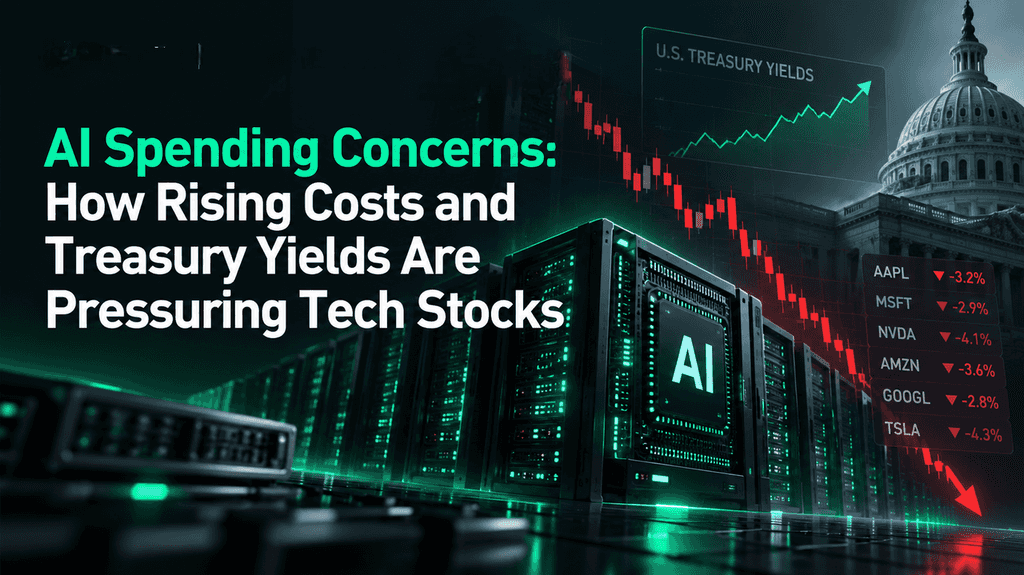
AI spending concerns are putting technology stocks under renewed pressure as investors question whether the industry's expanding data center investments will deliver sufficient returns. The Nasdaq Composite fell 2.60% on October 22, 2026, amid worries about infrastructure costs, financing needs, and technology valuations. Meta's latest earnings and a subsequent equity-financing announcement intensified that debate, while stress in AI-related corporate bonds highlighted the risks facing debt-dependent businesses. Treasury yields also shifted sharply during the sell-off, making it important to distinguish the impact of government borrowing rates from company-specific financing costs.
Key Takeaways
-
AI spending is pressuring tech stocks: Investors are questioning whether rising data center and chip costs will generate sufficient long-term returns.
-
Meta's revenue growth comes with high costs: Third-quarter 2026 revenue reached $64.60 billion, up 26% year over year, while free cash flow fell to negative $2.12 billion.
-
Meta announced a potential $95 billion financing plan: The October 26 announcement included proposed equity offerings, raising questions about future funding and shareholder dilution.
-
CoreWeave faces significant financing pressure: The AI cloud provider reported $2.575 billion in second-quarter revenue, a $626 million net loss, and approximately $640 million in net interest expense.
-
Treasury yields are not the only market driver: On October 22, the 10-year U.S. Treasury yield fell to 4.96%, while the Nasdaq Composite dropped 2.60%.
-
Big Tech earnings could shape the AI outlook: Microsoft and Alphabet were scheduled to report on October 28, followed by Amazon on October 29, offering fresh evidence about cloud growth and AI investment returns.
AI Spending Concerns Put Tech Stocks Under Pressure as Infrastructure Costs Rise
Rising artificial intelligence infrastructure costs are putting technology stocks under pressure as investors reassess spending on data centers, advanced chips, and computing capacity. Demand for AI services continues to expand, but financing these projects requires substantial capital, and revenue growth does not guarantee attractive investment returns. The October market moves brought those competing realities into sharper focus.
October 2026 Tech Stock Sell-Off Highlights Growing AI Investment Concerns
U.S. technology stocks experienced significant selling pressure on October 22, 2026. The Nasdaq Composite declined 2.60% to 26,008.86, while the S&P 500 fell about 1.21% to 7,663.43. Semiconductor shares were particularly weak, with the Philadelphia Semiconductor Index down approximately 6.7%. Meta Platforms lost around 7% after reporting quarterly earnings, suggesting that investors were focusing not only on sales growth but also on the costs of delivering future AI products. The selling was concentrated in major technology names: the Dow Jones Industrial Average edged higher, and many stocks outside the sector advanced.
The retreat also exposed the difficulty of interpreting a technology-led sell-off as a verdict on AI demand itself. Investors were reassessing the time required for infrastructure projects to begin generating sufficient earnings, alongside the risk that current valuations already assume unusually strong growth. On October 26, the Nasdaq recovered 0.83%, underscoring how quickly sentiment can change around new disclosures and market expectations.
Meta's AI Capital Expenditures, Negative Free Cash Flow, and $95 Billion Financing Plan
Meta's October 21 earnings report showed how strong operating performance can coexist with heavy infrastructure spending. Third-quarter revenue reached $64.60 billion, up 26% from a year earlier, while capital expenditures, including finance-lease principal payments, totaled $34.91 billion. Operating cash flow was $32.79 billion, leaving negative free cash flow of $2.12 billion for the quarter. Meta also narrowed its 2026 capital expenditure forecast to $135 billion–$145 billion, raising the lower end of the previous range. Reported quarterly costs and expenses rose 68%, but the figure included a separate $9.89 billion legal charge; attributing that entire increase to AI investment would misrepresent the company's results.
On October 26, Meta announced a potential $95 billion equity-financing plan, consisting of approximately $22.5 billion in proposed common stock, $12.5 billion in preferred depositary shares, and a possible later share-sale program of up to $60 billion. These were announced financing arrangements, not $95 billion in completed proceeds. Meta held $82.45 billion in cash, cash equivalents, and marketable securities as of September 30, giving it considerable funding flexibility. Nevertheless, the planned offerings added share issuance and possible dilution to investors' assessment of AI-related capital commitments. The central question is whether future operating performance can support the scale and duration of that investment.
CoreWeave's Debt Burden and AI Data Center Expansion Costs
CoreWeave illustrates a different financial model from Meta's diversified advertising business. In the second quarter of 2026, the specialized AI cloud provider reported $2.575 billion in revenue, more than double the year-earlier figure, alongside a $626 million net loss and approximately $640 million in net interest expense. Net interest expense was equivalent to nearly 24.9% of quarterly revenue. The ratio is not the company's borrowing rate, but it indicates the scale of its financing burden relative to sales. CoreWeave also reported approximately $104 billion in revenue backlog as of June 30. Backlog reflects contracted demand, not cash already collected or earnings already recognized.
Additional factors are important when evaluating whether growth can translate into durable returns:
-
Customer delivery commitments: Signed contracts must still be fulfilled on schedule, and revenue recognition depends on the services provided under those agreements.
-
Power and construction constraints: Grid connections, cooling systems, and data center commissioning can delay the point at which purchased equipment begins producing billable computing capacity.
-
Equipment replacement cycles: Advances in AI accelerators may require fresh investment before earlier hardware has generated the returns initially projected.
These pressures help explain why the credit market is increasingly sensitive to how AI infrastructure providers fund new capacity, rather than simply how much capacity they intend to build.
How Treasury Yields and Borrowing Costs Affect AI Stock Valuations
Treasury yields affect the valuation of future corporate earnings, while the additional interest investors demand on company debt influences financing expenses. Both matter for AI businesses committing capital years before all the associated returns are realized. However, government bond yields and corporate credit conditions can move in different directions, so neither should be used alone to explain a technology-stock sell-off.
Rising Treasury Yields Put Pressure on Technology Stock Valuations
When U.S. Treasury yields rise, the present value investors assign to profits expected years in the future may decline. This sensitivity is particularly relevant for growth-oriented technology companies, where expectations about long-term earnings can account for a large share of the stock's valuation. Higher returns on government securities may also raise the compensation investors require for taking equity risk. These mechanisms create valuation pressure without implying that every increase in yields will produce a stock-market decline; earnings forecasts, competitive position, and investor positioning also matter.
The October timeline shows why precise dates matter. The benchmark 10-year Treasury yield was 5.13% on October 21, then fell to 4.96% on October 22, a decline of 17 basis points, as demand for government bonds increased during market weakness. It stood at 5.00% on October 26 in the Treasury's daily data. In other words, the sharp October 22 technology sell-off occurred alongside falling government bond yields, after yields had been elevated earlier in the month.
Corporate Borrowing Costs and Credit Spreads Increase AI Financing Risks
Corporate borrowing costs include more than the underlying Treasury rate. Investors generally demand a credit spread to compensate for the possibility of repayment problems, limited liquidity, and uncertainty about future business performance. When that spread widens, a company's financing costs can rise even while government bond yields are declining. During October, pressure on CoreWeave's unsecured bonds made this distinction especially visible: reported yields on some of its debt reached the mid-teens. Those traded yields reflect investors' required returns in the secondary market, not necessarily the rate the company would pay across every new financing arrangement.
Several contract and balance-sheet features help determine which AI businesses are most exposed:
-
Debt maturities: Loans and bonds coming due during difficult market conditions can create refinancing risk even when current interest payments remain manageable.
-
Fixed versus floating rates: Variable-rate liabilities can respond quickly to reference-rate changes, whereas outstanding fixed-rate debt generally retains its contractual coupon.
-
Collateral and project finance: Borrowing backed by specific infrastructure or customer agreements may carry different terms and risks from unsecured corporate bonds.
-
Liquidity reserves: Available cash and committed credit facilities can give a company more room to manage construction delays or unexpected costs.
For investors, the distinction is practical: lower Treasury yields might support equity valuations, but they do not necessarily eliminate funding problems for companies facing wider credit spreads or weaker operating cash flow.
AI Stock Outlook 2026 Earnings Growth, Investment Returns, and Market Risks
The AI stock outlook for the rest of 2026 will depend less on headline spending totals than on evidence that commercial demand can produce sustainable profitability. Investors will also be watching how companies price AI products, use newly installed capacity, and manage the financial risks of expansion. Upcoming earnings and monetary policy announcements could change market expectations, but neither strong demand nor lower interest rates would guarantee higher share prices.
AI Earnings Growth and Measurable Returns on Infrastructure Investment
Cloud revenue offers one measure of commercial demand, although it cannot be treated as a direct measure of AI profitability. Amazon Web Services generated $42.2 billion in second-quarter 2026 sales, up 37% year over year. That growth included a broad range of cloud workloads, not only AI services. Assessing the return on AI investment requires a closer look at incremental operating profit, pricing, depreciation, and cash generated after ongoing infrastructure spending. A provider could report rapid sales growth while still facing pressure on margins if its cost to deliver computing services rises just as quickly.
Companies must also balance the economics of model training with the recurring costs of inference, when customers actually use AI services. More efficient chips, software improvements, and stronger utilization can lower the expense of each completed task, but competition may push some of those savings toward customers through lower prices. The crucial measure is whether a company can retain enough of the productivity benefit to improve its financial performance over time. That depends on the type of AI product, its pricing model, customer retention, and the amount of computing capacity required to serve demand.
Upcoming Big Tech Earnings and Federal Reserve Policy Catalysts
Several scheduled events could provide new evidence about the economics of AI investment. Microsoft's fiscal first-quarter earnings and Alphabet's third-quarter results were expected after the U.S. market close on October 28, with Amazon expected to report on October 29. The Federal Reserve's October 27–28 policy meeting adds another potential catalyst, because investors will assess both the rate decision and officials' comments about inflation and financial conditions. As of the October 27 research date, these upcoming announcements had not yet been released.
Beyond headline earnings figures, the following company-specific disclosures deserve attention:
-
Microsoft: Azure growth, enterprise AI product adoption, and management commentary on capacity availability could clarify the balance between demand and cloud infrastructure investment.
-
Alphabet: Google Cloud margins and Search advertising trends could show whether AI-powered services support the company's established sources of earnings.
-
Amazon: AWS operating performance and updates on custom Trainium processors could offer evidence about efforts to improve computing efficiency and supplier flexibility.
-
Federal Reserve: The policy statement and subsequent press conference could reshape expectations for future borrowing conditions, even without an immediate change in the benchmark rate.
Key Market Risks and Bullish or Bearish Signals for AI Stocks
The direction of AI-related shares will likely differ among established software platforms, chipmakers, cloud providers, and newer infrastructure businesses. A more constructive outlook would require evidence of improving earnings quality and commercial returns, while a weaker scenario could involve slower customer adoption, excess computing capacity, or disappointing financial guidance. High expectations also matter: a company can report solid results and still see its shares decline when investors had anticipated faster growth. For that reason, changes in expectations are often as important as the earnings numbers themselves.
Other developments could shape the market through the end of 2026:
-
AI service pricing: Competition that reduces the cost of model access may expand demand while putting pressure on revenue earned per unit of computing activity.
-
Hardware concentration: Dependence on a limited number of advanced chip suppliers can expose developers and cloud operators to delivery delays or unfavorable purchasing terms.
-
Sector concentration: Index funds and thematic portfolios with large positions in a few technology companies can experience substantial swings when those firms move together.
Investors also encounter AI-related exposure outside conventional equity markets. Some tokenized stock products are designed to track listed companies, but their legal rights, liquidity, and issuer arrangements differ from direct share ownership. Those distinctions matter when comparing ways to gain exposure to the same technology industry.
Conclusion
AI spending concerns are putting pressure on technology-stock valuations as infrastructure costs rise and returns remain uncertain. The next phase will depend on earnings growth, cash generation, infrastructure utilization, and financing costs. Upcoming technology earnings and Federal Reserve signals may influence market sentiment, but sustained confidence will require clear evidence that AI revenue can justify the substantial investment.
FAQs
How Can Investors Measure the Return on AI Infrastructure Investments?
Investors can begin with a simple payback estimate: divide a project's initial cost by its expected annual net cash inflow, assuming those inflows are relatively stable. More complete methods, including net present value and internal rate of return, consider the timing of cash flows and the cost of capital. Forecasts should account for ongoing maintenance, electricity, and hardware replacement rather than treating all future revenue as profit.
Can an AI Company Report Profits While Having Negative Free Cash Flow?
Yes. Accounting profit and free cash flow measure different things. A company can recognize revenue and net income while spending large amounts of cash on servers, property, and equipment. Those assets are typically expensed gradually through depreciation, although the cash may be paid much earlier. Reviewing both figures helps distinguish current profitability from the demands of financing expansion.
Why Does Customer Concentration Matter for AI Cloud Companies?
An AI cloud provider may depend on a small group of customers for a large share of revenue. If one customer reduces spending, delays deployment, or renegotiates a contract, the effect can be substantial. Customer concentration disclosures help investors judge how dependent future revenue is on particular contracts and whether the business could absorb the loss of a major client.
How Can Electricity Grid Delays Affect AI Data Center Investments?
New data centers need electricity connections, transformers, cooling systems, and local approvals before their full computing capacity can be used. Delays can leave expensive equipment idle while development and financing expenses continue. The financial impact depends on project contracts, the time required to secure power, and whether capacity can be deployed at an alternative location.
Disclaimer
This general market information, possibly from third-party, commercial, or sponsored sources, is provided for reference and educational purposes only and does not constitute financial or investment advice, an offer, solicitation, or guarantee. We disclaim liability for its accuracy, completeness, reliability, and any resulting losses. Investments/trading are risky; past performance doesn’t guarantee future results. Users should research, judge prudently, and take full responsibility. For further details, please consult KuCoin’s Terms of Use and Risk Disclosure.