

Institutions Can Now Convert Underlying Shares Into Ondo Tokenized Stocks on Ethereum and BNB Chain
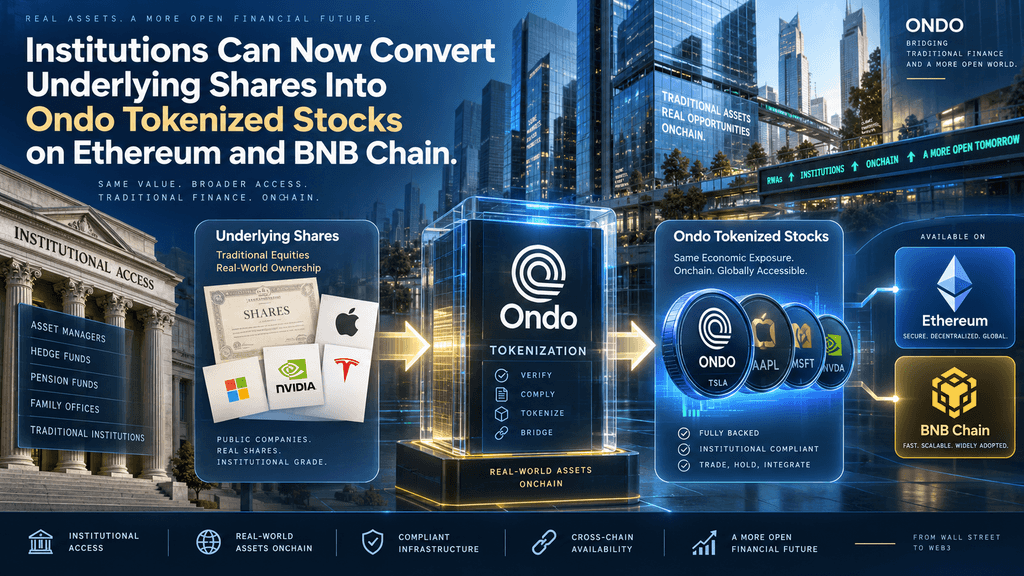
Ondo Finance announced on September 21, 2026, that approved institutions can convert underlying shares and ETFs directly into corresponding Ondo Stocks tokens or redeem tokens for the physical shares through integration with Alpaca’s Instant Tokenization Network. The capability operates on Ethereum and BNB Chain and sits alongside the platform’s existing cash-funded minting process. Institutions transfer shares via internal book entry from their Alpaca accounts into Ondo’s account; matching tokens are then issued on-chain. Redemption reverses the flow. Access remains restricted to entities that hold active accounts with both firms and receive case-by-case approval.
The change reduces the need for separate cash outlays when institutions already hold the underlying inventory, potentially lowering financing costs and timing mismatches. As of September 22, 2026, data from RWA.xyz showed Ondo with approximately $3.66 billion in distributed asset value across more than 440 products, placing it among the largest tokenization platforms by that metric. The development strengthens the link between traditional share custody and on-chain markets, offering institutions a more capital-efficient route to supply liquidity for tokenized equities while preserving the one-to-one backing of Ondo Stocks by the underlying securities held at regulated brokers.
Approved institutions initiate a mint by requesting that underlying shares move from their own Alpaca brokerage account into Ondo’s Alpaca account through an internal book transfer. No public market trade occurs; the transfer is handled as a book-entry movement within the same custodian infrastructure. Once the shares settle into Ondo’s account, the platform issues the equivalent number of Ondo Stocks tokens on the chosen network, either Ethereum or BNB Chain. The process is designed to run without a separate manual approval for each transaction after the institution has completed initial onboarding and received eligibility. Redemption works in reverse: the institution sends Ondo Stocks tokens back, and the corresponding shares return to its Alpaca account.
Official documentation confirms that Ondo currently charges no fees for these ITN mint or redeem operations. Supported assets include major U.S. equities and ETFs such as those tracking AAPL, MSFT, NVDA, SPY, and QQQ, among others listed in the integration guides. This mechanism builds on Alpaca’s Instant Tokenization Network, which was introduced to support in-kind creation and redemption against brokerage-held shares without conventional settlement delays. By removing the cash intermediary step, institutions can convert inventory they already hold into onchain positions more rapidly, supporting continuous inventory management across traditional and digital venues. The automation reduces operational friction that previously required sourcing fresh capital even when the physical shares were already in custody.
The design prioritizes speed and certainty of parity between the offchain shares and the onchain tokens. Because the transfer remains internal to Alpaca’s systems, settlement risk associated with moving assets across different custodians is minimized. Institutions must use matching email addresses for their Ondo and Alpaca accounts during onboarding to complete the handshake successfully. Live accounts are required for production activity, while sandbox environments support testing. Capacity limits can apply during periods of high demand, potentially delaying acceptance of a mint request or the final return of shares on redemption until capacity frees up. These operational parameters ensure the system scales within the constraints of the underlying brokerage rails while delivering the 24/7 availability that onchain markets expect. The result is a primary-market channel that treats existing share inventory as usable collateral for token issuance rather than an idle holding that must be liquidated or financed separately.
Market makers and other liquidity providers often maintain inventories of both traditional shares and tokenized equivalents to meet demand across venues. Under the prior cash-funded model, an institution holding the physical shares still needed to deploy additional cash to mint the matching tokens. That requirement introduced financing costs and potential timing gaps between the traditional position and the onchain inventory. The in-kind route eliminates that cash leg. Institutions can now move shares directly into token form, then deploy the tokens into secondary markets on centralized platforms, decentralized exchanges, or wallets that support Ondo Stocks. When demand shifts, they can redeem tokens and reclaim the shares without intermediate sales.
Ondo has stated that this structure makes institutional capital a more readily available source of liquidity for secondary markets, supporting tighter spreads and greater depth. As trading volume in tokenized equities has grown, the ability to replenish inventory without raising fresh capital becomes a practical advantage for firms managing continuous two-sided markets. The efficiency gain is especially relevant on networks such as Ethereum and BNB Chain, where transaction costs and confirmation times differ, allowing market makers to choose the venue that best matches their latency and fee preferences. Deeper secondary liquidity benefits end users as well. Tighter spreads reduce the cost of entering and exiting positions in tokenized stocks and ETFs. Greater depth absorbs larger orders with less price impact.
Because Ondo Stocks already connects to the liquidity of traditional exchanges such as Nasdaq and the NYSE through just-in-time minting and redemption, the in-kind channel amplifies that linkage. Institutions can respond more quickly to order-flow imbalances by converting physical inventory into on-chain supply or the reverse. Over time, consistent inventory management of this type can narrow the gap between on-chain and off-chain pricing for the same underlying equity. The model does not remove market risk or the need for careful risk controls, yet it lowers one structural barrier that previously constrained how efficiently capital could move between the two domains.
Access is limited to institutions approved by Alpaca on a case-by-case basis. ITN is not offered as a generally available feature of Ondo Stocks. Prospective users must maintain active accounts with both Ondo Finance and Alpaca, complete the applicable onboarding and compliance steps for each firm, and request activation from both parties. The same email address must be used across the two platforms to enable the technical handshake. BrokerAPI accounts at Alpaca meet the requirements; a TradingAPI account alone is insufficient under current guidelines. Institutions already in a relationship with Alpaca can coordinate directly, while others may request an introduction through Ondo.
Once approved, the conversion functionality becomes available on Ethereum and BNB Chain for the list of supported underlying symbols. These restrictions reflect the regulated nature of the underlying securities and the need to maintain clear custody chains and investor protections. Only entities that satisfy both firms’ standards can participate, ensuring that the primary-market route remains within the institutional perimeter. The case-by-case approval process allows Alpaca and Ondo to assess operational readiness, risk controls, and compliance posture before granting access. Institutions interested in the capability are directed to contact both organizations to begin the activation process.
Documentation emphasizes that the feature is designed for authorized participants rather than broad retail or open access. This controlled rollout helps preserve the integrity of the one-to-one backing model, under which every Ondo Stocks token corresponds to shares or cash in transit held at U.S.-registered broker-dealers. By limiting participation to vetted institutions, the platform reduces the operational and compliance surface area while still expanding the pool of capital that can support secondary-market liquidity. The requirements also align with the broader regulatory environment governing the offer and sale of tokenized securities, which remains jurisdiction-specific and subject to ongoing development.
Conversions through the Instant Tokenization Network are live on Ethereum and BNB Chain. These two networks host the token issuance and redemption endpoints for the in-kind process. Ethereum provides the established institutional and DeFi infrastructure, while BNB Chain offers lower transaction fees and a large active user base. Earlier infrastructure, including the Ondo Bridge developed with LayerZero, already enabled seamless transfer of more than 100 Ondo tokenized stocks and ETFs between the two chains with one-to-one parity. The addition of in-kind conversion on both networks therefore extends primary-market access to the same venues where secondary trading and bridging already occur.
Institutions can mint on one chain and, if desired, bridge the tokens to the other without breaking the economic linkage to the underlying shares. This multi-network support expands the addressable liquidity pool and allows participants to optimize for cost, speed, or composability depending on their strategies. The dual-network approach reflects broader market dynamics in which different blockchains attract distinct user and capital profiles. Ethereum continues to host significant institutional activity in tokenized Treasuries and funds, while BNB Chain has captured a growing share of tokenized equity volume in certain periods.
By supporting in-kind conversion on both, Ondo positions its Stocks product to draw liquidity from whichever network best serves a given participant’s needs. The technical implementation uses the same underlying Alpaca book-transfer rails regardless of the destination chain; only the final token issuance address changes. Capacity and rate limits may still apply, yet the availability of two major networks reduces single-chain concentration risk for institutions managing sizable inventories. Future expansion to additional chains remains possible as the broader Ondo Stocks roadmap evolves, but the September 2026 launch focuses on the two networks already carrying meaningful secondary activity.
Ondo has indicated that converting existing share inventory into on-chain liquidity supports tighter spreads and deeper markets for Ondo Stocks across secondary venues. When market makers can replenish token inventory more efficiently, they are better able to quote continuous two-sided markets. Reduced financing friction lowers the cost of maintaining inventory, which can be reflected in narrower bid-ask spreads. Greater depth absorbs larger orders with less slippage. These improvements compound because Ondo Stocks already link to traditional exchange liquidity through the just-in-time model: demand that cannot be met from existing on-chain inventory can trigger minting against the underlying shares, and excess supply can be redeemed.
The in-kind channel makes that linkage more capital-efficient for the institutions that intermediate the flow. As more approved participants adopt the route, the aggregate inventory available for secondary trading can increase without proportional new capital raises. Observable effects will depend on the volume of institutions that complete onboarding and the scale of inventory they choose to convert. Early adoption by active market makers is likely to produce the most visible tightening of spreads on the most liquid names. Less liquid tokenized stocks may see more gradual improvements as inventory depth builds.
Because the tokens trade on both centralized platforms and decentralized protocols, the liquidity benefits can appear across multiple venues simultaneously. Monitoring tools such as those provided by RWA.xyz already track distributed asset value and holder counts; sustained growth in secondary volume alongside the new primary-market route would indicate that the capital-efficiency gains are translating into broader market improvements. The structure does not guarantee tighter markets in every condition, yet it removes a previously identifiable friction that limited how quickly institutional capital could respond to demand.
The cash-funded process requires an institution to deliver cash or stablecoins to mint Ondo Stock tokens even if it already holds the underlying shares. That cash is used to acquire or secure the corresponding securities, after which tokens are issued. The in-kind process substitutes the existing shares for the cash leg. Shares move via internal transfer, and tokens are issued against them. Both routes ultimately result in tokens that are fully backed by the underlying securities or cash in transit held at regulated brokers. The practical difference lies in capital usage and timing.
Cash-funded minting can create a temporary double exposure or financing need; in-kind conversion avoids that by using inventory already on the balance sheet. Redemption under both models returns the economic exposure, but only the in-kind route returns the identical shares to the institution’s Alpaca account without an intermediate market transaction. Institutions can continue to use the cash route when they prefer or when they do not hold the underlying shares. The two channels therefore complement rather than replace each other.
Market makers that maintain both cash and share inventories gain flexibility: they can choose the lower-friction path for any given mint or redeem. Over time, the availability of both options may encourage more sophisticated inventory optimization, in which institutions dynamically allocate between physical and tokenized forms based on relative financing costs, expected demand, and network conditions. The coexistence of the two primary-market routes expands the set of tools available to professional participants without altering the core one-to-one backing principle that underpins investor confidence in the tokens.
As of September 22, 2026, RWA.xyz recorded approximately $3.66 billion in distributed asset value for Ondo across roughly 460 products and more than 480,000 holder addresses. The platform ranks second among tokenization platforms by that metric, behind Securitize. The product suite spans tokenized U.S. Treasuries, stocks, ETFs, and additional fixed-income and equity strategies. Ondo Stocks, the equity and ETF vertical, has grown substantially since its initial launch on Ethereum, with subsequent expansion to BNB Chain and bridging infrastructure.
Cumulative trading volume in the tokenized equity segment has reached multi-billion-dollar levels according to earlier platform updates. The addition of an in-kind conversion channel arrives against this backdrop of established scale, meaning the new route can draw on an already sizable secondary market rather than starting from a greenfield environment. The platform’s multi-chain presence further amplifies the potential reach of the conversion feature. Tokens issued on Ethereum or BNB Chain can move via the existing bridge, and many are already integrated into wallets, custodians, and DeFi applications.
Institutional participants using the in-kind route therefore gain access to a distribution network that extends beyond the primary minting venues. Holder counts in the hundreds of thousands indicate that demand is not confined to a small set of professional desks. The combination of broad product coverage, multi-network support, and now a more capital-efficient primary-market channel positions the platform to absorb additional institutional inventory without proportional infrastructure build-out. Continued growth in distributed value and secondary volume will serve as the practical test of whether the efficiency gains materialize at scale.
Alpaca’s Instant Tokenization Network provides the brokerage infrastructure that makes in-kind conversion possible. The network allows authorized participants to mint and redeem tokenized shares against securities held in brokerage accounts without waiting for conventional settlement cycles. Shares remain within Alpaca’s custody systems during the internal book transfer, preserving the chain of title and regulatory controls. Ondo acts as the issuer of the corresponding tokens once the shares arrive in its account. The partnership therefore separates the custody and brokerage functions from the tokenization and on-chain distribution functions while keeping them tightly linked through automated workflows.
Alpaca has described the network as infrastructure designed to support third-party partners that perform the actual tokenization, rather than Alpaca itself acting as the issuer. This division of roles aligns with regulatory expectations around securities custody and issuance. The technical implementation includes API endpoints for mint and redeem requests that specify the underlying symbol, quantity, issuer, network, and destination wallet.
Rate limits and capacity controls protect the system during high-volume periods. Because the same Alpaca account infrastructure supports both traditional trading and the tokenization network, institutions that already custody shares at Alpaca face a relatively short path to activation once approvals are granted. The network’s design goal of reducing costs and increasing speed relative to sell-and-repurchase cycles is realized concretely in the Ondo integration: institutions no longer need to liquidate shares in the open market solely to free cash for token minting. The result is a tighter operational loop between traditional custody and on-chain markets.
Professional trading desks that intermediate tokenized equity markets must manage inventory across multiple dimensions: physical shares, cash, tokenized positions on different chains, and exposure to funding rates or opportunity costs. The in-kind conversion channel shortens one of those dimensions. A desk holding a large position in a particular equity can convert a portion into tokens when on-chain demand rises, then redeem when demand falls, all without open-market transactions in the underlying.
This reduces both transaction costs and market-impact risk associated with building or reducing inventory. It also improves the ability to maintain delta-neutral or market-making books that span traditional and on-chain venues. Because the conversion is automated after initial approval, desks can respond to order flow with lower latency than processes requiring manual cash funding or sequential sales and purchases. The advantages compound when desks operate across both Ethereum and BNB Chain. Inventory can be minted on the lower-fee network and bridged if needed or minted directly on the chain where secondary demand is concentrated.
Capacity limits remain a practical constraint, so desks will still need to plan around peak periods. Nonetheless, the existence of a reliable in-kind route changes the calculus of how much capital must be held in cash versus shares. Over successive cycles of minting and redeeming, the cumulative reduction in financing drag can become material for high-volume participants. The structure therefore supports more continuous and capital-efficient market making, which in turn contributes to the tighter spreads and deeper books that benefit the broader ecosystem of tokenized equity users.
Tokenized equities represent one segment of the larger real-world asset market. Improvements in the capital efficiency of equity tokenization can inform approaches taken in other asset classes such as Treasuries, credit, or funds. When institutions can treat existing holdings as directly convertible into onchain form, the friction that previously separated traditional balance sheets from digital markets declines. That reduction encourages more seamless allocation of capital across domains and can accelerate the growth of secondary liquidity in tokenized products.
Ondo’s position as a major platform by distributed asset value means that operational improvements on its equity vertical have visibility across the broader RWA landscape. Other issuers and infrastructure providers may observe the adoption of the in-kind model and evaluate similar integrations with brokerage networks. The development also illustrates the continuing specialization of roles within the tokenization stack. Brokerage firms supply custody and settlement rails, specialized issuers handle token creation and onchain distribution, and secondary venues provide trading.
Clear interfaces between these layers, such as the ITN API and the internal book-transfer mechanism, allow each participant to focus on its comparative strength while still delivering an end-to-end experience. As more institutions complete the onboarding process, the volume of share inventory that can be converted on demand is likely to increase. That growth, if sustained, would expand the effective free float of tokenized equities available for secondary trading and further tighten the linkage between traditional and onchain price discovery.
Although the in-kind route lowers certain financing and timing frictions, it does not eliminate market, operational, or counterparty risks. Institutions remain exposed to price movements in the underlying equities between the decision to convert and the completion of secondary trades. Capacity limits on the ITN can delay mints or redemptions during congested periods. Technical or operational issues at either Ondo or Alpaca could interrupt the conversion workflow. Regulatory requirements continue to govern who may hold and transfer the tokens, and jurisdictional restrictions apply.
Custody risk, while mitigated by the use of regulated broker-dealers, is never zero. Institutions must therefore maintain robust risk management frameworks that account for both the traditional and on-chain legs of their positions. The absence of mint or redeem fees on the ITN channel is helpful, yet other costs such as network gas, bridging fees, or secondary trading commissions still apply. Eligibility restrictions mean that only a subset of market participants can access the channel. Firms that do not meet the approval criteria must continue to rely on the cash-funded route or secondary-market purchases.
The case-by-case nature of approvals also implies that scaling the participant base will take time. These constraints are intentional and reflect the need to preserve regulatory compliance and operational integrity. Institutions evaluating the feature should weigh the capital-efficiency benefits against the operational requirements and the residual risks that remain after conversion. Independent due diligence on both the technology and the counterparties remains essential before committing significant inventory to the process.
The September 2026 launch of in-kind conversion adds a practical tool to the institutional toolkit for managing tokenized equity exposure. As more approved firms activate the capability and convert meaningful share inventories, secondary markets on Ethereum and BNB Chain stand to benefit from deeper and more responsive liquidity. The model demonstrates that existing custody relationships can be leveraged to support onchain markets without requiring institutions to liquidate or refinance holdings. Continued expansion of supported assets, potential addition of further networks, and refinement of capacity management will determine how far the efficiency gains extend.
Data from RWA.xyz and secondary trading venues will provide ongoing visibility into whether distributed asset value and trading volumes respond to the improved primary-market access. The broader direction of real-world asset tokenization depends on precisely these kinds of infrastructure improvements: reductions in capital friction, clearer operational interfaces between traditional and digital systems, and controlled expansion of institutional participation. Ondo’s implementation with Alpaca supplies a concrete example of how those elements can be combined. Market participants, infrastructure providers, and observers will monitor adoption rates, spread behavior, and inventory turnover as indicators of success.
Market news moves fast — but where you act on it matters just as much. This October, KuCoin launches KuCoin 5.0, transforming KuCoin into a rebuilt platform. Here's what actually changes for you:
-
One account for everything. Older platforms split your money across separate "spot," "margin," and "futures" accounts and expected you to understand why. KuCoin 5.0's unified account removes that entirely — deposit once, and everything is simply there (only available to VIPs for now).
-
Stocks, indices, and commodities. KuCoin 5.0 expands beyond crypto into global markets. When crypto chops sideways and equities rally (or the reverse), you rotate in minutes instead of opening a brokerage account and waiting days for fiat rails.
-
Real-world assets (RWA). Tokenized exposure to traditional assets like commodities, right inside your crypto account. One of the fastest-growing segments in global finance is no longer reserved for institutions — you access it from the same balance you trade with.
-
Earn while you learn. Not ready to trade? KCUSD lets your stablecoins earn daily, auto-compounding interest. The lowest-stress way to put your idle deposit to work for 4% yield.
-
An AI assistant in plain language. Ask questions, get market context, understand what you're looking at — built into the platform, no jargon required.
-
An app that doesn't overwhelm. Faster, cleaner, and consistent — intuitive from the first tap, not after a tutorial.
-
Safety you can check, not just trust. A MiCAR-licensed EU entity, Proof of Reserves you can verify yourself, and internationally certified security (SOC 2 Type II, ISO 27001:2022).
Create your account in minutes — and start on the platform built for where crypto is going, not where it's been.
What exactly changes for institutions that already hold shares they want to tokenize?
Institutions that already custody eligible shares in an Alpaca account can now request an internal book transfer of those shares into Ondo’s Alpaca account. Upon completion of the transfer, Ondo issues the matching Ondo Stocks tokens on Ethereum or BNB Chain.
Which networks currently support the in-kind conversion process?
The conversion functionality is live on Ethereum and BNB Chain. Institutions select the destination network when submitting the mint request through the Alpaca interface. Tokens issued on either network can later be bridged using existing infrastructure if the institution wishes to move them between the two chains while preserving the economic linkage to the underlying shares.
Who is eligible to use the Instant Tokenization Network conversion feature?
Eligibility is limited to institutions that maintain active accounts with both Ondo Finance and Alpaca, complete the required onboarding and compliance processes, and receive case-by-case approval from Alpaca. The feature is not available to the general public or to entities that have not completed the dual-platform approval process. Interested institutions are advised to contact both organizations to begin the activation request.
Does the in-kind conversion replace the existing cash-funded minting option?
No. The cash-funded route remains available. Institutions that prefer to use cash or that do not hold the underlying shares can continue to mint through that channel. The in-kind option simply adds a second primary-market path that is more capital-efficient for those already holding the relevant inventory.
Are there fees associated with minting or redeeming through the ITN channel?
According to current Ondo documentation, the platform charges no fees for minting or redeeming Ondo Stocks through the Instant Tokenization Network. Other costs, such as network transaction fees or any applicable secondary-market commissions, may still apply depending on subsequent activity.
How does the conversion affect the one-to-one backing of Ondo Stocks tokens?
The backing model remains unchanged. Tokens issued via the in-kind route continue to be fully backed by the corresponding underlying shares (or cash in transit) held at U.S.-registered broker-dealers. The internal book transfer simply moves the shares from the institution’s Alpaca account into Ondo’s account so that the custody record matches the newly issued tokens.
Disclaimer: This content is for informational purposes only and does not constitute investment advice. Stock investments carry risk. Please do your own research (DYOR).