

What Are Agentic AI Stocks? Key Companies, Growth Drivers, and Investment Risks in 2026
Introduction
What if artificial intelligence could do more than answer questions and generate content - what if it could plan tasks, use software tools, and complete complex workflows? This is the promise of agentic AI, a technology trend creating potential opportunities across semiconductors, data-center networking, enterprise software, and workflow automation. Agentic AI stocks are shares of publicly traded companies that develop, supply, or deploy AI agents and the infrastructure needed to run them.
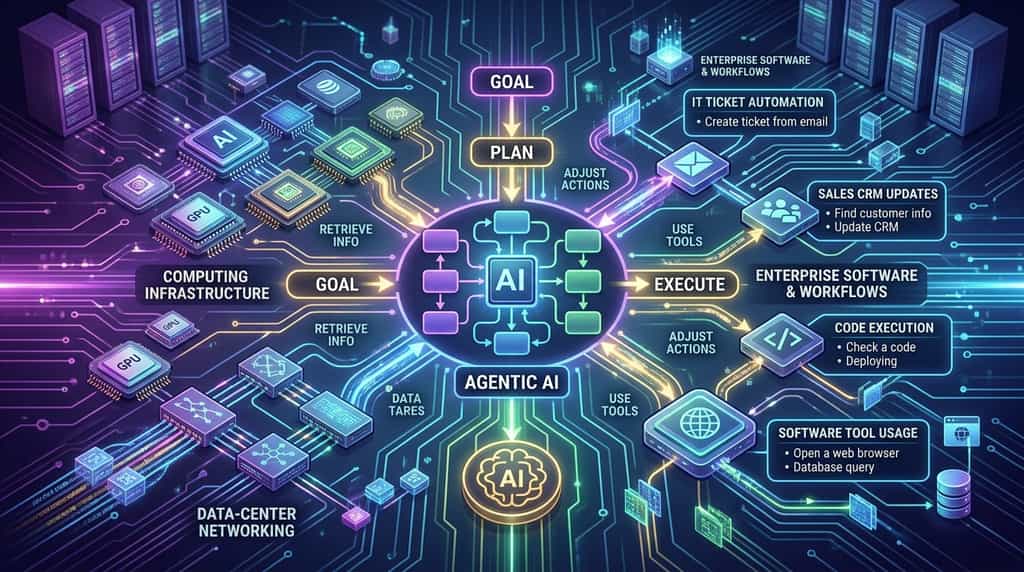
Unlike conventional chatbots, AI agents can work through multiple steps toward a defined goal, retrieve information, interact with connected applications, and adjust their actions based on results. This could help businesses automate repetitive work and improve productivity, but commercial adoption, reliability, computing costs, and competition will determine which companies capture lasting value.
Four companies illustrate different parts of this market: NVIDIA (NVDA) supplies AI computing infrastructure, Arista Networks (ANET) builds high-performance networking, ServiceNow (NOW) embeds AI into enterprise workflows, and Salesforce (CRM) develops AI agents for business applications. These are research examples, not investment recommendations. Each company has a distinct revenue model, risk profile, and level of exposure to agentic AI.
What Are Agentic AI Stocks?
Agentic AI stocks are publicly traded companies with exposure to AI systems that can plan and execute multi-step tasks, rather than simply respond to a prompt. The category includes chipmakers, networking suppliers, cloud providers, enterprise software vendors, and workflow automation platforms. It is an investment theme, not an official stock-market classification, so companies described as agentic AI stocks may benefit in very different ways.
An AI agent typically combines an AI model with instructions, relevant context, access to data, and tools that allow it to perform actions. For example, an IT service agent could classify an employee's request, retrieve relevant records, troubleshoot a common issue, create a ticket, and escalate a problem when necessary. A sales agent could summarize customer information, prepare follow-up material, and update a customer relationship management system. Human review may still be required for sensitive, costly, or consequential actions.
The commercial opportunity comes from moving AI beyond content generation into operational workflows. If agents can complete tasks accurately and consistently, businesses may pay for subscriptions, usage-based services, infrastructure, or implementation support. However, a product demonstration does not prove that a business has achieved meaningful revenue. Investors should look for evidence of paid adoption, repeat usage, customer retention, and measurable business value.
Which Agentic AI Stocks Are Worth Researching in 2026?
NVIDIA, Arista Networks, ServiceNow, and Salesforce represent four distinct ways to study the agentic AI market. NVIDIA supplies computing infrastructure, Arista provides the networking that connects AI systems, ServiceNow embeds agents into enterprise workflows, and Salesforce integrates agents into customer-facing business applications. Comparing them helps investors understand where revenue may emerge and which risks matter for each business.
1. NVIDIA (NVDA): The Computing Infrastructure Behind AI Agents
NVIDIA is a major supplier of accelerated computing infrastructure used to develop and run AI models. Its exposure to agentic AI comes from the processing capacity required when agents reason through tasks, call models, retrieve information, and repeat operations until a workflow is complete.
According to NVIDIA's official second-quarter fiscal 2027 results, published on August 26, 2026, revenue reached $96.2 billion, up 106% year over year, while Data Center revenue rose to $89.0 billion, up 117%. These results show strong demand for AI computing infrastructure, although NVIDIA does not isolate how much of that revenue comes specifically from agentic AI.
The investment question is whether AI computing demand can remain strong as businesses move from experimentation to production. Agents may generate substantial inference workloads because they can perform multiple model calls for a single task. However, NVIDIA's future results also depend on customer spending, competition, product transitions, supply capacity, and the economics of building AI infrastructure. Its results should not be treated as a direct measure of agent adoption alone.
2. Arista Networks (ANET): Networking for AI Data Centers
Arista Networks provides high-performance networking equipment and software that connect servers, storage, and computing systems in data centers. Its agentic AI exposure is indirect: as organizations expand AI infrastructure, they may need faster and more efficient networks to move data between computing resources.
In its October 7, 2026, company announcement, Arista discussed rack-scale architectures for AI fabrics, reflecting the industry's focus on networking systems designed for demanding AI workloads. Its broader product portfolio includes high-bandwidth Ethernet platforms and software for data-center environments.
This makes Arista relevant to the infrastructure layer supporting agentic AI. As AI applications become more complex, the network connecting accelerators and servers can affect system utilization, performance, and operating efficiency. Yet Arista is not primarily an AI-agent developer, and its financial results depend on a broader networking market. Investors should consider customer concentration, competition, supply constraints, and the possibility that infrastructure spending changes over time.
3. ServiceNow (NOW): AI Agents for Enterprise Workflows
ServiceNow is a direct example of a software company seeking to turn AI agents into tools for completing enterprise work. Its platform connects business processes across areas such as IT service management, employee services, customer operations, and security workflows.
ServiceNow's October 21, 2026, announcement with NVIDIA introduced the general availability of Arc, a personal enterprise AI agent designed to plan and execute tasks across workplace tools. The companies also described an approach that combines software-level policies with runtime protections to help enterprises define which actions agents can take.
The business opportunity is to help organizations automate more work through software they already use. ServiceNow could benefit if customers adopt agents for additional workflows and pay for capabilities that provide measurable productivity gains. Its AI governance features may also be important for businesses that need to manage permissions, data access, and agent activity.
However, technical availability is not the same as financial success. Investors should examine customer adoption, subscription growth, retention, operating margins, and the cost of developing and delivering AI services. ServiceNow's third-quarter 2026 results are scheduled for October 28, so investors should consult the company's subsequent official disclosures for updated financial information.
4. Salesforce (CRM): AI Agents for Sales and Customer Service
Salesforce offers another enterprise software approach, integrating AI agents with customer relationship management, service, sales, and business data. Its Agentforce platform is designed to help companies build and deploy agents that can perform tasks within business applications.
According to Salesforce's official second-quarter fiscal 2027 earnings release, published on August 26, 2026, Agentforce annual recurring revenue exceeded $1.5 billion, growing more than 240% year over year. Salesforce also reported 7.0 billion Agentic Work Units delivered to date across Agentforce and Slack, including 3.2 billion during the quarter. These company-reported metrics provide evidence of usage and monetization, although they do not by themselves establish future profitability.
Salesforce's potential advantage is its existing position in enterprise customer data and workflows. Businesses may find it useful to deploy agents in environments where customer records, service histories, and sales processes already reside. If those agents improve response times or automate routine work, the company may be able to expand its relationship with existing customers.
The main questions are whether adoption can continue, whether agent features create incremental revenue, and whether the economics remain attractive as usage grows. Investors should also consider competition from other software platforms and the possibility that customers will expect advanced AI features to be included in existing subscriptions.
What Are the Main Risks of Agentic AI Stocks?
The main risks include uncertain commercial adoption, unreliable agent behavior, cybersecurity concerns, strong competition, and valuations that already reflect optimistic expectations. Agentic AI may change how businesses operate, but the financial benefits will depend on whether companies can deploy the technology reliably and earn more than it costs to provide.
Reliability is a central challenge. An agent can misinterpret instructions, retrieve incorrect information, or perform an unintended action when connected to business systems. Enterprises may require monitoring, permission limits, testing, audit trails, and human review. These safeguards are essential in sensitive workflows, but they can increase deployment costs and limit how much work can be automated.
Competition presents another risk. Established software vendors may add similar capabilities to their platforms, while new developers may offer specialized products at lower prices. Infrastructure suppliers also face changing customer requirements and competitive pressure. A product that appears differentiated today may become less attractive as models, hardware, and software platforms improve.
Finally, investors should avoid equating industry growth with stock performance. Even if businesses adopt more AI agents, a particular company may fail to win customers or maintain its margins. Share prices also reflect expectations about future earnings, interest rates, and broader market conditions. Investors should verify company claims, assess valuation, and consider the possibility of losing capital rather than relying on the popularity of an AI theme.
Join KuCoin's Futures Trading Competition
Looking to put your market analysis and trading skills to the test? Join the KuCoin Futures Trading Competition and explore an opportunity to compete with other traders.

Whether you are tracking AI-related stocks like Micron or following broader market trends, disciplined risk management remains essential when trading volatile assets. Before participating, review the competition rules, eligibility requirements, reward details, and trading conditions on the official event page. Futures trading involves substantial risk and may not be suitable for every trader.
Conclusion
Agentic AI stocks provide exposure to several parts of a developing technology market, from computing infrastructure and networking to enterprise software and workflow automation. NVIDIA, Arista Networks, ServiceNow, and Salesforce illustrate these different business models. NVIDIA supplies computing systems, Arista connects AI infrastructure, ServiceNow applies agents to enterprise workflows, and Salesforce integrates agents into customer-facing applications.
Their opportunities depend on different factors. Infrastructure providers need sustained demand for computing and networking capacity, while software companies must demonstrate that customers will adopt AI agents, pay for them, and continue using them. Across the category, reliability, security, implementation costs, competition, and valuation remain important considerations.
Investors should look beyond announcements and examine financial disclosures, customer adoption, recurring revenue, margins, and cash flow. They should also distinguish direct agent development from indirect infrastructure exposure rather than treating all AI-related companies as interchangeable. The agentic AI theme may create commercial opportunities, but it does not guarantee that every company will capture lasting value or that its stock price will rise. Careful research and a balanced assessment of risk are essential when evaluating this evolving market.
FAQs
1. What is the difference between agentic AI and generative AI?
Generative AI produces content such as text, images, and code in response to user requests. Agentic AI uses AI models, tools, and workflow logic to plan and perform multi-step tasks. The two categories overlap because agents often rely on generative AI models.
2. Which industries could benefit from agentic AI?
Potential applications include IT services, customer support, software development, sales operations, finance, and business process automation. The benefits will depend on whether agents can perform tasks reliably, integrate with existing systems, and deliver measurable value.
3. Are NVIDIA and Arista Networks pure-play agentic AI stocks?
No. NVIDIA supplies computing infrastructure used by a wide range of AI applications, while Arista Networks provides networking equipment and software for data centers and other environments. Their exposure to agentic AI is primarily through the infrastructure needed to support AI workloads.
4. What should investors check before evaluating an AI stock?
Investors should examine revenue growth, recurring revenue, profitability, cash flow, customer adoption, competitive positioning, and valuation. They should also review company filings and assess whether the business can turn AI usage into sustainable financial results.
5. Can agentic AI reduce the need for human workers?
Agentic AI may automate some repetitive tasks and change how people perform certain jobs, but the extent of the impact will vary by industry, workflow, and implementation. Reliability, oversight, accountability, and the need for human judgment will continue to matter.
Disclaimer
This general market information, possibly from third-party, commercial, or sponsored sources, is provided for reference and educational purposes only and does not constitute financial or investment advice, an offer, solicitation, or guarantee. We disclaim liability for its accuracy, completeness, reliability, and any resulting losses. Investments/trading are risky; past performance doesn’t guarantee future results. Users should research, judge prudently, and take full responsibility. For further details, please consult KuCoin’s Terms of Use and Risk Disclosure.