

USDT Adoption Surges in Developing Countries as Tether Becomes a Hedge Against Currency Devaluation
2026/08/25 11:32:00
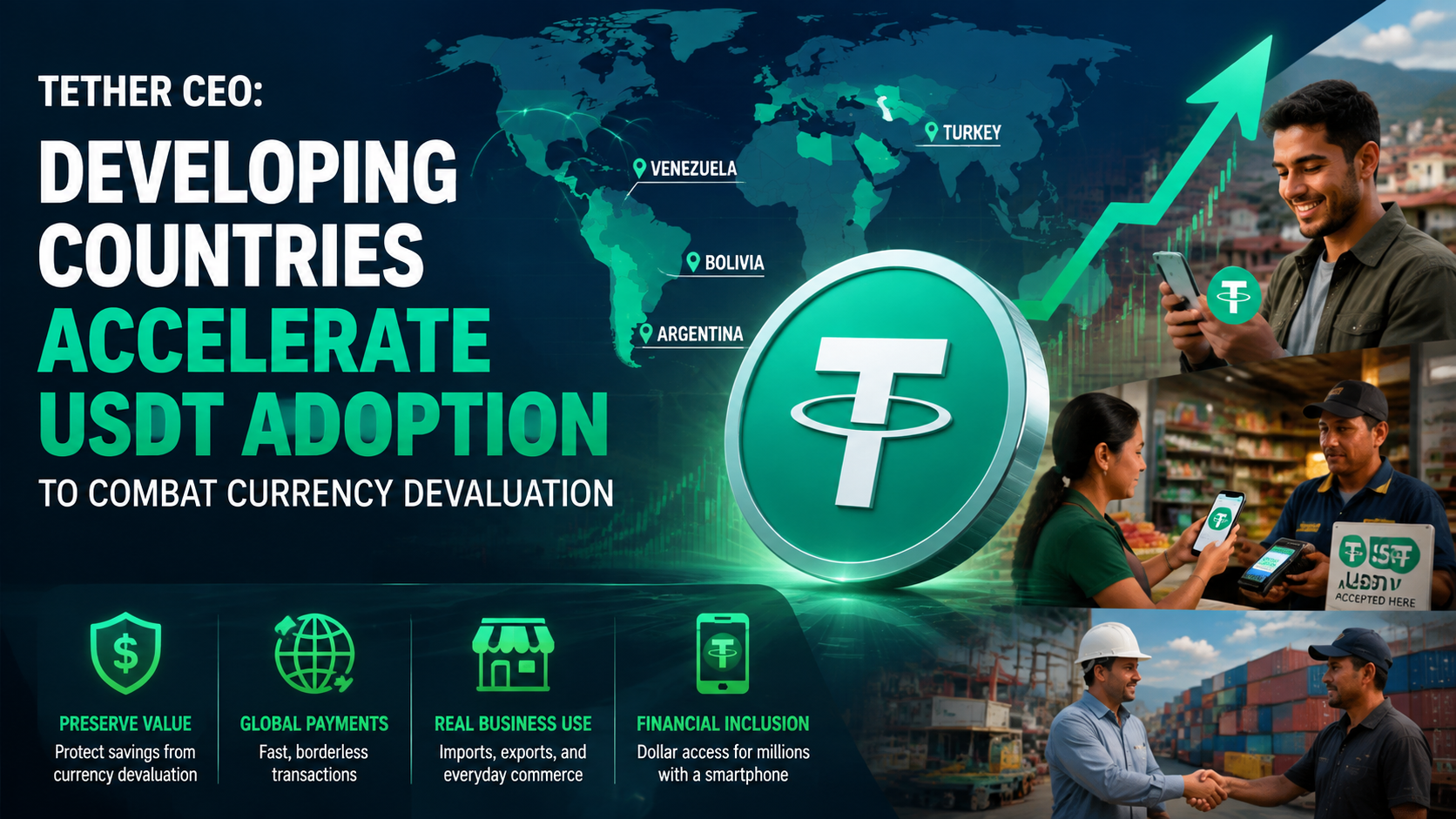
USDT Gains Ground as a Dollar Alternative in Inflation-Hit Economies
Tether CEO Paolo Ardoino articulated on August 23, 2026, that economies in several developing countries are increasingly and significantly relying on USDT for a wide range of both internal and foreign commerce activities. He underscored that Tether’s mission of promoting financial inclusion has become more crucial and relevant than ever before in the current economic climate. These remarks, which have been reported across multiple media outlets, including CriptoNoticias, and confirmed in Ardoino’s own social media post, specifically focus on the situations in Venezuela, Argentina, Bolivia, and Turkey.
In these particular markets, residents and businesses are progressively treating the dollar-pegged stablecoin as a highly practical and effective tool for settling trade, preserving value, and conducting everyday transactions, especially when local currencies are facing significant depreciation, physical dollar shortages, or various restrictions within conventional financial systems. USDT has successfully moved beyond the confines of crypto trading platforms and has entered into real-economy functions, particularly in high-inflation or dollar-scarce environments. It offers a blockchain-based pathway to dollar exposure that traditional banking systems often cannot provide at the necessary scale or speed.
How Currency Depreciation Drives Demand for Dollar-Pegged Stablecoins in Emerging Markets
Local currency weakness remains a primary force behind stablecoin adoption in the countries Ardoino highlighted. When a national currency loses purchasing power quickly, households and firms seek instruments that maintain value relative to a more stable reference. USDT, designed to track the U.S. dollar, fills that role without requiring a U.S. bank account. In practice, this means users can hold, transfer, or settle in a digital form of the dollar using only a smartphone and a compatible wallet or exchange access. Data from Chainalysis shows that Latin America recorded approximately $1.5 trillion in cryptocurrency activity between July 2022 and June 2025, with Argentina contributing an estimated $93.9 billion, Venezuela $44.6 billion, and Bolivia $14.8 billion. These volumes show not only speculative flows but also practical demand for dollar-like assets.
Tether reported that its products had served more than 570 million people worldwide as of March 2026. The circulating supply of USDT stood near $183 billion in late August 2026, with the total supply approaching $189 billion at peaks earlier in the year. This scale supports liquidity deep enough for commercial settlement and savings. The shift illustrates how monetary instability can accelerate the use of blockchain-based dollars even when formal banking channels remain constrained or costly. Official inflation readings and parallel-market premiums continue to reinforce the incentive to move value into assets that preserve purchasing power more reliably than local cash or bank deposits.
Venezuela’s Small and Medium Enterprises Turning to USDT for Import and Export Settlements
In Venezuela, Ardoino specifically noted that small and medium-sized enterprises use USDT to settle import and export transactions. The country has long operated a hybrid currency environment in which the bolívar coexists with physical dollars and digital assets. Official exchange rates published by the Central Bank of Venezuela have continued to depreciate; by late August 2026, the BCV rate stood near 785 bolívares per dollar, while peer-to-peer USDT rates traded higher, reflecting ongoing market pressures. Businesses facing limited access to physical dollars or banking constraints have adopted the stablecoin for invoice settlement because transfers can occur around the clock and across borders with relatively low friction.
Chainalysis data places Venezuela 18th in its 2025 Global Crypto Adoption Index and ninth when adjusted for population size. The practical outcome is that USDT functions as a working-capital tool for firms that need to pay foreign suppliers or receive payment for exports without depending solely on scarce physical currency or delayed banking processes. Local observers describe a hybrid system in which bolívares, cash dollars, and stablecoins circulate side by side. This commercial layer of adoption distinguishes Venezuela’s use case from purely speculative activity and underscores why Ardoino framed USDT as infrastructure for domestic and foreign trade rather than a trading pair alone.
Bolivia’s Commercial Transactions and Fuel Purchases Incorporating the Stablecoin
Bolivia provides another concrete illustration of commercial uptake. Ardoino cited the use of USDT in commercial transactions, including fuel purchases. The country ended a long-standing fixed exchange-rate regime in June 2026, moving to a more flexible system after years of reserve pressure and parallel-market premiums. The official rate shifted from roughly 6.96 bolivianos per dollar to levels near 9.73 and later higher, while peer-to-peer markets continued to reflect supply and demand for dollars. In this environment, businesses have turned to USDT for certain payments where traditional dollar liquidity is tight.
The Central Bank of Bolivia has published reference rates linked to peer-to-peer USDT activity, indicating official recognition of the market’s role. Crypto transaction volumes through formal channels rose sharply in preceding periods, and some banks began offering related services. For fuel and other commercial deals, the stablecoin offers a settlement option that bypasses some of the delays or shortages associated with physical currency. The pattern aligns with Ardoino’s broader observation that developing-country economies are relying on USDT for internal commerce when conventional channels face restrictions or scarcity. This commercial embedding helps explain the sustained demand that supports Tether’s overall circulation figures.
Argentina’s Peer-to-Peer Markets and Street Economy Reliance on USDT for Value Preservation
Argentina’s experience centers on peer-to-peer markets and informal street economies where USDT serves as a store of value and medium of exchange. Monthly inflation reached 3.4 percent in March 2026 after currency movements, according to reports citing IMF data. Annual inflation remained elevated, with official figures around 33–34 percent in mid-2026 and IMF projections near 30 percent for the year. Capital controls and gaps between official and parallel rates have long encouraged savers and traders to seek dollar-denominated instruments outside the formal banking system.
Ardoino pointed to widespread use of USDT in these peer-to-peer and street settings for wealth preservation and exchange. Chainalysis ranked Argentina 20th in the 2025 Global Crypto Adoption Index. Platforms operating across Latin America have reported that dollar stablecoins accounted for a substantial share of purchases by users in the region. The result is a practical form of digital dollarization that does not require opening a foreign bank account. Users can convert local currency into USDT, hold it, and later convert or transfer as needed, providing a buffer against further depreciation. This everyday utility reinforces the financial-inclusion dimension Ardoino highlighted.
Turkish Households Using USDT as an Inflation Hedge Amid Persistent Price Pressures
Turkey illustrates the savings and hedging motive. Consumer inflation fell from 49.4 percent in September 2024 to 30.9 percent by December 2025, yet remained elevated. Official annual rates stood near 31.75 percent in July 2026, with the central bank later adjusting its end-2026 forecast upward to 28 percent while retaining an interim target of 24 percent. Household inflation expectations stayed higher still. In this setting, residents have used USDT to protect the purchasing power of savings when local-currency deposits or cash lose value.
Ardoino identified Turkey as one of the markets where the stablecoin functions as an inflation hedge. Chainalysis placed Turkey 14th in the 2025 Global Crypto Adoption Index. The ability to hold a dollar-pegged asset on a smartphone provides an accessible alternative for households that may face limits on foreign-currency bank accounts or simply prefer an instrument they can transfer independently. While authorities have at times restricted crypto payments, demand for stablecoin exposure tends to persist when inflation continues to erode local purchasing power. The Turkish case therefore complements the commercial examples from Latin America by showing a strong household savings dimension.
Financial Restrictions and Dollar Cash Shortages Amplifying Stablecoin Utility
Beyond pure inflation or depreciation, restricted financial systems and shortages of physical dollars amplify the appeal of USDT. In several of the markets Ardoino named, obtaining cash dollars through banks can be difficult or subject to limits. Capital controls, reserve shortages, or administrative hurdles create gaps that digital assets can partially fill. USDT can be acquired via peer-to-peer platforms, held in non-custodial wallets, and transferred without the same intermediaries.
This structural feature explains why the stablecoin has moved into trade settlement and everyday transactions. Tether’s own reporting of hundreds of millions of users, concentrated in emerging markets, is consistent with the pattern. The technology does not eliminate underlying economic challenges, yet it supplies a functional workaround that traditional rails often cannot match in speed or accessibility. Ardoino’s framing of financial inclusion as more important than ever reflects this gap between formal financial systems and the practical needs of businesses and households.
USDT Circulating Supply Growth and Market Position in 2026
USDT’s scale underpins its usefulness in the environments described. Circulating supply hovered near $183 billion in late August 2026, with total supply figures approaching or exceeding $188–189 billion at points earlier in the year. Tether has continued to mint additional tokens in response to demand, maintaining deep liquidity across multiple blockchains. Company figures indicate products served more than 570 million people by March 2026.
These numbers matter for real-economy use because commercial settlement and savings require reliable liquidity and low slippage. When Venezuelan importers, Bolivian traders, or Argentine peer-to-peer participants move value, the depth of the USDT market helps keep spreads manageable. The growth direction also reflects cumulative demand from emerging-market users rather than solely from developed-market trading. Official attestations and reserve disclosures provide transparency on the asset backing, although users still evaluate counterparty and operational risks independently.
Chainalysis Adoption Rankings and Regional Transaction Volumes Supporting the Trend
Independent data from Chainalysis corroborates the geographic concentration of activity. In the 2025 Global Crypto Adoption Index, Turkey ranked 14th, Venezuela 18th, and Argentina 20th. Population-adjusted rankings elevate Venezuela further. Across Latin America, tracked crypto activity reached nearly $1.5 trillion from mid-2022 to mid-2025. Country-level estimates assign substantial shares to Argentina, Venezuela, and Bolivia.
These volumes encompass multiple assets, yet stablecoins form a large component of retail and commercial flows in high-inflation settings. The rankings and absolute numbers illustrate that adoption is not marginal. When Ardoino states that several developing-country economies rely heavily on USDT for commerce, the on-chain and survey data provide quantitative context. The figures also highlight that the phenomenon is multi-year rather than a short-lived spike, consistent with persistent currency and banking frictions.
Logical Mechanics of Using USDT for Cross-Border and Domestic Trade
The operational advantages of USDT in trade settings are straightforward. A supplier in one country can receive USDT from a buyer in another, convert locally if needed, or hold the stablecoin. Settlement occurs on public blockchains with near-24-hour availability, reducing dependence on correspondent banking hours or intermediate correspondent banks. For domestic use, peer-to-peer platforms allow conversion between local currency and USDT with varying degrees of formality.
In Venezuela, the import-export settlement use case shows businesses treating the token as working capital. In Bolivia, commercial payments, including fuel, demonstrate acceptance within supply chains. In Argentina, the peer-to-peer layer supports both trade and savings. Each application rests on the same core properties: dollar peg, transferability, and accessibility via mobile devices. These mechanics explain why the stablecoin has become embedded rather than remaining a niche trading instrument.
Results for Financial Inclusion and Access to Dollar Liquidity
Ardoino’s emphasis on financial inclusion points to a structural outcome. Hundreds of millions of people in markets with limited banking access or high inflation can now hold and move dollar-denominated value without traditional U.S. banking relationships. Mobile penetration in many developing economies enables wallet use even where physical bank branches are scarce. The result is a form of dollarization that operates outside, or parallel to, formal banking systems.
This access carries both benefits and trade-offs. Users gain a savings and payment tool that better preserves value, yet they also assume risks related to platform security, regulatory changes, and the operational integrity of the issuer. Tether’s scale and multi-year track record have supported confidence among many users, while ongoing attestation and audit processes address transparency questions. The inclusion dimension remains central to the narrative Ardoino advanced on August 23.
Market Context and Sustained Demand Drivers
The pattern Ardoino described sits within a wider stablecoin landscape in which dollar-pegged tokens serve as the dominant form of on-chain dollar liquidity. Demand from emerging markets has been a consistent growth driver for USDT over several years. High inflation, parallel exchange rates, and banking frictions create recurring incentives to adopt the asset.
Even as some countries make progress on disinflation, residual uncertainty and the memory of past depreciation episodes sustain precautionary demand. Commercial users who have integrated USDT into settlement processes tend to continue using it for efficiency reasons. The combination of savings, payments, and trade use cases produces a diversified demand base that supports the large circulating supply observed in 2026.
Considerations for Users in High-Adoption Markets
Users in these markets still confront operational and market risks. Wallet security, phishing, platform freezes, and potential regulatory shifts can affect access to funds. The dollar peg itself depends on the issuer’s reserve management and redemption processes. While Tether has published regular attestations and reported substantial excess reserves at various points, independent verification and user diligence remain essential.
Price discovery on peer-to-peer markets can also diverge temporarily from the official dollar rate, creating spreads that users must manage. Local authorities in some jurisdictions have imposed restrictions on crypto payments or exchanges, introducing compliance and access uncertainty. These factors do not negate the utility Ardoino described, yet they form part of the practical reality for households and firms relying on the stablecoin.
Outlook for Stablecoin Use in Developing Economies
Looking ahead, the journey of USDT adoption will depend on the evolution of local inflation, exchange-rate regimes, banking access, and regulatory frameworks. Progress on macroeconomic stabilization in individual countries could moderate precautionary demand, while continued frictions would sustain it. Technological improvements in wallets, payment interfaces, and interoperability may further lower barriers to everyday use.
Tether’s stated focus on financial inclusion suggests the company will continue positioning USDT as infrastructure for markets where traditional dollar access remains limited. Independent data providers will track whether commercial and savings use cases continue to expand. The August 2026 remarks by Ardoino provide a clear snapshot of current reliance and the economic conditions that produced it.
FAQs
What specific statement did Tether CEO Paolo Ardoino make regarding USDT in developing countries?
On August 23, 2026, Paolo Ardoino posted that several developing countries’ economies are heavily relying on USDT for both internal and foreign commerce, adding that Tether’s mission of financial inclusion is more important than ever. Subsequent reporting identified Venezuela, Argentina, Bolivia, and Turkey as the primary examples, with use cases spanning trade settlement, commercial payments, peer-to-peer exchange, and inflation hedging.
Which countries did Ardoino highlight for accelerated USDT adoption?
The countries cited in connection with the statement are Venezuela, Argentina, Bolivia, and Turkey. In Venezuela, the focus is on small and medium enterprise import and export settlements; in Bolivia, on commercial transactions including fuel; in Argentina, on peer-to-peer and street-economy value preservation; and in Turkey, on household inflation hedging.
How large is the current circulating supply of USDT?
As of late August 2026, the circulating supply of USDT stood near $183 billion, with total supply figures reported around $188–189 billion at recent peaks. Tether has continued to issue additional tokens in response to demand, supporting liquidity for both trading and real-economy uses.
What do Chainalysis rankings show about crypto adoption in these markets?
In the 2025 Global Crypto Adoption Index, Turkey ranked 14th, Venezuela 18th, and Argentina 20th. Population-adjusted rankings place Venezuela higher. Latin America as a whole recorded roughly $1.5 trillion in crypto activity from July 2022 through June 2025, with substantial country-level contributions from Argentina, Venezuela, and Bolivia.
Why do businesses in Venezuela use USDT for trade settlements?
Limited access to physical dollars and constraints within conventional banking channels make digital dollar settlement attractive. USDT allows importers and exporters to settle invoices around the clock and across borders with relatively low friction, operating alongside bolívares and cash dollars in a hybrid currency environment.
How does high inflation in Turkey influence USDT demand?
Annual consumer inflation remained above 30 percent through much of 2026 after earlier declines from higher peaks. Households seeking to protect savings purchasing power have turned to dollar-pegged assets that can be held and transferred independently of traditional bank foreign-currency limits, making USDT a practical hedge.
🔥 KuCoin Offers A More Stable Option in A Volatile Market
If you worry about the frequent ups and downs in the market, and pursue a more stable option to earn money passively, KuCoin is the right place to come:
Simple Earn: Deposit and withdraw tokens anytime, earning stable returns.
Kucoin Earn: Earn stable profits with professional asset management.
Hold to Earn: Earn rewards by holding assets in Funding, Trading, Margin, Futures, Mining, and Unified Accounts.
Staking: Unlock the earning potential of on-chain assets.
Advanced Investments: Advanced Investments offer a variety of structured products to help your money grow in any market.
Shark Fin: Principal Protection and Guaranteed Gains
Dual Investment: Buy low and sell high with transparent return calculations.
Snowball: High yields, with price protection.
Discount Buy: Buy crypto at discount prices.
KCS Loyalty: Level up to enjoy exclusive perks by staking ≥ 1 KCS.
KuCoin Wealth: Discover future value and begin your smart investing journey.
KCS Benefits: Hold and stake KCS to access benefits across the platform.
KCS Staking 2.0: Participate in KCS on-chain governance to earn yield.
Disclaimer: This content is for informational purposes only and does not constitute investment advice. Cryptocurrency investments carry risk. Please do your own research (DYOR).