

From Bitcoin Mining to AI: Why Keel Shut Down U.S. Mining to Build HPC Data Centers
2026/08/11 18:08:00
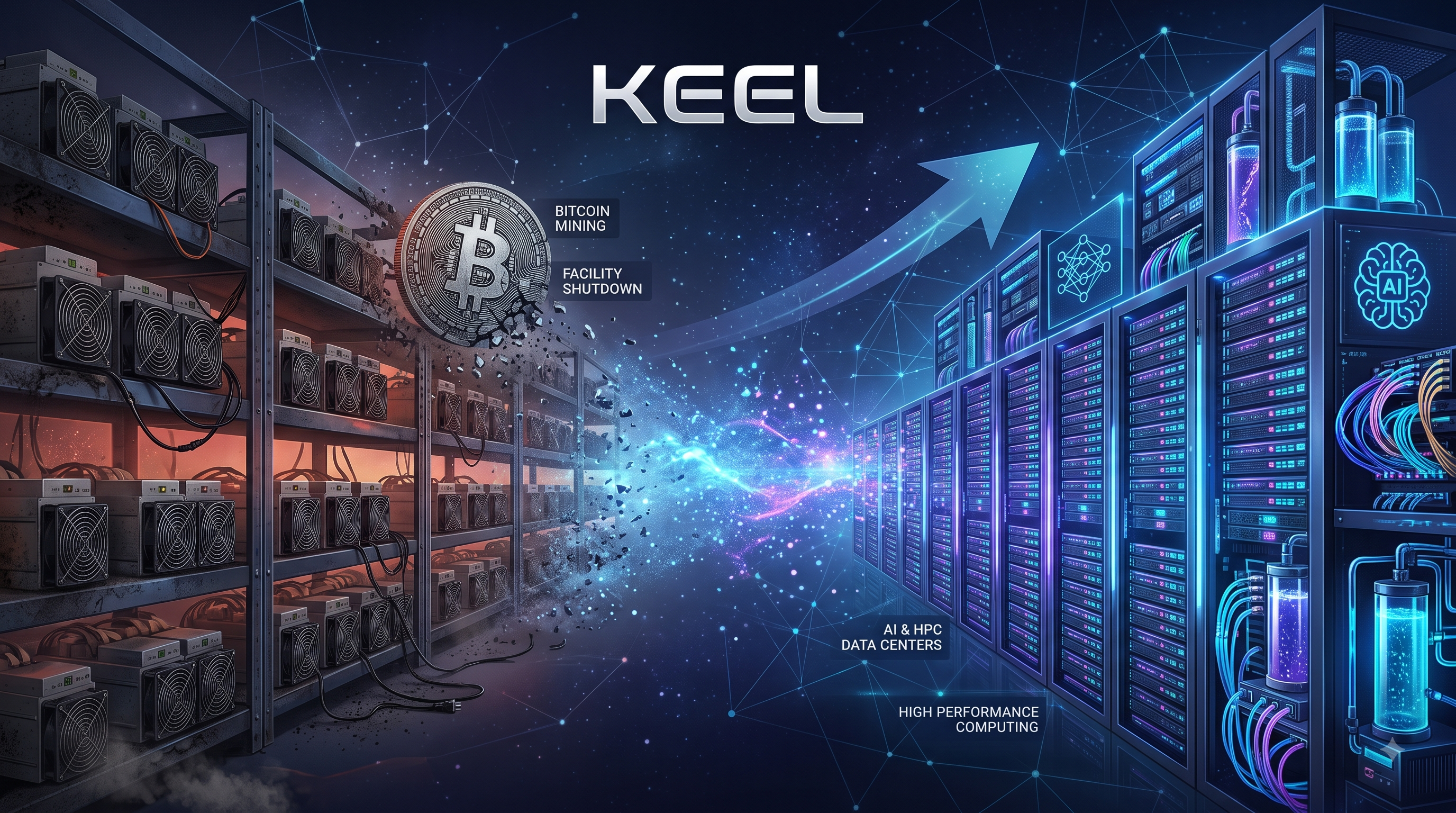
Bitcoin mining companies have spent years competing for one scarce resource: cheap, reliable electricity. Now, the artificial intelligence boom is forcing some of them to rethink what that power is actually worth. Keel Infrastructure, formerly known as Bitfarms, has become one of the clearest examples of that shift. On June 29, 2026, the company ended its remaining U.S. Bitcoin mining operations after shutting down its Washington site two months earlier, clearing the way for a broader push into high-performance computing and AI data centers. Keel still maintains legacy Bitcoin mining operations in Canada, so this is not a complete exit from mining—but it is a decisive exit from U.S. Bitcoin production.
For crypto investors, the bigger story is not simply that another miner is chasing AI. It is that electricity, grid connections and development-ready land may now be worth more in certain locations when used for AI infrastructure than when used to mine Bitcoin. That raises a much broader question for the industry: if AI companies are willing to pay more for premium power capacity, what happens to the economics—and geography—of Bitcoin mining?
What Happened to Keel’s U.S. Bitcoin Mining Business?
Keel's transformation has been building for more than a year. The company was previously Bitfarms, one of the better-known publicly traded Bitcoin miners, but completed its U.S. redomiciliation on April 1, 2026 and adopted the Keel Infrastructure name as part of a broader shift toward digital infrastructure. The company now describes itself primarily as a developer and owner of data centers and energy infrastructure for HPC and AI workloads, with a 2.2 GW development pipeline across Pennsylvania, Washington and Québec.
The U.S. mining shutdown happened in two major steps:
| Date | Development | Strategic Significance |
| Nov. 2025 | Bitfarms announces Washington HPC conversion | First full mining-to-AI conversion plan |
| Apr. 1, 2026 | Bitfarms becomes Keel Infrastructure | Corporate identity shifts toward digital infrastructure |
| Apr. 28, 2026 | Washington Bitcoin mining stops | Site begins transition toward an 18 MW HPC facility |
| Jun. 29, 2026 | Panther Creek, Scrubgrass and Sharon mining stops | Keel completes its U.S. Bitcoin mining exit |
| Aug. 2026 | U.S. sites remain in development | HPC revenue has not yet begun |
Keel's latest quarterly filing says the accelerated cessation of mining was driven both by HPC and AI construction schedules and by macroeconomic factors affecting Bitcoin mining profitability. The company has also classified mining equipment associated with the closed U.S. operations for sale.
Why Is Keel Leaving Bitcoin Mining for AI?
The decision does not necessarily mean Keel has concluded that Bitcoin mining is structurally unprofitable. Instead, it reflects a changing calculation around the highest-value use of electricity. Bitcoin mining converts power into computational hash rate and ultimately BTC-denominated revenue. The economics fluctuate with Bitcoin prices, network difficulty, transaction fees, mining-machine efficiency and power costs. Keel itself reported that average Bitcoin network difficulty was 10% higher year over year during Q2 2026, while the company mined 354 BTC, down 36% from the same quarter in 2025.
AI infrastructure offers a very different economic model. Rather than continuously competing for a fixed pool of Bitcoin block rewards, a data center operator can potentially lease power and computing infrastructure to hyperscalers, cloud providers or AI companies under longer-term commercial agreements. Galaxy Research has argued that predictable contracted cash flows and higher infrastructure valuations make HPC especially attractive to miners that already control suitable power-rich sites.
That distinction matters. A miner may still be able to earn money mining Bitcoin, yet conclude that a particular 100 MW grid connection could generate greater risk-adjusted value as an AI data center. The relevant question therefore becomes less about whether Bitcoin mining is profitable and more about whether Bitcoin mining remains the most profitable use of the electricity infrastructure the miner controls.
Why Bitcoin Miners Have Something AI Companies Need
Power Is Becoming the Real Asset
Bitcoin mining companies are often evaluated through hash rate, fleet efficiency and BTC production, but their most strategically valuable assets may increasingly lie beneath those metrics. Large mining operators have spent years acquiring land, negotiating utility agreements, building substations and securing access to hundreds of megawatts of power. Those assets are difficult to replicate quickly, particularly as new large-load projects face increasingly complicated grid interconnection processes. Galaxy Research notes that AI developers are particularly interested in sites that combine substantial power capacity with acreage, cooling resources, fiber connectivity and existing approvals.
Keel's strategy illustrates this change in perspective. Its June 2026 portfolio included 341 gross MW of current energized capacity, 648 MW of secured data-center capacity and a total development pipeline of roughly 2.16 GW when expansion opportunities were included. In other words, its investment story is increasingly about controlling large blocks of electricity rather than operating the maximum possible number of ASIC miners.
AI Can Monetize Power Differently
The contrast can be simplified like this:
| Bitcoin Mining | AI / HPC Infrastructure |
| Revenue linked to hash rate and Bitcoin economics | Revenue can be linked to long-term customer contracts |
| Highly sensitive to network difficulty | Less directly exposed to crypto network competition |
| Mining hardware requires periodic upgrades | Data-center infrastructure supports customer computing hardware |
| Flexible uptime and curtailment | Higher uptime requirements |
| Can operate in remote low-cost energy markets | Often requires stronger fiber, redundancy and supporting infrastructure |
None of this guarantees that AI will produce better returns. HPC facilities require significantly more capital and more complex engineering. But where the right site exists, AI can give a former mining company access to a completely different customer base and valuation framework.
Turning a Bitcoin Mine Into an AI Data Center Is Not Easy
One of the biggest misconceptions surrounding the Bitcoin miner-to-AI trade is that miners can simply remove ASICs and install GPUs. In reality, a mining facility and an AI data center have very different operating requirements. Galaxy Research highlights networking, liquid cooling, power redundancy and internal facility design as major conversion challenges. Modern AI systems require extremely fast connections between GPUs, high-density racks and far more demanding uptime standards than Bitcoin mining.
Keel's Washington project illustrates the scale of the upgrade. The former 18 MW Bitcoin mining facility is being redesigned to support HPC/AI workloads, including advanced liquid cooling and rack densities of up to 190 kW. When the conversion was announced in November 2025, the company said it had entered into a $128 million agreement covering critical data-center infrastructure and was targeting completion in late 2026.
| Requirement | Bitcoin Mining Facility | AI/HPC Data Center |
| Computing hardware | SHA-256 ASIC miners | GPUs and AI accelerators |
| Cooling | Air, hydro or immersion cooling | High-density air/liquid systems |
| Networking | Relatively modest | High-speed, low-latency networking |
| Power redundancy | Limited requirement | Strong redundancy often essential |
| Rack architecture | ASIC-oriented | Dense server racks |
| Uptime expectations | Highly flexible | Much stricter |
| Conversion capex | Lower | Potentially substantial |
That means investors should be careful when valuing a miner simply because it owns megawatts. Power creates optionality, but it does not automatically create an AI data center.
Inside Keel’s HPC Conversion Plan
Keel's U.S. strategy currently centers on Washington and Pennsylvania. The former Moses Lake mining location in Washington is being developed as an 18 gross MW HPC data center. In Pennsylvania, the company stopped Bitcoin mining at Panther Creek, Scrubgrass and Sharon on June 29. Panther Creek and Scrubgrass had approximately 60 MW and 63 MW of energized capacity respectively as of the end of June, while Keel plans to convert the 110 MW Sharon site into an HPC data center.
| Site | Former Use | Current Direction |
| Moses Lake, Washington | Bitcoin mining | 18 MW HPC development |
| Sharon, Pennsylvania | Bitcoin mining | Planned 110 MW HPC data center |
| Panther Creek, Pennsylvania | Bitcoin mining / energy infrastructure | Energy sales and HPC development |
| Scrubgrass, Pennsylvania | Bitcoin mining / energy infrastructure | Energy sales and HPC development |
The most important detail for investors is what has not happened yet. As of August 7, Keel said it had not started HPC data-center operations or recognized HPC-related revenue at the Washington, Panther Creek, Scrubgrass or Sharon sites. The company reported that it was in active negotiations at three priority sites and had made progress on zoning, permitting, fiber contracts and delivery of long-lead equipment, but the commercial transition remains a development story rather than an operating AI-revenue story.
The Financial Trade-Off Behind Keel’s AI Bet
Moving away from mining creates a potentially uncomfortable transition period. Bitcoin miners can generate revenue as soon as ASIC machines are installed, powered and connected to a mining pool. HPC development involves a much longer sequence: permitting, engineering, power infrastructure, cooling systems, construction, customer negotiations, commissioning and eventually contracted revenue. Keel has effectively chosen to sacrifice part of its existing mining cash flow before its new AI infrastructure is commercially operational.
That trade-off is already visible in its financial results. Keel reported Q2 2026 revenue of $30 million, down from $61 million a year earlier. Adjusted EBITDA fell from positive $7 million to negative $24 million, while the company reported an operating loss of $141 million. Management attributed part of the revenue decline to lower average Bitcoin prices and the Washington mining shutdown. At the same time, Keel raised $458 million through convertible notes and reported approximately $819 million of liquidity as of August 7, giving it substantial capital to pursue the infrastructure buildout.
For investors, the central equation is therefore straightforward: Keel is exchanging near-term mining revenue for the possibility of higher-value, longer-duration infrastructure revenue later. The success of the strategy will depend not on how many mining machines it switches off, but on whether it converts those megawatts into completed facilities with creditworthy customers and economically attractive contracts.
What Keel’s Exit Means for Bitcoin Mining
The broader implication is that AI is increasing the opportunity cost of electricity for certain Bitcoin miners. Historically, an operator securing inexpensive power might have asked whether Bitcoin could be mined profitably at that electricity rate. Now, miners with premium sites have an additional question: could an AI customer pay considerably more for access to the same power? Galaxy expects suitable mining sites in developed markets to increasingly compete for HPC demand while Bitcoin miners migrate toward cheaper, more remote or stranded energy sources that are less suitable for conventional data centers.
This does not automatically hurt Bitcoin's mining ecosystem. When a miner removes hash rate, other miners compete for a slightly larger share of the network's fixed block subsidy until difficulty adjusts. AI conversions could therefore slow hash-rate growth relative to a scenario in which every available megawatt was devoted to mining. Galaxy has argued that this may improve economics for miners that remain focused on Bitcoin, particularly if BTC prices rise faster than network difficulty.
The result could be a more specialized mining industry. Premium grid-connected assets near fiber and large customers may increasingly be evaluated as AI infrastructure, while Bitcoin mining remains particularly well suited to flexible, inexpensive and geographically isolated electricity. Instead of eliminating mining, AI may gradually reshape where mining takes place and what kinds of energy resources miners pursue.
Is AI Replacing Bitcoin Mining?
Not exactly. AI and Bitcoin mining overlap in their appetite for electricity, but their infrastructure needs are different enough that they will not always compete for the same site. AI data centers generally benefit from reliable grid access, fiber connectivity, sophisticated cooling, high uptime and proximity to the broader technology ecosystem. Bitcoin miners, by contrast, can monetize electricity in places where many conventional computing applications would struggle to operate.
That flexibility may become Bitcoin mining's most important competitive advantage in an AI-heavy electricity market. A remote hydroelectric project, curtailed renewable source or geographically isolated source of excess generation can still be useful to a miner because Bitcoin mining does not require its computing output to be physically close to an end user. Galaxy's long-term view is that mining may increasingly migrate toward stranded or remote power as hyperscalers compete more aggressively for premium locations.
At the same time, Keel is not an isolated example of crypto infrastructure moving toward AI. Hut 8, which has deep roots in Bitcoin mining, signed a 15-year agreement in 2026 for 352 MW of AI data-center capacity at its Texas Beacon Point campus, with a base contract value of approximately $9.8 billion. The scale of that transaction illustrates why investors are increasingly valuing miners not only by Bitcoin production, but by the future commercial value of their power portfolios.
What Crypto Investors Should Watch Next
AI-related megawatt announcements can look impressive, but they do not all represent the same thing. A company identifying 500 MW of potential power is very different from having 500 MW energized, permitted, built and leased to a customer. Keel itself distinguishes between current energized capacity, secured capacity and expansion capacity, a useful framework for evaluating other Bitcoin miners pursuing similar strategies.
| Metric | Why It Matters |
| Potential MW | Indicates theoretical development opportunity |
| Secured power | Shows whether utility capacity is actually committed |
| Permitted MW | Reduces development uncertainty |
| Construction-stage MW | Signals that capital is being deployed |
| Energized MW | Confirms usable power is available |
| Contracted MW | Demonstrates real customer demand |
| HPC revenue | Confirms the new business model is operating |
| Capex per MW | Helps determine project economics |
The biggest mistake would be to treat every announcement that a mining company is “pivoting to AI” as equivalent. Investors should follow the progression from power access → permits → construction → customer contract → energization → revenue. For Keel, those milestones are likely to matter more to future valuation than quarterly Bitcoin production once the U.S. mining business disappears from comparable results.
What Keel’s Pivot Says About the Future of Bitcoin Mining
Keel's transformation points toward a broader change in how publicly traded mining companies may be valued. During earlier Bitcoin cycles, the central questions were how many exahashes a miner operated, what its fleet efficiency looked like and how much BTC it produced. Those metrics still matter for pure-play miners, but companies with large energy portfolios increasingly have another source of optionality: they can ask which computing workload produces the most value from each megawatt.
That makes energy infrastructure itself increasingly important. A site capable of hosting mining today, AI infrastructure tomorrow or potentially both over its lifetime becomes more than a Bitcoin production facility. It becomes an asset whose value depends on power scarcity and the range of industries willing to pay for access to that electricity.
Keel's strategy is therefore less about abandoning crypto for the latest technology trend than about repositioning around the resource both industries need most. Its CEO summarized the company's current thesis in August with a focus on power as the core constraint behind data-center development. Whether that strategy succeeds will depend on execution, but the logic is already influencing the broader mining sector.
Conclusion
Keel's exit from U.S. Bitcoin mining does not prove that Bitcoin mining has become obsolete. It shows that the economic value of mining infrastructure is changing. In locations with large grid connections, fiber access and development potential, AI companies may offer miners an alternative way to monetize assets that were originally assembled to produce Bitcoin.
The opportunity comes with substantial risk. Keel has already stopped U.S. mining, while its new HPC facilities had not yet generated revenue as of August 7. That leaves permitting, construction, customer contracting and financing as critical milestones.
For the wider crypto industry, however, the message is significant. Bitcoin mining is increasingly becoming an energy infrastructure business, not merely a competition for more ASICs. Some megawatts will migrate toward AI; others will remain more valuable for mining. Keel's bet is that its best U.S. power assets belong in the first category.
And that may become one of the defining questions for Bitcoin miners in the AI era: what is the highest-value use of an electron?
FAQs
Is Keel Infrastructure the same company as Bitfarms?
Yes, although the corporate structure changed as part of the transition. Bitfarms completed a redomiciliation from Canada to the United States on April 1, 2026, with newly formed Keel Infrastructure Corp. becoming the ultimate parent company. The business then began operating publicly under the Keel name and KEEL ticker.
Is Keel still mining Bitcoin outside the United States?
Yes. Keel's Q2 2026 filing states that it continues to maintain legacy Bitcoin mining operations in Canada while transitioning its Québec assets toward HPC and AI opportunities. Its U.S. Bitcoin mining operations ended on June 29, 2026, and its final Paraguay operation was sold in April.
Can Bitcoin ASIC miners be converted into AI computers?
No in the practical sense. Bitcoin ASICs are specialized for SHA-256 hashing, while modern AI workloads generally rely on GPUs or other accelerators designed for matrix-heavy computation. When a Bitcoin mining site becomes an AI facility, the reusable assets are primarily power connections, land and selected electrical infrastructure—not the mining ASICs themselves. The facility also typically requires major networking, cooling and redundancy upgrades.
Does shutting down Bitcoin mines reduce Bitcoin issuance?
Not permanently. Bitcoin's block subsidy is defined by the protocol rather than by the number of active miners. If total network hash rate falls, blocks can temporarily arrive faster or slower than the target interval, but Bitcoin periodically adjusts mining difficulty to bring block production back toward its designed schedule.
What is the difference between HPC and a traditional data center?
HPC facilities are designed for computationally intensive workloads such as AI model training, scientific computing and large GPU clusters. They generally require much higher rack densities, faster internal networking and more sophisticated cooling than conventional facilities used primarily for web hosting, storage or general enterprise applications.
Disclaimer: This content is for informational purposes only and does not constitute investment advice. Cryptocurrency investments carry risk. Please do your own research (DYOR).