

Is Ethereum a Good Investment in 2026? A Deep Dive into the Future of ETH
2026/03/24 17:33:02
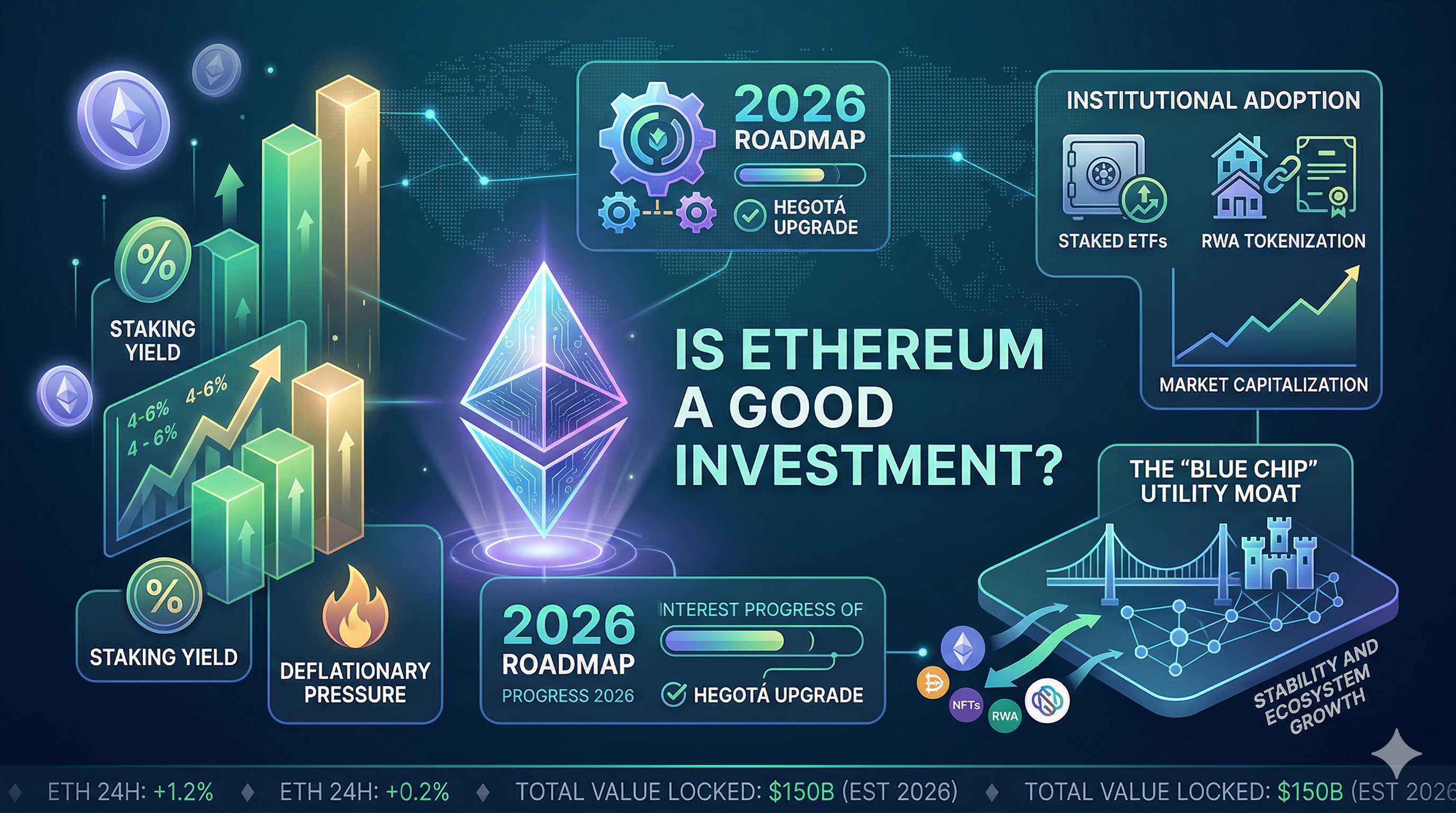
The cryptocurrency landscape has shifted dramatically in recent years. What was once a playground for speculative retail traders has evolved into a sophisticated global financial layer. At the heart of this transformation lies Ethereum, the world’s most utilized smart contract platform. As we navigate through 2026, the question "Is Ethereum a good investment?" is no longer just about price action; it is about the fundamental role this network plays in the future of the digital economy.
In this deep dive, we examine Ethereum’s current position, the critical technical milestones ahead, and the institutional forces shaping its valuation. Whether you are a seasoned holder or a newcomer, understanding the structural changes occurring in the Ethereum ecosystem is essential for making informed investment decisions.
Key Takeaways
-
Technological Maturity: The "Glamsterdam" and "Hegotá" upgrades in 2026 aim to solidify Ethereum's scalability and decentralization, introducing Verkle Trees to reduce storage costs for node operators.
-
Institutional Integration: Spot Ethereum ETFs have matured, and the rise of "staked ETFs" has introduced a "digital bond" narrative, attracting conservative institutional capital looking for yield.
-
Tokenization Leadership: Ethereum remains the preferred settlement layer for Real-World Assets (RWAs), with major financial institutions like BlackRock and JPMorgan shifting production-grade platforms to the network.
-
Economic Dynamics: While Layer 2 (L2) solutions have reduced base-layer fees, the sheer volume of institutional activity and tokenized assets is creating a new floor for ETH demand, despite the transition from a purely deflationary model to a "yield-focused" one.
-
Market Position: Ethereum faces stiff competition from high-throughput chains like Solana, but its massive liquidity moat and "provable security" standards (aiming for 128-bit security by year-end 2026) maintain its status as the industry’s "blue chip."
Is Ethereum a Good Investment in 2026?
To evaluate Ethereum as an investment in 2026, one must look past the short-term volatility and focus on the network’s transition from a speculative startup phase to a production-grade financial infrastructure. As of early 2026, Ethereum has demonstrated remarkable resilience. Despite market corrections in late 2025, the underlying on-chain fundamentals—such as Total Value Locked (TVL), active developer count, and Layer 2 transaction volume—have continued to reach new heights.
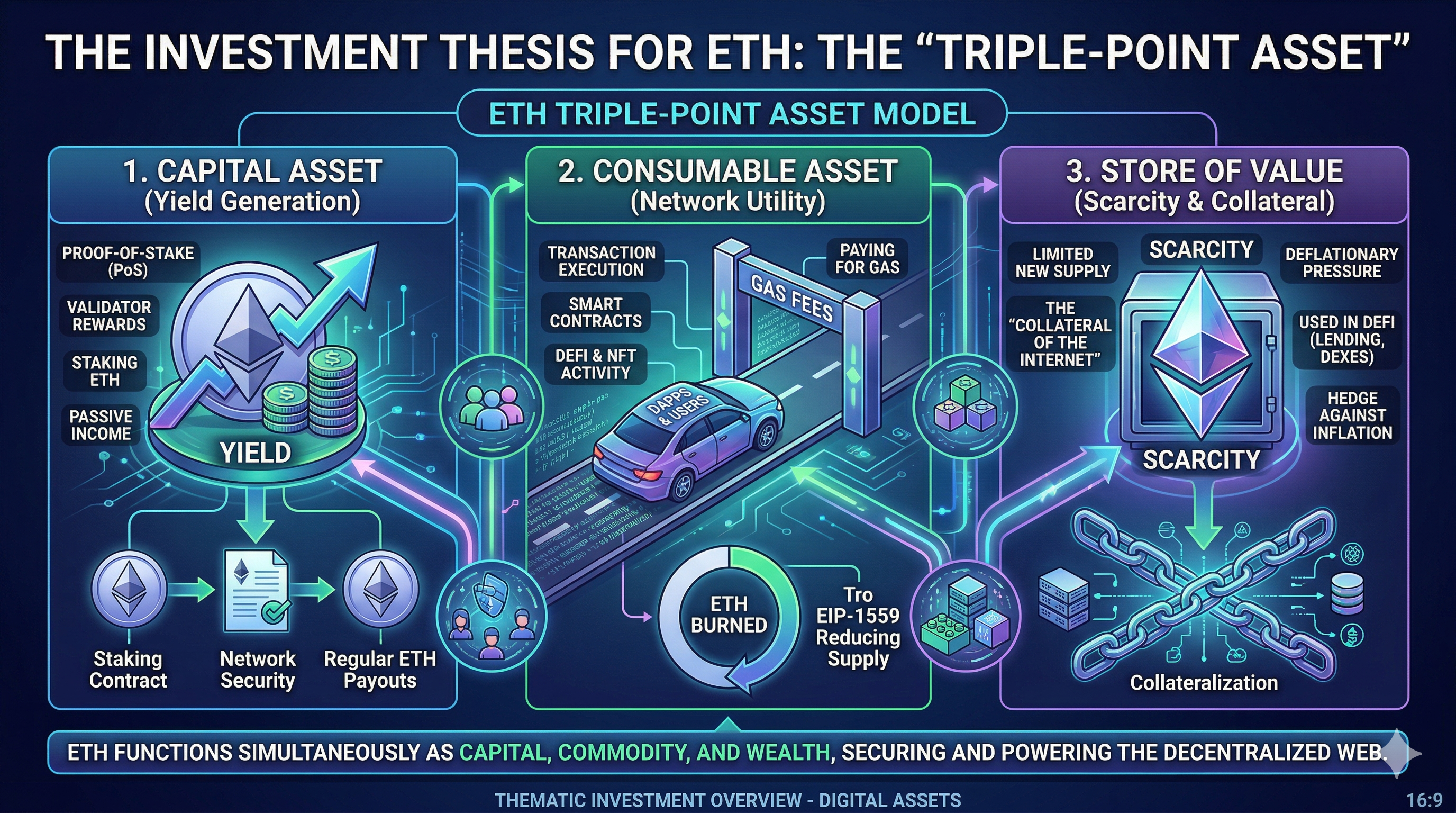
The investment thesis for ETH has matured into a "triple-point asset" model. It serves as a capital asset through staking, a consumable asset via gas fees, and a store of value due to its scarcity and role as the "collateral of the internet." In 2026, we are seeing the fruition of the "staking flywheel," where corporate treasuries and endowments, including high-profile disclosures from entities like Harvard Management Company, are allocating to ETH not just for price appreciation, but for the 3–5% staking yield.
Performance-wise, Ethereum has begun to decouple slightly from Bitcoin’s purely "digital gold" narrative. While Bitcoin remains the market leader in terms of capitalization, Ethereum often exhibits higher "beta"—meaning it captures more upside during bullish phases of the cycle due to the compounding effect of its ecosystem growth. However, investors must remain aware that this same beta can lead to sharper drawdowns. The current market outlook for 2026 suggests a period of "re-accumulation," where institutional "smart money" is absorbing the supply released during previous peaks, setting the stage for the next leg of adoption.
How the Hegotá Upgrade Impacts ETH Value in 2026
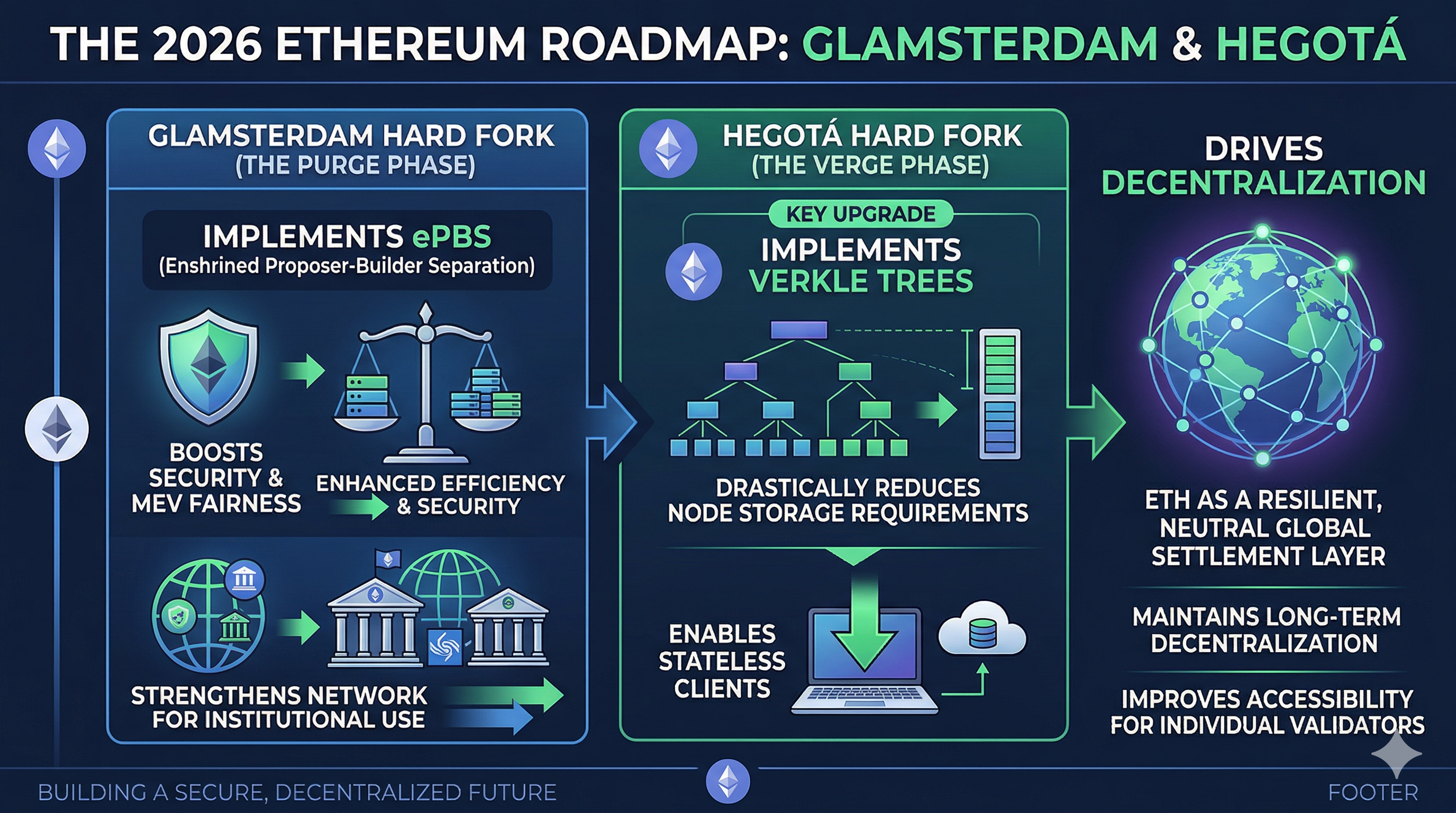
The year 2026 is a pivotal one for Ethereum’s technical evolution, defined by two major hard forks: Glamsterdam in the first half of the year and Hegotá in the second. These are not merely maintenance updates; they represent the successful execution of the "The Purge" and "The Verge" phases of the Ethereum roadmap. Understanding these upgrades is critical for investors, as they directly address the "scalability vs. decentralization" trade-off that has long been a point of contention.
Glamsterdam – Strengthening Security and Fairness
The Glamsterdam upgrade focused on immediate efficiency, introducing Enshrined Proposer-Builder Separation (ePBS). This technical shift helps protect the network against censorship and ensures that the value generated by transactions—known as Maximum Extractable Value (MEV)—is distributed more fairly among participants. For the ETH token, this means a more secure and robust network, which is a prerequisite for high-stakes institutional use.
Hegotá – Decentralization Through Verkle Trees
However, the real "headliner" for 2026 is the Hegotá upgrade. The primary feature of Hegotá is the implementation of Verkle Trees. Currently, running an Ethereum node requires significant storage because of the "state bloat"—the ever-growing record of all accounts and contracts. Verkle Trees allow for much smaller "proofs," which could reduce node storage requirements by nearly 90%. This paves the way for "stateless clients," allowing users to verify the blockchain with minimal hardware. From an investment perspective, this increases the "decentralization premium" of ETH, making it harder for any single entity to control the network and ensuring its long-term survival as a neutral global settlement layer.
Ethereum vs. Solana vs. Layer 2s
One of the most frequent questions from investors in 2026 is whether Ethereum is losing ground to high-speed competitors like Solana or if its own Layer 2 ecosystem is "cannibalizing" its value. The reality is more nuanced. While Solana has carved out a significant niche in retail transactions and high-frequency applications, Ethereum has doubled down on its role as the "Layer 0" of global finance.
The rise of Layer 2 solutions like Base, Arbitrum, and Optimism has indeed shifted transaction volume away from the Ethereum mainnet. This has led to a "low fee" regime on the base layer, which initially worried some investors who relied on high gas burns to drive ETH scarcity. However, by 2026, the market has begun to realize that these L2s act as "revenue funnels" for the mainnet. As L2 volume grows exponentially, the aggregate "settlement fees" paid to the Ethereum L1 provide a more sustainable and scalable source of value capture than high retail fees ever could.
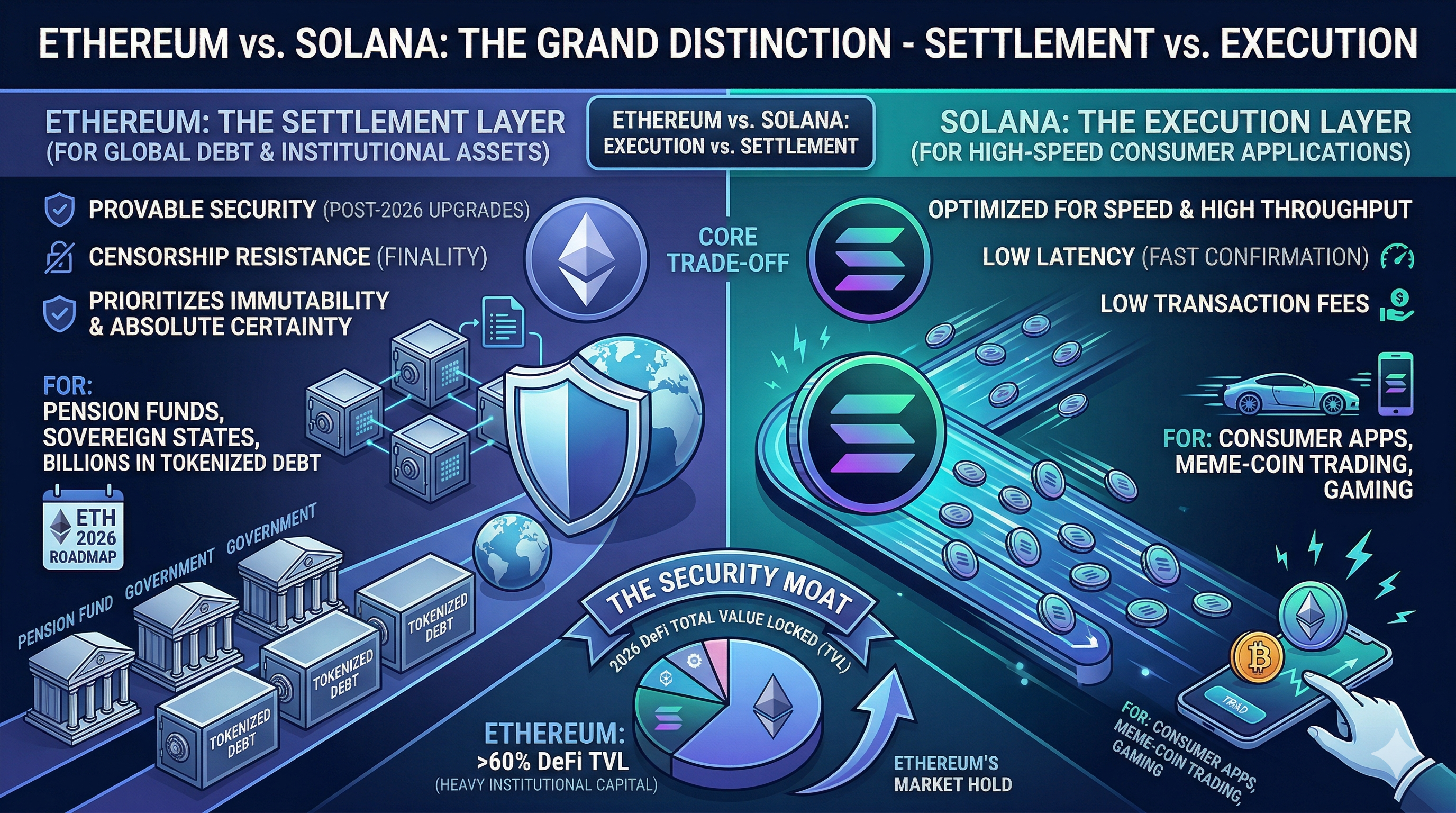
When comparing Ethereum to Solana, the distinction has become one of "Execution vs. Settlement." Solana is optimized for speed, which is ideal for consumer apps and meme-coin trading. Ethereum, through its 2026 upgrades, is optimizing for "provable security" and "censorship resistance." For a pension fund or a sovereign state tokenizing billions in debt, the speed of a transaction matters less than the absolute certainty that the transaction cannot be reversed or censored. This "security moat" is why Ethereum still holds over 60% of the total DeFi TVL in 2026, even as competitors grow.
| Feature | Solana (Execution) | Ethereum (Settlement) |
| Primary Optimization | Speed and Throughput | Provable Security and Censorship Resistance |
| Ideal Use Case | Consumer apps, gaming, and high-frequency meme-coin trading. | High-value asset tokenization, decentralized finance (DeFi) infrastructure, and global settlement. |
| Priority | Low transaction fees and instant finality. | Absolute certainty that a transaction cannot be reversed or censored. |
How Staked ETFs and Tokenized Debt Lock Up ETH
If 2024 was the year of the Bitcoin ETF, 2026 would be the year of the "Institutional Ethereum Build-out." The arrival of Spot Ethereum ETFs was only the first step. In the current market, we are seeing the second generation of these products: "Staked ETFs." These funds allow institutional investors to gain exposure to ETH price movements while also collecting the staking yield, essentially turning Ethereum into a high-tech "digital bond."
This shift has changed the composition of ETH holders. We are seeing a "lock-up" of supply as institutions move their assets into long-term staking. By mid-2026, nearly 30% of the total ETH supply is staked, significantly reducing the "liquid float" available on exchanges. When demand increases—whether through ETF inflows or increased network usage—this reduced supply can lead to more explosive price movements.
Beyond ETFs, the "Tokenization of Real-World Assets" (RWA) has become the primary driver of institutional utility. Major players like BlackRock have expanded their BUIDL fund, and multiple global banks are now using Ethereum to settle tokenized Treasuries and private credit. These institutions choose Ethereum not because of hype, but because of its "neutrality." No single corporation or government owns the Ethereum network, making it a safe common ground for global financial settlement. In 2026, RWAs on Ethereum are projected to exceed $300 billion, providing a massive, non-speculative source of demand for the network’s native token.
Understanding ETH Burn Rates and Staking Yields
Ethereum’s economic model has undergone a transformation that every investor must understand. Since the implementation of EIP-1559 and The Merge, ETH has the potential to be "deflationary"—meaning the total supply decreases over time. However, in 2026, with the proliferation of Layer 2s and the Hegotá efficiency gains, the supply dynamics have become more balanced.
During periods of high network activity, the amount of ETH burned from transaction fees still exceeds the new ETH issued to stakers, leading to "Ultrasound Money" periods. In quieter market phases, the supply may grow slightly (mildly inflationary). However, the "yield" component has become the more dominant story for investors in 2026. With staking rewards hovering around 3–4%, ETH provides a competitive real yield compared to traditional fixed-income assets, especially in a macro environment where central banks may be cutting rates.
The "Passive Income" aspect of ETH is a powerful retention tool. Unlike many other crypto assets where holders must wait for "number go up" to realize a profit, ETH stakers are continuously accumulating more of the asset. This creates a "sticky" investor base that is less likely to sell during market dips, providing a psychological and structural floor for the price. When evaluating ETH as an investment, one must look at the "Total Return"—the combination of price appreciation and the compounding effect of staking rewards.
Ethereum Price Prediction 2026-2030: What Do Experts Forecast?
Price predictions in the cryptocurrency space should always be taken with caution, but in 2026, the range of expert forecasts has become more grounded in valuation models rather than pure speculation. Major financial institutions now publish regular "ETH Price Targets" based on network revenue, P/E (Price-to-Earnings) ratios, and market share of the global settlement industry.
2026 Price Outlook
For the remainder of 2026, many analysts see a "bull case" where ETH could challenge and surpass its previous all-time highs, with targets ranging from $6,000 to $10,000. These forecasts are typically predicated on a few key factors: continued growth in Spot ETF AUM (Assets Under Management), a successful rollout of the Hegotá upgrade, and a macro-environment of "monetary easing."
2030 Long-Term Forecasts
Looking further out toward 2030, the "ultra-bull" cases from firms like VanEck and ARK Invest suggest that if Ethereum successfully captures even 5–10% of the global remittance and asset settlement market, the price could reach into the tens of thousands. Conversely, "bear case" scenarios often point to regulatory risks or the potential for a "breakdown in L2-to-L1 value accrual." Regardless of the specific number, the consensus among experts is that Ethereum has moved out of its "survival" phase and into its "expansion" phase. It is no longer a question of "will Ethereum exist in five years?" but rather "how much of the global economy will run on it?"
Conclusion
Ethereum in 2026 stands as a testament to the power of decentralized innovation. It has evolved from a decentralized computer for niche developers into a robust, institutional-grade settlement layer that secures hundreds of billions of dollars in value. While the "get rich quick" days of early crypto may be behind us, the "blue-chip" era of Ethereum offers a different kind of opportunity: a stake in the foundational infrastructure of the future internet.
The investment case for Ethereum is built on three pillars: technical excellence (the Hegotá upgrade), institutional integration (ETFs and RWAs), and a unique economic model that rewards long-term holders through staking. Risks remain—competition is fierce, and the regulatory environment is still evolving, but the "liquidity moat" and network effects of Ethereum are increasingly difficult to ignore. As always, investors should perform their own due diligence, but in the landscape of 2026, Ethereum’s role as a "digital bond" and "global settlement layer" makes it a central piece of any modern digital asset portfolio.
FAQs
Is it too late to buy Ethereum in 2026?
It is not "too late" in the sense of the network’s utility. While the massive 100x gains of the early 2010s are unlikely, Ethereum is entering its "Institutional Growth" phase. Investors today are buying into a more stable, yield-bearing asset that is becoming a standard part of global finance, similar to buying "Blue Chip" stocks in the 1990s.
How does the Hegotá upgrade affect the average ETH holder?
For most holders, the upgrade will be "invisible" but beneficial. It makes the network more secure and decentralized by making it easier for people to run their own nodes. Over the long term, this strengthens the "trustless" nature of Ethereum, which is a key driver of its value as an investment.
What is the difference between investing in ETH and a Spot ETH ETF?
Buying ETH directly allows you to control your "private keys" and participate in "native staking" for maximum yield. Investing in a Spot ETH ETF provides a regulated, familiar way to gain price exposure through a traditional brokerage account, but you may not receive the full staking rewards, and you will pay management fees.
Can Solana "kill" Ethereum in 2026?
"Solana vs. Ethereum" is no longer a zero-sum game. Solana has won significant market share in high-speed retail and consumer applications. However, Ethereum has successfully positioned itself as the "Premium Settlement Layer" for high-value institutional assets. Both ecosystems are likely to coexist, serving different parts of the global economy.
What are the biggest risks to Ethereum's price in 2026?
The primary risks include potential regulatory "overreach" regarding staking as a security, technical bugs in major upgrades like Hegotá, and macro-economic factors like high-interest rates that could draw capital away from "risk-on" assets. Investors should also monitor "L2 fragmentation," where too many sub-networks could dilute the user experience.