

What Happens to Bitcoin and Risk Assets During Geopolitical Conflicts?
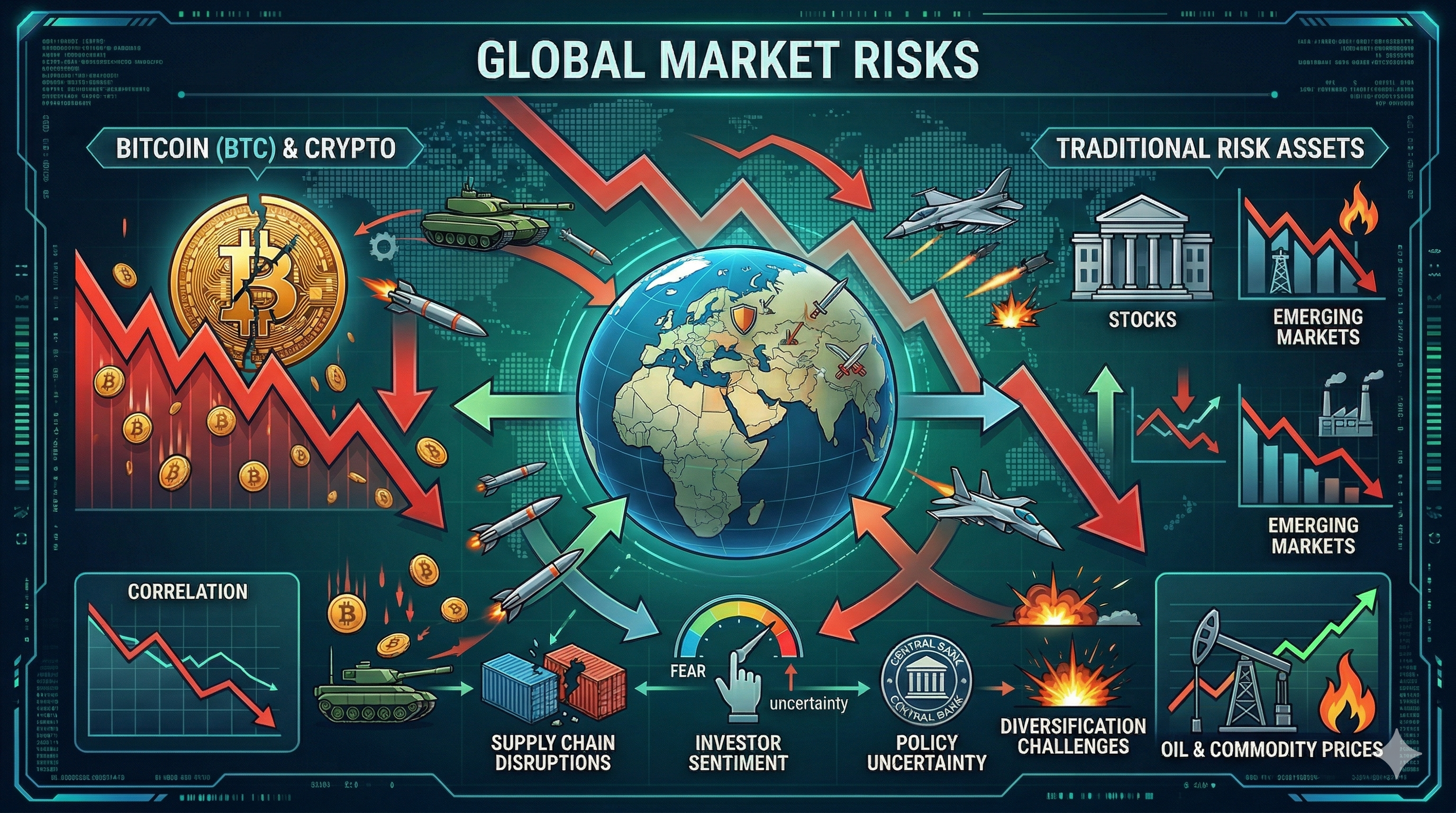
Global financial markets are navigating one of the most complex geopolitical landscapes in recent history. The escalating tensions between the United States and Iran, ongoing ripple effects from the Russia-Ukraine conflict, and the lingering uncertainty surrounding the U.S.-China economic relations have all contributed to heightened market volatility. Investors across traditional and digital assets are watching carefully, asking a key question: how do risk assets, including Bitcoin and other cryptocurrencies, behave during periods of geopolitical stress? The answer is neither straightforward nor static; it depends on a mixture of macroeconomic variables, investor psychology, liquidity conditions, and asset-specific characteristics.
Historically, geopolitical events have triggered sharp market responses. For example, during the first Gulf War in 1990, equities experienced immediate sell-offs while gold and U.S. Treasury bonds appreciated due to their safe-haven status. In the crypto era, however, the dynamics are more nuanced. Bitcoin, with a market cap hovering near $2.5 trillion in March 2026 and a price range between $69,000 and $70,000, is frequently observed reacting both to traditional risk-off environments and to unique crypto market drivers. Unlike gold, which has centuries of safe-haven credibility, or U.S. Treasuries, which offer near-zero default risk, Bitcoin is still an emergent asset class. Its decentralized structure, high liquidity, and institutional adoption make it a hybrid financial instrument, part risk-on, part potential macro hedge.
The 2026 geopolitical backdrop has already tested this hybrid role. In late February and early March, the escalation in the Middle East prompted a rapid 7% intraday drop in Bitcoin, echoing global equity declines and triggering significant liquidations in crypto derivatives markets. Yet, within days, Bitcoin partially recovered, trading near $66,000–$70,000, highlighting its capacity for resilience once panic-driven selling subsides. Such oscillations underscore a fundamental characteristic of Bitcoin during crises: while it is susceptible to immediate risk-off behavior, it can regain footing faster than many traditional assets, largely due to its borderless nature and the active presence of institutional participants.
For investors and traders, understanding Bitcoin’s behavior during geopolitical conflicts is no longer an academic exercise. It informs portfolio construction, risk management, and strategic positioning, particularly in high-volatility environments. Platforms like KuCoin, which provide spot trading, futures, staking options, and risk management tools such as stop-loss orders and Copy Trading, allow market participants to navigate these complex scenarios responsibly. Recognizing the nuanced behavior of Bitcoin and related risk assets can mean the difference between capital preservation and exposure to unnecessary losses during geopolitical turbulence.
In this article, we will explore how Bitcoin and other risk assets respond to geopolitical events, examine historical patterns with multiple case studies, compare them to traditional safe havens, analyze market mechanics, and offer practical insights for investors and traders. By combining real-time 2026 data, behavioral analysis, and expert perspectives, readers will gain a comprehensive understanding of how to navigate geopolitical uncertainty in both crypto and traditional financial markets.
Geopolitical Stress and Risk Asset Behavior
Geopolitical conflicts trigger complex dynamics across global financial markets, influencing everything from currency valuations to commodity prices, equities, and increasingly, digital assets such as Bitcoin. Investors and traders refer to these periods as “risk-off” environments, where market participants actively seek to reduce exposure to volatile or uncertain assets. Understanding the mechanics of these reactions is critical for navigating 2026’s volatile geopolitical landscape, including the ongoing tensions between the United States and Iran.
1. Liquidity and Flight to Safety
Liquidity is a central determinant of market behavior during crises. Traditional safe-haven assets, gold, U.S. Treasuries, and certain reserve currencies like the Swiss franc, benefit from high market depth, allowing significant capital flows without causing massive price disruptions. For instance, during the early March 2026 escalation in the Middle East, investors rotated funds into U.S. Treasuries and gold-backed ETFs to mitigate exposure, even as equities and risk-sensitive crypto assets fell. Gold, despite being considered a safe haven, experienced a brief dip due to simultaneous liquidity stress in global markets, highlighting the sometimes counterintuitive dynamics that arise during acute geopolitical shocks.
Bitcoin, with a market capitalization around $2.5 trillion, has become increasingly liquid due to deep spot and derivatives markets. Platforms like KuCoin provide investors with high-liquidity spot trading, futures, and Copy Trading, allowing both retail and institutional actors to enter or exit positions rapidly. However, high liquidity also means that during abrupt geopolitical shocks, the market can react reflexively: leveraged traders face margin calls, algorithmic trading amplifies volatility, and panic selling can create sharp price movements. In March 2026, Bitcoin initially fell from $68,000 to $63,000 within hours following military escalations in Iran, reflecting this amplified liquidity-driven reaction.
2. Risk-On vs. Risk-Off Dynamics
Risk-on assets, including equities, high-yield bonds, and many altcoins, typically decline during geopolitical crises. Conversely, risk-off assets, such as gold, U.S. Treasuries, and cash equivalents, often benefit from safe-haven demand. Bitcoin occupies a hybrid space; it can behave like a risk asset in the short term, moving with equities, but can also act as a digital hedge in situations involving capital controls or currency instability.
Historical data demonstrate this dual role. During the Russia-Ukraine conflict (2022), Bitcoin initially declined in tandem with equities, reflecting risk-off sentiment. However, over several weeks, it recovered and outperformed certain European equities, demonstrating its partial decoupling from traditional risk assets once market participants digested initial shocks. The 2026 US-Iran conflict reinforced this pattern: after the initial 7% drop, Bitcoin rebounded to $66,000–$70,000, showing that temporary volatility does not necessarily define the medium-term trend.
3. Behavioral Economics and Sentiment Amplification
Investor psychology plays a major role in market dynamics during geopolitical events. Fear and Greed indices, real-time social media sentiment (Reddit, X, Discord), and fund flows often move faster than underlying fundamentals. In March 2026, panic selling drove mass liquidations in Bitcoin futures, which were particularly pronounced on highly leveraged positions. Behavioral feedback loops like these can amplify price declines, creating reflexive market movements.
These dynamics underscore why risk management is critical. Investors who rely solely on price fundamentals may underestimate the influence of sentiment-driven shocks. Platforms like KuCoin offer tools such as stop-loss orders, portfolio tracking, and Copy Trading, enabling traders to implement structured risk mitigation strategies. Responsible positioning, particularly during geopolitical shocks, can limit losses and preserve capital.
4. Macro-Correlations and Systemic Drivers
Geopolitical crises often influence multiple macro variables simultaneously. For instance, oil prices spiked in March 2026 due to Middle East tensions, creating inflationary concerns that affected equities and crypto alike. In risk-off periods, correlations between asset classes often increase, meaning Bitcoin can temporarily move in tandem with equities, even if its long-term fundamentals remain unaffected. Understanding these cross-asset linkages allows investors to anticipate potential reactions and hedge accordingly.
Additionally, central bank responses, such as interest rate adjustments or liquidity injections, can dramatically alter risk sentiment. During March 2026, market participants closely monitored Federal Reserve guidance, as expectations of delayed rate hikes influenced both equity and crypto markets. Bitcoin’s decentralized nature means it is somewhat insulated from traditional monetary policy, but short-term trading behavior remains sensitive to macroeconomic shifts.
Historical Case Studies of Bitcoin During Geopolitical Crises
Examining historical instances of geopolitical turmoil provides insight into Bitcoin’s complex behavior during periods of market stress. While its history is relatively short compared to traditional assets, Bitcoin has been tested in multiple crises, ranging from military conflicts to trade disputes and regional instability. These case studies highlight its dual role as both a risk asset and a potential hedge under specific conditions.
1. Russia-Ukraine War (2022–2023)
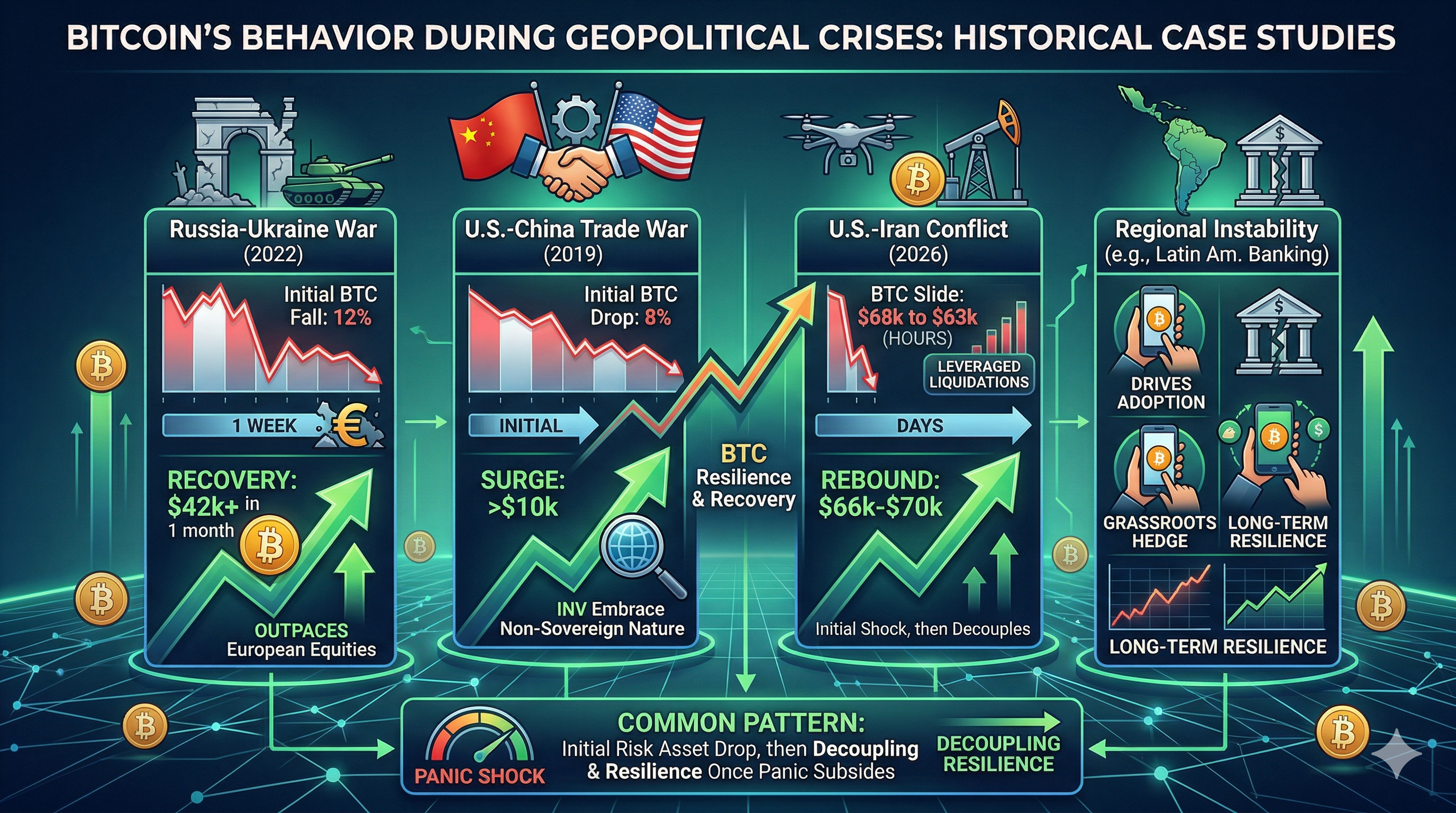
The Russia-Ukraine conflict marked one of the first major geopolitical crises to occur during Bitcoin’s emergence as a widely traded digital asset. Following Russia’s invasion of Ukraine in February 2022, global equities experienced immediate sell-offs, and traditional safe havens like gold saw sharp inflows. Bitcoin, initially perceived as a potential “digital gold” alternative, also experienced volatility. In the first week, BTC dropped approximately 12% from $44,500 to $39,200, reflecting panic selling and systemic risk-off sentiment.
However, unlike many equities, Bitcoin began a recovery phase within a month. Factors contributing to this rebound included cross-border capital flows seeking a store of value, increasing institutional adoption, and heightened retail interest in crypto as a hedge against regional banking instability. Notably, in March 2022, BTC reclaimed $42,000, while some European equities remained below pre-crisis levels. This case illustrates that Bitcoin may initially mimic risk-on assets during acute shocks but can decouple once markets stabilize.
2. U.S.-China Trade Tensions (2019)
Although not a military conflict, the 2019 U.S.-China trade dispute created significant market uncertainty, particularly in technology and industrial sectors. Equity markets reacted with sharp declines during tariff announcements, and investors sought safe-haven alternatives. Bitcoin’s price behavior mirrored a short-term risk-off pattern, dropping roughly 8% from $8,200 to $7,550 in early May 2019.
Interestingly, Bitcoin rebounded once traders evaluated the broader economic landscape. Over the following two months, BTC surged above $10,000 as investors increasingly viewed it as an uncorrelated asset outside the control of any single nation-state. This scenario demonstrates Bitcoin’s hybrid behavior, initially behaving like a risk asset but later serving as a potential hedge in prolonged uncertainty.
3. Middle East Tensions: US-Iran Conflict, Early 2026
In early 2026, escalating tensions between the United States and Iran provided a live test of Bitcoin’s resilience in geopolitical stress. Market reaction was swift: Bitcoin fell from $68,000 to $63,000 within hours, coinciding with a broader sell-off in global equities and increased volatility in oil prices. Futures contracts across crypto exchanges, including KuCoin, triggered forced liquidations, magnifying downward pressure.
Within days, however, BTC partially recovered to $66,000–$70,000, demonstrating how short-term panic does not necessarily dictate medium-term outcomes. Analysts highlighted the role of liquidity and investor psychology: initial sell-offs were driven by risk-averse traders, while longer-term holders capitalized on market dislocations. This event underscored Bitcoin’s resilience in the face of rapid geopolitical shocks and its emerging role in diversified portfolios.
4. Regional Conflicts and Cryptocurrency Adoption
Beyond global crises, regional conflicts have also influenced Bitcoin adoption. For example, during localized banking crises in Latin America in 2023–2024, Bitcoin usage spiked as citizens sought to preserve capital amid currency devaluation. These cases reveal that Bitcoin can act as a protective asset in regions facing systemic financial instability, even when broader global markets are stable. Peer-to-peer trading volumes, on-chain transaction metrics, and wallet activity surged, highlighting real-world demand for decentralized financial solutions.
5. Lessons from Historical Patterns
Analyzing these case studies reveals several consistent themes:
Short-Term Risk-On Mimicry: During the first hours or days of a crisis, Bitcoin often moves in line with equities and risk assets. Panic selling and leverage liquidation amplify declines.
Medium-Term Recovery Potential: Bitcoin frequently rebounds faster than equities once initial panic subsides, thanks to global liquidity and its decentralized nature.
Regional Hedging Function: In localized crises or currency instability, Bitcoin adoption rises, reflecting its potential as a store of value.
Behavioral Amplification: Social sentiment, algorithmic trading, and news cycles can magnify short-term volatility, making risk management tools essential for traders.
These patterns underscore the importance of contextual analysis. Geopolitical crises differ in scale, duration, and market impact. Understanding the mechanisms at play, leverage, liquidity, macroeconomic correlations, and investor behavior, helps investors make informed decisions. Platforms like KuCoin provide tools to navigate these complexities responsibly, including futures hedging, spot trading, and structured Copy Trading strategies.
Comparative Analysis: Bitcoin vs. Traditional Safe Havens
Bitcoin’s role during geopolitical crises is best understood in comparison to established safe-haven assets, including gold, U.S. Treasuries, and reserve currencies like the Swiss franc. While traditional assets have centuries of historical precedent, Bitcoin’s relatively short history provides emerging insights into its hybrid behavior-part risk-on asset, part potential hedge.
1. Asset-Class Behavior During Geopolitical Stress
|
Asset Class |
Typical Response During Crisis |
2026 Observations |
|
Gold |
Appreciates due to intrinsic value and liquidity |
Gold surged ~5% during March 2026 Middle East tensions, though temporarily impacted by liquidity-driven selling |
|
U.S. Treasuries |
Strong inflows, yields fall |
Treasury yields fell ~12 bps as investors sought capital preservation |
|
USD & CHF |
Currency appreciation |
USD index strengthened ~2% against major currencies |
|
Bitcoin (BTC) |
Mixed; often initially falls with equities, later recovers |
Dropped 7% intraday in early March 2026, rebounding within days to near $70,000 |
|
Equities |
Risk-off: declines in global stock indices |
S&P 500 fell ~3.2%, MSCI World Index down ~2.9% during the initial escalation |
This table illustrates the hybrid role of Bitcoin. While it shares characteristics with risk-on assets during acute market shocks, its decentralized structure, high liquidity, and global adoption allow it to recover more rapidly than traditional equities, sometimes even outperforming them in medium-term periods.
2. Correlation Dynamics
Correlation analysis provides further insight. Historically, Bitcoin’s correlation with U.S. equities ranges from 0.2 to 0.5 in risk-on periods, rising temporarily to 0.7–0.8 during acute geopolitical crises. In March 2026, preliminary correlation estimates between Bitcoin and S&P 500 during the US-Iran escalation were around 0.72, indicating strong short-term alignment with traditional markets. By the end of the week, as panic subsided, the correlation dropped back toward 0.48, highlighting Bitcoin’s partial decoupling once immediate shocks passed.
Altcoins often exhibit higher volatility and stronger correlations with Bitcoin. For example, Ethereum (ETH) fell ~9% alongside BTC during early March 2026, while smaller-cap altcoins like Solana (SOL) and Polkadot (DOT) experienced 12–15% intraday declines. This reflects lower liquidity and sensitivity to risk-off sentiment, reinforcing Bitcoin’s relative stability within the crypto ecosystem.
3. Comparative Risk Metrics
Investors often consider volatility, liquidity, and downside risk when evaluating asset performance during crises. In March 2026:
-
Gold: Volatility (30-day ATR) ~1.8%, highly liquid
-
Treasuries: Volatility low (~0.5%), extremely liquid
-
Bitcoin: Volatility (30-day ATR) ~3.5%, high liquidity but prone to leverage amplification
-
S&P 500: Volatility ~2.7%, moderately liquid
These metrics highlight that, while Bitcoin is more volatile than traditional safe havens, its liquidity and rapid recoveries can make it suitable for tactical hedging or diversification.
4. Strategic Implications
Investors can use these insights to structure portfolios during geopolitical uncertainty:
-
Allocate core safe-haven positions (gold, Treasuries) for stability.
-
Treat Bitcoin as a tactical hedge, particularly when traditional risk assets decline sharply.
-
Consider altcoin exposure carefully, recognizing amplified volatility and lower liquidity.
-
Use risk management tools on platforms like KuCoin, spot/futures, stop-loss orders, and Copy Trading strategies, to reduce exposure during acute events.
Bitcoin’s behavior is neither fully aligned with traditional risk-off assets nor completely independent. Its hybrid characteristics offer unique diversification potential but require disciplined risk management to navigate geopolitical crises successfully.
Conclusion
Geopolitical conflicts put profound and multifaceted effects on financial markets, and 2026 has demonstrated that both traditional and digital assets are influenced by a complex interplay of liquidity, sentiment, macroeconomic variables, and investor behavior. Bitcoin, in particular, has evolved into a hybrid asset class: it often behaves like a risk-on asset during acute market shocks yet exhibits resilience that allows it to recover faster than many equities. The early March 2026 US-Iran tensions exemplify this dynamic. BTC initially dropped 7% in response to market-wide risk-off sentiment, mimicking the declines seen in global equities and altcoins. Within days, however, Bitcoin rebounded toward $70,000, reflecting its decentralized nature, high liquidity, and growing institutional participation.
Comparative analysis reinforces Bitcoin’s unique position among financial instruments. Traditional safe havens such as gold, U.S. Treasuries, and reserve currencies like the Swiss franc offer long-standing reliability, low volatility, and historical credibility during geopolitical crises. Bitcoin, by contrast, provides global accessibility, rapid liquidity, and potential hedging opportunities, but also carries higher volatility and sensitivity to leverage-driven liquidations. For altcoins, the risk is amplified due to lower market depth and higher correlation with Bitcoin, particularly during periods of panic. Understanding these nuances is essential for investors seeking to manage risk and capture potential upside without exposing themselves to unnecessary losses.
From a strategic perspective, the lessons are clear:
1. Diversification remains essential. Combining core safe-haven assets with a measured Bitcoin allocation can improve portfolio resilience.
2. Risk management is non-negotiable. Leveraged positions, derivatives exposure, and rapid market swings necessitate tools like stop-losses, futures hedging, and structured Copy Trading strategies. Platforms such as KuCoin provide these options, enabling investors to implement disciplined approaches during periods of heightened uncertainty.
3. Behavioral awareness is critical. Social sentiment, news cycles, and algorithmic trading can exaggerate short-term volatility, requiring calm, data-driven decision-making rather than reactive trading.
Ultimately, Bitcoin’s response to geopolitical crises is context-dependent. It is neither a perfect safe haven nor a purely speculative instrument. Its performance is influenced by macro factors, liquidity, behavioral patterns, and market infrastructure. Investors who combine a clear understanding of historical patterns with disciplined risk management, real-time monitoring, and strategic use of crypto platforms can position themselves to navigate uncertainty effectively.
Geopolitical events will continue to shape risk asset behavior, but Bitcoin’s hybrid characteristics, combined with careful portfolio construction and informed strategy, offer both opportunities and challenges. Staying informed, maintaining diversification, and leveraging tools responsibly is the most reliable approach for preserving capital and capturing potential upside in volatile markets.