

DeFi Bridge Architectures: Which Are Riskiest for Your Stablecoins in 2026?
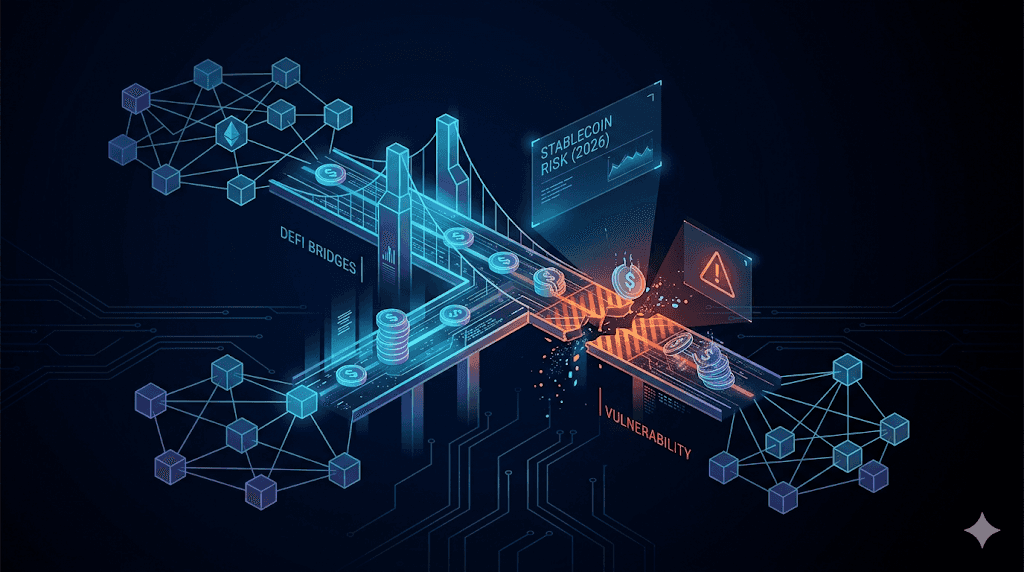
Is your stablecoin truly stable once it leaves its native chain, or are you holding a digital IOU that could vanish in a single block? As of late April 2026, the primary risk to the $300.5 billion stablecoin market is not the underlying collateral but the bridge architecture used to move it. The Lock-and-Mint architecture remains the riskiest for stablecoins because it creates synthetic "wrapped" assets that lose all value if the source chain vault is exploited. According to the Federal Reserve Bank of Kansas City’s April 10, 2026, briefing, nearly 48.8% of all stablecoins are now active in cross-chain environments, making bridge security the ultimate single point of failure for global liquidity.
To understand the current risks, we must examine the infrastructure layers:
Cross-chain bridges: These are technical frameworks that facilitate the transfer of assets and data across independent blockchain networks.
Stablecoin security: This refers to the cryptographic and economic measures used to maintain a 1:1 peg during cross-layer movements.
Interoperability protocols: These are the foundational communication standards that allow disparate blockchains to synchronize their state and transaction history.
The Taxonomy of DeFi Bridge Architectures in 2026
DeFi bridge architectures are categorized by how they handle the transfer of value, with Lock-and-Mint, Burn-and-Mint, and Atomic Swaps serving as the three dominant models. Based on a technical review by Frontiers in Blockchain in March 2026, the industry has shifted toward "asynchronous messaging" to support the high volume of Layer-2 transactions. Each model offers a different trade-off between speed, capital efficiency, and security, but they all share the fundamental goal of ensuring that an asset cannot exist in two places at once.
Lock-and-Mint: The IOU Model
Lock-and-mint bridges are the most common architecture, where an asset is locked in a smart contract on the source chain, and a representative wrapped token is minted on the destination chain. This model is highly scalable but introduces custodial risk, as the value of the wrapped token is entirely dependent on the security of the vault on the source chain. According to technical data from the April 18, 2026, KelpDAO incident, a failure in the validation logic allowed an attacker to mint unbacked tokens, proving that the Lock-and-Mint model is only as strong as its message verifier.
Burn-and-Mint: The Native Transfer Model
Burn-and-mint architectures, often used in canonical"bridges, involve destroying the asset on the source chain and re-issuing a native version on the destination chain. This is generally considered more secure than Lock-and-Mint because it avoids the creation of synthetic IOUs. However, according to the V2E framework analysis in early 2026, this model requires the bridge to have minting rights on both chains, which can lead to systemic inflation if the bridge's administrative keys are compromised.
Liquidity Provider (LP) Pools: The AMM Model
LP-based bridges use existing liquidity pools on both the source and destination chains to "swap" assets rather than minting new ones. This architecture avoids the creation of wrapped tokens entirely but is limited by the available liquidity in the pools. Based on data from the Mercati, infrastrutture, sistemi di pagamento report, LP bridges are highly resilient to total loss but are prone to high slippage and liquidity crunches during periods of extreme market volatility.
Why Lock-and-Mint is the Riskiest for Stablecoins
Lock-and-mint bridges pose the greatest risk to stablecoins because they decouple the token from its legal and financial backing, replacing it with a contract-based claim. If the bridge's vault on Ethereum is drained, the "wrapped USDC" on a Layer-2 like Arbitrum becomes a worthless entry on a ledger with no collateral to claim. According to the NDSS Symposium in February 2026, this backing gap is the primary driver of stablecoin de-pegging events, as market participants rush to exit the synthetic asset at any price.
The risk is further compounded by the re-hypothecation of wrapped stablecoins. In 2026, many DeFi protocols allow users to use wrapped stablecoins as collateral for loans. If the underlying bridge is exploited, the resulting bad debt can trigger a liquidation cascade across multiple chains simultaneously. According to data from the April 2026 market updates, the KelpDAO exploit created nearly $177 million in bad debt on Aave because the protocol could not distinguish between "backed" and "unbacked" tokens in real-time.
Furthermore, Lock-and-Mint bridges often rely on a centralized or semi-decentralized validator set to authorize minting. Based on the "1/1 DVN" flaw identified in recent bridge attacks, a single compromised node can authorize the creation of billions in unbacked stablecoins. This makes Lock-and-Mint architectures a "honey pot" for sophisticated hackers who only need to find one logic error or compromise one key to drain the entire system.
Evaluation of Bridge Verification Models: External vs. Native
Verification models determine who vows for the validity of a cross-chain transfer, with External Verifiers being significantly riskier than Native Verification or ZK-Proofs. According to a 2026 study in Informatica, bridges using external verifiers, such as a multi-sig or a separate validator set, account for over 90% of all bridge-related capital losses. These external sets are often less secure than the blockchains they are connecting, creating a weakest link problem.
External Verification (The Multi-Sig Risk)
External verification relies on a third party to monitor the source chain and sign a message on the destination chain. In 2026, many "fast" bridges still use this model to reduce latency. However, as evidenced by the $292 million KelpDAO breach on April 18, 2026, these external signers can be spoofed or compromised. Based on reports from Security.org, the centralization of these signers on major cloud providers like AWS and Google Cloud creates a systemic cluster risk for the entire DeFi ecosystem.
Native and Light Client Verification
Native verification involves the destination chain running a light client of the source chain to verify the transaction itself. This is theoretically much safer because it does not rely on a third-party intermediary. However, according to TeleZK-L2 research published in early 2026, the high gas cost of running light clients on-chain has led many developers to short-cut the process, introducing subtle logic flaws that can be exploited by profit-driven attackers.
ZK-Proof Verification: The Gold Standard of 2026
Zero-Knowledge (ZK) proofs have emerged in 2026 as the most secure verification model, allowing for mathematical certainty without trusting a validator set. By submitting a ZK-SNARK that proves a transaction is finalized on the source chain, the destination chain can authorize a transfer with 100% cryptographic confidence. According to Frontiers in Blockchain, the recent 13.4x speedup in ZK-proof generation has finally made this model viable for high-frequency stablecoin trading, although its complexity still requires rigorous auditing.
Stablecoin De-pegging and Asynchronous State Errors
Asynchronous state errors are a leading cause of stablecoin instability in L2 environments, occurring when the finality of a transaction is not synchronized between the two chains. In 2026, attackers often exploit the latency window between a deposit and its finalization. According to the NDSS Symposium, if a bridge allows a user to mint wrapped stablecoins before the source deposit is immutable, an attacker can "re-org" the source chain to delete the deposit while keeping the minted tokens.
| Bridge Architecture | Risk Level for Stablecoins | Primary Vulnerability |
| Lock-and-Mint | Critical | Asset-Backing (Vault) Compromise |
| Burn-and-Mint | High | Infinite Minting via Admin Keys |
| LP Pool (AMM) | Low/Medium | Liquidity Crunches & High Slippage |
| ZK-Messaging | Low | Smart Contract Logic Errors |
This time-gap vulnerability is particularly dangerous for stablecoins because they are often used as "instant" liquidity. Based on the Federal Reserve Bank of Kansas City's April 2026 data, the velocity of stablecoins has increased by 35% year-over-year, meaning that any delay or error in state synchronization can have immediate, compounding effects on the global market. To combat this, modern bridges are implementing Intent-Alignment Arbiters that monitor the global state to ensure that a minting event never occurs without a finalized, irreversible deposit.
The Economic Impact of "Bad Debt" on Multi-Chain Stablecoins
Bad debt in bridge protocols occurs when the value of the assets locked in the source vault is less than the value of the tokens minted on the destination chain. In April 2026, the KelpDAO exploit demonstrated how quickly bad debt can paralyze the DeFi ecosystem. When $292 million in unbacked rsETH was minted, it effectively poisoned the liquidity pools of Aave and other lending protocols, forcing them to freeze withdrawals to prevent a total collapse.
For stablecoins, bad debt is a contagion risk. If a bridge that carries a significant portion of a stablecoin’s supply is compromised, the stablecoin may lose its peg even on chains that weren't directly involved in the hack. According to the Mercati, infrastrutture, sistemi di pagamento report, the interconnectedness of modern DeFi means that a single bridge failure can lead to a 15-20% deviation in stablecoin prices across the entire interoperability web.
To manage this, the "DeFi United" relief fund was established on April 24, 2026, to socialize these losses and re-collateralize broken bridges. However, as noted by market analysts, this bailout model is not sustainable for the long term. The industry must move toward Proof-of-Reserve (PoR) systems that provide real-time, on-chain evidence that every wrapped stablecoin is backed 1:1 by liquid collateral.
The Rise of "Intent-Based" Bridge Architectures
Intent-based architectures represent the newest evolution in 2026, shifting the focus from "how" a bridge works to "what" the user wants to achieve. In this model, a user expresses an "intent" (e.g., "I want 100 USDC on Arbitrum"), and specialized market makers, known as "solvers," fulfill that intent using their own liquidity. According to the V2E methodology, this removes the need for a traditional bridge contract entirely, as the risk is shifted to professional solvers.
The advantages for stablecoins are significant:
-
Zero Wrapped Risk: Users receive native stablecoins on the destination chain, avoiding the risks associated with Lock-and-Mint IOUs.
-
Instant Liquidity: Solvers can provide funds immediately, ignoring the finality lag of the underlying blockchains.
-
Competitive Pricing: Multiple solvers compete to fulfill an intent, ensuring the user gets the best possible exchange rate.
Based on current adoption trends in April 2026, intent-based systems now account for 25% of all cross-chain stablecoin volume. While they introduce new risks, such as solver collusion or censorship, they provide a much-needed alternative to the wrapped asset trap that has caused billions in losses over the past five years.
Should You Trade Stablecoins and DeFi Assets on KuCoin?
Trading stablecoins and cross-chain assets on KuCoin provides a vital layer of professional security that protects you from the architectural risks of unvetted DeFi bridges. While the Lock-and-Mint model continues to pose a threat to decentralized users, KuCoin’s internal risk management systems act as a security filter, ensuring that the assets listed on the platform have undergone rigorous technical and economic stress tests. By trading on KuCoin, you benefit from:
Vetted Bridge Infrastructure: KuCoin only supports cross-chain assets with proven security track records, avoiding the alpha-stage bridges that are most susceptible to logic flaws and DVN exploits.
Native Stablecoin Liquidity: Access native USDC and USDT liquidity across multiple chains without having to manage the wrapped asset risks of experimental L2 bridges yourself.
Real-Time Bad Debt Monitoring: KuCoin’s security teams monitor the backing ratio of all integrated assets 24/7, allowing the platform to respond to de-pegging events or exploits before they impact your portfolio.
Professional Asset Protection: Gain exposure to the yield-bearing potential of the DeFi ecosystem through KuCoin Earn, where your assets are protected by industry-leading security protocols and institutional-grade custody.
In the high-risk environment of 2026, trading on a reputable exchange like KuCoin is the most effective way to navigate the interoperability web without exposing your capital to the architectural failures that have defined the recent DeFi cycle.
Conclusion
The evolution of DeFi bridge architectures in April 2026 has made it clear that Lock-and-Mint models are the weakest link for stablecoin security. By creating synthetic IOUs that are entirely dependent on a vulnerable source vault, these bridges introduce a level of custodial and technical risk that is incompatible with the "stable" promise of digital dollars. As the KelpDAO exploit and subsequent Aave bad debt crisis have shown, a single validation logic error or a "1/1 DVN" configuration can wipe out hundreds of millions in value in minutes.
However, the industry is not standing still. The move toward Native and ZK-Proof verification is creating a more resilient foundation for global liquidity. Combined with the rise of Intent-Based systems that eliminate wrapped assets entirely, the 2026 landscape is slowly closing the "trust window" that exploiters have thrived in.
For investors and developers alike, the takeaway from early 2026 is that infrastructure is everything. Security is no longer an afterthought but the primary product. By utilizing ZK-verified messaging, prioritizing native transfers, and trading on secure platforms like KuCoin, the DeFi ecosystem can move past its "bridge hack" era and toward a truly interoperable, stable future.
FAQs
Why is Lock-and-Mint architecture so dangerous for stablecoins?
It creates synthetic "wrapped" tokens. If the source vault is hacked, the wrapped asset loses all collateral backing and value, even if your personal wallet remains untouched.
What is the "1/1 DVN" configuration error?
It is a single point of failure where only one validator signature is required. If that node is compromised, attackers can mint infinite unbacked tokens, as seen in KelpDAO.
How do ZK-proofs improve bridge security in 2026?
They replace third-party trust with mathematical evidence. Destination chains verify source transactions using cryptographic certainty, eliminating risks from compromised human validator sets or centralized multi-sig configurations.
What is "bad debt" in the context of a bridge hack?
Bad debt occurs when unbacked tokens enter lending protocols as collateral. This poisons liquidity pools because the protocol holds valueless assets while real funds have been borrowed against them.
Is it safer to use a centralized exchange or a decentralized bridge in 2026?
Centralized exchanges like KuCoin are generally safer. They utilize native liquidity and internal vetting, avoiding smart contract logic flaws and "wrapped" asset risks inherent in decentralized bridges.
Disclaimer:This content is for informational purposes only and does not constitute investment advice. Cryptocurrency investments carry risk. Please do your own research (DYOR).