



Best AI Crypto Tokens to Buy in 2026: Top Picks and What Makes Them Worth Watching
2026/05/17 03:07:07
Introduction
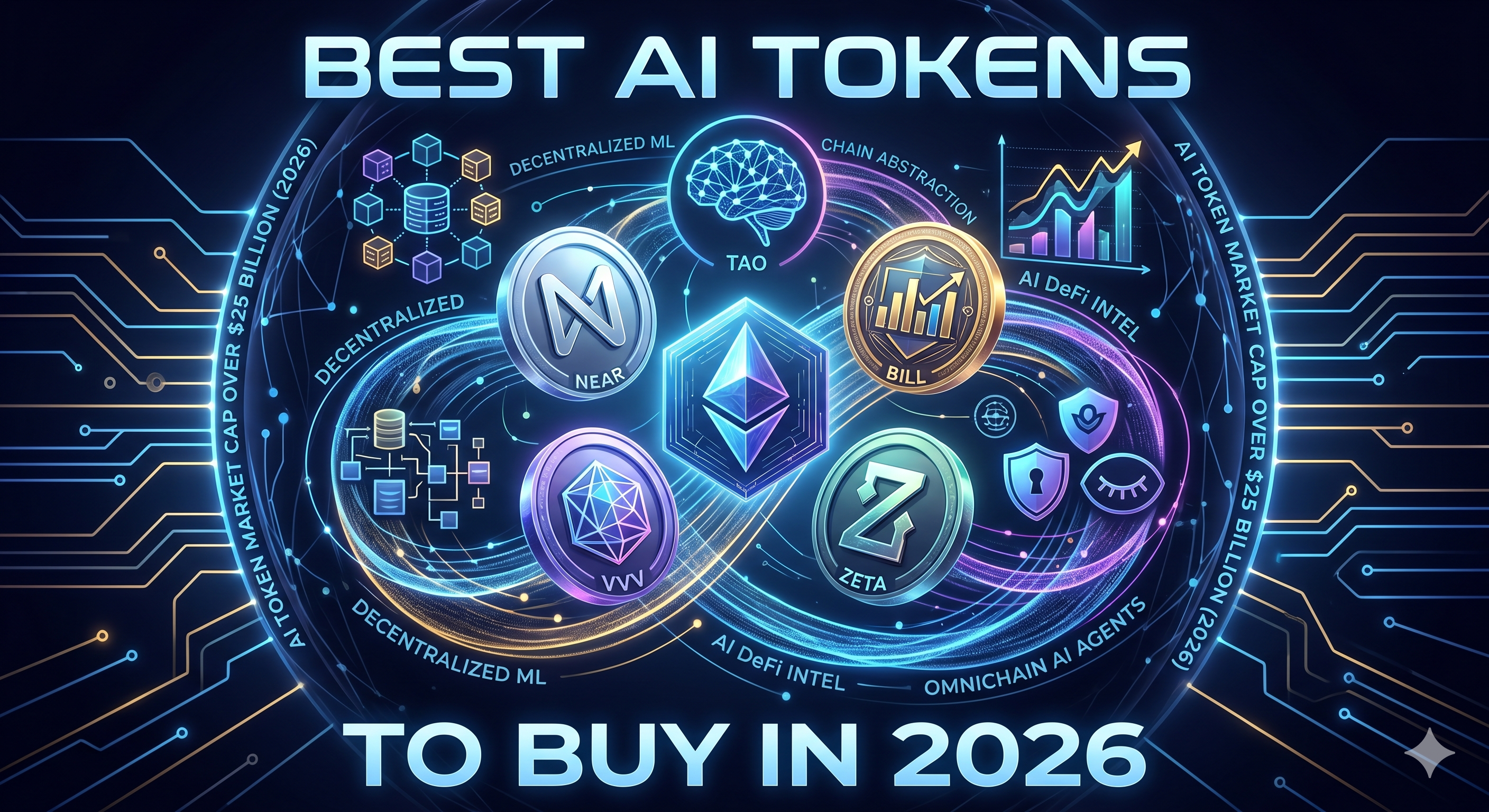
Artificial intelligence tokens now represent one of the fastest-growing sectors in crypto, with the combined AI token market cap surpassing $25 billion in early 2026, according to CoinGecko data. But which projects are actually building lasting value — and which are riding hype alone?
The best AI tokens to buy in 2026 are those combining real utility, active development, and strong community traction — projects like NEAR, TAO, BILL, VVV, and ZETA each target distinct niches within the AI-crypto intersection. This article breaks down what separates genuine AI infrastructure plays from speculative noise, evaluates each token on fundamentals, and helps you decide which AI crypto coins deserve a place in your portfolio this year.
What Are AI Crypto Tokens and Why Are They Surging in 2026?
AI crypto tokens are digital assets tied to blockchain projects that integrate artificial intelligence into their core functionality — whether through decentralized compute networks, AI-powered trading agents, or machine learning data marketplaces.
The surge in 2026 is driven by three converging forces. First, the mainstream AI industry continues its explosive growth, with global AI spending projected to exceed $300 billion this year, according to IDC's March 2026 forecast. Second, blockchain offers a natural infrastructure layer for decentralized AI — solving problems around data ownership, compute distribution, and model transparency that centralized AI giants struggle with. Third, regulatory clarity in major markets has given institutional investors more confidence to allocate capital toward AI-crypto crossover projects.
How AI Tokens Differ from General Crypto Assets
AI tokens are not simply cryptocurrencies with "AI" in the name. Legitimate projects serve specific functions within AI ecosystems:
-
Compute tokens pay for decentralized GPU and processing power
-
Data tokens incentivize the sharing and curation of training datasets
-
Agent tokens power autonomous AI agents that execute on-chain tasks
-
Infrastructure tokens secure networks purpose-built for AI workloads
This functional specificity is what separates investable AI tokens from meme-driven projects. When evaluating any AI token, the first question should always be: what role does this token play in an actual AI workflow?
The Market Context in 2026
The AI token sector has matured considerably since the initial hype wave of 2023-2024. According to Messari's Q1 2026 report, the number of AI-tagged tokens on major exchanges grew by 40% year-over-year, but trading volume concentrated increasingly in the top 20 projects. This consolidation suggests the market is beginning to reward substance over speculation — a healthy sign for serious investors evaluating the best AI tokens to buy now.
How Should You Evaluate AI Tokens Before Buying?
The most reliable evaluation framework for AI crypto coins combines technical fundamentals, tokenomics, and real-world adoption metrics — not just price momentum.
Technical Fundamentals
Start with the project's actual technology. Does the protocol solve a genuine problem in the AI stack? Key questions to ask include:
-
Is the AI component integral to the protocol, or bolted on as marketing?
-
Does the project have a working product, or only a whitepaper?
-
Are there verifiable on-chain metrics — active users, transactions, compute hours delivered?
Projects with live mainnets, measurable usage, and developer activity on GitHub tend to outperform those still in testnet or concept phase. According to Electric Capital's April 2026 Developer Report, AI-focused crypto projects saw a 55% increase in monthly active developers compared to the previous year — but this growth was heavily concentrated in the top 15 projects.
Tokenomics and Supply Dynamics
Even strong technology can be undermined by poor token design. Look for:
-
Reasonable inflation schedules that do not dilute holders excessively
-
Clear utility — the token must be required for network participation, not optional
-
Vesting transparency — check whether large team or VC unlocks are imminent
A token with heavy unlock events in the next 6 months faces significant sell pressure regardless of its technical merits.
Community and Ecosystem Health
Active communities signal sustained interest beyond speculative trading. Metrics worth tracking include governance participation rates, the number of third-party applications building on the protocol, and the quality of ecosystem partnerships. A project with 50 active builders on its platform is generally a stronger long-term bet than one with 500,000 passive token holders.
Which AI Tokens Are the Best Picks for 2026?
The following five tokens represent distinct approaches to the AI-crypto intersection, each targeting a different layer of the decentralized AI stack. They are selected based on technology differentiation, ecosystem traction, and relevance to the broader AI narrative in 2026.
NEAR Protocol (NEAR) — AI-Enabled Layer 1 With Chain Abstraction
NEAR stands out as a Layer 1 blockchain that has pivoted aggressively toward AI integration while maintaining one of the most developer-friendly ecosystems in crypto. Its chain abstraction technology allows AI agents to interact seamlessly across multiple blockchains — a critical capability as multi-chain AI applications become the norm.
NEAR's AI strategy centers on its NEAR AI initiative, which provides infrastructure for building, deploying, and monetizing AI models on-chain. The protocol's sharding architecture — known as Nightshade — delivers the throughput needed for compute-intensive AI tasks without sacrificing decentralization.
Why it matters in 2026: NEAR's focus on user-friendly account abstraction and AI agent frameworks positions it as a gateway for mainstream AI applications entering Web3. According to data from NEAR's ecosystem dashboard as of April 2026, the network processes over 5 million daily transactions, with AI-related dApps accounting for a growing share of network activity. Its established market presence and deep liquidity also make it a lower-risk entry point compared to smaller AI tokens.
Bittensor (TAO) — Decentralized Machine Learning Network
TAO powers Bittensor, arguably the most ambitious decentralized AI project in crypto. Bittensor creates a peer-to-peer marketplace for machine intelligence, where AI models — called "miners" — compete to provide the best outputs and are rewarded with TAO tokens based on performance.
The network operates through specialized "subnets," each dedicated to a specific AI task such as text generation, image recognition, or data scraping. Validators assess the quality of miner outputs and distribute rewards accordingly. This creates a permissionless, meritocratic system for AI development that directly challenges the centralized model dominated by companies like OpenAI and Google.
Why it matters in 2026: Bittensor's subnet ecosystem has expanded significantly, with over 50 active subnets as of Q1 2026, according to Taostats data. The TAO token has a Bitcoin-like fixed supply of 21 million, which creates scarcity dynamics that appeal to long-term holders. The project's unique positioning as a "decentralized AI internet" gives it a narrative moat that few competitors can replicate. However, TAO's high token price and technical complexity mean it is best suited for investors who understand both AI and crypto deeply.
Billions Network (BILL) — AI-Powered DeFi Intelligence
BILL is the native token of Billions Network, a project focused on bringing AI-driven intelligence to decentralized finance. While many AI tokens target infrastructure, Billions Network applies artificial intelligence directly to trading, portfolio management, and risk assessment within DeFi ecosystems.
The platform leverages machine learning models to analyze on-chain data, identify yield opportunities, and automate complex DeFi strategies that would be impractical for individual users to execute manually. This positions BILL at the intersection of two of crypto's most powerful narratives — AI and DeFi.
Why it matters in 2026: The convergence of AI and DeFi is one of the defining trends of this market cycle. As DeFi protocols grow more complex, the need for AI-powered tools to navigate them increases proportionally. Billions Network addresses this demand directly, offering retail and institutional users alike a way to leverage artificial intelligence for smarter on-chain financial decisions. For investors looking for AI tokens with clear, immediate utility in the DeFi space, BILL represents a compelling niche play.
Venice Token (VVV) — Privacy-Focused Generative AI
VVV powers Venice, a decentralized platform for private, uncensored generative AI. In a landscape where centralized AI providers increasingly restrict outputs and collect user data, Venice offers an alternative — AI inference that runs without storing user prompts or tracking usage.
The VVV token serves as the access and governance mechanism for the Venice ecosystem. Users stake or spend VVV to access AI models for text generation, image creation, and code writing — all without the privacy compromises associated with centralized alternatives like ChatGPT or Midjourney.
Why it matters in 2026: Privacy concerns around AI usage have intensified in 2026, with multiple jurisdictions introducing stricter data handling regulations for AI providers. Venice's privacy-first approach positions VVV to capture demand from users — particularly in regulated industries and privacy-conscious markets — who want AI capabilities without surveillance trade-offs. The project's focus on generative AI also gives it direct exposure to the fastest-growing segment of the AI industry.
ZetaChain (ZETA) — Omnichain Infrastructure for AI Agents
ZETA is the native token of ZetaChain, a Layer 1 blockchain built specifically for omnichain interoperability. While not exclusively an AI project, ZetaChain's universal connectivity makes it critical infrastructure for AI agents that need to operate across multiple blockchains simultaneously.
ZetaChain enables smart contracts on one chain to read, write, and interact with assets and data on any other connected chain — including non-smart-contract chains like Bitcoin. For AI agents that need to execute complex multi-chain strategies, this cross-chain capability is essential.
Why it matters in 2026: As AI agents become more sophisticated, they increasingly need to operate across multiple blockchain ecosystems. An AI trading agent, for example, might need to borrow on Ethereum, swap on Solana, and settle on Bitcoin — all in a single workflow. ZetaChain provides the connective tissue for these multi-chain AI operations. According to ZetaChain's April 2026 ecosystem update, the network has seen a notable uptick in AI-related applications deploying on its infrastructure, reflecting this growing demand for omnichain AI capabilities.
How Do These AI Tokens Compare on Key Metrics?
A side-by-side comparison helps clarify where each token fits within a diversified AI crypto portfolio.
|
Token
|
Primary Use Case
|
AI Focus Area
|
Key Strength
|
Risk Level
|
|
NEAR
|
Layer 1 blockchain
|
AI agents & chain abstraction
|
Developer ecosystem, scalability
|
Moderate
|
|
TAO
|
Decentralized ML network
|
Model training & inference
|
Unique subnet architecture, fixed supply
|
High
|
|
BILL
|
DeFi intelligence
|
AI-powered trading & risk
|
Direct DeFi utility, growing niche
|
High
|
|
VVV
|
Private generative AI
|
Text, image, code generation
|
Privacy-first positioning
|
High
|
|
ZETA
|
Omnichain infrastructure
|
Cross-chain AI agent support
|
Universal interoperability
|
Moderate-High
|
Each token occupies a distinct niche. NEAR and ZETA provide infrastructure layers, TAO targets the core AI model layer, VVV addresses the application layer with a privacy angle, and BILL bridges AI with DeFi. A balanced approach might include exposure across multiple layers rather than concentrating in a single project.
Should You Buy AI Tokens on KuCoin?
KuCoin offers a streamlined way to access the AI token sector, with all five tokens discussed in this article — NEAR, TAO, BILL, VVV, and ZETA — available for spot trading on the platform.
KuCoin's advantages for AI token investors include deep liquidity on major trading pairs, competitive fee structures, and advanced trading tools that suit both beginners and experienced traders. The platform's Token Spotlight and research sections also provide regular analysis of trending AI projects, helping users stay informed about sector developments.
For those new to AI crypto investing, KuCoin's dollar-cost averaging (DCA) tools allow you to build positions gradually rather than trying to time volatile markets. More experienced traders can leverage KuCoin's futures and margin products for tactical exposure to AI token price movements.
Getting started is straightforward — create a KuCoin account, complete verification, deposit funds, and search for any of the AI tokens discussed above. Given the sector's volatility, consider starting with smaller position sizes and scaling in as you develop conviction in specific projects.
Conclusion
The AI token sector in 2026 represents a maturing market where genuine utility is beginning to separate winners from pretenders. The five tokens highlighted in this article — NEAR, TAO, BILL, VVV, and ZETA — each address distinct and meaningful segments of the decentralized AI ecosystem, from core machine learning infrastructure to privacy-focused applications and cross-chain agent interoperability.
Successful AI token investing requires looking beyond the narrative. Focus on verifiable on-chain metrics, sound tokenomics, active development communities, and clear product-market fit. The projects most likely to deliver long-term value are those solving real problems in the AI stack — not simply attaching the "AI" label to existing crypto primitives.
Risk management remains critical. AI tokens are inherently volatile, and the sector faces unique challenges including regulatory uncertainty, technology execution risk, and narrative-driven price swings. Diversifying across multiple layers of the AI-crypto stack — infrastructure, model, and application — provides more balanced exposure than concentrating in any single project.
As always, invest only what you can afford to lose, conduct your own research beyond any single article, and consider your personal risk tolerance before making allocation decisions. The AI-crypto intersection holds enormous promise, but disciplined evaluation will always outperform hype-driven speculation.
FAQs
Are AI crypto tokens a good long-term investment?
AI tokens with genuine utility and growing adoption can be strong long-term holds, but the sector is highly speculative. Only projects demonstrating real on-chain usage, active development, and sustainable tokenomics are likely to retain value across market cycles. Treat AI tokens as a high-risk, high-reward allocation within a diversified crypto portfolio — not as a guaranteed bet on AI's growth.
How do AI tokens generate value for holders?
AI tokens generate value through network utility — they are required to pay for services like decentralized compute, AI model access, data queries, or governance participation. As network usage grows, demand for the token increases. Some tokens also implement burn mechanisms or staking rewards that create additional value accrual for holders. The key is whether the token is essential to the network's function or merely optional.
What is the difference between AI tokens and AI meme coins?
AI tokens are tied to functional protocols that deliver AI-related services on-chain — compute, inference, data, or agent execution. AI meme coins use AI branding for marketing but lack underlying technology or utility. The distinction matters enormously for investment outcomes. Check whether a project has a working product, developer activity, and measurable usage before classifying it as a legitimate AI token.
Can AI tokens survive a crypto bear market?
AI tokens with real revenue and usage metrics have a better chance of surviving bear markets than purely speculative ones. During the 2022 bear market, infrastructure tokens with active ecosystems retained more value than narrative-driven assets. Projects generating protocol revenue — through compute fees, subscription models, or data marketplace commissions — have built-in demand floors that provide some downside protection even when speculative interest fades.
How much of my portfolio should I allocate to AI tokens?
Most financial analysts and crypto researchers suggest limiting speculative sector bets — including AI tokens — to 5-15% of your total crypto portfolio, depending on your risk tolerance. Within that AI allocation, diversifying across infrastructure, application, and data layers reduces concentration risk. Never allocate funds you cannot afford to lose entirely, and rebalance periodically as market conditions and project fundamentals evolve.