

Anthropic Co-Founder Warns of Massive AI Job Losses — Why Crypto Traders Should Care
2026/05/26 15:45:02
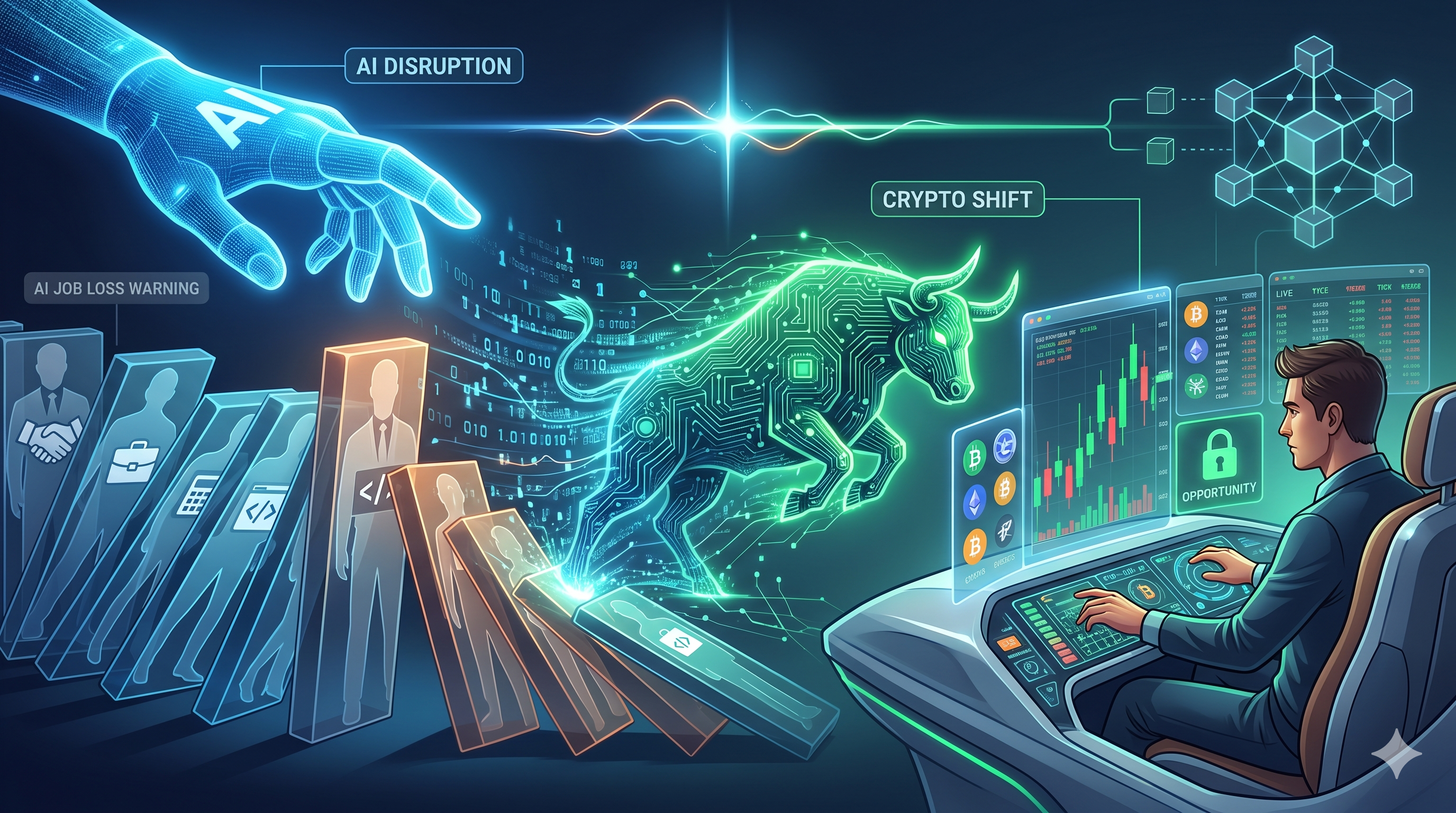
The intersection of artificial intelligence and global macroeconomics just experienced a watershed moment, and the tremors are already being analyzed across financial markets and the Web3 ecosystem. On May 25, 2026, Chris Olah, the co-founder and head of interpretability at the $900 billion frontier AI lab Anthropic, stood before the Vatican Synod Hall alongside Pope Leo XIV. His message was stark, unprecedented for an industry leader, and deeply consequential: artificial intelligence has reached a threshold where massive, large-scale job losses are a very real possibility, and the centralized technology industry cannot be trusted to manage this crisis alone.
For cryptocurrency traders and investors, this isn't just an abstract philosophical or ethical debate. The global crypto market operates heavily on narratives, liquidity cycles, and structural shifts in trust. When a leading architect of the AI revolution publicly admits that the current trajectory of artificial intelligence could trigger widespread economic displacement—and calls for external intervention to curb the monopolistic power of Big Tech—it immediately validates several core theses of the crypto market.
From the rapid rise of Decentralized AI (DeAI) protocols to the sudden mainstream necessity of Proof of Humanity and Universal Basic Income (UBI) tokens, Olah’s warning has poured new gasoline on the hottest narratives in the digital asset space. Here is a deep dive into what was said, why it matters in today's economic climate, and exactly how crypto traders should be analyzing this historic paradigm shift.
💡 Tips: New to crypto? KuCoin's Knowledge Base has everything you need to get started.
What Chris Olah Said
To understand the market implications, we must first look at the exact context and content of the event. Chris Olah was invited to the Vatican to speak at the formal presentation of Pope Leo XIV’s first encyclical, Magnifica Humanitas, a sweeping manifesto addressing the ethical, social, and economic rise of artificial intelligence.
As Anthropic’s head of interpretability, Olah’s primary job is to reverse-engineer the "black box" of frontier AI models to understand their internal behaviors and potential risks. If anyone understands the true capabilities of the technology coming down the pipeline, it is him.
During his address, Olah made several critical concessions that shocked both the tech and financial sectors:
-
Large-Scale Displacement: Olah explicitly stated that there is a "real possibility" that AI will displace human labor at a very large scale.() He noted that if this materializes, supporting those displaced will become a "moral imperative of historic proportions."
-
Misaligned Incentives: He acknowledged that every frontier AI lab, including Anthropic, operates inside a web of incentives that often conflict with doing the right thing. He cited the intense pressure to stay commercially viable, geopolitical forces, and the human flaws of pride and ambition.
-
The Need for Outside Scrutiny: Breaking ranks with the traditional Silicon Valley ethos of self-regulation, Olah argued that the development of frontier AI cannot be left to tech labs alone. He called for "earnest, thoughtful critics" from outside the tech industry—including religious leaders, governments, and civil society—to provide oversight.
Olah essentially admitted that the commercial engine driving AI forward is too powerful to be steered by the engineers building it. He validated the fear that AI is not just a tool for productivity, but a highly disruptive force capable of fundamentally rewriting the global labor market.
Why the Warning Matters Now
The timing of this warning is critical for market analysts. Over the past two months—through March and May 2026—the narrative surrounding AI and the economy has been highly contested, creating a volatile environment for tech stocks and risk assets.
Earlier in 2026, optimistic reports, such as a major European Union study, suggested that AI adoption had boosted labor productivity by 4% without causing any noticeable employment declines, pointing instead to "capital deepening" where AI complements human workers. This gave traditional markets a massive confidence boost, continuing the narrative that AI was purely a bullish catalyst for corporate efficiency.
However, the internal reality at frontier labs paints a different picture. We are rapidly transitioning from generative AI "assistants" (like the early versions of ChatGPT or Claude) to fully autonomous AI agents capable of executing complex, multi-step workflows. For example, recent geopolitical friction erupted when the U.S. government blocked the expansion of Anthropic's "Mythos," an autonomous vulnerability-discovery model that reportedly shook global bank cybersecurity governance by uncovering 10,000 critical vulnerabilities in a single month.
When autonomous agents like Mythos can do the work of entire cybersecurity teams, the narrative shifts from "productivity tool" to "human replacement." Olah’s warning at the Vatican serves as the definitive public confirmation of this shift. Anthropic is currently in talks to raise $30 billion at an astonishing $900 billion valuation; they are not a fringe player, but the vanguard of the industry. When a $900 billion entity signals that their product could break the labor market, global regulators, institutional investors, and decentralized tech builders are forced to pay attention.
Why Crypto Traders Should Care
For the cryptocurrency ecosystem, Olah’s warning is the macroeconomic catalyst that Web3 builders have been anticipating for years. Crypto traders should care about this event because it directly intersects with market sentiment, tech-sector volatility, and the fundamental value proposition of decentralized networks.
First and foremost, the crypto market is a highly reactive barometer for institutional and retail trust. Olah’s primary thesis—that Big Tech operates under commercial and geopolitical incentives that conflict with the public good—is the exact foundational argument for Web3. If centralized AI monopolies cannot be trusted to self-regulate, the logical alternative is Decentralized AI (DeAI), where models are open-source, compute is distributed, and governance is managed by token holders rather than a closed boardroom.
Secondly, the threat of massive job losses changes the macroeconomic landscape for risk assets. If unemployment spikes due to automation, we will likely see a return to aggressive quantitative easing (money printing) and the implementation of Universal Basic Income (UBI) programs to stimulate the economy and prevent social collapse. Historically, the expansion of the M2 money supply and the debasement of fiat currency has been the strongest bullish catalyst for Bitcoin and the broader crypto market.
Finally, crypto traders thrive on identifying emerging narratives before they hit the mainstream. The Vatican event firmly bridges the gap between dystopian AI fears and tangible, actionable investment narratives. Traders are now actively rotating capital based on the premise that AI disruption will require cryptographic solutions.
Possible Market Impact on Crypto
While direct causation is difficult to map in the short term, this type of high-profile headline significantly impacts market sentiment and capital allocation. Here is how Olah’s warning is likely to influence specific crypto sectors and narratives:
-
The Resurgence of DeAI (Decentralized AI)
If the centralized control of AI is a systemic risk, decentralized infrastructure becomes a premium asset. We will likely see heightened speculative interest in tokens associated with AI computing and infrastructure.
-
Decentralized Compute Networks: Protocols that aggregate idle GPU power from around the world offer a censorship-resistant alternative to centralized server farms. If regulators crack down on centralized AI labs, developers will flock to decentralized compute networks.
-
Decentralized Machine Learning: Blockchains that incentivize the collaborative training and open-sourcing of AI models are perfectly positioned to capture market share from closed-source behemoths.
-
Proof of Humanity and Digital Identity
As AI agents become indistinguishable from humans online—and as the labor market shrinks—verifying who is a real human and who is a bot will become a critical infrastructure requirement.
-
Sybil Resistance: Projects utilizing biometric data, zero-knowledge proofs, or social trust graphs to issue "Proof of Humanness" credentials will see massive structural demand. If UBI is to be distributed fairly, governments and protocols must have a way to ensure that autonomous AI agents cannot drain the funds.
-
UBI Tokens and Automated Wealth Distribution
Olah’s mention of the "moral imperative" to support displaced workers directly feeds into the Universal Basic Income narrative. Several cryptocurrency projects have already built the tokenomics for global, permissionless UBI. As the employment crisis looms, these tokens may transition from niche experiments to vital financial safety nets, drawing immense retail speculation.
-
Bitcoin and Ethereum as the "AI Settlement Layers"
If AI agents replace human labor, they will become the new economic actors. An AI agent cannot easily open a traditional bank account, undergo KYC protocols, or wait three days for a wire transfer to clear. They require a natively digital, permissionless, and instant settlement layer. Ethereum, Solana, and Layer-2 networks are poised to become the financial rails for the machine-to-machine (M2M) economy. Meanwhile, Bitcoin remains the ultimate non-sovereign store of value in an era where governments may be forced to radically devalue their currencies to fund AI-driven welfare programs.
AI, Risk Assets, and Investor Psychology
To truly understand how this event will ripple through the charts, traders must look at the broader picture of investor psychology. Crypto often trades as a high-beta risk asset, meaning it is highly sensitive to macroeconomic shifts, interest rates, and tech-sector sentiment.
Over the past two months, traditional tech equities have seen increased volatility as investors weigh the massive capital expenditures (CapEx) required to build AI infrastructure against the potential regulatory headwinds. When figures like Pope Leo XIV and Chris Olah publicly align to warn of AI's dangers, it signals to Wall Street that aggressive regulatory intervention is imminent. The EU AI Act is already in motion, and U.S. policymakers are paying close attention to the national security risks posed by models like Mythos.
When fear enters the traditional tech market (the "fear trade"), capital tends to rotate. If investors believe that Big Tech companies will face antitrust lawsuits, windfall taxes, or strict deployment limits, they will look for unregulated or decentralized alternatives. The psychology here is simple: investors want exposure to the AI supercycle, but they are increasingly wary of the single-point-of-failure risks associated with centralized tech monopolies. Crypto offers a "backdoor" into the AI boom, allowing investors to bet on the infrastructure and the cryptographic countermeasures without holding equities in the crosshairs of regulators.
Furthermore, existential dread regarding job security often drives retail investors toward high-risk, high-reward alternative assets. The psychological desire to achieve financial independence before the "AI takes over" has historically fueled retail participation in the crypto markets, acting as a potent driver for altcoin volatility.
What Traders Should Watch Next
The Vatican speech was the catalyst, but the real trading opportunities will emerge in the follow-through. Crypto traders should not blindly buy the news; instead, they should monitor the following key indicators over the coming months:
-
Regulatory Retaliation and Policy Shifts:
Watch how U.S. and European regulators respond to Olah’s comments. If the SEC or the CFTC begins holding hearings specifically citing the "misaligned incentives of frontier labs," expect a swift market rotation out of centralized AI proxies and into decentralized Web3 alternatives.
-
Tech Sector Earnings and AI CapEx:
Keep a close eye on the upcoming earnings reports from major chip manufacturers and cloud providers. If tech companies continue to spend billions on AI infrastructure while simultaneously announcing headcount reductions, the narrative of "massive job losses" will be validated by hard data, further boosting the UBI and Proof of Humanity crypto narratives.
-
Labor Market Data (Non-Farm Payrolls):
The macroeconomic environment hinges on the U.S. labor market. If summer 2026 job reports show a sudden, unexpected cooling—specifically in white-collar, cognitive labor sectors—the market will instantly price in the "AI displacement" factor. This will likely trigger a dovish pivot from central banks, historically a highly bullish signal for Bitcoin.
-
DeAI Protocol Milestones:
Monitor the on-chain metrics of major DeAI networks. Are developers actually migrating to decentralized GPU rendering? Are token generation events (TGEs) for new decentralized machine learning protocols drawing significant total value locked (TVL)? Market sentiment must be backed by on-chain adoption.
Where to Position for the AI Supercycle: The KuCoin Advantage
Knowing that capital is rotating from Big Tech into Web3 is only half the battle; the other half is having the right infrastructure to capture it. As DeAI protocols and UBI narratives gain momentum, the highest-upside opportunities are often found before they reach mainstream institutional platforms. Often referred to as the "People's Exchange," KuCoin has carved out a unique reputation for discovering and listing early-stage, high-potential altcoins—including the very infrastructure tokens powering the decentralized AI movement. If you are looking to front-run the macroeconomic shift Olah warned about, exploring KuCoin’s dedicated AI token sectors and deep liquidity pools might provide the strategic edge needed. After all, capitalizing on the AI revolution isn't just about spotting the trend; it's about being positioned in the right venue when the market makes its move.
Conclusion
Chris Olah’s historic address alongside Pope Leo XIV at the Vatican is far more than a headline—it is a macro-economic warning shot. By publicly stating that artificial intelligence threatens human labor on a massive scale and that Big Tech is structurally incapable of self-regulation, the co-founder of Anthropic has fundamentally shifted the global conversation.
For crypto traders, this event bridges the gap between Web3 ideals and real-world necessity. The structural issues Olah highlighted—monopolistic control, misaligned incentives, the need for transparent oversight, and the impending crisis of human identity and income in an automated world—are the exact problems that cryptography, decentralized networks, and blockchain technology were designed to solve. As the regulatory and economic fallout of the AI revolution accelerates throughout 2026, the intersection of DeAI, digital identity, and cryptocurrency will undoubtedly remain one of the most explosive and consequential narratives in global finance.
FAQs
Why do AI job losses affect the cryptocurrency market?
If AI causes widespread job losses, governments may be forced to implement Universal Basic Income (UBI) and engage in aggressive money printing (quantitative easing). Historically, fiat debasement drives investors toward hard-capped, non-sovereign assets like Bitcoin. Additionally, mass unemployment accelerates the narrative need for decentralized financial solutions and cryptographic digital identity.
What are DeAI tokens?
DeAI stands for Decentralized Artificial Intelligence. DeAI tokens are cryptocurrencies that power networks aiming to decentralize various aspects of the AI stack. This includes decentralized GPU rendering networks (sharing computing power), decentralized machine learning protocols, and open-source AI marketplaces, providing an alternative to centralized giants like OpenAI or Anthropic.
How does Universal Basic Income (UBI) connect to crypto?
As AI automation increases, the concept of UBI—a recurring cash payment given to all citizens—has gained traction. Crypto intersects with this through "Proof of Humanity" protocols, which use cryptography and biometrics to verify that a user is a real human (not an AI bot) in order to fairly distribute decentralized UBI tokens directly on the blockchain.
Is AI trading or transacting on the blockchain a reality?
Yes. As AI evolves into autonomous agents capable of performing multi-step tasks, these agents require a financial layer to pay for server space, data access, and API calls. Because AI agents cannot easily use traditional banking systems, they increasingly use cryptocurrency and smart contracts on blockchain networks to settle transactions instantly and permissionlessly.