

Altcoin Sentiment Improves: Which Sectors Are Leading?
Introduction
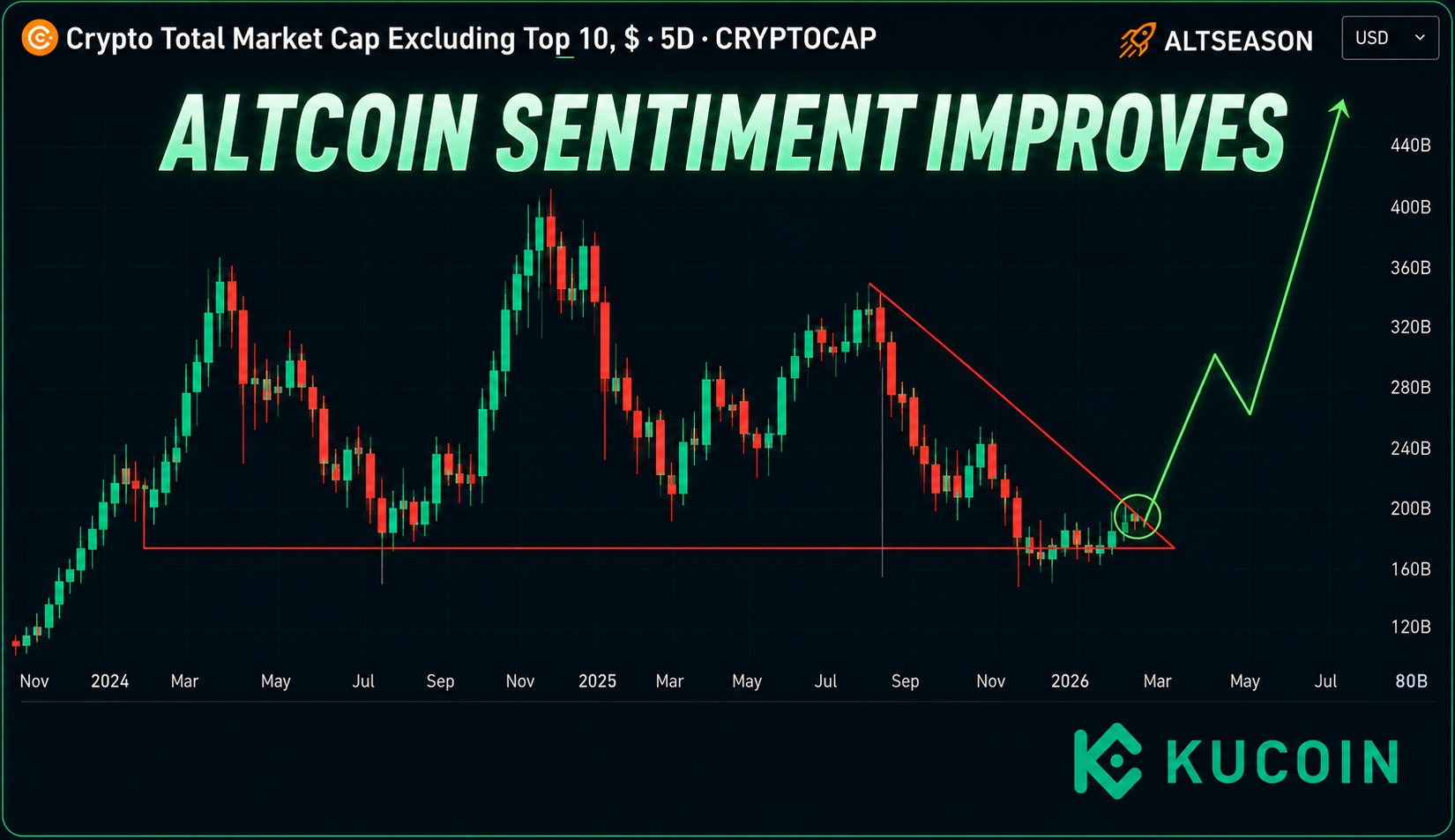
For most of 2025 and into 2026, Bitcoin has commanded the conversation and the capital. Altcoins have largely waited. Now, for the first time since January, the data is shifting.
In early May 2026, the CoinMarketCap Altcoin Season Index crossed the 50 mark on its short-term reading. Search volume for the term "altseason" hit its highest point of the year. Several altcoins staged sharp rallies that lifted total crypto market capitalization back toward $2.74 trillion. Altcoin sentiment shifted noticeably.
None of that means altseason has officially arrived. But it does mean something is moving, and investors who understand what is driving it are better positioned than those reacting to headlines and price actions.
This article breaks down what the current data actually shows, which technical signals analysts are watching, and which sectors are drawing real capital in this cycle.
What Is Altcoin Season and How Is It Measured?
Altcoin season, or altseason, is when capital stops concentrating in Bitcoin and starts moving broadly into alternative cryptocurrencies, driving prices higher across the market simultaneously.
The official benchmark for measuring it is the CoinMarketCap Altcoin Season Index. It tracks the top 100 coins by market cap, excludes stablecoins like Tether and DAI, and leaves out asset-backed tokens like WBTC and stETH. Every day, it measures how many of those coins have outperformed Bitcoin over the last 90 days. The score runs from 1 to 100.
Cross 75 and it is officially Altcoin Season. Drop to 25 or below and it is Bitcoin Season. Everything in between is a market in transition.
As of May 11, 2026, the index is oscillating around 50. That puts the market exactly at the midpoint between Bitcoin Season and a confirmed altseason. It is neither one nor the other. Capital is moving, but it has not committed to a direction yet.
The index crossing and holding above 50 is widely watched as the first meaningful threshold before the 75 confirmation level, and the fact that it is testing that level now is why altseason sentiment has picked up sharply this month.
History shows what a real altseason looks like when it arrives. During the first half of 2021, large-cap altcoins returned an average of 174% while Bitcoin returned just 2% over the same period. At the peak, the combined market cap of the top 100 altcoins reached roughly 130% of Bitcoin's. Multiple narratives ran simultaneously, trading volumes surged across large-cap coins, and FOMO was visible in price action across the board.
The cycle that leads into altseason follows a recognizable sequence. Bitcoin rises first and dominance climbs. Ethereum then starts outperforming. Network activity picks up, more applications get built and used, and new narratives attract capital across multiple sectors. Rotation out of Bitcoin accelerates. That progression, tracked daily through the CMC index, is what turns altseason from a feeling into a measurable market event.
How to Know When It Is Altseason?
Altseason is confirmed when the CoinMarketCap Altcoin Season Index crosses and holds above 75, meaning at least 75% of the top 100 qualifying coins have outperformed Bitcoin over the last 90 days.
One day above the threshold is not enough. Several consecutive days above it, with the reading staying elevated, is what separates a genuine altseason from a brief spike in sentiment.
Three supporting signals sharpen the picture further:
-
Bitcoin dominance (BTC.D) declining on a weekly basis: A one-day dip means nothing. A consistent weekly downtrend in BTC's share of total market cap is what creates room for altcoin capital inflows to register.
-
The ETH/BTC ratio is rising: In every prior cycle, Ethereum outperforming Bitcoin was one of the earliest signs that rotation was beginning. Capital historically flows from Bitcoin to Ethereum first, then spreads outward to smaller altcoins.
-
Trading volume spreads across multiple large-cap altcoins at once: Altseason is not one coin pumping or one sector running. It is broad-based volume and price appreciation happening simultaneously across the top 100.
In May 2026, none of these conditions are fully met. The index is oscillating around 50, not 75. BTC.D has not turned down convincingly on the weekly chart. The ETH/BTC ratio is recovering but has not broken out. Investors watching these markers have a clear, objective framework. The question is no longer whether altseason is coming. It is whether the current setup will produce the conditions that confirm it.
The State of Bitcoin Dominance in May 2026
Bitcoin dominance (BTC.D) is the ratio of Bitcoin's market cap to the total crypto market. When it rises, capital is concentrated in Bitcoin. When it falls in a growing market, altcoins tend to benefit.
BTC.D sits near 60.1% as of early May 2026. It recently broke out of an eight-month range that held between 58% and 60% from August 2025 through April. That breakout, on its face, is not good news for altcoins.
Momentum indicators give a mixed read. Recent Bitcoin dominance analyses shows RSI pushing into overbought territory and MACD turning positive, suggesting the breakout still has momentum, even if near-term exhaustion remains possible.
The key level most analysts are watching is 59.63%. That is the 0.236 Fibonacci retracement from the prior cycle. A weekly close below that level would be the first meaningful structural shift in favor of altcoins since the current Bitcoin-led phase began. It has not happened yet, but the setup is forming.
One additional nuance worth understanding: standard BTC.D calculations include the stablecoin market in the denominator. With USDT at roughly $189 billion and USDC near $78 billion, stablecoins inflate the total market cap by over $320 billion. When adjusted for that, Bitcoin's real dominance over risk-on altcoins is closer to 64%, not 60%.
That gap matters when assessing how far dominance actually needs to fall before altcoins benefit in a meaningful way.
Technical Patterns Analysts Are Watching for Altseason 2026
Beyond the Bitcoin dominance chart, several long-term technical structures are shaping the altseason narrative.
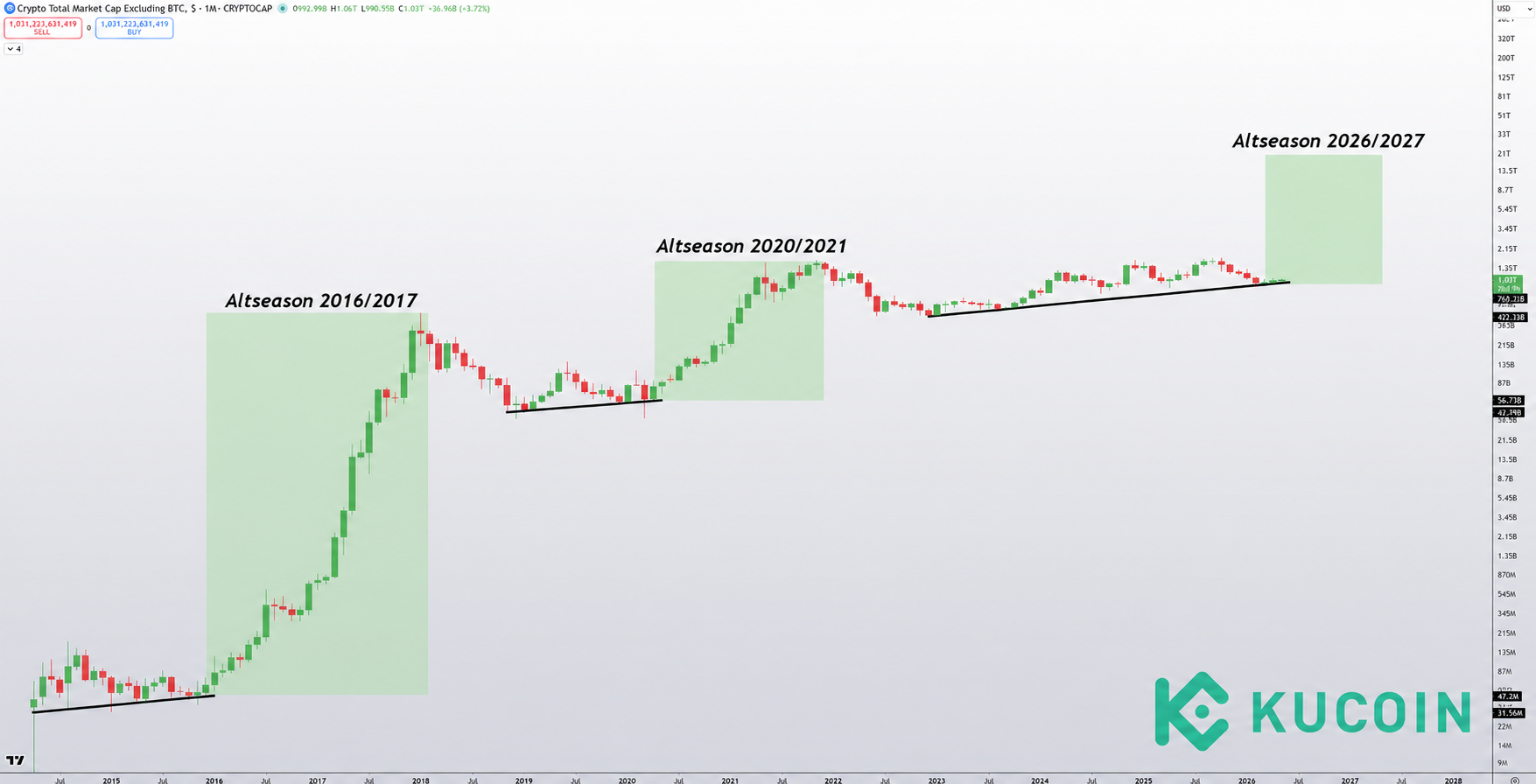
Crypto analyst El Crypto Prof on X recently highlighted a multi-year ascending triangle forming on the total altcoin market cap chart excluding Bitcoin. According to the analysis, similar structures have appeared three times over the past decade, with each preceding a major expansion phase for altcoins.
The first setup developed between 2015 and 2016. Altcoins consolidated within a broad range before briefly breaking below support in late 2016. That deviation marked the cycle low ahead of the 2017 altcoin rally. A comparable structure formed again between 2019 and 2020. The March 2020 Covid-driven crash pushed the market below the trendline temporarily before altcoins reversed sharply and entered the 2020–2021 expansion phase.
The current structure follows a similar trajectory. Altcoins established a base throughout 2022, maintained a rising trendline into 2024, and recently produced another deviation near the upper boundary of the formation. The total altcoin market cap currently sits around $1.2 trillion.
Another closely watched signal is Bitcoin dominance near the 59.63% level. A confirmed breakdown below that range would strengthen the case for capital rotating into altcoins. At the same time, traders are monitoring whether the Altcoin Season Index can sustain a move above 50, which would indicate broader participation across the altcoin market.
The technical outlook remains conditional. If Bitcoin dominance trends higher while the Altcoin Season Index weakens, the bullish altseason thesis loses momentum. However, if dominance continues to decline and altcoin participation expands, analysts expect these long-term patterns to gain further confirmation.
Why the 2026 Altseason Could Be Different From 2021
Before examining which sectors are leading, it is worth addressing the most common misunderstanding among retail investors entering this setup.
The 2021 altseason was broad. Capital flowed into almost everything at once. DeFi, NFTs, Layer-1 chains, meme coins, gaming tokens. The entire market lifted together for weeks at a time. Many investors came to see that as the default structure of an altseason.
In 2026, that model does not apply. Spot Bitcoin ETFs have now accumulated over $87 billion in cumulative inflows. That capital enters exclusively through Bitcoin. It does not rotate into altcoins. It creates a structural floor for BTC and compresses the pool of capital available to the broader market.
At the same time, the number of tradable altcoins has multiplied dramatically since 2021. Capital that does rotate into the altcoin market is spread across far more assets, diluting the impact on any individual token unless it has a specific narrative or catalyst behind it.
The result is a market where sector selection drives results. The investors doing well in 2026 are not those holding baskets of mid-cap altcoins waiting for the tide to lift everything. They are positioned in the narratives drawing real institutional capital: Real World Assets, Artificial Intelligence, Decentralized Physical Infrastructure, and Layer-2 networks.
Understanding why each of these sectors is attracting money is the core of any actionable altseason strategy right now.
Real World Assets: The Sector With Institutional Backing
Real World Asset (RWA) tokenization is the process of putting ownership rights to traditional financial instruments on the blockchain. Think government Treasury bills, private credit loans, real estate, and commodities represented as tokens that can be traded and settled on-chain.
This sector has moved faster than almost any other crypto narrative in recent memory. In early 2025, tokenized RWAs were worth about $5.4 billion. By late April and early May 2026, the market had grown to roughly $28 billion to $31 billion, with much of the expansion coming from institutional categories such as credit, funds, gold, and equities.
Platforms like Ondo Finance and Securitize each held over $2 billion in total value locked earlier this year, according to DefiLama data.
The appeal is straightforward. Tokenized Treasury products are currently offering 4.5% to 5.2% annual yields with on-chain liquidity. That is competitive with traditional fixed income and accessible without a brokerage account. For institutional allocators already operating in DeFi, it is an obvious product. For retail investors, platforms like Ondo Finance and Franklin Templeton's BENJI offer lower entry barriers.
The important distinction with RWA compared to other narratives is that the capital entering it is not speculative. It is seeking yield, not price appreciation. That makes RWA one of the more durable inflows of the cycle, less vulnerable to sentiment swings than, say, meme coins or gaming tokens.
Artificial Intelligence Tokens: From Hype to Revenue
The intersection of AI and blockchain was a speculative narrative in 2024. In 2026, parts of it have become something more verifiable: actual revenue from real usage.
Bittensor (TAO) is the clearest example. The protocol generated $43 million in revenue during Q1 2026 from real AI service usage, not from token sales or speculation. TAO rose 21.57% quarter over quarter off the back of that performance. Nvidia deployed $420 million into the protocol, with 77% staked. Polychain Capital added another $200 million. These are not retail-driven flows.
The broader AI crypto sector reached between $26 billion in combined market cap by early May 2026. Tokens like Render (RENDER), Fetch.ai (FET), and SingularityNET (AGIX) sit around decentralized compute, autonomous agent infrastructure, and distributed AI model deployment.
The key difference between AI tokens worth holding and those that are not is the revenue test. Protocols generating real fees from real users have a fundamental anchor that speculative tokens do not. In a market where institutional capital is increasingly involved, that distinction separates the assets that get accumulation from those that get ignored.
DePIN: Blockchain Meets the Physical World
Decentralized Physical Infrastructure Networks, or DePIN is a growing sector that uses blockchain token incentives to coordinate the deployment of real-world hardware. DePIN participants contribute compute power, wireless coverage, data storage, or sensor networks and earn tokens in return.
The sector reached $20 billion across several projects as of early 2026. The narrative gained meaningful mainstream attention following major infrastructure disruptions in Europe, which demonstrated the fragility of centralized grid systems and made decentralized alternatives more credible in public conversation.
The most significant tailwind for DePIN right now is its convergence with AI. The global demand for GPU compute is outpacing what centralized data centers can supply. DePIN projects that provide decentralized compute infrastructure are a direct beneficiary of that gap. Render Network operates directly at this intersection, allowing GPU owners to sell unused compute capacity to creators and AI developers.
Investors approaching DePIN should be selective. The sector's track record varies sharply by project. Hardware deployment costs, token inflation mechanics, and the challenge of maintaining service quality through decentralized coordination are real risks. Projects with active deployments and measurable service metrics are worth evaluating. Those with theoretical utility and no live hardware are significantly higher risk.
Ethereum and Layer-2 Networks: The Historical Gateway
In every prior cycle, the first signal of a genuine altseason was not a broad market move. It was Ethereum beginning to outperform Bitcoin on the ETH/BTC ratio. Capital historically flows from Bitcoin to Ethereum first, and then continues outward into smaller altcoins. That sequencing has not changed.
Ethereum is currently priced around $2,299 to $2,332 as of early May, recovering from a low of $1,821 in February 2026. Its all-time high was $4,953 in August 2025. At current levels, Ethereum has significantly underperformed both Bitcoin and its own prior cycle pattern on a percentage basis.
That underperformance, relative to its historical precedent, is part of why analysts see it as a rotation candidate when Bitcoin dominance begins to fall.
The DeFi sector built on Ethereum and Layer-2 infrastructure has matured substantially. It is no longer purely speculative; it is increasingly evolving into institutional-grade financial infrastructure that powers decentralized applications. That underlying demand supports the medium-term case for Ethereum and its ecosystem tokens.
The Risks That Could Delay a Broader Altcoin Recovery
Improving sentiment and strong sector narratives do not eliminate the structural headwinds facing altcoins. Three deserve honest acknowledgment.
The first is the ETF capital lock-in. Spot Bitcoin ETFs have now pulled in over $87 billion. That capital is held by institutional investors accessing crypto through regulated financial products. It does not rotate into altcoins, and it will not unless altcoin ETFs reach comparable scale. Ethereum ETFs are live. Solana, XRP, and Hyperliquid filings are pending. But the gap between Bitcoin ETF inflows and altcoin ETF inflows remains enormous.
The second is the Federal Reserve. The Fed has signaled one rate cut in the second half of 2026, and markets have priced in limited relief until that materializes. Altcoins are more sensitive to rate expectations than Bitcoin because they carry higher risk. Any renewed tightening signals would likely pressure altcoins disproportionately.
The third is the liquidity fragmentation problem. The altcoin market in 2026 contains vastly more tokens than in 2021. The same total capital inflow distributed across a broader universe of assets produces smaller individual price moves. For broad altseason conditions, the stablecoin pool of over $320 billion needs to actively rotate into altcoin positions at scale, not just sit idle. That rotation has not yet materialized.
What Confirms a Genuine Altseason?
The improving sentiment in May 2026 is a real signal. The Altcoin Season Index crossing 50, search interest reaching a yearly high, and strong rallies across select altcoins all point to growing market attention and early capital rotation.
Still, a confirmed altseason requires three conditions to align at the same time:
-
Bitcoin dominance must sustain a weekly close below 59.63%.
-
The 90-day Altcoin Season Index needs to break above 50 and remain there.
-
Stablecoin liquidity must rotate more visibly into altcoins through stronger exchange volume and on-chain activity.
So far, none of those conditions are fully confirmed. The 90-day index is still hovering around 50. Bitcoin dominance has yet to secure a sustained breakdown below 59.63%. Stablecoin capital flows into altcoins also remain limited.
Most analysts currently see three possible scenarios for the remainder of 2026.
The base case, with roughly 60% probability, is selective rotation. Sectors such as AI, RWA, and DePIN continue attracting capital while the broader altcoin market remains uneven. In this environment, sector selection matters more than expecting every altcoin to rally simultaneously.
The second scenario, estimated around 30%, is a broader altseason emerging in late 2026 or early 2027. For that to happen, Bitcoin dominance would need to break decisively lower while capital rotates across a much wider portion of the market, particularly the top 100 assets.
The final scenario, carrying roughly 10% to 20% probability, is prolonged Bitcoin dominance. Continued institutional ETF inflows could keep BTC.D elevated near 66%, leaving altcoins under pressure well into next year.
Momentum is clearly improving, but the market has not delivered full confirmation yet.
Conclusion
Altcoin sentiment has improved meaningfully in May 2026, but the market has not yet entered a fully confirmed altseason. The Altcoin Season Index moving above 50, rising search interest, and renewed strength across select sectors all suggest that capital rotation is beginning. However, Bitcoin dominance remains elevated, the ETH/BTC ratio has not fully broken out, and stablecoin liquidity has yet to rotate into altcoins at the scale seen in previous cycles.
Unlike 2021, this cycle is shaping up to be far more selective. Broad market rallies are less likely in an environment where Bitcoin ETFs continue absorbing institutional capital and the number of tradable altcoins has expanded significantly. Instead, capital is concentrating around sectors with stronger fundamentals and real-world demand.
So far, Real World Assets (RWA), Artificial Intelligence (AI), DePIN, and Ethereum-related infrastructure are leading the market narrative. These sectors are attracting attention because they are tied to measurable adoption, institutional participation, or growing network utility rather than purely speculative momentum.
For investors and market participants, the key signals remain clear: Bitcoin dominance needs to weaken structurally, the Altcoin Season Index must sustain higher readings, and liquidity needs to spread across a broader range of assets. Until then, the current environment looks more like an early-stage rotation phase than a full altseason confirmation.
FAQs
What is altcoin season?
Altcoin season is a market phase where most altcoins outperform Bitcoin over a sustained period. It is commonly measured using the CoinMarketCap Altcoin Season Index.
How is the Altcoin Season Index calculated?
The index tracks whether the top 100 cryptocurrencies outperform Bitcoin over the previous 90 days. A score above 75 is generally considered a confirmed altseason.
Which crypto sectors could lead the 2026 altseason?
RWA, AI, DePIN, and Ethereum Layer-2 projects are currently leading the 2026 altcoin narrative due to growing institutional interest and stronger real-world utility.
What is Bitcoin dominance (BTC.D)?
Bitcoin dominance measures Bitcoin’s share of the total cryptocurrency market capitalization. Falling BTC.D often signals capital rotating into altcoins.
Can Ethereum trigger the next altseason?
Historically, altseason begins after Ethereum starts outperforming Bitcoin on the ETH/BTC trading pair, making Ethereum a key market indicator for altcoin momentum.
Disclaimer: This article is for informational and educational purposes only and does not constitute financial or investment advice. Cryptocurrency markets are volatile. Conduct independent research before making any investment decisions.