

Meta Muse Wonder Explained: Features, AI Agent Capabilities, and How It Compares to ChatGPT
Meta introduced Muse Wonder and Muse Wonder Full on October 12, 2026, expanding its artificial intelligence capabilities with models designed for complex reasoning, software development, and autonomous AI agents. Developed by Meta Superintelligence Labs, the models feature Active Memory and Active Focus, two technologies intended to improve how AI systems retain information and complete long-running tasks. Muse Wonder also competes with advanced OpenAI models, including GPT-6 Astra, across several AI performance benchmarks. With developer access available and broader integration into Meta's Muse assistant planned, the launch raises important questions about how Meta Muse Wonder compares with ChatGPT in features, performance, pricing, and practical applications.
Key Takeaways
-
Meta Muse Wonder launch: Meta introduced Muse Wonder and Muse Wonder Full on October 12, 2026, targeting complex AI-agent workflows, software development, and professional tasks involving financial, legal, and health information.
-
Active Memory and Active Focus: The models are designed to retain relevant information across conversations, recover from errors, and continue multi-step assignments while requesting clarification or approval when necessary.
-
AI benchmark performance: Muse Wonder Full scored 56 on the Artificial Analysis Intelligence Index, compared with 52 for standard Muse Wonder. Both models are competitive, although performance varies across different evaluations.
-
API pricing and context capacity: Muse Wonder supports approximately one million tokens of context, with standard API pricing of $4 per million input tokens and $20 per million output tokens.
-
Availability and subscriptions: Muse Wonder is accessible through Meta's API and Muse Code, while Wonder Full requires a qualifying Muse Code subscription starting at $50 monthly. Broader consumer integration into Muse was announced as a future rollout.
-
ChatGPT comparison and privacy: Both ecosystems support agentic workflows, but access, pricing, and data controls differ. Meta's Muse Code subscriptions default to Contributor mode, which permits training use unless disabled.
What Is Meta Muse Wonder and How Does It Work?
Meta Muse Wonder is a family of advanced artificial intelligence models developed by Meta Superintelligence Labs and introduced on October 12, 2026. The lineup includes Muse Wonder and Muse Wonder Full, both designed for complex tasks involving reasoning, research, software development, and autonomous workflows. Building on Meta's earlier Muse Spark models, the new systems focus on agentic AI, allowing AI-powered applications to plan actions, use connected tools, and work through multi-step assignments rather than simply generating responses to individual prompts. Meta developed the models using advances in pretraining and reinforcement learning, with the aim of improving their performance on sustained professional and personal tasks.
How Muse Wonder Handles Complex Tasks
Muse Wonder works by interpreting a user's objective, identifying the necessary steps, and using available tools to complete the assignment. Its agentic architecture supports task planning, parallel tool execution, and delegation to specialized sub-agents when supported by the application. For example, a software development agent can examine project requirements, modify code across multiple files, run tests, and address errors during implementation. The model can also reconsider its approach when an initial attempt fails, although successful execution depends on the accuracy of its reasoning and the capabilities of its connected tools.
The models support a context window of 1,048,576 tokens, allowing them to process extensive documents, codebases, and other information within a single request. Meta also reports multimodal capabilities involving text, images, audio, video, and PDF documents. Similar approaches to planning and automated execution appear in AI agents in cryptocurrency, where connected systems can analyze blockchain activity and perform defined tasks. However, Muse Wonder is not a dedicated cryptocurrency trading platform, and its ability to interact with external applications depends on the permissions and integrations provided by developers.
Muse Wonder, Muse Wonder Full, and Meta's AI Ecosystem
Meta developed two versions of Muse Wonder to support different levels of AI-powered work. Both models share approximately one-million-token context capacity, but Muse Wonder Full is positioned as the higher-capability version for demanding professional and development tasks. The distinction between these models and Meta's broader AI products is important because an underlying model does not automatically provide every feature available through a connected application.
-
Muse Wonder: The standard model, available through the Meta Model API and Muse Code for developers building AI-powered applications and automated workflows.
-
Muse Wonder Full: Meta's more capable model, accessible through qualifying Muse Code subscriptions for demanding coding and agentic tasks.
-
Muse Code: Meta's AI coding environment, which supports software development, debugging, and multi-agent workflows using compatible Muse models.
-
Muse personal AI agent: Meta's consumer-facing assistant, which is expected to incorporate Muse Wonder capabilities through a phased rollout beginning with subscribers.
Meta Muse Wonder Features, Active Memory, and AI Agent Capabilities
Meta Muse Wonder introduces two core technologies, Active Memory and Active Focus, designed to make AI agents more useful for tasks that extend beyond individual conversations. These capabilities help the models retrieve relevant information, maintain progress toward objectives, and respond when circumstances change. Meta has also expanded their ability to work with professional information, navigate digital environments, and handle assignments involving multiple decisions. The focus is on improving practical task execution while allowing users to retain control over important actions.
Active Memory: How Muse Wonder Remembers and Retrieves Information
Active Memory allows Muse Wonder to carry important information across conversations and retrieve relevant details when they become useful. Rather than relying entirely on instructions repeated in every interaction, the model is designed to recognize connections between earlier conversations and new requests. For example, an AI assistant could use previously shared preferences or project requirements when preparing a new recommendation, reducing the need for users to explain the same information repeatedly. Meta describes this selective retrieval as a central component of its approach to personalized AI agents.
The distinction between remembering information and using it appropriately is particularly important. A system may retain extensive conversation history without identifying which details matter for a particular task. Muse Wonder's Active Memory is intended to address this problem by bringing relevant context into the reasoning process when needed. However, the feature does not guarantee perfect recall, and persistent memory should not be confused with the amount of information a model can process in a single request. Its effectiveness also depends on the surrounding application's memory implementation and data-access controls.
Active Focus: How Muse Wonder Maintains Progress on Difficult Tasks
Active Focus is designed to help Muse Wonder continue working when a task encounters unexpected difficulties. Instead of stopping after an unsuccessful attempt, the model can reconsider its approach, respond to new information, and work through obstacles. This is particularly relevant to long-running assignments involving changing requirements, multiple sources of information, or several dependent actions. Meta evaluates this capability through FocusBench, an internal assessment of how agents handle obstacles across multiple interactions, while SWE-Marathon measures sustained execution on complex software engineering projects.
An important part of Active Focus is determining when independent action is appropriate and when human input is necessary. Meta states that Muse Wonder can request clarification when instructions are unclear and seek approval before important actions. For businesses using agentic AI, these safeguards matter when workflows involve financial records, confidential documents, or external services. However, the ability to continue working does not eliminate errors or guarantee task completion. Organizations still need suitable permissions, monitoring, and verification procedures when deploying autonomous agents in sensitive environments.
AI Agent Capabilities: Research, Personalization, and Professional Applications
Beyond memory and sustained reasoning, Muse Wonder supports AI agents that can interpret information, interact with digital services, and produce outputs tailored to specific requirements. Meta has demonstrated several applications involving personal planning, document-based work, and coordinated actions across websites. In financial markets, related applications of AI in crypto trading involve automated market monitoring, data analysis, and trading strategies. However, Meta has not announced Muse Wonder as a dedicated trading system, and its general financial-analysis capabilities should not be confused with verified investment performance.
Examples presented in Meta's research include:
-
Personalized activity planning: Preparing a running plan using individual preferences and circumstances while interacting with browsers and connected applications.
-
Complex event organization: Creating a wedding seating chart that accounts for multiple matching requirements and guest relationships.
-
Customized product orders: Designing and ordering personalized merchandise using photographs from an Instagram profile.
-
Professional document analysis: Working with legal, financial, and health-related information to support research and document-based assignments, with specialist review remaining important for consequential decisions.
These applications illustrate how Muse Wonder's capabilities extend beyond conventional question answering. Their practical value depends on the accuracy of the model's reasoning, the reliability of connected tools, and the level of control users retain over access to information and external actions.
Meta Muse Wonder vs ChatGPT on Performance, Pricing, and Availability
The comparison between Meta Muse Wonder and ChatGPT extends beyond AI model performance to include practical capabilities, developer costs, and product accessibility. Meta's models compete with advanced OpenAI reasoning systems, particularly GPT-6 Astra, while ChatGPT provides a broader assistant platform with integrated research, coding, and productivity tools. Independent benchmarks indicate that Muse Wonder Full performs competitively in several demanding tasks, although neither system consistently leads across every evaluation. Understanding these differences helps users assess which platform better suits their professional, technical, or everyday requirements.
Muse Wonder vs ChatGPT: AI Agent Performance and Real-World Capabilities
Muse Wonder and ChatGPT can both support complex AI-assisted work, but their capabilities are delivered through different products and workflows. Meta emphasizes autonomous agents built around its models, particularly for software engineering, professional research, and tasks involving external applications. OpenAI offers comparable functionality through ChatGPT Work and Codex, allowing users to conduct research, develop software, analyze information, and produce documents or applications. ChatGPT Work also supports connected services and recurring workflows, with user control over consequential actions.
The comparison requires separating the underlying AI models from the applications built around them. ChatGPT provides an established interface for users who need research, writing, data analysis, and application integrations, while Meta's Muse Wonder developer services allow programmers to build customized agents. Neither system should be considered universally superior based on advertised features alone. Reliability, available integrations, subscription limits, and the ability to review completed work are more meaningful considerations than whether a particular capability is described as autonomous.
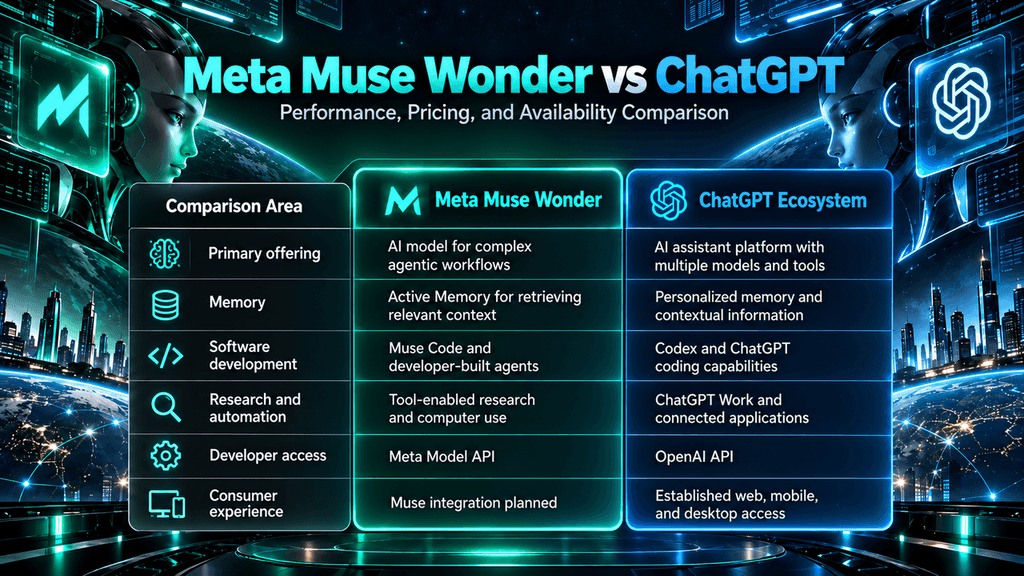
Both platforms support AI-assisted workflows, although their practical usefulness depends on the tools, integrations, and permissions available. Muse Wonder is particularly relevant to developers building customized AI agents, while ChatGPT offers an established environment for research, content creation, coding, and everyday productivity. The better choice depends on the user's requirements rather than model capabilities alone.
Meta Muse Wonder vs GPT-6 Astra: What Do AI Benchmarks Show?
Meta's October 12, 2026, model card reported competitive results against OpenAI's GPT-6 Astra and Anthropic's Claude models. Independent evaluations from Artificial Analysis provide additional context, although some task-specific comparisons published by Meta combine third-party measurements, provider-reported scores, and internally conducted testing. The results suggest that Muse Wonder Full is particularly capable in sustained software engineering and selected professional tasks, while competing models retain advantages in other evaluations.
Several benchmark results illustrate these differences:
-
Overall AI performance: Muse Wonder Full scored 56 on the Artificial Analysis Intelligence Index, compared with 53 for GPT-6 Astra and 52 for standard Muse Wonder. Claude Opus 5.5 scored 58 on the same evaluation.
-
Software engineering: Meta's published DeepSWE 1.1 comparison shows Muse Wonder Full scoring 79.0%, against 74.1% for GPT-6 Astra. The figures come from different reporting sources, so they are not a perfectly controlled head-to-head comparison.
-
Financial research: Muse Wonder Full scored 59.1 on Vals Finance Agent V2, compared with 53.5 for GPT-6 Astra. The benchmark evaluates financial-analysis tasks involving company filings and market information.
-
Healthcare reasoning: GPT-6 Astra scored 65.3 on HealthBench Pro, exceeding Muse Wonder Full's 62.3. This evaluation assesses responses to professional-grade medical questions.
The evaluation methodology is essential to understanding these figures. On DeepSWE 1.1, Meta's scorecard uses Datacurve's third-party results for Muse Wonder Full and OpenAI's provider-reported result for GPT-6 Astra. Other software engineering evaluations may also use different agent frameworks and execution environments. Strong benchmark performance does not guarantee reliable real-world results, particularly when AI agents handle financial decisions, confidential records, or complex technical systems.
Meta Muse Wonder Pricing Compared With ChatGPT
Meta offers Muse Wonder through usage-based API pricing and separate Muse Code subscriptions. According to Meta's published pricing, the standard model costs $4 per million input tokens and $20 per million output tokens, with cached input priced at $0.20 per million tokens. Meta does not apply a separate long-context pricing premium, although additional charges apply to certain tools, including web search grounding. OpenAI also offers usage-based API access, but its pricing depends on the selected model, context length, and processing tier. Comparing developer costs therefore requires identifying the exact models and billing conditions rather than relying on a single advertised rate.
For developers requiring Muse Wonder Full, Meta offers the Muse Code Power Usage plan at $50 per month and Maximum Usage at $200 per month. These plans provide different usage allowances, with the higher tier offering 80 times the Everyday Usage allowance. ChatGPT follows a separate subscription structure, including free access and paid Plus, Pro, Business, and Enterprise options, with capabilities varying by plan. Comparing monthly prices alone would be misleading because Muse Code primarily serves software development workflows, whereas ChatGPT subscriptions cover a broader collection of assistant features. Additional API usage, connected services, and specialized tools may also affect operating costs.
Muse Wonder Availability, Privacy, and Access Restrictions
As of October 14, 2026, Muse Wonder's availability depends on whether users want developer access or a consumer AI assistant. Meta introduced the standard model through its developer services, while the more capable Full version has additional access restrictions. ChatGPT is available through web and mobile applications, with more advanced agentic workflows accessible according to subscription eligibility. Meta has also announced plans to extend Muse Wonder into its consumer-facing Muse assistant, although its original launch announcement did not provide a confirmed date for universal availability.
Several access and privacy considerations are relevant:
-
Developer deployment: Muse Wonder is available through the Meta Model API, but Muse Wonder Full is restricted to qualifying Muse Code subscriptions rather than standard pay-as-you-go API access.
-
Training and data controls: In Standard mode, Meta states that submitted prompts, files, code, context, and model responses are not used to train Meta models. Muse Code subscriptions default to Contributor mode, which permits training use in exchange for additional usage. Subscribers can disable that setting for future content.
-
Consumer accessibility: ChatGPT offers an established consumer interface, whereas Meta's broader integration of Muse Wonder into the Muse assistant remains subject to its announced rollout schedule.
-
Business adoption: Organizations should evaluate account permissions, data-handling policies, integration compatibility, and approval requirements before allowing either platform to perform sensitive financial or operational tasks.
For organizations considering either system, data governance and deployment controls are as important as model performance. Access to confidential documents or the authority to make external changes should be granted according to operational requirements, with clear accountability for decisions and actions. For cryptocurrency users, the security risks of AI assistants can also include exposed API credentials, unauthorized wallet access, and excessive application permissions. These concerns apply broadly to connected AI agents rather than being specific to Muse Wonder.
Conclusion
Meta Muse Wonder expands Meta's AI capabilities with models designed for complex reasoning, long-running assignments, and professional AI-agent workflows. Its Active Memory and Active Focus technologies aim to improve how agents retrieve information, recover from difficulties, and complete tasks involving connected applications. Benchmark results indicate that Muse Wonder Full competes closely with advanced models from OpenAI and Anthropic, particularly in software engineering and selected professional evaluations.
The choice between Muse Wonder and ChatGPT ultimately depends on the intended workflow. Meta offers developers access to models designed for customized AI agents, while ChatGPT combines research, coding, and productivity capabilities within an established assistant platform. Pricing, integration options, data controls, and real-world reliability are important considerations for both systems. As Meta expands Muse Wonder into its consumer ecosystem, independent testing and transparent safety practices will help determine how its capabilities perform beyond controlled evaluations.
🔥 Beyond the Headlines: What KuCoin 5.0 Means for You
Market news moves fast — but where you act on it matters just as much. This October, KuCoin launches KuCoin 5.0, transforming KuCoin into a rebuilt platform. Here's what actually changes for you:
-
One account for everything. Older platforms split your money across separate "spot," "margin," and "futures" accounts and expected you to understand why. KuCoin 5.0's unified account removes that entirely — deposit once, and everything is simply there (only available to VIPs for now).
-
Stocks, indices, and commodities. KuCoin 5.0 expands beyond crypto into global markets. When crypto chops sideways and equities rally (or the reverse), you rotate in minutes instead of opening a brokerage account and waiting days for fiat rails.
-
Real-world assets (RWA). Tokenized exposure to traditional assets like commodities, right inside your crypto account. One of the fastest-growing segments in global finance is no longer reserved for institutions — you access it from the same balance you trade with.
-
Earn while you learn. Not ready to trade? KCUSD lets your stablecoins earn daily, auto-compounding interest. The lowest-stress way to put your idle deposit to work for 4% yield.
-
An AI assistant in plain language. Ask questions, get market context, understand what you're looking at — built into the platform, no jargon required.
-
An app that doesn't overwhelm. Faster, cleaner, and consistent — intuitive from the first tap, not after a tutorial.
-
Safety you can check, not just trust. A MiCAR-licensed EU entity, Proof of Reserves you can verify yourself, and internationally certified security (SOC 2 Type II, ISO 27001:2022).
Create your account in minutes — and start on the platform built for where crypto is going, not where it's been.
FAQs
Is Meta Muse Wonder open source?
No. Meta Muse Wonder and Muse Wonder Full are proprietary AI models, and their model weights have not been publicly released. Developers can access Muse Wonder through Meta's hosted services, but they cannot download and run the full model independently. Meta offers Muse Glimmer as a separate open-weight alternative for developers who need local deployment and greater control over their infrastructure.
Can Meta Muse Wonder generate images, videos, and audio?
Muse Wonder can analyze text, images, videos, audio recordings, and PDF documents, but its direct output is text. For image generation and editing, Meta provides a separate model called Muse Image. This distinction matters because understanding visual or audio content does not automatically mean a model can generate those media formats. Developers may combine different models to build applications with broader multimodal functionality.
Does Muse Wonder have access to real-time internet information?
Muse Wonder can retrieve current information through supported web search tools when developers enable search grounding. This allows applications to incorporate information beyond the model's existing training knowledge. However, internet access is not automatic for every request, and retrieved information may still contain inaccuracies. Financial researchers should verify market prices, company announcements, and economic figures against authoritative sources before relying on AI-generated analysis.
Can Meta Muse Wonder be trusted for cryptocurrency trading or investment decisions?
Muse Wonder can assist with financial research, document interpretation, and the organization of market information, but its outputs should not replace independently verified financial analysis. AI models can misinterpret data, overlook relevant developments, or generate inaccurate conclusions. Investors should confirm prices, financial disclosures, and regulatory information using reliable sources. Any application that executes trades or handles funds should also maintain appropriate authorization, transaction limits, and human oversight.
Disclaimer
The information provided on this page may originate from third-party sources and does not necessarily represent the views or opinions of KuCoin. This content is intended solely for general informational purposes and should not be considered financial, investment, or professional advice. KuCoin does not guarantee the accuracy, completeness, or reliability of the information, and is not responsible for any errors, omissions, or outcomes resulting from its use. Investing in digital assets carries inherent risks. Please carefully evaluate your risk tolerance and financial situation before making any investment decisions. For further details, please consult KuCoin’s Terms of Use and Risk Disclosure.