

Jupiter Adds Anchorage-Backed USDGO to Its $1 Billion Solana Lending Platform
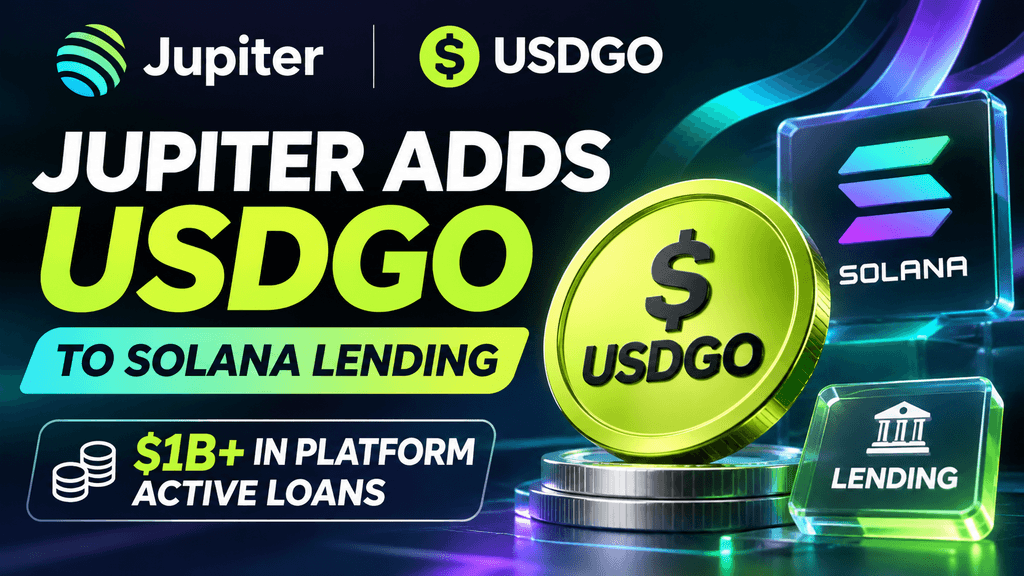
Jupiter adds Anchorage-backed USDGO to its $1 billion Solana lending platform, expanding stablecoin borrowing, liquidity, and DeFi yield opportunities. Jupiter has expanded its Solana-based decentralized finance services by launching a dedicated lending market for USDGO, a U.S. dollar-backed stablecoin issued by Anchorage Digital Bank. Announced on November 12, 2026, the integration allows users to supply USDGO for variable interest or borrow the stablecoin against eligible cryptocurrency collateral. The development follows Jupiter Lend's milestone of more than $1 billion in active loans, highlighting the platform's expanding role in on-chain credit markets. With USDGO valued at approximately $1.1 billion at launch, the integration introduces additional lending utility while raising questions about liquidity, borrowing demand, and long-term stablecoin adoption.
Key Takeaways
-
Jupiter launched USDGO lending on Solana on November 12, 2026, enabling stablecoin deposits and collateral-backed borrowing through Jupiter Lend.
-
Jupiter Lend surpassed $1 billion in active loans, highlighting its growing role in Solana's decentralized finance ecosystem.
-
Anchorage Digital Bank issues USDGO, while OSL Group manages its distribution, connecting institutionally issued stablecoin liquidity with decentralized lending.
-
USDGO lending offers variable interest rates, while collateral requirements, liquidation thresholds, and smart-contract vulnerabilities introduce additional financial risks.
-
USDGO's approximately $1.1 billion market capitalization at launch provides potential liquidity, but actual lending adoption depends on deposits and borrowing demand.
-
Future growth will depend on Solana stablecoin adoption, Jupiter's platform expansion, liquidity conditions, institutional participation, and sustained USDGO lending activity.
How Does Jupiter’s New USDGO Lending Market Work on Solana?
Jupiter's dedicated USDGO market expands lending and borrowing services on the Solana (SOL) network. Through Jupiter Lend, users can deposit the dollar-backed stablecoin into lending pools or borrow USDGO against supported cryptocurrency collateral. Issued by Anchorage Digital Bank and operated and distributed by OSL Group, USDGO gains another financial application beyond payments, transfers, and on-chain trading. The integration connects dollar-denominated assets with decentralized lending infrastructure, allowing borrowing and lending transactions to be managed through blockchain-based smart contracts.
How USDGO Lending and Collateral-Backed Borrowing Work on Jupiter Lend
Jupiter Lend operates through automated lending pools that connect stablecoin depositors with borrowers. Users supplying USDGO contribute liquidity to the protocol's Earn product, where deposited assets become available for collateral-backed borrowing. In return, lenders receive variable interest generated by borrowing demand, with annual percentage yields (APYs) determined by pool utilization and applicable incentives. According to Jupiter's official documentation, depositors receive JL Tokens representing their share of the lending pool, which accumulate value as interest accrues. The protocol retains a 10% reserve factor from borrower interest payments, while the remaining 90% is allocated to lenders. Unlike fixed-return arrangements, lending yields fluctuate with borrowing activity, available liquidity, and changes in incentive programs.
Borrowers can access USDGO without immediately selling their existing cryptocurrency holdings by depositing supported assets as collateral. Jupiter's launch highlighted Solana (SOL), Jupiter Perps LP (JLP), and Bitcoin (BTC) among the collateral options associated with the new market, subject to individual vault requirements and supported token representations. The protocol uses overcollateralized lending, meaning borrowers must maintain collateral worth more than their outstanding debt under the applicable risk parameters. Smart contracts monitor borrowing positions and can initiate liquidations when collateral values breach specified thresholds. Borrowing costs, collateral limits, and liquidation conditions vary by market, making individual vault parameters important when evaluating the financing arrangement.
How Anchorage Digital and OSL Group Support USDGO's Solana Integration
Anchorage Digital Bank, a federally chartered U.S. digital asset bank, issues USDGO, while Hong Kong-listed OSL Group oversees its branding, distribution, and commercial applications. The stablecoin is designed to maintain a one-to-one relationship with the U.S. dollar through reserves consisting of cash and high-quality liquid assets, including U.S. Treasuries. Anchorage publishes monthly third-party reserve attestations to provide transparency around the assets supporting circulating USDGO. The issuance framework gives the stablecoin an institutional foundation, although oversight of the issuer is distinct from the operation and security of decentralized lending protocols.
The November launch represents the second phase of USDGO's integration with Jupiter, following its introduction to on-chain trading on October 12, 2026. That earlier phase enabled trading liquidity through Jupiter Lend's Smart Vaults using Fluid's Liquidity-as-a-Service infrastructure. The latest expansion introduces dedicated borrowing and lending functions, creating another use case for USDGO within Solana's financial ecosystem. Access through self-custodial wallet infrastructure also broadens the potential distribution of these services without requiring users to transfer custody to a centralized account. Actual adoption, however, will be determined by deposits, borrower participation, and available liquidity rather than the number of wallets capable of accessing the market.
Why Jupiter’s USDGO Integration Matters for Its $1 Billion Lending Platform
Jupiter's USDGO integration connects an institutionally issued stablecoin with an established decentralized credit market. On November 11, 2026, Jupiter announced that its lending platform had surpassed $1 billion in active loans, demonstrating the scale of borrowing activity before the new stablecoin market was introduced. Adding USDGO expands the range of dollar-denominated assets available through Jupiter's infrastructure and could diversify borrowing options. However, the milestone represents outstanding loans across the platform's lending markets, not funds deposited into the newly introduced USDGO market.
What Jupiter's $1 Billion Active Loan Milestone Reveals About Its DeFi Growth
Active loans measure the outstanding value of assets borrowed through a lending protocol, whereas total value locked (TVL) measures assets held within its smart contracts. These indicators provide different perspectives on financial activity and should not be treated as interchangeable. Jupiter's November 11 announcement reported approximately $1.7 billion in ecosystem-wide TVL, based on early-November DeFiLlama data, alongside more than $2 trillion in cumulative decentralized exchange aggregator trading volume. These figures illustrate the scale of Jupiter's broader financial infrastructure rather than USDGO-specific adoption. Their significance lies in showing that the new lending market can use an existing protocol framework instead of requiring an entirely separate lending system.
Lending balances also demonstrate why performance must be evaluated across consistent reporting periods. DeFiLlama recorded approximately $961 million in Jupiter Lend TVL on November 13, while active loans stood near $901 million. These observations illustrate how balances can fluctuate after a protocol crosses a major milestone. From an operational perspective, additional stablecoin liquidity may help accommodate different borrowing preferences, but increased deposits do not automatically translate into higher protocol revenue. Borrowing demand, interest rates, utilization, and the protocol's retained share of interest determine each market's economic contribution. Tracking borrower-paid fees and protocol revenue alongside TVL therefore provides a more complete assessment of lending performance.
How USDGO's $1.1 Billion Market Capitalization Could Support Jupiter's Lending Liquidity
USDGO's approximately $1.1 billion market capitalization at the November 12 announcement represents an existing supply of dollar-denominated assets that could potentially support additional lending activity. However, circulating market capitalization is not equivalent to available lending liquidity, since tokens may remain in wallets, support payments, or participate in other financial applications. Historical CoinGecko data shows that USDGO's market capitalization declined from approximately $1.299 billion on October 29 to $1.081 billion on November 12, a decrease of about 16.8%, while its reported closing price remained near $1.00. This reflects a contraction in reported circulating value rather than a comparable decline in the stablecoin's price. The reasons for the change cannot be established from market capitalization alone. Jupiter's new lending market creates another potential source of USDGO demand, but its financial contribution will depend on actual deposits, outstanding loans, and sustained utilization rather than the stablecoin's total circulating value.
How Anchorage-Backed USDGO Lending Yields, Collateral, and Risks Compare
The expansion of USDGO into decentralized lending introduces important differences between stablecoin reserve-backed rewards and returns generated through borrowing activity. While the stablecoin's reserves support its intended U.S. dollar peg, lending interest depends on market conditions, borrower demand, and incentive arrangements. Collateral requirements determine borrowing capacity, while liquidation mechanisms seek to protect lending pools when positions become insufficiently secured. These distinctions are essential for evaluating the financial characteristics of USDGO lending rather than assuming that institutional issuance provides fixed returns or comprehensive protection against losses.
How USDGO Lending APY Compares With Institutional Stablecoin Rewards
USDGO lending yields on Jupiter are determined by borrowers' interest payments and any additional incentives available in the lending market. OSL Group previously cited an estimated 3.24% annualized yield in May 2026 for a separate USDGO rewards arrangement, which was subject to professional-investor eligibility requirements. Anchorage Digital also operates a distinct rewards program for enrolled institutional clients, with daily accrual and monthly distributions under its program terms. These arrangements differ from Jupiter's variable lending APY, which responds to borrowing demand and pool utilization. The November 12 announcement described active lending incentives but did not establish a guaranteed supply rate or permanent incentive schedule. Consequently, meaningful yield comparisons must account for eligibility, how returns are generated, changing interest rates, and the risks associated with each arrangement.
How Loan-to-Value Ratios and Liquidation Thresholds Affect USDGO Borrowing
The financial risk of borrowing USDGO depends partly on each lending vault's loan-to-value (LTV) ratio, liquidation threshold, and collateral volatility. LTV determines the maximum borrowing capacity relative to deposited collateral, while the liquidation threshold identifies when a position becomes eligible for forced collateral sales. For example, a hypothetical 75% LTV would allow up to $7,500 in borrowing against $10,000 of eligible collateral, although this is an illustration rather than a verified USDGO vault parameter. Jupiter's documentation distinguishes partial liquidations from full liquidations triggered beyond a vault's Liquidation Max Limit. Liquidation penalties vary by vault, while accrued borrowing interest can gradually increase outstanding debt. Consequently, a position may become riskier even without additional borrowing, particularly if collateral prices decline or borrowing costs rise.
Why USDGO Reserve Backing Does Not Eliminate DeFi Lending Risks
USDGO's reserve structure addresses the stablecoin's backing but does not protect Jupiter Lend participants from every potential loss. Anchorage Digital publishes third-party reserve attestations, providing information about the assets supporting the token's intended dollar value. However, deposited USDGO may become temporarily unavailable for withdrawal when lending-pool utilization is high or liquidity is committed to outstanding loans. Smart-contract vulnerabilities, inaccurate oracle pricing, and insufficient collateral recovery during extreme market movements create additional exposure. Jupiter's documentation also explains that lending deposits are represented by transferable JL Tokens, meaning control of the corresponding claim token determines who can redeem the underlying position. Reserve transparency, withdrawal liquidity, and lending-contract security are therefore separate considerations when evaluating overall financial risk.
What Does Jupiter’s USDGO Launch Mean for Solana Stablecoin Adoption and Future Growth?
Jupiter's USDGO integration could support additional financial applications for Solana-based stablecoins by connecting an institutionally issued digital dollar with decentralized credit markets. The development reflects the expanding role of stablecoins in decentralized finance, where dollar-denominated assets can support payments, collateralized borrowing, and liquidity management. Its broader significance will depend on whether USDGO attracts sustained financial activity beyond existing settlement and treasury-management applications. Although the launch establishes additional functionality, future growth remains sensitive to borrowing demand, liquidity conditions, institutional participation, and the wider cryptocurrency market.
How USDGO Could Strengthen Solana Stablecoin Adoption and Institutional Liquidity
Solana's stablecoin ecosystem had approximately $14.11 billion in circulating stablecoin value as of November 13, 2026, according to DeFiLlama. USDGO's market capitalization was approximately $1.08 billion, equivalent to about 7.6% of that network-wide figure. The comparison illustrates USDGO's potential significance within Solana's dollar-denominated asset market, although circulation alone does not demonstrate active lending demand. The integration could encourage more stablecoin liquidity to participate in decentralized credit markets, where lenders provide funds and borrowers access collateral-backed financing. If deposits and borrowing demand grow together, the resulting activity could support more efficient capital utilization. However, market participation remains uncertain, particularly during periods of declining stablecoin circulation and reduced liquidity across digital assets.
The development also creates a potential connection between institutional stablecoin infrastructure and decentralized financial applications. OSL Group originally introduced USDGO on February 10, 2026, with an initial $50 million issuance on Solana, emphasizing corporate payments, cross-border settlement, and treasury management. By August 2026, OSL reported that circulating USDGO had exceeded $1.2 billion, demonstrating substantial growth during the stablecoin's first six months. Adding lending functionality broadens the financial activities USDGO can support, potentially making it more useful for organizations managing digital-dollar balances. Nevertheless, institutional participation is not guaranteed. Corporate treasury users may face custody requirements, regulatory restrictions, internal risk policies, and counterparty considerations that limit their participation in permissionless lending markets.
What Could Drive Jupiter USDGO Adoption and Solana DeFi Growth After November 2026?
One potential catalyst is Jupiter's broader expansion into integrated on-chain financial services. On November 11, 2026, Jupiter announced its Aggregate Everything initiative, introducing four product developments focused on asset discovery, portfolio management, token baskets, and curated investment strategies. The company scheduled further product presentations ahead of Solana Breakpoint, beginning November 15, 2026. These developments could improve how users discover and manage digital assets through connected financial interfaces, potentially increasing visibility for supported stablecoins. However, Jupiter has not established that these products will generate additional USDGO demand, and no specific USDGO expansion announcement was confirmed for the conference as of November 14. Broader product availability should therefore be considered a possible distribution catalyst rather than evidence of future lending growth.
Looking ahead, the strongest indicators of USDGO's success will be actual lending deposits, outstanding USDGO loans, borrowing utilization, and sustained liquidity, rather than platform-wide statistics alone. Higher utilization can indicate stronger borrowing demand, but excessive utilization may restrict withdrawals and increase financing costs. Stablecoin issuance and redemption activity will also help determine whether the new lending functionality translates into sustained circulation growth. Meanwhile, OSL's plans to expand institutional payment services and Anchorage Digital's potential support for additional blockchain networks could broaden USDGO's distribution over time, although implementation schedules and their effects on Jupiter remain uncertain. Measurable lending activity, reliable market infrastructure, and continued demand for dollar-denominated credit will ultimately determine the integration's longer-term significance for Solana.
Conclusion
Jupiter's November 12 USDGO integration expands the role of an institutionally issued stablecoin within Solana's decentralized lending ecosystem. By adding collateral-backed borrowing and variable-interest lending, the platform has introduced another financial application for USDGO while building on its established on-chain credit infrastructure.The development's long-term impact will depend on whether the new market attracts meaningful deposits, sustained borrowing demand, and sufficient liquidity to support its operations. Although the integration provides additional utility, actual adoption and economic performance remain more important indicators than headline market capitalization or platform-wide lending milestones.
FAQs
Is USDGO Automatically Yield-Bearing Without Lending It?
No. Holding USDGO does not automatically entitle every holder to interest. Jupiter Lend offers variable returns when eligible users supply USDGO to lending pools. Separate institutional rewards programs have their own eligibility requirements, rates, and distribution arrangements.
Can Users Withdraw USDGO From Jupiter Lend at Any Time?
Withdrawal availability depends on the lending pool's available liquidity. When utilization is high, substantial outstanding loans or withdrawal constraints may delay access to deposited funds. Users can monitor liquidity and utilization through Jupiter Lend's statistics interface.
What Happens if a User Transfers Their Jupiter Lend JL Tokens?
JL Tokens represent ownership of a lending deposit. Transferring them also transfers the right to redeem the underlying assets and accumulated interest. Users who no longer hold the corresponding JL Tokens generally cannot withdraw that deposit.
Can Every USDGO Holder Redeem Tokens Directly for U.S. Dollars?
Not necessarily. Direct redemption through the issuer depends on eligibility and applicable redemption terms. Holding USDGO in a self-custodial wallet does not automatically establish a direct redemption relationship with Anchorage Digital Bank. Other holders may depend on secondary-market liquidity.
Are There Additional Fees When Using Jupiter USDGO Lending?
Jupiter Lend retains 10% of borrower interest through its protocol reserve factor. Users may also incur Solana network transaction fees and token-account creation costs. Borrowers should additionally consider applicable liquidation penalties and effective interest rates when assessing financing costs.
Disclaimer: This general market information, possibly from third-party, commercial, or sponsored sources, is provided for reference and educational purposes only and does not constitute financial or investment advice, an offer, solicitation, or guarantee. We disclaim liability for its accuracy, completeness, reliability, and any resulting losses. Investments/trading are risky; past performance doesn’t guarantee future results. Users should research, judge prudently, and take full responsibility. For further details, please consult KuCoin’s Terms of Use and Risk Disclosure.