

Will the Final CLARITY Act Drive CRCL to $200 and Boost Coinbase Stock in 2026?
Introduction
On May 2, 2026, Coinbase Chief Policy Officer Faryar Shirzad announced on X that the final CLARITY Act stablecoin yield text was published, ending months of deadlock. Senate Banking Committee Chairman Tim Scott confirmed the bill is "in the red zone," with markup expected in May.
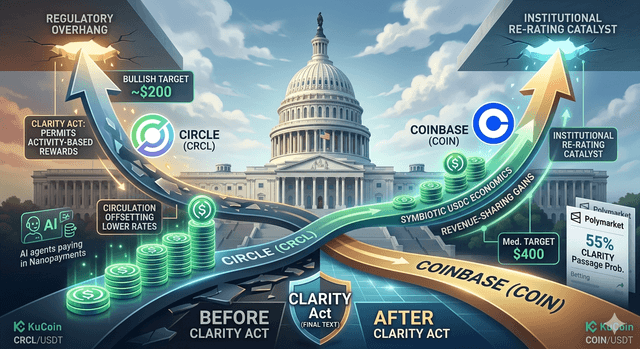
This regulatory breakthrough removes the largest overhang on Circle (NYSE: CRCL) and Coinbase (NASDAQ: COIN). While CRCL trades near $100 with bullish targets near $200, this breakthrough may prove equally beneficial to Coinbase due to the companies' intertwined economics.
For readers who want to learn more background information, the below are the recommended readings:
-
"CRCL vs Other Crypto Stocks"examines how USDC dominance shapes Circle's moat.
-
"What Is the CLARITY Act" breaks down the legislative mechanics driving this rally.
-
"KuCoin vs Coinbase" compares trading infrastructure for investors seeking exposure.
What Does the Final CLARITY Act Say About Stablecoin Rewards?
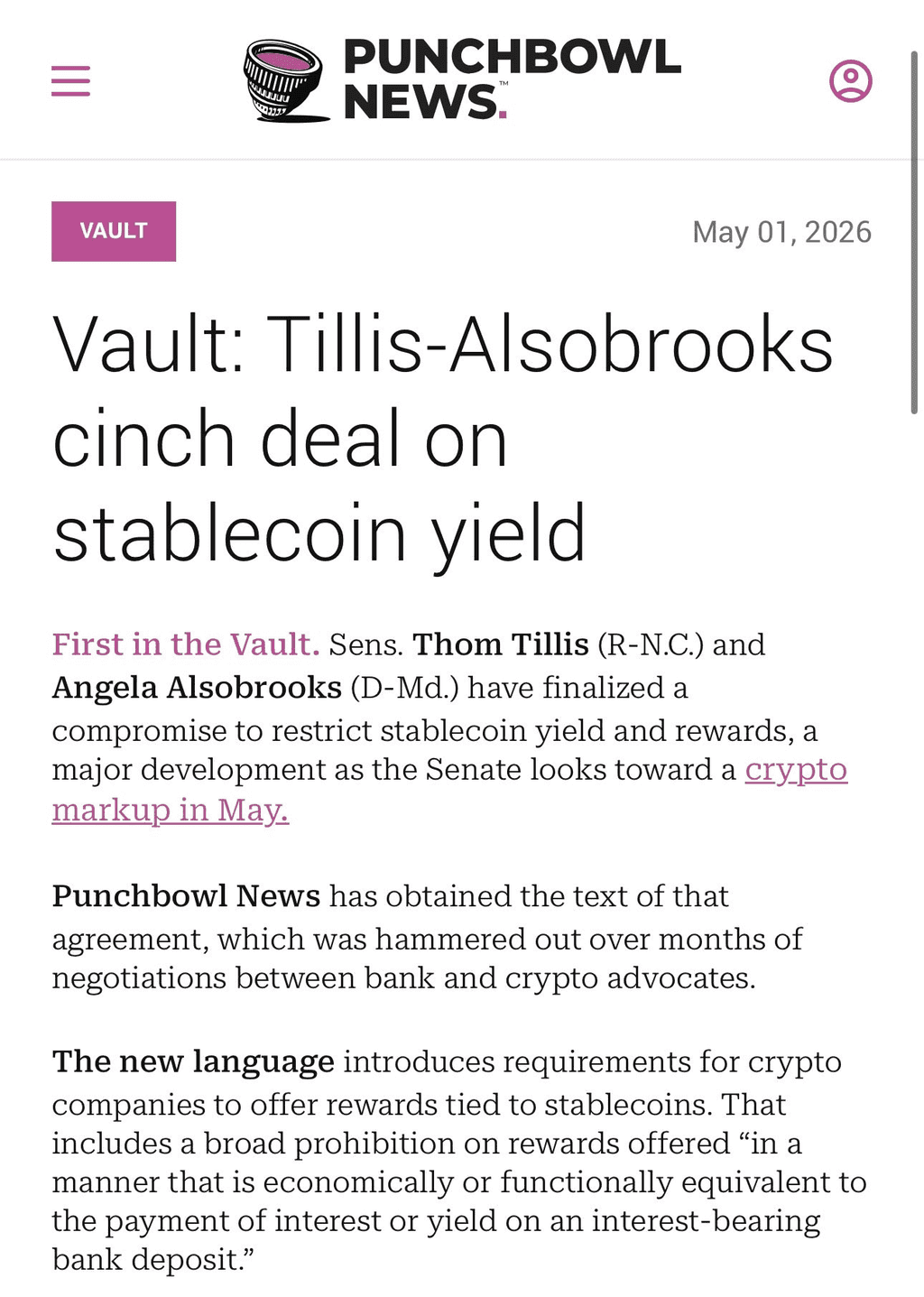
The final CLARITY Act text settles the stablecoin yield debate by prohibiting passive interest payments while explicitly protecting activity-based rewards. The latest Clarity Act, finalized by Senators Thom Tillis and Angela Alsobrooks on May 2, 2026, bans any form of interest or yield paid solely for holding stablecoins, or any arrangement economically equivalent to a bank deposit.
However, it carves out a broad exception for "activity-based or transaction-based rewards and incentives" tied to bona fide activities. This compromise ends the legislative paralysis that had stalled the bill since January and caused multiple crypto selloffs.
Why Did Earlier Drafts of Clarity Act Crush CRCL and Crypto Valuations?
Earlier drafts of the CLARITY Act created existential uncertainty for Circle because banking lobbyists pushed for a blanket ban on all stablecoin yield-like payments. Their concern was straightforward: if USDC paid competitive yields, it could function as a high-interest savings account and drain deposits from traditional banks. This fear caused the bill to stall in the Senate for months.
In March 2026, rumors of a strict yield ban triggered a 20% single-day crash in CRCL stock, wiping out billions in market value. The market correctly priced in that a prohibition on all rewards would cripple Circle's ability to compete with bank deposits and payment platforms, turning USDC into a purely transactional instrument with no user incentives.
The banking lobby's influence was so pronounced that even Coinbase, which typically benefits from regulatory clarity, saw its stock pressured. The uncertainty affected the entire stablecoin sector because investors could not model future revenue streams. If platforms could not offer any yield-like benefits, USDC circulation growth might stall, directly threatening Circle's reserve-income model and Coinbase's revenue-sharing agreement. The March selloff demonstrated how tightly both stocks trade on legislative rumors.
What Changed in the May 2026 Compromise?
The May 2026 text represents a material concession from banks and a significant win for the crypto industry. The prohibition applies only to passive holding rewards. The bill explicitly permits rewards calculated by reference to balance, duration, or tenure -- provided the underlying reward is tied to qualifying activity. Permitted activities include payments, transfers, market-making, staking, governance participation, and loyalty programs. The SEC, CFTC, and Treasury Secretary must jointly issue rules within one year defining the full list of permitted activities.
This structure allows Circle and its partners to continue offering incentives that drive real usage. Users who actively transact, stake, or participate in DeFi can receive rewards. Platforms can design loyalty programs that factor in how much a user holds and for how long, as long as the reward is activity-linked.
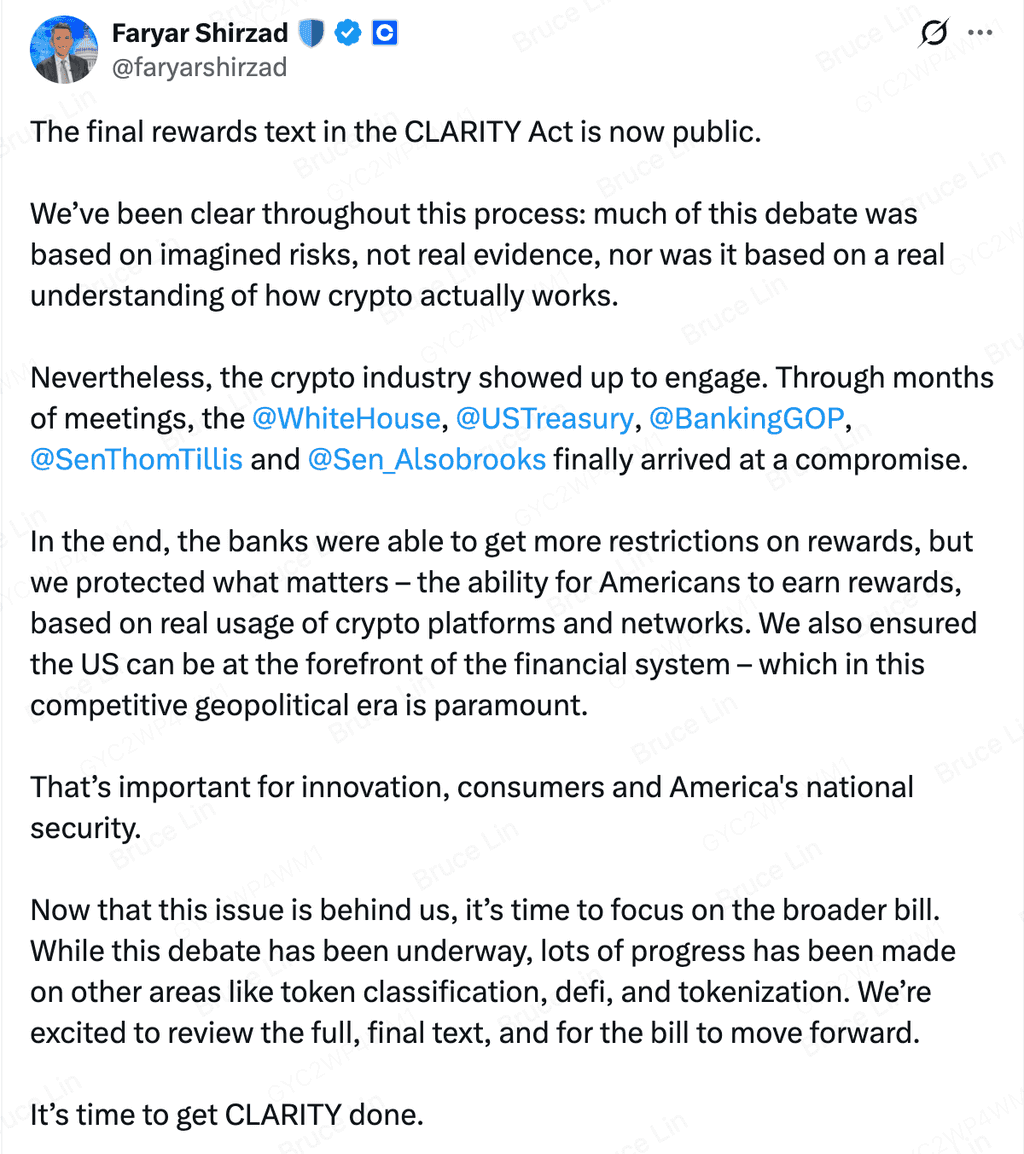
According to Coinbase's Shirzad, "the banks were able to get more restrictions on rewards, but we protected what matters -- the ability for Americans to earn rewards, based on real usage of crypto platforms and networks." Polymarket traders immediately raised the odds of CLARITY passing in 2026 to 55%, up 9% within 24 hours of the announcement.
Why Is the Final CLARITY Act a Major Catalyst for CRCL?
The final CLARITY Act removes the largest regulatory ceiling on Circle's business model and validates its transition from a reserve-income company to a full-stack payments infrastructure provider. With the yield uncertainty resolved, Circle can aggressively expand USDC incentives across trading, payments, DeFi, and its newly launched Nanopayments network without fear of a federal prohibition. This clarity is particularly valuable ahead of Circle's Q1 2026 earnings report on May 11, when management can guide with confidence on partnership and product expansion.
How Does the Final Clarity Act Protect Circle's Business Model?
The final Clarity Act protects Circle by preserving the incentive mechanisms that drive USDC adoption. Circle's revenue model depends on expanding USDC circulation; the more dollars held in USDC, the larger the reserve base generating interest income. In FY2025, reserve income accounted for $2.637 billion of Circle's $2.747 billion total revenue. The company cannot afford to have platform partners restricted from offering user incentives that encourage holding and using USDC.
The final text ensures that Circle's platform partners -- including Coinbase, Stripe, Visa, and emerging fintech integrations -- can design reward programs that incentivize genuine economic activity. This is critical for Circle's "other revenue" line, which management guided to $150-170 million in FY2026 and includes subscription services, transaction fees, and platform monetization. If platforms could not reward users, USDC risked becoming a static settlement layer rather than an active financial instrument, capping Circle's growth narrative.
Can USDC Circulation Growth Offset Lower Interest Rates?
Yes, USDC circulation growth is already offsetting the decline in reserve yields. Circle disclosed USDC circulation of $79.2 billion as of March 16, 2026, up from $75.3 billion at year-end 2025. This 5.2% quarterly expansion comes even as the effective federal funds rate sits near 3.64%, well below the 5.0% reserve return rate Circle enjoyed in FY2024. The company has repeatedly stated that USDC circulation can expand at roughly a 40% CAGR, supporting continued revenue growth even in a lower-rate environment.
Analysts are taking notice. The 33-analyst consensus price target for CRCL stands at $131.14, implying 31.5% upside from the May 1 close of $99.70. Bullish targets from Bernstein, Needham, and BTIG cluster between $250 and $280, predicated on USDC circulation reaching $100 billion or more. CoinCodex algorithmic models project CRCL trading between $188 and $432 by year-end 2026, with an average price target near $305. While the $200 level is not guaranteed, the removal of the CLARITY Act overhang makes it a plausible scenario if circulation growth accelerates and rate-cut headwinds moderate.
How Will USDC Nanopayments Expand Circle's Valuation Ceiling?
Circle's valuation narrative shifted from stablecoin issuer to machine-economy infrastructure provider on April 29, 2026, when the company launched gas-free USDC Nanopayments on mainnet. This product enables USDC transfers as small as $0.000001 with near-instant verification and zero gas fees, settling across 11 blockchain networks including Ethereum, Base, Arbitrum, and Optimism. It targets AI agents, APIs, and machine-driven commerce.

What Is Gas-Free USDC Nanopayments?
Nanopayments is a payment rail built on Circle Gateway, the company's unified liquidity layer. Users deposit USDC into non-custodial smart contracts and authorize transfers via EIP-3009 signatures. Instead of settling every transaction individually on-chain, the system verifies and deducts each payment immediately, then batches settlements for blockchain processing. Merchants can deliver goods or services within milliseconds of authorization rather than waiting for block confirmation.
This architecture solves the fundamental problem of micropayments on blockchain networks. Traditional credit card networks cannot economically process $0.01 transactions due to fee floors. Bitcoin and Ethereum face volatility and gas costs that make sub-dollar payments impractical. Nanopayments creates a stable, high-frequency settlement layer specifically designed for software agents that pay per API call, per second, or per dataset read. Early production integrations include Alchemy, Goldsky, and Quicknode.
Why Does the Agentic Economy Matter for CRCL?
The agentic economy represents a structural expansion of Circle's total addressable market beyond human-to-human payments. Over 98% of AI-driven payments already use USDC, according to Circle's 2026 data. As autonomous software agents proliferate across industries -- automatically calling APIs, purchasing compute, accessing data feeds -- they require a settlement currency that is stable, programmable, and capable of high-frequency microtransactions. USDC Nanopayments is purpose-built for this use case.
This elevates Circle's valuation framework. Investors can no longer value CRCL purely as a leveraged play on interest rates and stablecoin balances. The company is building the monetary layer for machine-to-machine commerce, a market with potentially trillions of dollars in transaction volume. If Nanopayments captures even a small fraction of agentic commerce, Circle's transaction-fee revenue could grow from a rounding error today into a material earnings driver by 2028. The CLARITY Act's passage would accelerate this by giving institutional developers regulatory certainty to build on USDC.
Why Does Coinbase Stand to Gain Even More Than Circle?
Coinbase may capture greater economic value from the CLARITY Act than Circle itself due to the companies' lopsided revenue-sharing agreement. While Circle is the USDC issuer and manages reserves, Coinbase remains the dominant economic beneficiary of USDC growth. This symbiotic relationship means that any catalyst expanding USDC adoption -- including regulatory clarity -- flows disproportionately to Coinbase's bottom line.
How Does the USDC Revenue-Sharing Agreement Work?
Coinbase receives 100% of the reserve income generated on USDC held within its platform, plus 50% of reserve income from USDC held off-platform. In FY2024, Circle paid Coinbase approximately $908 million in revenue share out of $1.01 billion in total distribution costs -- roughly 56% of all reserve income. By early 2025, Coinbase held 22% of total USDC supply, up from just 5% in 2022. Average USDC in Coinbase products reached an all-time high of $17.8 billion in Q4 2025, an 18% quarter-over-quarter increase.
This means that while Circle bears 100% of the operational cost of issuing and managing USDC, it retains less than half of the revenue after Coinbase's share. If the CLARITY Act drives USDC circulation higher through expanded platform integrations and reward programs, Coinbase's stablecoin revenue grows with minimal incremental cost. The arrangement has made USDC a high-margin, recurring revenue stream for Coinbase, contributing to the $2.8 billion in subscription and services revenue the company reported in FY2025.
Will CLARITY Act Passage Revalue COIN Stock?
Yes, regulatory clarity is a core pillar of the bull case for COIN. The stock trades around $206 as of late April 2026, down approximately 10% year-to-date while CRCL has gained roughly 30%. This divergence reflects investor concern over Coinbase's exposure to trading-volume cyclicality and its Q4 2025 GAAP net loss of $667 million, which was driven by a non-cash crypto portfolio markdown. However, adjusted net income was $178 million, and the company holds $11.3 billion in cash.
Analysts see significant upside if the CLARITY Act passes. The 48-analyst consensus median target is $400, with a range of $205 to $510. Goldman Sachs maintains a Buy rating with a $235 target, while Bernstein's bull case reaches $510. The key catalyst is the removal of regulatory uncertainty that has compressed Coinbase's P/E multiple relative to traditional financial exchanges. With the Deribit acquisition closed, Base L2 processing record transactions, and the OCC trust charter conditionally approved, the CLARITY Act could be the final catalyst triggering institutional re-rating.
Should You Trade CRCL and COIN on KuCoin?
KuCoin offers traders access to both the spot and futures markets for crypto-linked equities through tokenized stock products and traditional crypto trading pairs. While CRCL and COIN trade on traditional U.S. exchanges, KuCoin users can gain exposure to these assets through tokenized stocks that allow for 24/7 trading outside U.S. market hours. For investors seeking to capitalize on the CLARITY Act catalyst, KuCoin provides leveraged instruments and advanced order types that traditional brokerages do not offer:
New users can now register at KuCoin and Get Up to 11,000 USDT in New User Rewards.

Conclusion
The final CLARITY Act text represents a watershed moment for both Circle and Coinbase. By prohibiting passive stablecoin yields while preserving activity-based rewards, the final Clarity Act removes the regulatory overhang that has suppressed CRCL and COIN valuations for months. Circle gains the clarity needed to expand USDC incentives, drive circulation growth, and scale its newly launched Nanopayments infrastructure for the agentic economy. Coinbase benefits from the same regulatory tailwind through its dominant revenue-sharing agreement, which captures the majority of USDC economics.
While CRCL reaching $200 in 2026 depends on continued USDC circulation growth, interest rate stability, and execution on non-reserve revenue streams, the probability of achieving that target has materially increased with the May 2026 compromise. Coinbase, trading at a steeper discount to analyst targets, may offer equal or greater upside if the CLARITY Act passes and triggers institutional re-rating. Both stocks remain tied to the broader crypto cycle, but the legislative clarity removes a idiosyncratic risk factor that had no precedent in traditional financial markets. Investors should monitor the Senate markup schedule and Q1 earnings for definitive signals.
FAQs
Can CRCL realistically reach $200 in 2026?
CRCL reaching $200 is plausible but not guaranteed. Analyst targets range from $60 to $294, with bullish cases clustering between $250 and $280 based on USDC circulation expansion toward $100 billion. The stock would need to nearly double from its May 2026 level of approximately $100, requiring sustained balance growth and favorable rate conditions.
What is the exact difference between prohibited yield and permitted rewards under the final Clarity Act?
The CLARITY Act prohibits any interest or yield paid solely for holding stablecoins, or any arrangement economically equivalent to a bank deposit. Permitted rewards must be tied to bona fide activities such as payments, transfers, staking, governance, market-making, or loyalty programs. The bill explicitly allows rewards calculated by reference to balance, duration, or tenure, provided the underlying incentive is activity-based.
How much revenue does Coinbase actually generate from USDC?
Coinbase generated approximately $908 million from its USDC revenue-sharing agreement with Circle in FY2024, representing roughly 56% of Circle's total reserve income. The average USDC held on Coinbase products reached an all-time high of $17.8 billion in Q4 2025. This revenue contributes to Coinbase's $2.8 billion subscription and services segment.
What are the risks if the CLARITY Act fails to pass?
If the CLARITY Act stalls, both CRCL and COIN would lose a critical regulatory catalyst. Circle would face continued uncertainty over stablecoin reward rules, potentially slowing platform partnerships. Coinbase would remain exposed to state-level regulatory fragmentation and SEC enforcement risk. Polymarket currently assigns a 55% probability to 2026 passage, implying significant residual uncertainty.