

Pons, Long, and Hookr: Three Onchain Trades With Different Jobs
Introduction
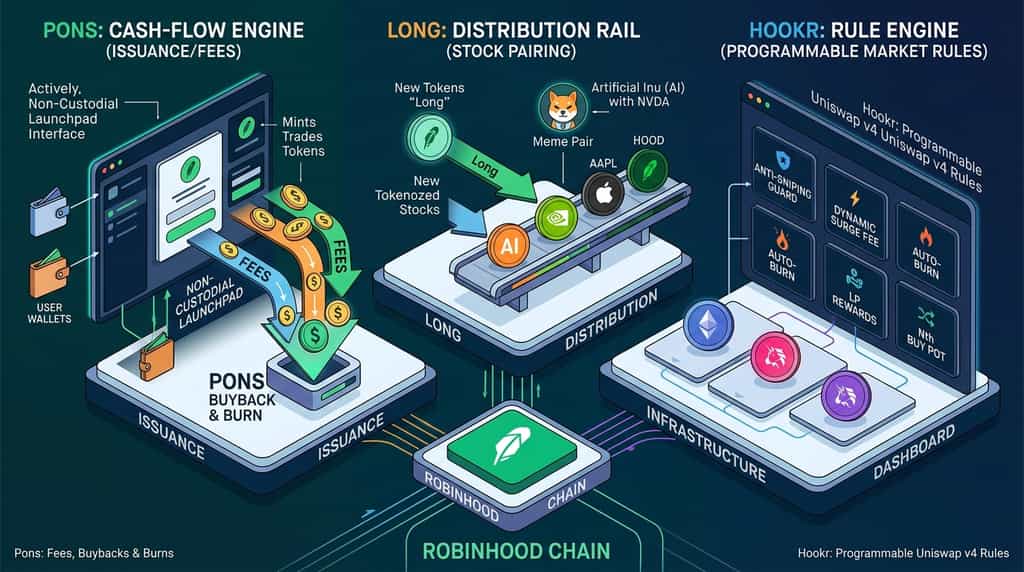
Pons, Long, and Hookr are three different onchain trades on Robinhood Chain, not one narrative with three tickers. According to DefiLlama, the Pons launchpad recorded about $123.97 million in fees over 30 days and about $188.25 million in cumulative fees, while CoinMarketCap showed PONS near a $268.92 million market cap after a September 5, 2026 all-time high of $0.9683. Pons turns permissionless token issuance into protocol cash flow and routes a share of that activity into PONS buybacks and burns. Long pairs new tokens with tokenized stocks so meme flow can distribute stock liquidity. Hookr sells custom Uniswap v4 market rules — anti-sniping, dynamic fees, auto-burn, and LP rewards — that a standard launch curve does not set at the pool level.
Traders who buy all three as the same Robinhood Chain bet are mixing a cash-flow token, a distribution token, and an infrastructure token. The jobs diverge most clearly when volume cools.
What Jobs Do Pons, Long, and Hookr Actually Perform?
Pons, Long, and Hookr split the Robinhood Chain trade into issuance, stock distribution, and programmable market rules. They share a chain. They do not share a business model.
Robinhood Chain is an Ethereum layer-2 in the Arbitrum Orbit family. Public activity scaled through summer 2026, and permissionless apps could deploy without a Robinhood Markets listing committee. That design produced a launchpad race, not a single official token. Pons is a non-custodial launchpad. KuCoin’s August 27, 2026 listing announcement describes it as a platform that lets users deploy and trade from their own wallets, with no platform custody of user assets. Long, at long.xyz, launches tokens against Robinhood stock tokens rather than only against ETH. Hookr, at hookr.fun, is modular infrastructure for composing Uniswap v4 hooks, including on tokens that already trade.
Analyst Haotian framed the split on October 4, 2026 as a phase divergence. Pons wins and loses on activity data. Long is a distribution rail whose quote asset is a tokenized stock, while the demand is still mostly meme demand. Hookr is the rules layer that simpler curves do not provide. That framing is an opinion, not a price forecast. It is useful because it forces a job description before a ticker comparison.
The practical test is what happens if speculative issuance falls. A buyback token needs fees. A stock-pairing launchpad needs people who still want the stock as the other side of the pool. A hooks marketplace needs builders who will pay for rules after the first candle. Those are different failure modes.
|
Trade
|
Primary job
|
What the token is tied to
|
Main weakness
|
|
Pons (PONS)
|
Low-cost token issuance and fee capture
|
Protocol fees used for buybacks and burns
|
Activity data can reverse and pressure the same buyback loop
|
|
Long (AI and platform flow)
|
Distribute tokenized stocks through meme pairs
|
Stock-token liquidity and community tokens such as Artificial Inu
|
Stock-as-LP support is thinner than the distribution narrative
|
|
Hookr (HOOKR)
|
Programmable Uniswap v4 market rules
|
Hook-fee share used to buy back and burn HOOKR
|
Adoption and time, not day-one volume
|
How Does Pons Turn Launch Volume Into a Token?
Pons converts launch and swap activity into PONS demand only while fees stay large enough to fund buybacks. The mechanism is simple. The dependency is not.
Pons lets a user mint a token and open a pool without a listing committee or a professional liquidity provider. Users sign launches and trades from their own wallets. Early V1 markets used a 1 percent trading fee, with project documentation describing a 70 percent creator share and a 30 percent protocol share, and with 80 percent of the protocol share directed to open-market PONS buys sent to a burn address. V2 later allowed graduated tokens to pair with stock tokens such as Nvidia, Apple, and Robinhood, which pulled Pons closer to the stock-distribution trade without changing its core cash-flow design.
According to CoinMarketCap, PONS recently traded near $0.395, with a market cap of about $268.92 million, 24-hour volume of about $46.13 million, and a circulating supply of about 680.17 million. The same page recorded an all-time high of $0.9683 on September 5, 2026, about 59 percent above the later quote, and an all-time low of $0.003783 on July 17, 2026. Market cap and fully diluted value sat on top of each other in that snapshot, so the visible supply was already the tradable supply. That removes an unlock overhang. It does not remove flow risk.
According to DefiLlama, Pons showed about $123.97 million in 30-day fees, about $9.92 million in 7-day fees, about $1.07 million in 24-hour fees, about $20.7 million in 30-day revenue, and about $188.25 million in cumulative fees. Earlier in September, DefiLlama-tracked daily fees were reported near $5.95 million on a peak day, briefly ahead of Pump.fun. The gap between that peak day and a later $1.07 million day is the whole Pons argument in one comparison. Issuance can be cheap. Sustaining the buyback loop is not cheap.
What Is Long Trying to Distribute Beyond a Meme?
Long is a stock-distribution launchpad whose flagship demand still comes from meme trading. The stock token is the quote asset. It is not yet proof that buyers want the stock.
long.xyz launches new tokens against Robinhood stock tokens. The team’s own framing is a merger of real-world assets with memes and community coins. Artificial Inu, ticker AI, is the reference market: an ERC-20 launched through Long on July 14, 2026, paired with the Nvidia stock token rather than only with ETH. Its contract on Robinhood Chain is 0x2e8c31162b855a2ffa90f6f8634643ad6f111e18. Project descriptions are explicit that AI does not represent Nvidia equity, does not confer shareholder rights, and does not give holders an automatic redemption right.
According to a CoinMarketCap-sourced quote compiled by CryptoSlate on October 3, 2026, AI traded near $0.14, with a market cap of about $136.04 million and 24-hour volume of about $14.76 million, on a supply near 1 billion. A GeckoTerminal pool page around the same period showed a market cap near $125.85 million. The spread is normal for a token whose deepest liquidity sits onchain. Both readings place AI well below the roughly $200 million area reported at the September peak, and well below PONS.
Long’s company updates are the right source for platform flow, and they are large. On September 2, 2026, the project reported more than $425 million in tokenized-stock volume over 24 hours and about $12 million in stock total value locked, framed as roughly 20 percent of onchain stock liquidity at the time. By September 7, cumulative volume was reported above $1 billion, with the team estimating about 15 percent of tokenized-stock volume on decentralized exchanges since Robinhood Chain launch and about 10 percent of stock liquidity. On September 25, Long extended the model through LONG 500, linking meme-and-stock pools across a stated set of more than 70 tokenized stocks, with fee streams aimed at a broader reserve rather than a single Nvidia pair.
Why Did Hookr Rise When Simpler Launchpads Cooled?
Hookr’s job is the rule set on the pool, not the speed of the launch. That is why it can matter after Pons and Long have already issued the token.
According to Hookr’s own product update, the current system lets a team set custom rules for any market on Robinhood Chain, including real-world assets, and not only for a new launch. Tokens already trading, including tokens from Pons or pools.trade, can open a Hookr pool and manage liquidity under community-chosen rules. A pool composes hook blocks at creation. Five live blocks are surge fee, launch guard, auto-burn, LP rewards, and an Nth-buy pot. A pool can compose up to eight blocks, and the rules are fixed for the life of that pool.
The fee design is the cleanest contrast with a flat launchpad curve. The base Uniswap v4 LP fee goes entirely to in-range liquidity providers. Optional hook fees default to an 80 percent destination — LPs, creator, pot, or burn, depending on the block — and a 20 percent protocol share, capped at 50 percent. Hookr states that there is no flat protocol fee, and that the protocol share is used to buy back and burn HOOKR. New token launches open at a fixed 2.5 ETH valuation, or the equivalent in the chosen quote. A guard window can restrict liquidity to the founding position, a snipe tax can apply during that window, and the first buy is capped at 5 percent of supply. Those constraints are visible before signing. They are not a promise of profit.
HOOKR itself is smaller than the other two trades. A Blockscout reading for contract 0x18E674231A58c239Dc7DaeDcffE15Ec3A24cff5c showed a price near $0.0122, a circulating market cap near $12.2 million, a total supply of 1 billion, and roughly 7,700 holders. Other trackers have printed higher market-cap readings in the same period. Either way, HOOKR is an infrastructure token priced on adoption, not on a nine-figure fee base. Hookr also states that the standard profile contracts are verified, and that there is no third-party audit. That is a material disclosure, not a footnote.
How Should Traders Compare These Three Onchain Trades?
The right comparison is job, cash-flow evidence, and failure mode — not which ticker moved more last week. On those tests, Pons has the fees, Long has the distribution story, and Hookr has the rule engine.
Pons is the only one of the three with a DefiLlama fee series in the nine-figure 30-day range. That makes PONS the cleanest activity bet, and the most exposed to a fee slowdown. Long has reported cumulative stock volume above $1 billion and a LONG 500 expansion across more than 70 stock tokens, but AI’s market cap near $136 million on the October 3 CoinMarketCap reading is a meme valuation sitting on a stock quote. Hookr has the most explicit on-swap rules and the least proven fee base, with a Blockscout market cap near $12 million.
Position overlap is easy to overstate. A trader can be long PONS because DefiLlama fees remain elevated, indifferent to AI because the stock quote is not equity, and early on HOOKR because post-launch hooks are only starting to attach to existing tokens. Those are three theses. A single “Robinhood Chain ecosystem” basket hides the conflict: if issuance cools, Pons and Long can weaken together, while Hookr’s relative case depends on builders staying even when meme volume does not.
Three misconceptions are worth killing before sizing a trade.
First, none of these tokens is issued by Robinhood Markets. Pons, Long, and Hookr are third-party apps on a permissionless chain. A Robinhood Chain deposit network is not a Robinhood brokerage account.
Second, a stock-token pair is not a stock. AI paired with Nvidia does not deliver Nvidia shareholder rights. Hookr’s ability to use a tokenized stock as a quote asset does not change that.
Third, a buyback is not a peg. Pons routes protocol fees toward burns. Hookr routes a hook-fee share toward HOOKR burns. Both stop mattering if the underlying flow stops. Neither mechanism obliges a market maker to bid the token at the last price.
|
Check
|
Pons
|
Long
|
Hookr
|
|
Evidence to underwrite
|
DefiLlama fees and CoinMarketCap float
|
Project-reported stock volume and AI liquidity
|
Onchain rules, verified contracts, HOOKR burn share
|
|
Recent scale
|
About $268.92 million market cap; about $123.97 million in 30-day fees
|
AI near $136 million; platform cumulative stock volume reported above $1 billion
|
Blockscout market cap near $12.2 million
|
|
What breaks the thesis
|
Fee drop and buyback disappointment
|
Meme attention leaves the stock quote
|
Hooks are not adopted after launch
|
Beyond the Headlines: What KuCoin 5.0 Means for You
Market news moves fast — but where you act on it matters just as much. This October, KuCoin launches KuCoin 5.0, transforming KuCoin into a rebuilt platform. Here's what actually changes for you:
-
One account for everything. Older platforms split your money across separate "spot," "margin," and "futures" accounts and expected you to understand why. KuCoin 5.0's unified account removes that entirely — deposit once, and everything is simply there (only available to VIPs for now).
-
Stocks, indices, and commodities. KuCoin 5.0 expands beyond crypto into global markets. When crypto chops sideways and equities rally (or the reverse), you rotate in minutes instead of opening a brokerage account and waiting days for fiat rails.
-
Real-world assets (RWA). Tokenized exposure to traditional assets like commodities, right inside your crypto account. One of the fastest-growing segments in global finance is no longer reserved for institutions — you access it from the same balance you trade with.
-
Earn while you learn. Not ready to trade? KCUSD lets your stablecoins earn daily, auto-compounding interest. The lowest-stress way to put your idle deposit to work for 4% yield.
-
An AI assistant in plain language. Ask questions, get market context, understand what you're looking at — built into the platform, no jargon required.
-
An app that doesn't overwhelm. Faster, cleaner, and consistent — intuitive from the first tap, not after a tutorial.
-
Safety you can check, not just trust. A MiCAR-licensed EU entity, Proof of Reserves you can verify yourself, and internationally certified security (SOC 2 Type II, ISO 27001:2022).
Create your account in minutes — and start on the platform built for where crypto is going, not where it's been.
Conclusion
Pons, Long, and Hookr answer three different questions on the same chain. Pons asks how much fee volume a permissionless launchpad can capture, and whether that volume keeps funding PONS buybacks. DefiLlama’s roughly $123.97 million in 30-day fees and $188.25 million in cumulative fees make that question measurable, while CoinMarketCap’s drop from the September 5 high of $0.9683 to about $0.395 shows the same data can reprice the token quickly. Long asks whether meme flow can distribute tokenized stocks. Project updates above $1 billion in cumulative stock volume, and AI’s market cap near $136 million, describe a real distribution experiment that still depends on attention. Hookr asks whether pool rules — guard windows, surge fees, auto-burn, LP rewards — can be productized after the launch. Its own documentation says yes. Its roughly $12 million Blockscout market cap says the market has not paid for that answer yet.
The useful takeaway is separation. A fee slowdown hits Pons first. A meme slowdown hits Long’s stock-quoted tokens even if the stock narrative stays intact. A hooks slowdown hits Hookr even if Pons volume returns. Traders who want one Robinhood Chain exposure should pick the job they can underwrite, not the ticker that shared a headline.
FAQs
Is PONS the official token of Robinhood?
No. PONS is the token of Pons, a third-party non-custodial launchpad deployed on Robinhood Chain. Robinhood Markets does not issue it. KuCoin’s listing describes Pons as a platform for wallet-based deployment and trading, not as a Robinhood product.
Does buying Artificial Inu give exposure to Nvidia shares?
No. AI is a community token launched through Long and paired with a Nvidia stock token. Project descriptions state that it does not represent Nvidia equity, does not confer shareholder rights, and does not create an automatic redemption right.
Can a Hookr pool change its fee rules after launch?
No. Hookr states that rules are fixed at pool creation, hashed into a registry, and enforced on swaps and liquidity adds. Profiles are immutable. A new mechanic requires a new profile and a new pool, not an admin edit of the open market.
Do Pons or Hookr buybacks guarantee a price floor?
No. Pons directs a share of protocol fees to PONS buys and burns. Hookr directs a default 20 percent of optional hook fees to HOOKR buys and burns. Both flows scale with activity. Neither is a redemption reserve or a contractual bid.
Disclaimer: This article is for informational purposes only and does not constitute financial, legal, or investment advice. Always conduct your own research before interacting with digital assets.