

Robinhood Chain Is Turning Meme Coins Into Stock-Market Weapons: Inside the Stock-Paired Token Boom
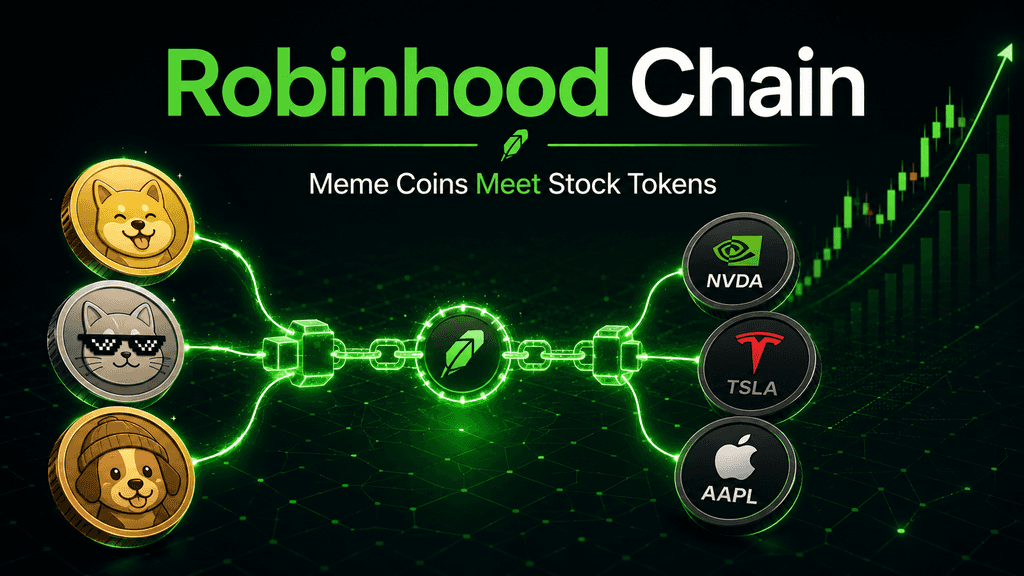
Robinhood Chain is creating a new connection between meme coin speculation and tokenized finance. The Ethereum-compatible Layer 2 launched in July 2026 with a focus on tokenized financial assets and Robinhood Stock Tokens while independent developers quickly introduced meme coins and new DeFi markets. Robinhood officially confirmed the Robinhood Chain mainnet launch on July 1 2026. Since then some meme tokens have begun trading directly against Stock Tokens linked to companies such as Nvidia Tesla Apple and Hims & Hers. These stock-paired meme coins create an unusual overlap between speculative crypto trading real-world assets and traditional market exposure.
How Meme Coins Took Over Robinhood Chain and Entered Stock Token Markets
Robinhood Chain launched with a clear focus on tokenized finance but early activity quickly showed that traders were also drawn to speculative assets. The Ethereum-compatible Layer 2 was designed to support Robinhood Stock Tokens and other real-world asset applications yet meme coins soon became one of the network's most active trading categories. That early momentum eventually developed into a more distinctive trend as meme tokens began appearing in liquidity pools alongside Stock Tokens. The result is a new type of onchain market where crypto speculation and tokenized financial assets increasingly overlap.
Robinhood Chain Was Built for Tokenized Finance
Robinhood Chain was developed as financial infrastructure for bringing more traditional assets onchain while remaining compatible with Ethereum Layer 2 networks smart contracts and applications. Robinhood Stock Tokens play an important role in that strategy because they provide eligible users with economic exposure to companies and exchange-traded funds through blockchain-based assets. These tokens are not the same as directly owning the underlying shares because holders do not receive traditional shareholder ownership or voting rights. Their ERC-20 structure does however make them easier to integrate into decentralized exchanges, liquidity pools and other DeFi applications. This composability gave developers more freedom to experiment with Stock Tokens beyond simple trading and helped create the conditions for new markets combining real-world asset exposure with crypto-native speculation.
Meme Coins Became a Major Driver of Robinhood Chain Activity
Meme coins quickly became one of the strongest sources of early activity on Robinhood Chain despite the network's original emphasis on tokenized real-world assets. CoinGecko data showed that meme coins represented about 79.2% of Robinhood Chain decentralized exchange volume on July 27 2026 compared with a much smaller share for RWA-related trading. Tokens such as CASHCAT attracted speculative traders and helped increase liquidity across decentralized exchanges while new launchpads made it easier for developers to introduce community-driven assets.
Robinhood Chain activity continued to expand through August with daily DEX volume reaching hundreds of millions of dollars and The Block reporting a then-record of approximately $989 million in single-day trading volume on August 31. Although infrastructure and utility projects also gained momentum the meme coin boom demonstrated that traders were willing to use Robinhood Chain for much more than Stock Tokens alone. The rapid rise of meme trading also changed the way liquidity developed across the network. Instead of separating speculative crypto assets from tokenized financial products developers began experimenting with ways to connect the two markets directly. That shift became especially important as Robinhood Stock Tokens gained wider use across decentralized applications. Meme coins were no longer simply competing with Stock Tokens for trading volume. In some cases they started relying on Stock Tokens as part of their own liquidity structure which created a new relationship between speculative tokens and assets linked to traditional financial markets.
Stock-Paired Meme Coins Are Creating a New Onchain Market
The emergence of stock-paired meme coins represents one of the most unusual developments on Robinhood Chain. Instead of trading only against ETH or stablecoins some meme tokens are now paired directly with Robinhood Stock Tokens linked to companies such as Nvidia Tesla Apple and Hims & Hers. Artificial Inu is one prominent example because its AI token has traded against the NVDA Stock Token in a dedicated liquidity pool. Similar structures are appearing around other Stock Tokens as launchpads experiment with using tokenized market exposure as liquidity for newly created crypto assets. This model does not mean meme coin projects own or control the underlying public companies. It shows instead how Robinhood Chain's permissionless network design allows independent developers to deploy applications and tokens while Stock Tokens can become active building blocks within decentralized markets. As more projects adopt these structures the boundary between meme coin trading real-world assets and DeFi liquidity is becoming less distinct and potentially more important to the future growth of the Robinhood Chain ecosystem.
How Stock-Paired Meme Coins Use Robinhood Stock Tokens for Liquidity
Stock-paired meme coins introduce a different liquidity model from the one commonly used across crypto markets. Most meme tokens launch against assets such as ETH or stablecoins because those assets provide an established source of liquidity and a familiar reference price. On Robinhood Chain some projects are instead using Stock Tokens as the quote asset inside decentralized exchange pools. This allows a speculative crypto token and an asset linked to traditional financial markets to trade within the same onchain market. The structure is possible because Robinhood Stock Tokens use an ERC-20 format that can interact with smart contracts and decentralized finance applications.
How Stock Token Liquidity Pools Work on Robinhood Chain
In a stock-paired liquidity pool traders exchange a meme token against a Robinhood Stock Token rather than against a conventional stablecoin. These decentralized liquidity pools use smart contracts to hold paired assets and facilitate token swaps without relying on a traditional order book. A pair such as AI/NVDA therefore connects Artificial Inu with the NVDA Stock Token which provides economic exposure linked to Nvidia shares. When users trade through the pool the balance of both assets changes according to buying and selling activity while liquidity providers supply the tokens needed to keep the market functioning. This means demand for a meme coin can indirectly increase the amount of a particular Stock Token being used inside decentralized liquidity pools even though the meme token itself has no ownership interest in the underlying company. The model also makes Stock Tokens more useful within DeFi because they can serve as active liquidity assets rather than simply being held for price exposure.
Launchpads and decentralized applications can potentially create markets around Stock Tokens linked to companies such as Nvidia Tesla Apple or other available equities and ETFs. The important distinction is that the Stock Token remains a separate financial instrument from the underlying share. What changes is its role inside Robinhood Chain where it can become part of trading pairs liquidity strategies and other smart-contract applications. This composability is one reason stock-paired meme coins have attracted attention as developers explore how tokenized financial assets can interact with crypto-native markets.
Why Meme Coin Demand Can Affect Stock Token Liquidity
Stock-paired markets can create additional demand for Stock Tokens because every active liquidity pool requires inventory of both assets in the trading pair. If a meme coin attracts significant trading volume more Stock Tokens may be supplied to pools to support deeper liquidity and reduce large price movements caused by individual trades.
Research into Robinhood Chain markets has shown that a meaningful share of the onchain supply of some Stock Tokens has already been deployed in pools paired with other crypto tokens. This creates a feedback loop in which speculative activity around a meme coin can generate more trading volume for the Stock Token used alongside it without necessarily changing demand for the underlying company's shares in the traditional stock market. The structure can also create unusual pricing conditions when Stock Token liquidity is limited. If demand rises quickly while available token inventory remains relatively small the onchain Stock Token price can temporarily move away from the price of the asset it tracks. This risk may become more noticeable outside traditional market hours when normal issuance redemption or arbitrage mechanisms are less responsive.
As liquidity deepens those price differences may become easier for market participants to correct but the possibility highlights an important difference between holding an actual listed share and trading its blockchain-based economic representation. For Robinhood Chain this interaction between meme coin demand Stock Token liquidity and DeFi market structure is becoming one of the most important areas to watch as stock-paired trading develops.
Can Robinhood Chain Meme Coins Affect Stock Tokens and Traditional Markets?
The rapid growth of stock-paired meme coins raises a bigger question than trading volume alone: can speculative activity on Robinhood Chain influence Stock Token prices or eventually reach traditional equity markets? The evidence so far suggests the strongest effects occur within the onchain Stock Token market where supply can be much thinner than the underlying stock market. Meme-driven demand can create temporary pricing distortions and pressure Stock Token inventory but the connection to actual shares remains limited by the structure of Robinhood Stock Tokens and the enormous difference in market size between decentralized pools and major public equities.
Thin Stock Token Supply Can Create Sharp Price Premiums
One of the clearest risks is a temporary gap between the market price of a Robinhood Stock Token and the traditional share it tracks. A notable example emerged around the HIMS Stock Token when meme-driven demand absorbed a large portion of its available onchain supply during a weekend. Research published by DeFiPrime reported that the Hims & Hers-linked instrument traded as much as 112% above the underlying stock's previous NYSE closing price while additional Stock Token supply was unavailable. After issuance resumed the premium reportedly collapsed within about two hours and the HIMS Stock Token supply expanded from roughly 15,227 tokens to 73,685 within around two days. The episode demonstrates how intense speculative activity can temporarily distort the price of a Stock Token when available onchain supply is limited even when nothing comparable is happening to the underlying security.
Meme Coin Activity Has Not Shown It Can Move Major Stock Prices
The potential impact becomes much smaller when the analysis moves from Stock Tokens to actual shares traded on traditional exchanges. Current evidence does not show Robinhood Chain meme coins materially moving Nvidia Tesla Apple Hims & Hers or other underlying equities. September research covering 19 major Robinhood Stock Tokens identified 432 stock-paired liquidity pools containing approximately $8.84 million in Stock Tokens and generating about $95.3 million in 24-hour trading volume during the measured period. Those figures are significant for an emerging blockchain ecosystem but remain relatively small compared with the liquidity and valuations of major publicly traded companies. The more plausible connection is indirect because stronger Stock Token demand may eventually require additional inventory or hedging activity. That is different from claiming that a meme coin can directly control or materially move the underlying stock.
Stock Tokens and Real Shares Remain Legally Different Markets
Another reason the effect on traditional markets has clear limits is that Robinhood Stock Tokens are not legally equivalent to directly held company shares. Robinhood's official Stock Token documentation describes the instruments as tokenized debt securities issued by Robinhood Assets Jersey Limited that provide economic exposure to referenced securities without giving holders legal or beneficial ownership of those underlying assets. Stock Token holders therefore should not automatically be treated as shareholders with the voting rights and ownership privileges associated with ordinary equity ownership. This distinction is particularly important when headlines suggest a meme coin has accumulated a large share of an asset such as NVDA. A liquidity pool can hold a significant percentage of the relatively small onchain NVDA Stock Token float without owning an equivalent percentage of Nvidia itself.
The Bigger Impact May Be on How Stocks Trade Onchain
The longer-term significance of Robinhood Chain may therefore be less about meme coins moving Wall Street prices and more about how they change the way equity-linked assets are used after being brought onchain. Robinhood Stock Tokens use blockchain infrastructure that makes them compatible with decentralized applications and potential use cases such as trading lending collateral and structured financial products. Meme coins have added another experimental layer by turning Stock Tokens into active components of crypto-native markets that can continue operating outside traditional exchange hours. This creates opportunities for new forms of financial composability but also introduces challenges involving fragmented liquidity weekend pricing smart-contract risk and temporary differences between onchain token values and underlying securities. If Stock Token adoption grows substantially the relationship between Robinhood Chain DeFi real-world assets and traditional financial markets could become more economically meaningful even if individual meme coin trading remains too small to move major stocks directly.
Conclusion
Robinhood Chain's stock-paired meme coin trend shows how tokenized financial assets can develop uses far beyond simple market exposure. Meme coins are increasingly using Stock Tokens as onchain liquidity assets creating a new intersection between DeFi real-world assets and speculative crypto trading. While current evidence does not show these markets materially moving major underlying stocks thin, Stock Token liquidity can still produce temporary pricing distortions. Whether the trend lasts will depend on liquidity adoption regulation and developer activity but it provides an early example of how traditional market exposure could become increasingly programmable onchain.
FAQs
What is Robinhood Chain?
Robinhood Chain is an Ethereum-compatible Layer 2 blockchain designed to support tokenized financial assets, decentralized applications and onchain trading. It focuses heavily on financial products such as Robinhood Stock Tokens while remaining permissionless enough for independent developers to deploy DeFi platforms, meme coins and other blockchain applications.
Does Robinhood Chain have its own native token?
Robinhood Chain currently uses ETH for gas fees rather than requiring a separate native network token. Users therefore need ETH to cover transaction costs when interacting with compatible decentralized applications or transferring assets. Independently launched tokens on Robinhood Chain should not be confused with an official Robinhood Chain cryptocurrency.
Are Robinhood Stock Tokens the same as owning real shares?
No. Robinhood Stock Tokens provide economic exposure linked to an underlying stock or ETF but they are structurally different from directly owning shares through a traditional brokerage account. Stock Token holders do not automatically receive the same shareholder ownership voting rights or legal claims associated with directly held securities.
What does a stock-paired meme coin mean?
A stock-paired meme coin is a crypto token that trades against a Stock Token inside an onchain liquidity pool rather than using only a conventional asset such as ETH or a stablecoin. For example a meme token may trade against a Stock Token linked to Nvidia. The structure connects speculative crypto trading with equity-linked exposure while keeping the two assets legally and economically distinct.
Can Robinhood Chain Stock Tokens trade when stock markets are closed?
Blockchain markets can continue operating outside normal stock-exchange trading hours because decentralized networks do not follow the same opening and closing schedule as traditional exchanges. However pricing may become less efficient when the underlying market is closed particularly if Stock Token supply or arbitrage activity is limited. That can increase the possibility of temporary premiums or discounts.
Are meme coins launched on Robinhood Chain officially backed by Robinhood?
Not necessarily. Robinhood Chain is permissionless which allows independent developers to deploy smart contracts and tokens without Robinhood operating or endorsing every project. A meme coin being available on Robinhood Chain or using a Robinhood Stock Token as a trading pair therefore should not automatically be interpreted as an official Robinhood partnership.
🔥 KuCoin Offers A More Stable Option in A Volatile Market
If you worry about the frequent ups and downs in the market, and pursue a more stable option to earn money passively, KuCoin is the right place to come:
Simple Earn: Deposit and withdraw tokens anytime, earning stable returns.
Kucoin Earn: Earn stable profits with professional asset management.
Hold to Earn: Earn rewards by holding assets in Funding, Trading, Margin, Futures, Mining, and Unified Accounts.
Staking: Unlock the earning potential of on-chain assets.
Advanced Investments: Advanced Investments offer a variety of structured products to help your money grow in any market.
Shark Fin: Principal Protection and Guaranteed Gains
Dual Investment: Buy low and sell high with transparent return calculations.
Snowball: High yields, with price protection.
Discount Buy: Buy crypto at discount prices.
KCS Loyalty: Level up to enjoy exclusive perks by staking ≥ 1 KCS.
KuCoin Wealth: Discover future value and begin your smart investing journey.
KCS Benefits: Hold and stake KCS to access benefits across the platform.
KCS Staking 2.0: Participate in KCS on-chain governance to earn yield.
Disclaimer: This content is for informational purposes only and does not constitute investment advice. Cryptocurrency investments carry risk. Please do your own research (DYOR).