

ONDO and JPMorgan Bring Tokenized U.S. Treasuries to On-Chain Settlement as RWA Enters a New Institutional Stage
2026/05/13 12:06:02
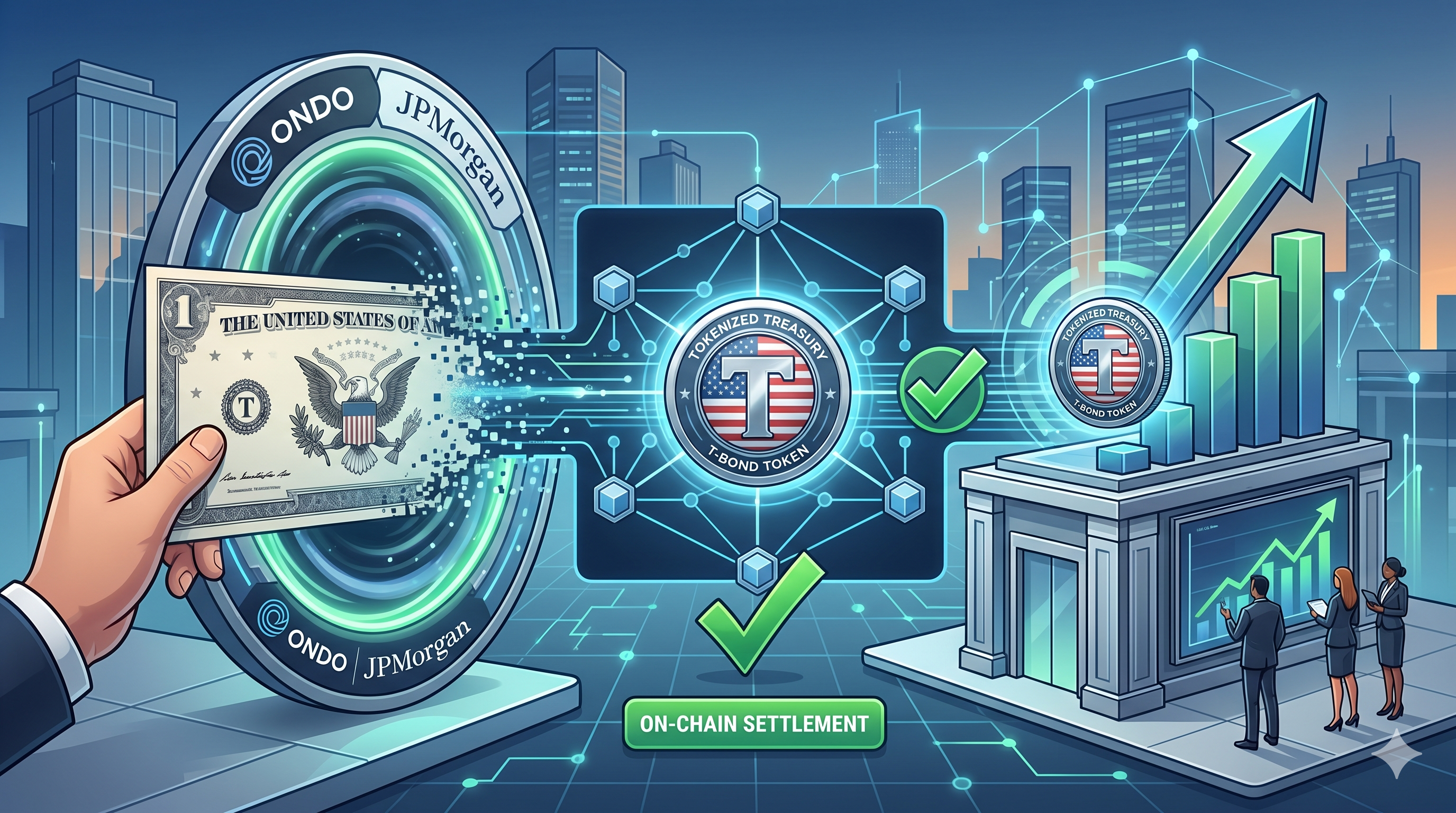
Ondo Finance, J.P. Morgan’s Kinexys, Mastercard, and Ripple complete a cross-border tokenized U.S. Treasury redemption, signaling a new institutional stage for RWA tokenization and on-chain settlement. The real-world asset sector is entering a new institutional phase as Ondo Finance, Kinexys by J.P. Morgan, Mastercard, and Ripple demonstrate on-chain settlement for tokenized U.S. Treasuries.
The transaction involved Ripple redeeming part of its OUSG holdings on the XRP Ledger, while Ondo processed the redemption. Mastercard’s Multi-Token Network helped route the payment instruction, and Kinexys by J.P. Morgan handled the U.S. dollar settlement through banking infrastructure. This milestone shows that tokenized assets are moving beyond simple on-chain issuance. They are becoming part of real settlement systems that connect blockchain networks with regulated financial infrastructure. For the RWA market, it highlights a practical path toward faster, more efficient, and institution-ready tokenized finance.
ONDO and JPMorgan Bring Tokenized U.S. Treasuries to On-Chain Settlement
The collaboration between Ondo Finance and J.P. Morgan’s Kinexys represents a pivotal shift from theoretical blockchain experiments to functional institutional infrastructure. By successfully integrating tokenized U.S. Treasuries with regulated banking rails, the transaction demonstrated a synchronized settlement flow where assets move on-chain while the corresponding cash leg is settled through traditional financial systems. This partnership—which included Ripple, Mastercard, and Kinexys—proves that the primary hurdle for Real-World Assets (RWAs) is no longer just digital creation, but the ability to provide reliable, end-to-end redemption and liquidity at scale.
For the broader financial landscape, this move establishes a practical bridge that combines the speed and transparency of public blockchains with the security of bank-grade fiat settlement. Institutional investors stand to gain significantly from this model, as it offers 24/7 availability and superior capital efficiency compared to legacy market processes. By moving beyond proof-of-concept, Ondo and J.P. Morgan are effectively defining the operational standards for the next generation of financial markets, where tokenized assets are treated not as isolated crypto experiments, but as integral components of a unified global economy.
Tokenized U.S. Treasuries Explained
Tokenized U.S. Treasuries transform traditional government debt into programmable digital assets, bridging the gap between the world's safest collateral and blockchain technology. By converting Treasury exposure into a tokenized format, these products allow for 24/7 liquidity, faster settlement times, and direct integration into decentralized financial applications. This evolution goes beyond mere digitalization; it requires a sophisticated framework of legal structures, secure custodians, and compliance protocols to ensure that the digital token remains a credible and stable representation of its underlying physical asset.
The recent collaboration between Ondo Finance, J.P. Morgan, Mastercard, and Ripple marks a critical milestone in this sector by moving from isolated experiments to integrated financial workflows. This transaction demonstrated that tokenized Treasuries can move seamlessly on a public blockchain while maintaining a secure link to regulated banking rails for cash settlement. By solving the complex "last mile" of redemption and payment, this infrastructure provides institutional investors with the transparency of blockchain records combined with the reliability of traditional banking, effectively setting the standard for how real-world assets will operate in a modernized global economy.
RWA Tokenization Enters a New Institutional Stage
The successful cross-border redemption involving Ondo, J.P. Morgan, Mastercard, and Ripple marks a definitive transition for Real-World Assets (RWAs) from experimental tokens to functional institutional infrastructure. While the early phase of tokenization focused on simply proving that assets like Treasuries, private credit, and commodities could exist on a blockchain, the market has now pivoted toward institutional settlement. This shift prioritizes the "last mile" of the transaction—ensuring that digital assets can be reliably redeemed for cash through regulated banking rails, thereby meeting the rigorous compliance and liquidity requirements of global financial entities.
By synchronizing on-chain asset movement with bank-grade fiat settlement, this transaction addresses the primary friction points of traditional finance: slow processing times, high costs, and restrictive banking hours. Tokenized U.S. Treasuries serve as the ideal catalyst for this evolution due to their status as the world’s premier collateral. The ability to settle these assets cross-border and outside of standard market hours, while maintaining a clear audit trail on public blockchains, offers a blueprint for superior capital efficiency and 24/7 market availability that legacy systems cannot match.
Ultimately, the significance of this milestone lies in its scalability. Demonstrating a seamless redemption flow for Treasuries provides a repeatable model that can be applied to more complex asset classes, including corporate bonds, money-market funds, and real estate. As tokenized assets become deeply integrated with global payment networks and major financial institutions, they are no longer just digital representations of securities—they are becoming the foundational components of a faster, more transparent, and interconnected next-generation settlement model.
A New Settlement Model for Digital Capital Markets
The collaboration between Ondo Finance and J.P. Morgan underscores a strategic shift toward a hybrid settlement model, where blockchain technology and traditional banking coexist rather than compete. In this framework, public blockchains provide the infrastructure for asset movement—offering transparency, programmability, and 24/7 availability—while regulated banking rails manage the crucial fiat leg of the transaction. This approach allows institutional investors to leverage the efficiency of digital assets without abandoning the established compliance, identity frameworks, and regulatory trust inherent in the global banking system.
Rather than seeking to replace legacy finance, this model positions blockchain as a powerful new infrastructure layer for Real-World Assets (RWAs). By integrating on-chain asset transfers with bank-grade payment routing, the Ondo transaction serves as a blueprint for the future of tokenized bonds, funds, and collateral. This pragmatic integration suggests that the next generation of capital markets will be defined by a "best-of-both-worlds" architecture, where the speed of blockchain and the stability of institutional finance combine to create a more liquid and capital-efficient global economy.
Ondo Finance’s Role in the RWA Market
Ondo Finance has become one of the most recognized names in the tokenized real-world asset sector. Its focus on tokenized Treasuries has placed it at the center of one of the most practical blockchain use cases. Ondo’s strategy is based on bringing institutional-grade financial products on-chain. By creating tokenized products backed by traditional assets, Ondo aims to connect crypto investors and institutions with yield-bearing assets from traditional finance.
OUSG is an important part of this strategy. It gives eligible investors exposure to short-term U.S. government Treasuries in tokenized form. This makes it possible for investors to access Treasury-backed exposure through blockchain-based infrastructure. In the latest transaction, Ondo’s role was not limited to issuing the asset. It also processed the redemption and helped connect the on-chain asset movement with the off-chain cash settlement process. This matters because the full lifecycle of tokenized assets includes issuance, holding, transfer, redemption, and settlement.
For the broader ONDO ecosystem, this strengthens the project’s position in the RWA sector. The transaction shows that Ondo is not only building tokenized products but also participating in institutional settlement workflows. The platform’s expansion can also be seen through reports on its tokenized securities platform surpassing $700 million in TVL, reflecting growing activity around tokenized financial products.
At the same time, market participants should avoid assuming that every institutional milestone automatically leads to immediate token price movement. The long-term value of the ONDO ecosystem will depend on adoption, assets under management, transaction volume, fees, regulation, and continued institutional participation.
J.P. Morgan and Kinexys Strengthen Institutional Blockchain Settlement
J.P. Morgan’s participation gives this transaction major institutional weight. As one of the largest financial institutions in the world, J.P. Morgan has the scale, reputation, and client base to influence how tokenized finance develops. Kinexys by J.P. Morgan is the bank’s blockchain-focused platform for institutional settlement and digital finance. Its role in the transaction was to handle the U.S. dollar settlement side through banking infrastructure. This is an essential part of tokenized finance. Public blockchains can move tokens quickly, but institutions still need reliable cash settlement. Without a trusted fiat settlement layer, tokenized assets cannot become fully useful for banks, asset managers, and global investors.
J.P. Morgan’s involvement also shows that major banks are no longer treating blockchain settlement as a distant experiment. They are actively testing how tokenized assets can interact with existing financial systems. For the RWA market, this is a positive signal. Institutional adoption depends heavily on trust. When major banks participate in tokenized asset transactions, it gives the market more credibility and may encourage other financial institutions to explore similar infrastructure.
Mastercard and Ripple Connect Tokenized Assets to Global Finance
Mastercard’s role in the transaction highlights the growing importance of payment networks in tokenized finance. Its Multi-Token Network is designed to support digital asset and tokenized payment activity in a way that institutions can use. In the Ondo transaction, Mastercard helped route the payment instruction between the tokenized Treasury redemption and J.P. Morgan’s settlement system. This role may sound less visible than the on-chain transfer, but it is a key part of the process.
Tokenized finance needs coordination between asset movement, payment instructions, compliance, identity, and settlement. Payment networks are well positioned to provide this connectivity because they already operate across global financial systems. Ripple’s participation gave the XRP Ledger an important institutional use case. Ripple redeemed part of its OUSG holdings on the XRP Ledger, which handled the on-chain asset movement.
The XRP Ledger has long been known for fast and low-cost settlement. These characteristics are relevant for tokenized assets because institutions need networks that can process transactions efficiently and reliably. For Ripple, the transaction strengthens its position in institutional blockchain finance. Ripple has focused on payments, liquidity, and cross-border settlement for years. Tokenized real-world assets are a natural extension of that strategy because they combine digital asset movement with global financial infrastructure.
The use of XRP Ledger in a transaction involving Ondo, J.P. Morgan, and Mastercard is meaningful for the ecosystem. It shows that public blockchain networks can be part of institutional RWA workflows. Still, it is important to separate infrastructure adoption from token price speculation. A successful institutional transaction may improve market perception, but long-term impact depends on actual usage, liquidity, transaction volume, network fees, and broader adoption.
Benefits of Tokenized U.S. Treasuries
Tokenized U.S. Treasuries offer a transformative suite of benefits for institutional finance by integrating the stability of government debt with the technological agility of blockchain. The primary advantage lies in enhanced capital efficiency, driven by near-instantaneous settlement and 24/7 availability, which allow institutions to bypass the restrictive operating hours and manual delays of traditional legacy systems. Furthermore, the programmability of these assets enables them to interact seamlessly with smart contracts and automated collateral management tools, while the inherent transparency of on-chain records provides a more verifiable audit trail of ownership. Collectively, these improvements empower investors to optimize liquidity and manage risk with a level of precision and speed that was previously unattainable in conventional debt markets.
These benefits explain why tokenized Treasuries have become one of the strongest categories in the RWA market. They combine a trusted traditional asset with blockchain-based efficiency. The market’s growth is also reflected in reports showing that tokenized U.S. Treasuries rose by more than $1 billion since 2026 began, signaling increasing demand for blockchain-based Treasury exposure.
RWA Market Growth and Institutional Adoption
The RWA market has become one of the strongest narratives in digital assets because it connects blockchain technology with large existing financial markets. Unlike many crypto trends, real-world asset tokenization is tied to assets that already have major global demand. U.S. Treasuries, corporate bonds, private credit, real estate, commodities, and money-market funds represent enormous markets. If even a small portion of these assets moves on-chain, the tokenized asset sector could become one of the largest areas in blockchain finance.
Institutional adoption is likely to develop gradually. Banks, asset managers, payment companies, custodians, and regulators all need time to build standards and confidence. However, transactions like the Ondo and JPMorgan redemption show that the infrastructure is beginning to take shape.
The most important shift is from narrative to usage. RWA tokenization is no longer just about saying that traditional assets can move on-chain. It is about proving that they can be used in real financial workflows. This includes issuance, transfer, custody, redemption, settlement, reporting, and compliance. Each part of the process must work for institutions to adopt tokenized assets at scale. The broader institutional momentum around this sector is also visible in coverage of major financial institutions racing to tokenize real-world assets.
Market Impact for ONDO and the RWA Sector
The transaction has naturally increased attention on ONDO and the broader RWA sector. Investors often look for projects that are connected to institutional adoption, and Ondo Finance is one of the leading names in tokenized Treasuries.
The development may strengthen Ondo’s reputation as a serious player in the RWA market. It shows that Ondo’s infrastructure can connect with major financial firms and payment networks.
However, investors should approach the market carefully. Institutional partnerships and successful transactions can improve long-term credibility, but token prices are influenced by many factors. These include market sentiment, liquidity, tokenomics, regulation, revenue, adoption, and broader crypto market conditions.
The stronger signal is not short-term price movement. The stronger signal is that real-world asset tokenization is gaining institutional traction. If tokenized Treasuries continue to grow and if more institutions use these products, the entire RWA sector could benefit over time.
Key metrics to watch include tokenized Treasury market size, assets under management, redemption volume, institutional users, settlement activity, and integrations with banks and payment networks.
The Future of Tokenized Bonds and On-Chain Settlement
The next phase of RWA tokenization will focus on scale. First-of-their-kind transactions are important, but the market needs repeatable systems that can support larger volumes, more participants, and more asset classes.
Tokenized Treasuries are likely to remain a leading category because they are familiar, liquid, and widely trusted. Once the infrastructure for Treasury tokenization becomes more mature, other assets may follow.
Corporate bonds could be tokenized to improve settlement and secondary-market access. Money-market funds could move on-chain for better liquidity management. Private credit could become more transparent and accessible. Real estate funds could use tokenization to support fractional ownership. Commodities could become easier to trade and settle digitally.
Each asset class has different legal, operational, and liquidity challenges. Treasuries are the natural starting point, but broader tokenization will require stronger standards, clearer regulation, and deeper institutional participation.
The Ondo and JPMorgan transaction suggests that the foundation is being built. Banks, payment networks, blockchain platforms, and asset issuers are starting to work together. That collaboration will be essential for the RWA market to scale.
Conclusion: RWA Tokenization Moves Into Financial Infrastructure
The on-chain redemption of tokenized U.S. Treasuries involving Ondo Finance, Kinexys by J.P. Morgan, Mastercard, and Ripple marks a major step for the RWA sector. It shows that tokenized assets are moving beyond simple issuance and becoming part of real settlement infrastructure. By connecting blockchain-based Treasury products with institutional payment and banking rails, the transaction highlights how traditional finance and digital assets can work together.
For Ondo, J.P. Morgan, Mastercard, and Ripple, the milestone strengthens their roles in the future of tokenized finance. More importantly, it signals that RWA tokenization is entering a new institutional stage where real-world assets may become faster, more efficient, and more useful in global markets.
FAQs
What is the ONDO and JPMorgan tokenized U.S. Treasury transaction?
It was a cross-border redemption of tokenized U.S. Treasuries involving Ondo Finance, J.P. Morgan’s Kinexys, Mastercard, and Ripple. The transaction showed how tokenized assets can move on-chain while the cash side settles through banking infrastructure.
What are tokenized U.S. Treasuries?
Tokenized U.S. Treasuries are blockchain-based representations of exposure to U.S. government debt or Treasury-backed products. They allow traditional Treasury assets to be used in digital financial systems.
What is RWA tokenization?
RWA tokenization means converting real-world assets such as bonds, U.S. Treasuries, real estate, private credit, or commodities into blockchain-based tokens.
What role did J.P. Morgan play?
J.P. Morgan participated through Kinexys, its institutional blockchain settlement platform. Kinexys supported the U.S. dollar settlement side of the transaction.
How was Ripple involved?
Ripple redeemed part of its OUSG holdings on the XRP Ledger. The XRP Ledger supported the on-chain movement of the tokenized Treasury asset.
What does this mean for the RWA market?
It shows that RWA tokenization is moving beyond simple asset issuance and into real settlement infrastructure, where tokenized assets can connect with banks, payment networks, and institutional investors.
Disclaimer: This article is for informational purposes only and is not financial advice. Always do your own research before buying or trading crypto.