

Cobo Launches Agentic Wallet: How Cobo’s Agentic Wallet Gives AI Agents Enforceable Autonomy Without Giving Up Control
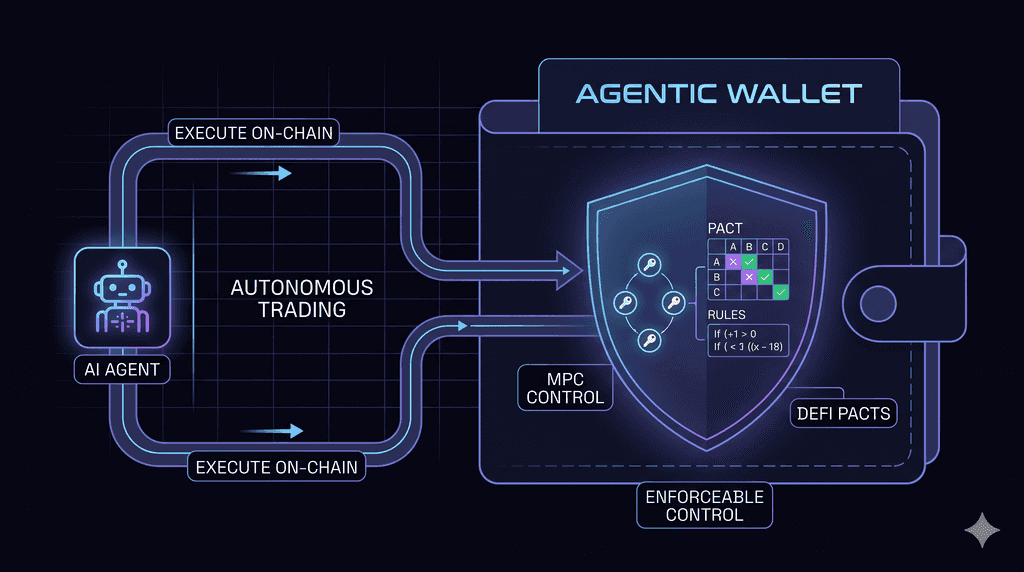
Now, the intersection of AI and blockchain reached a critical turning point. While AI chatbots have been talking for years, we have finally entered the era of Agentic AI, autonomous entities that can execute trades, manage portfolios, and settle payments on-chain.
However, the industry has faced a major security paradox: how do you give a bot a credit card without it spending you into bankruptcy?
Traditional wallets forced a binary choice: either give the AI your private key or require a human to sign every single move. Cobo’s Agentic Wallet (CAW) solves this with Enforceable Autonomy, a framework that allows agents to act independently while remaining strictly bounded by cryptographically enforced human rules.
Key Takeaways
-
CAW is the first self-custodial wallet for AI built on Multi-Party Computation (MPC).
-
Every task an AI performs is bound by an agreement that defines its intent, spending limits, and termination conditions, enforced at the infrastructure level.
-
To prevent AI hallucinations, Cobo uses a library of verified Recipes.
-
At launch, the wallet supports over 80 major blockchains and 3,000+ tokens, integrating natively with leading AI frameworks like OpenAI Agents SDK, LangChain, and Claude MCP.
-
The wallet offers a high-security MPC Mode for high-value operations and a forthcoming Custodial Mode optimized for high-frequency, low-latency micro-payments.
Why Traditional Wallets Fail AI Agents
Before Cobo’s breakthrough, integrating AI with blockchain was a game of dangerous trade-offs. The fundamental issue is that traditional wallet architectures were built for humans, not for autonomous algorithms that can execute thousands of decisions per second. This has led to a persistent trust dilemma that has stalled the growth of the machine economy.
Until now, developers were trapped in a binary choice that offered no middle ground:
You could give an AI agent an Externally Owned Account (EOA) and its associated private key. This gives the agent maximum speed and autonomy, but it is a security nightmare. Giving a bot your private key is effectively giving it a "blank check." If the AI's logic is compromised or its environment is hacked, your entire treasury can be drained in a single block.
To avoid the risk of a rogue agent, many systems require a human to sign off on every transaction. While this is secure, it completely negates the value of an autonomous agent. An AI that has to wait for a human to wake up and check their phone to approve a rebalance isn't an autonomous agent, it's just a fancy notification bot.
The rise of Large Language Models (LLMs) introduced a new layer of risk: intentional and unintentional errors.
AI agents are susceptible to hallucinations, where they might "invent" a contract address or misinterpret an API response. Even more concerning is prompt injection, where a malicious actor could trick an agent into executing a transaction that sends funds to an attacker's address. Without a wallet that understands the "context" of a transaction at the infrastructure level, a traditional wallet will blindly execute whatever the agent signs, regardless of how catastrophic the command might be.
Finally, traditional wallets lack the granular permissioning required for a multi-agent world. In a complex Web3 ecosystem, you might want one agent to only harvest yield on Aave, while another is restricted to trading on Uniswap with a specific slippage limit.
Traditional wallets are "all or nothing." They cannot natively enforce these micro-rules, forcing developers to build complex, fragile middleware that often becomes a target for exploits itself. To truly unlock the potential of the Agentic Economy, we needed a wallet that doesn't just store assets but actually understands and enforces the "boundaries" of the agent it serves.
Understanding Cobo’s "Enforceable Autonomy" Framework
At the heart of Cobo’s solution is a paradigm shift from "soft" permissions to Enforceable Autonomy.
In traditional systems, an AI agent’s power is limited only by its software code, which can be buggy or manipulated. Cobo moves these limits to the infrastructure layer, creating a sandbox that the agent physically cannot exit, regardless of how its underlying logic evolves or fails.
What is Enforceable Autonomy?
Cobo defines Enforceable Autonomy through the Pact Protocol. In this system, an agent is never given broad, standing permissions. Instead, every specific task requires a Pact, a dynamically generated, cryptographically signed agreement between the human owner and the agent.
A Pact is not just a "yes" to a transaction; it is a comprehensive mandate that includes:
-
Intent: The specific objective (e.g., "Yield farming on Aave").
-
Execution Plan: The exact steps and smart contracts the agent is allowed to interact with.
-
Permissions & Policies: Spending ceilings, slippage limits, and whitelisted protocols.
-
Completion Conditions: The specific trigger that automatically terminates the agent's authority once the goal is reached.
Cryptographic vs. Software Assurances
The true innovation of the Cobo Agentic Wallet (CAW) lies in how it enforces these Pacts. Most existing "agentic" solutions rely on Trusted Execution Environments (TEE) or API-level restrictions. These are software-level assurances; if the agent’s runtime is compromised or its LLM is manipulated via prompt injection, those software gates can be bypassed.
CAW, however, uses Multi-Party Computation (MPC). By sharding the private key into separate pieces held by the User, the Agent, and Cobo’s Infrastructure, it creates a mathematical guarantee. Because a valid signature requires a threshold of these shares, a compromised agent or a hallucinating LLM cannot independently generate a signature for a transaction that falls outside the active Pact. The infrastructure simply refuses to co-sign any movement of funds that hasn't been pre-authorized by the human owner.
The "Kill Switch" Architecture and Human Sovereignty
Despite the agent's high level of autonomy, Cobo ensures the human owner remains the ultimate sovereign. This is achieved through a dual-group signing architecture:
Agent + Cobo Group: Handles routine, Pact-authorized transactions automatically to ensure speed and 24/7 responsiveness.
Human + Cobo Group: Required for high-value governance decisions, policy changes, and initial Pact approvals.
Most importantly, the framework includes an Emergency Freeze (Kill Switch) capability. With one tap in the Cobo mobile app, a user can instantly freeze all sub-wallets and revoke all active Pacts. Because the user retains a recovery path that does not depend on the agent or even Cobo being online, they can rebuild their signing authority and move funds to safety at any time, ensuring that autonomy never translates into loss of control.
The Three World-First Innovations of the Cobo Agentic Wallet
Cobo Agentic Wallet (CAW) introduces a trifecta of technological "firsts" designed to bridge the trust gap between human owners and autonomous algorithms.
By moving beyond simple API keys and software-level gates, Cobo has established a multi-layered security stack that ensures an agent can operate independently without ever possessing the capability to go rogue.
MPC-Based Self-Custody for AI
Most existing agentic solutions rely on Trusted Execution Environments (TEE) or delegated Externally Owned Accounts (EOAs), both of which depend on software-level assurances. If the agent’s logic is compromised or its environment is hacked, the assets are immediately vulnerable.
Cobo CAW is the world’s first non-custodial wallet for AI built on Multi-Party Computation (MPC). This technology encrypts and shards the private key into three distinct shares: one held by the User, one by the Agent, and one by Cobo’s infrastructure.
Mathematical Guarantee: A valid signature requires a threshold of these shares. Even if an AI agent is manipulated via a prompt injection attack, it cannot generate a valid transaction signature on its own.
Dual Modes: Currently, the wallet operates in MPC Mode for high-value, high-risk operations. Cobo has also announced a forthcoming Custodial Mode optimized for low-latency, high-frequency micro-payments.
The Pact Protocol: Dynamic Task Boundaries
The Pact Protocol is a world-first human-agent authorization framework that elevates simple permissions into programmable, controlled autonomy. Unlike static policy systems that grant permanent access to a protocol, a Pact is dynamically generated for every single task.
Recipe-Driven Scenario Templates
To solve the industry-wide problem of AI hallucinations, where a Large Language Model (LLM) might fabricate a contract address or misinterpret an ABI, Cobo introduced Recipe-driven scenario templates.
Recipes are pre-verified skill playbooks that package all the necessary components of an on-chain task into an immutable template. Instead of an agent reasoning its way through a complex DeFi swap, it simply executes a verified Recipe.
This shifts the agent’s role from high-risk ad-hoc reasoning to low-risk autonomous execution, ensuring that the bot remains within the boundaries of verified, secure pathways at all times
Where AI Agents and Cobo Wallets Converge
Autonomous Yield & Asset Management
Traditionally, human traders had to monitor 24/7 markets to rebalance positions, which is both inefficient and exhausting.
AI agents can now be programmed with a Yield Pact to monitor APYs across protocols like Aave V3, Compound V3, and Morpho. If a higher yield becomes available on a different chain, the agent can autonomously migrate collateral, settle debts, and reinvest, all within a predefined slippage and gas fee budget.
For DAOs and Web3 startups, AI agents serve as automated treasurers. They can execute Dollar-Cost Averaging (DCA) strategies, maintain specific stablecoin-to-volatile asset ratios, and manage idle liquidity across over 80 supported blockchains.
Machine-to-Machine (M2M) Payments via x402
One of the most transformative use cases is the integration of the x402 protocol, the HTTP-native blockchain payment standard. This allows for a purely agentic economy where software can pay other software for services.
Autonomous API Consumption: An AI agent needing specialized data can use its Cobo wallet to settle a micropayment to a data provider instantly via x402, without human intervention or the need for a corporate credit card.
On-Demand Compute Power: AI agents can "rent" GPU power from decentralized compute networks (such as Akash or Render) by streaming payments through Superfluid recipes, paying only for the exact seconds of processing time they consume.
Smart Governance & Security Auditing
AI agents are increasingly being used to manage the "administrative" side of Web3, where human bandwidth is often the primary bottleneck.
Users can delegate their governance power to an agent bound by an Ideological Pact. The agent analyzes thousands of pages of DAO proposals and votes according to the user’s predefined values, ensuring active participation without the voter fatigue common in traditional governance.
Using the Cobo WaaS Skill, agents can perform real-time Checks before executing any transaction. They can analyze a target smart contract for reentrancy vulnerabilities, check destination addresses against global sanction lists, and flag potential "honeypot" tokens before a single cent is moved.
High-Frequency Social & Corporate Operations
The flexibility of the Cobo framework allows for lighter agentic interactions that improve daily Web3 workflows:
Discord & Telegram Tipping Bots: AI-powered social agents can manage community rewards and tipping ecosystems, executing hundreds of small-value transfers autonomously while remaining capped by a daily global budget Pact.
Multi-Approval Corporate Payroll: Institutional agents can be programmed to handle recurring payroll for global teams, automatically calculating tax withholdings and executing transfers once a threshold of "Human + Cobo" signatures is met, ensuring both speed and compliance.
Why This Is a Game-Changer for Institutional Web3
For institutional players, the primary barrier to adopting autonomous AI has always been the lack of a verifiable audit trail and the risk of catastrophic software failure. Cobo’s Agentic Wallet (CAW) removes these hurdles by transforming AI operations from a black box into a transparent, compliance-first infrastructure.
Bridging the Compliance Gap with Hard Enforcement
In traditional enterprise finance, "compliance" often relies on internal policies and human oversight—systems that are inherently prone to delay or circumvention. Cobo shifts this to cryptographic enforcement.
For compliance officers, this means they no longer have to "trust" that the AI code is functioning correctly; they can rely on the fact that the wallet infrastructure will physically reject any non-compliant transaction.
Permanent Auditability
One of the most significant institutional features is the permanent, tamper-proof audit trail. Unlike standard wallets that only record what happened (the transaction), CAW records the "Who, What, When, Why, and Which Rule."
Institutions can provide clear reports to investors and regulators showing exactly which AI agent made a decision, the market data it was reacting to, and the specific security guardrails that were in place at the time of execution.
Institutional Scalability and Risk Control
Managing a single AI agent is simple; managing hundreds across multiple strategies is a logistical nightmare. CAW is built for this Agentic Scale.
The framework supports up to 50 sub-wallets per account, allowing institutions to run parallel strategies without mixing assets or risk profiles.
The wallet includes built-in Circuit Breakers that monitor for abnormal slippage, malicious approvals, or sudden shifts in protocol liquidity, instantly freezing affected sub-wallets if a threat is detected.
Seamless Ecosystem Interoperability
By supporting over 80 blockchain networks and integrating natively with frameworks like LangChain, OpenAI Agents SDK, and Claude MCP, Cobo allows institutions to deploy AI agents across the entire Web3 landscape. This prevents vendor lock-in and ensures that as the AI economy evolves, institutional treasuries are already equipped with the necessary plumbing to interact with any new protocol or chain that emerges.
As the infrastructure for the Machine Economy matures with the launch of the Cobo Agentic Wallet, the focus for investors and developers is shifting toward execution. KuCoin provides the essential gateway to this new economy, offering the liquidity and tools needed to capitalize on the agentic shift.
Trading the Infrastructure of the Machine Economy
The rise of agentic wallets directly benefits the underlying protocols that provide compute power, data, and decentralized AI coordination. Using the KuCoin Spot Market, you can gain exposure to the pillars of this revolution:
AI Infrastructure: Trade market leaders like Bittensor (TAO), Render (RNDR), and Near Protocol (NEAR), which provide the computational backbone for autonomous agents.
Agentic Tokens: Position yourself in the emerging Agent Economy through projects like Virtuals Protocol (VIRTUAL) and the Artificial Superintelligence Alliance (FET/ASI), which are actively building the frameworks that Cobo’s CAW is designed to secure.
Leveraging Volatility in the AI Sector
The AI-crypto sector is known for rapid innovation and equally rapid price movements. For traders looking to hedge their portfolios or profit from high-frequency news cycles, KuCoin Futures offers the flexibility to trade AI-related assets with leverage. Whether you are hedging against a broader market pullback or going long on a breakthrough in Enforceable Autonomy, futures allow you to manage risk with professional-grade precision.
Powering Your Agents with KuCoin Earn and API
For those moving from trading to building, KuCoin’s infrastructure is perfectly aligned with the needs of the agentic economy:
Passive Growth for AI Reserves: While your AI agents are idle or waiting for the next "Pact" to trigger, you can deploy your stablecoins and AI tokens into KuCoin Earn to generate consistent, passive yield.
Developer-First Tools: Use KuCoin’s advanced Trading APIs to connect your own AI agents—powered by frameworks like OpenClaw or LangChain, directly to one of the world's most liquid exchanges. By combining Cobo’s secure wallet architecture with KuCoin’s execution layer, you can build a truly autonomous, institutional-grade trading system.
Conclusion
The launch of the Cobo Agentic Wallet is the missing link for the trillion-dollar AI economy. By solving the trust problem through MPC-based self-custody and the Pact Protocol, Cobo has turned autonomous on-chain execution from a high-risk experiment into a reliable, institutional capability. Today, the ability to grant AI agents Enforceable Autonomy will be the standard for any entity looking to scale in the decentralized world.
FAQs
What is the Enforceable Autonomy in Cobo's Agentic Wallet?
It is a security framework that uses the Pact Protocol to grant AI agents the power to execute transactions while cryptographically preventing them from moving funds outside of predefined human guardrails.
Can a Cobo Agentic Wallet prevent prompt injection attacks?
Yes. Because the wallet uses MPC-based security and pre-verified Recipes, a compromised AI cannot generate a valid signature for a malicious transaction that falls outside its authorized Pact.
Which AI frameworks does Cobo CAW support?
As of April 2026, CAW supports OpenAI Agents SDK, LangChain, Claude MCP, Agno, and CrewAI, allowing developers to easily integrate secure wallet features into popular AI models.
Is Cobo's Agentic Wallet custodial or non-custodial?
The primary mode is non-custodial (MPC Mode), where key shares are split between the user, the agent, and Cobo. A custodial mode for high-frequency, low-value micropayments is planned for future release.
How many blockchains does the Cobo Agentic Wallet support?
At launch, CAW supports over 80 major blockchains (including Ethereum, Solana, and Base) and more than 3,000 tokens.
Disclaimer:This content is for informational purposes only and does not constitute investment advice. Cryptocurrency investments carry risk. Please do your own research (DYOR).