

Hawkish FOMC Minutes Raise Rate Hike Risks: What’s Next for Bitcoin?
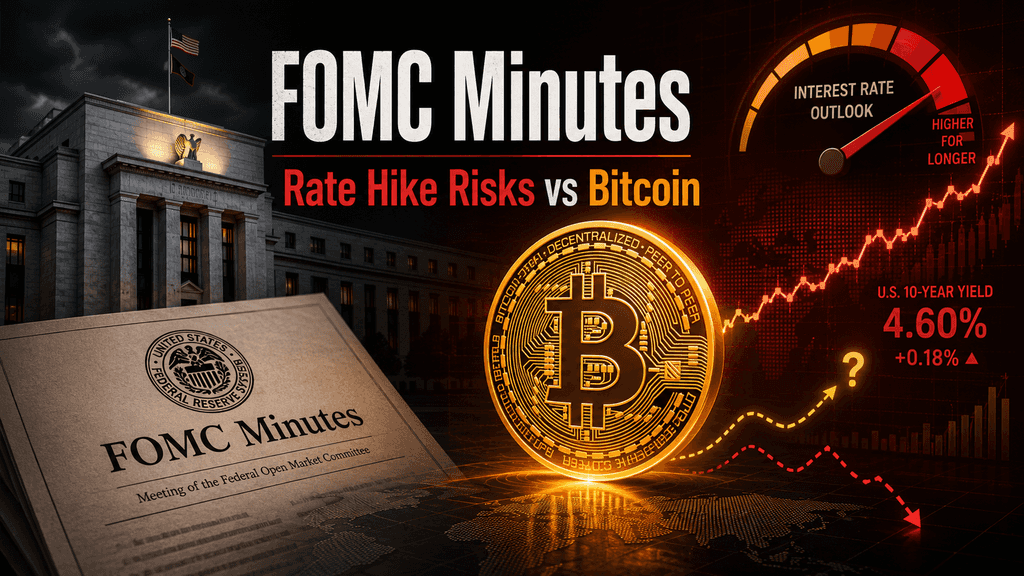
The latest Federal Open Market Committee minutes have put interest-rate risk back at the center of the crypto market. Minutes from the Federal Reserve’s July 28–29 meeting showed that concern over persistent inflation had intensified, with several policymakers already favoring a rate increase and a broader group prepared to tighten policy if inflation failed to move convincingly toward the Fed’s 2% target. The decision itself was a 9–3 vote to keep the federal funds rate at 3.50%–3.75%, with Beth Hammack, Neel Kashkari and Lorie Logan preferring a 25-basis-point hike.
For Bitcoin investors, however, the story is more complicated than “hawkish Fed, bearish BTC.” Bitcoin rallied above $68,000 around the same period even as the minutes revealed a more restrictive policy debate. Falling Treasury yields, a weaker dollar and the U.S. Treasury’s decision to expand long-dated bond buybacks helped offset the Fed’s hawkish message. The key question is therefore not simply whether the Fed sounds hawkish, but whether upcoming inflation and labor data become strong enough to turn that rhetoric into actual rate hikes.
What Did the Latest FOMC Minutes Actually Say?
The July meeting marked a notable change in the tone of the Federal Reserve’s policy debate. The FOMC left rates unchanged at 3.50%–3.75%, but three voting members wanted an immediate 25-basis-point increase. The published minutes went further than the headline vote: “several” policymakers were prepared to raise rates at the meeting, while “many” participants believed additional policy tightening would likely become necessary if inflation did not decline. Policymakers favoring tighter policy argued that price pressures had become broad-based and that acting too slowly could eventually require a sharper and more economically costly sequence of increases.
That distinction matters. The official 9–3 vote captures only voting FOMC members, while the meeting includes additional regional Fed presidents who participate in the discussion without voting in every year. The minutes therefore suggest that support for higher rates extended beyond the three formal dissenters. They also contained no discussion of support for a rate cut, highlighting how far the policy conversation has shifted from earlier expectations that inflation would cool enough to allow additional easing in 2026.
| Key FOMC Signal | What It Means |
| Rates held at 3.50%–3.75% | The Fed did not tighten policy in July |
| Three members voted for a 25bp hike | Hawkish dissent became significant |
| “Several” favored higher rates | Support extended beyond the formal vote |
| “Many” saw tightening as possible | Future hikes remain a credible option |
| Inflation remains above target | Price stability is still the Fed’s main concern |
The wording does not mean a new hiking cycle is guaranteed. “Several” and “many” describe the breadth of views rather than a formal commitment to act. What the minutes establish is that another rate increase has moved from a remote scenario into an active part of the Fed’s policy debate.
Why Is the Fed Turning More Hawkish?
The Fed’s shift is fundamentally about confidence—or the lack of it—that inflation will return sustainably to 2%. The July statement said inflation remained elevated, partly because supply shocks had pushed up prices in areas including energy. Policymakers were also operating against a backdrop of solid economic activity, strong productivity and capital investment, giving the central bank less reason to tolerate inflation simply to protect growth.
Inflation Is Proving Harder to Kill
The most worrying scenario for the Fed is no longer a temporary spike in a handful of categories. Policymakers favoring higher rates argued that price pressures appeared broad-based, while many participants worried that years of above-target inflation could eventually influence expectations, wage bargaining and firms’ pricing decisions. Once inflation expectations become embedded in everyday economic behavior, returning inflation to target can require substantially tighter policy.
The Fed is therefore trying to avoid waiting until persistent inflation becomes self-reinforcing. This explains why some policymakers would rather tighten moderately now than risk needing larger increases later. At the same time, the Fed still has to consider employment risks, particularly after softer labor-market information emerged following the July meeting. The result is a policy debate that is clearly more hawkish but not yet one-sided.
Middle East Risks, Tariffs and AI Complicate the Inflation Picture
Several unusual forces are making the inflation outlook harder to read. The Middle East conflict has disrupted energy markets and constrained oil and gas shipments through the Strait of Hormuz, increasing the possibility that higher energy and transportation costs spread through the economy. Tariffs add another source of goods-price pressure, while the enormous AI investment cycle is generating demand for electricity, data centers, chips, construction capacity and specialized labor.
AI investment illustrates the Fed’s dilemma particularly well. In the long run, artificial intelligence could lift productivity and expand supply, potentially reducing inflation. In the shorter run, however, the infrastructure boom can raise demand faster than electricity grids, equipment suppliers and labor markets can respond. For monetary policy, that means a productivity story that is potentially disinflationary over several years can still create inflationary pressure today.
Why Do Rate Hike Risks Matter So Much for Bitcoin?
Bitcoin does not respond to the federal funds rate through a single mechanical channel. What matters is how expectations for Fed policy change the broader price of money. When investors expect higher policy rates, short-term Treasury yields tend to rise, real yields can increase, the dollar often strengthens and credit conditions become less accommodating. Those moves raise the opportunity cost of holding non-yielding assets and reduce the amount of liquidity available for speculative and long-duration investments.
Bitcoin is especially sensitive to this environment because its valuation is not anchored to corporate earnings or a contractual cash flow. Investors instead price BTC according to scarcity, adoption, liquidity, risk appetite and expectations about future demand. A higher risk-free return makes cash and government bonds more attractive relative to volatile assets. At the same time, a stronger dollar can tighten global financial conditions because much of the world’s financial system remains dollar-denominated.
| Macro Change | Typical Implication for Bitcoin |
| Fed rate-hike expectations rise | Negative for risk appetite |
| 2-year Treasury yield rises | Signals tighter expected Fed policy |
| Real yields rise | Raises the opportunity cost of holding BTC |
| U.S. dollar strengthens | Tightens global dollar liquidity |
| Financial conditions loosen | Generally supportive for BTC |
| Rate-hike expectations fall | Can improve crypto risk appetite |
The two-year Treasury yield deserves particular attention because it reacts strongly to expected Fed policy. If a stronger CPI report suddenly pushes the two-year yield sharply higher while the dollar strengthens, Bitcoin may face more pressure even before the Fed actually changes rates. Conversely, if inflation cools and short-term yields decline, markets can effectively loosen financial conditions in advance of any official policy shift.
Why Didn’t Hawkish FOMC Minutes Crush Bitcoin?
The most interesting part of the latest episode is that markets did not react as though another rate hike had suddenly become inevitable. The minutes generated relatively little immediate reaction, even though their language was clearly more hawkish than crypto investors would normally prefer. Reuters reported that markets continued to focus on information received after the July meeting, including softer inflation and employment signals that reduced the urgency for an immediate September move.
This illustrates an important limitation of FOMC minutes: they are backward-looking. The document released on August 19 describes the debate held on July 28–29, using the information policymakers had at that time. By the time investors read the minutes, almost three additional weeks of economic and market data have accumulated. Markets therefore ask whether the reasoning recorded in the minutes is becoming more or less relevant—not simply whether the language sounds hawkish.
The second factor was the bond market. The U.S. Treasury announced that it would at least double the size of certain long-dated government-bond buyback operations from $2 billion to $4 billion per operation. The move helped push long-term Treasury yields lower and weakened the dollar, while stocks, gold and Bitcoin rallied. The 30-year yield fell by roughly 10 basis points from recent highs, and Bitcoin moved above $68,000 for the first time since June. The result was a tug-of-war between a hawkish Fed message and easier market-based financial conditions. For the moment, the latter proved powerful enough to prevent the minutes from becoming a major crypto selloff catalyst.
Is a September Rate Hike Really Coming?
A hawkish set of minutes should not be confused with confirmation of a September hike. Reuters reported after the release that the Fed was still expected to leave rates unchanged at its September 15–16 meeting, particularly after more recent data showed some easing in inflation and unexpected weakness in July employment. Futures markets were placing more emphasis on the possibility of tightening later in the year, including the October and December meetings.
That leaves three broad scenarios for Bitcoin:
| Fed Scenario | What Could Drive It | Possible Bitcoin Reaction |
| Hold | Inflation continues to cool and employment softens | Supportive if yields and dollar decline |
| 25bp hike | Inflation reaccelerates or expectations become less anchored | Initial downside risk and higher volatility |
| Hawkish hold | Fed pauses but warns that tightening is likely later | Mixed; depends heavily on yields and guidance |
The third scenario may be the most underappreciated. Bitcoin traders often reduce an FOMC meeting to a binary question—hike or no hike—but forward guidance can matter more than the rate decision itself. A September hold accompanied by warnings that inflation is too persistent, financial conditions are too loose and additional tightening is likely could push Treasury yields and the dollar higher even without an immediate increase.
Conversely, the Fed could hold while acknowledging clearer disinflation and growing labor-market risks. That would likely be interpreted very differently. The September meeting therefore matters not just because of the target rate but because it will provide new economic projections and another opportunity for the Fed to explain how its reaction function has changed since July.
What Could Push Bitcoin Higher Despite a Hawkish Fed?
The clearest bullish path does not require the Fed to suddenly become dovish. Bitcoin could continue performing well if market-based financial conditions improve faster than official policy tightens. Falling Treasury yields would reduce the relative attractiveness of government bonds, while a weaker dollar would ease an important source of global financial pressure. The reaction to the Treasury’s expanded bond-buyback program offered a live example: long-term yields fell, the dollar weakened and risk assets rallied even as the FOMC minutes revealed growing support for rate increases.
The more durable bullish scenario would be a renewed disinflation trend. If upcoming inflation reports show that price pressures are cooling, wage growth moderates and energy costs stabilize, investors may conclude that the Fed’s July concerns are becoming outdated. Rate-hike expectations could then retreat, pulling down short-term yields and improving liquidity conditions without requiring the central bank to immediately change policy.
This is why markets trade future monetary policy rather than yesterday’s policy debate. A hawkish document can coexist with rising Bitcoin if investors believe the data that motivated the hawkishness are already changing. For BTC, the most favorable combination would be cooling inflation, a softer labor market that does not collapse into recession, declining yields and continued crypto-specific demand. Under those conditions, the Fed could remain rhetorically cautious while financial conditions gradually become more supportive.
What Could Send Bitcoin Lower?
The bearish scenario is essentially the opposite: inflation stays high enough to force the Fed to turn warnings into action. A renewed rise in energy prices, stronger-than-expected core inflation or persistent wage pressure could push markets to price a higher path for the federal funds rate. Because policymakers have now made clear that further tightening is a legitimate option, inflation surprises may generate stronger market reactions than they would have when investors believed the next Fed move could only be a cut.
The Middle East remains particularly important. The Fed has repeatedly discussed the conflict as a source of uncertainty for energy prices, inflation expectations and economic activity. Earlier FOMC discussions noted that Middle East developments were already influencing oil futures and market-based inflation measures, while the July statement again referred to elevated uncertainty linked partly to the conflict. A sustained oil shock could therefore travel from geopolitical markets into Fed expectations and ultimately into Bitcoin.
The dangerous combination for BTC would be rising oil prices, stubborn core inflation, resilient economic demand, higher two-year Treasury yields and a stronger dollar at the same time. In that environment, Bitcoin would not merely be reacting to a hawkish headline. It would be confronting genuinely tighter financial conditions. The distinction matters because rhetoric can fade quickly; a sustained repricing of yields and liquidity is much harder for risk assets to ignore.
What Should Bitcoin Traders Watch Next?
The next phase of this story will be driven more by data than by the minutes themselves. Core PCE and CPI will show whether inflation is actually moving toward the Fed’s goal, while payroll growth, unemployment and wage data will indicate how much room policymakers have to tighten without creating excessive labor-market damage. Treasury yields will reveal whether investors believe the Fed’s hawkish warnings, and the dollar will show how those expectations are transmitting into global financial conditions.
Rather than watching any single indicator in isolation, crypto traders can focus on combinations. Rising hike expectations accompanied by a higher two-year yield and a stronger dollar would provide a much clearer tightening signal than a small change in futures probabilities alone. On the other hand, falling yields and a weakening dollar despite hawkish Fed rhetoric would suggest that markets are becoming more confident inflation can cool without substantial additional tightening.
Crypto-native liquidity also matters. Spot-market demand, ETF flows, stablecoin liquidity, perpetual-futures funding and open interest can either amplify or offset the macro environment. Bitcoin may remain resilient to modest Fed hawkishness when spot demand is strong and leverage is controlled. But if macro conditions tighten while futures positioning becomes crowded and funding rises sharply, the probability of a leveraged correction increases. The strongest trading framework therefore combines Fed expectations with both traditional financial conditions and crypto-market structure.
Bitcoin’s Next Move Depends on Inflation, Not Just the Fed
The FOMC minutes matter because they define the Fed’s reaction function. They tell investors that policymakers are no longer treating another rate hike as an implausible outcome. Several officials were ready to tighten in July, and many others indicated they could support higher rates if inflation failed to decline. That raises the sensitivity of Bitcoin, bonds and the dollar to every major inflation report released before the next meetings.
But the minutes do not determine what happens next. Inflation will determine whether the Fed has to act on its warnings; financial conditions will determine how much those warnings actually tighten markets; and crypto liquidity will determine how well Bitcoin absorbs the resulting pressure. That is why BTC can rally on a day when the underlying Fed message looks unfavorable.
The biggest macro risk for Bitcoin is therefore not a hawkish sentence buried in an FOMC document. It is a renewed inflation cycle that forces investors to price materially higher interest rates for longer. If that happens, yields and the dollar could become powerful headwinds. If inflation continues to cool instead, the July minutes may gradually look less like the beginning of a new hiking cycle and more like a snapshot of a policy debate that peaked before the data changed.
Conclusion
The latest FOMC minutes deliver a clear warning to Bitcoin investors: the possibility of further monetary tightening is real. The Fed kept rates at 3.50%–3.75% in July, but three officials voted for an immediate hike, several participants favored tighter policy, and many were prepared to act if inflation failed to improve. That makes upcoming inflation data significantly more important for crypto markets than they might have appeared only a few months ago.
Yet the market reaction also shows why a hawkish Fed does not automatically mean a bearish Bitcoin. Treasury yields, the dollar, liquidity conditions and crypto-specific demand can outweigh the message from a backward-looking set of minutes. For now, the central question is whether inflation gives the Fed a reason to convert hawkish language into higher rates. If price pressures cool, the threat of further tightening could fade and Bitcoin may continue benefiting from easier financial conditions. If inflation reaccelerates, however, the same FOMC minutes could prove to have been an early warning of a much tougher macro environment.
For Bitcoin traders, the next major move may depend less on what policymakers said in July than on whether the coming data gives them a reason to act on it.
FAQs
Are FOMC minutes the same as an interest rate decision?
No. The rate decision is announced immediately after an FOMC meeting, while the minutes provide a more detailed record of the policy discussion several weeks later.
How long after an FOMC meeting are the minutes released?
FOMC minutes are typically released about three weeks after the meeting, so they may already lag newer inflation, employment, or market data.
Do FOMC minutes always move Bitcoin?
No. Bitcoin usually reacts most when the minutes contain a surprise that changes expectations for interest rates, Treasury yields, or the U.S. dollar.
Are altcoins more sensitive to hawkish Fed policy?
Often, yes. Many altcoins have lower liquidity and higher volatility than Bitcoin, making them more vulnerable when tighter monetary policy reduces risk appetite.
Can Bitcoin rise while the Fed is tightening?
Yes. Bitcoin can still rise if falling yields, a weaker dollar, strong institutional demand, or improving crypto liquidity outweigh the negative impact of tighter Fed policy.
🔥 KuCoin Offers A More Stable Option in A Volatile Market
If you worry about the frequent ups and downs in the market, and pursue a more stable option to earn money passively, KuCoin is the right place to come:
Simple Earn: Deposit and withdraw tokens anytime, earning stable returns.
Kucoin Earn: Earn stable profits with professional asset management.
Hold to Earn: Earn rewards by holding assets in Funding, Trading, Margin, Futures, Mining, and Unified Accounts.
Staking: Unlock the earning potential of on-chain assets.
Advanced Investments: Advanced Investments offer a variety of structured products to help your money grow in any market.
Shark Fin: Principal Protection and Guaranteed Gains
Dual Investment: Buy low and sell high with transparent return calculations.
Snowball: High yields, with price protection.
Discount Buy: Buy crypto at discount prices.
KCS Loyalty: Level up to enjoy exclusive perks by staking ≥ 1 KCS.
KuCoin Wealth: Discover future value and begin your smart investing journey.
KCS Staking 2.0: Participate in KCS on-chain governance to earn yield.
Disclaimer: This content is for informational purposes only and does not constitute investment advice. Cryptocurrency investments carry risk. Please do your own research (DYOR).