



Bitcoin Holds Strong Above $79K: A Deep Dive into the 21-Day Moving Average Support
2026/05/11 06:24:01
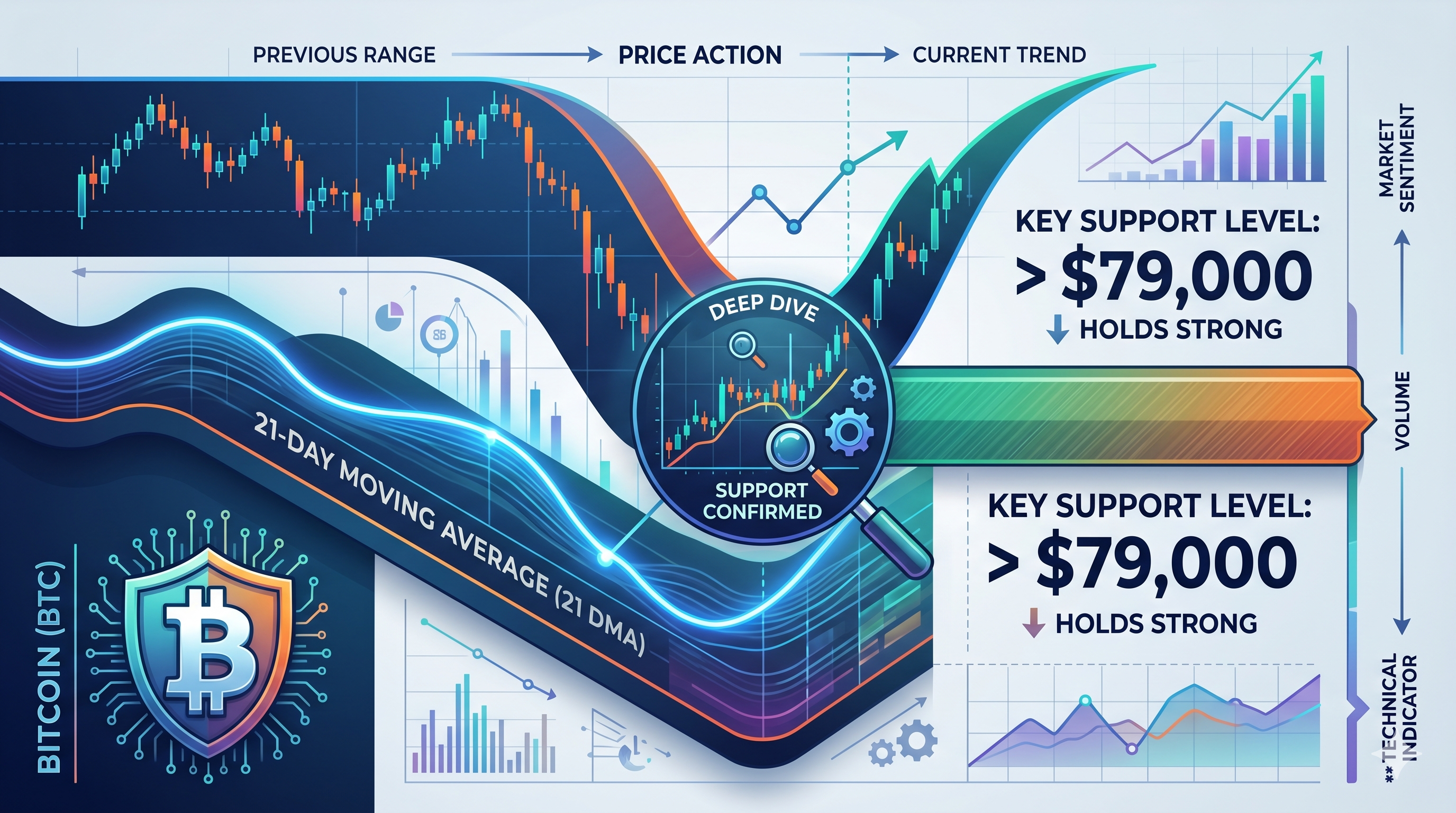
Is the Bitcoin bull market finally entering its "institutional maturity" phase, or are we witnessing another high-stakes technical dance? As of May 11, 2026, Bitcoin (BTC) has successfully reclaimed and held the pivotal $79,000 price level, effectively turning a psychological barrier into a formidable structural floor. The primary engine behind this stability is the 21-day Moving Average (21 MA), a technical indicator currently acting as the "line in the sand" for market bulls. With over $1.63 billion flowing into US spot Bitcoin ETFs in just the first ten days of May, the demand side of the equation has reached a fever pitch. Bitcoin is no longer just a speculative asset; it has become a high-beta institutional staple. This article explores why the $79K level is the most important support zone of the year and how the 21 MA is dictating the current uptrend.
Key Takeaways
-
The 21-Day Moving Average (MA) is the critical trend-defining tool, currently providing dynamic support for Bitcoin’s price above the $79,000 psychological mark.
-
Institutional ETF Inflows remain the dominant force, with US spot Bitcoin ETFs reaching a record $109 billion in total assets under management (AUM) as of May 2026.
-
$79,000 is the New Floor, having transformed from a stubborn resistance level in late Q1 into a foundational support level in Q2.
-
Miners are Re-entering a growth phase as hash rates rebound toward a projected 1.8 Zetahash (ZH/s) by year-end, signaling network health.
-
Macro Tailwinds, including easing energy prices and a softer US Dollar, are providing the necessary liquidity for Bitcoin to test the next resistance at $83,500.
The Strategic Importance of the 21-Day Moving Average
The 21-day Moving Average (21 MA) is currently the most significant short-term indicator for Bitcoin, serving as the definitive boundary between a bullish expansion and a corrective phase. As of mid-May 2026, Bitcoin has consistently bounced off this level, signaling that "dip-buying" behavior has become institutionalized. When the price stays above the 21 MA, it confirms that the average purchase price for short-term holders remains below the market price, reducing the immediate risk of a mass liquidation event.
Why the 21 MA Triggers Institutional Buying
Institutional algorithms often utilize the 21-day moving average to determine entry points for "weighted average" buy orders. Because this timeframe captures exactly three weeks of market activity, it balances short-term volatility with a clear directional trend. In the current 2026 market, whenever Bitcoin approaches the 21 MA near the $79,000–$80,000 range, we observe a significant spike in trade volume. This suggests that large-scale buyers are using this technical indicator as a signal to add to their positions, viewing any touch of the 21 MA as a "discount" within a broader uptrend.
Historical Context of 21 MA Support in 2026
Throughout April 2026, Bitcoin struggled to maintain its footing, briefly dipping toward $60,000 during a period of macro uncertainty. However, the recovery that began in late April saw Bitcoin slice through the 21 MA and hold it. This flip from resistance to support is a classic technical confirmation of a trend reversal. By maintaining price action above this moving average for over 14 consecutive sessions in May, Bitcoin has signaled to the broader market that the bearish momentum of Q1 has officially dissipated.
Analyzing the $79,000 Support Floor
Bitcoin’s ability to hold above $79,000 represents more than just a round number; it is the culmination of a supply-demand imbalance created by the 2024 halving and the subsequent surge in ETF participation. The $79K level aligns with the 21-week exponential moving average, a "bull market support band" that historically separates parabolic rallies from multi-month consolidations. By defending this level, bulls are essentially protecting the structural integrity of the entire 2026 recovery.
-
The Role of Exchange Reserves at $79K
Data from early May 2026 shows that Bitcoin exchange reserves have hit a multi-year low. As ETFs continue to absorb approximately 450 BTC daily (matching or exceeding the daily mining issuance), the liquid supply available for trade on exchanges is shrinking. When Bitcoin sits at $79,000, the "sell-side liquidity crisis" becomes apparent. Sellers are unwilling to part with their assets at what they perceive to be the "new floor," while buyers are forced to bid higher to secure any remaining supply.
-
Psychological vs. Technical Support
While $79,000 is technically significant due to moving average alignments, its psychological weight cannot be ignored. In 2025, Bitcoin peaked at an all-time high above $126,000 before a sharp drawdown. The $79K-$80K region was the last major "breakout point" before that historic run. By reclaiming this level in May 2026, Bitcoin is effectively telling investors that it has successfully "retested" its previous cycle’s breakout zone and is ready to build a base for a potential move back toward the $100,000 milestone.
ETF Inflows: The Oxygen of the 2026 Bull Market
The primary catalyst for Bitcoin’s price holding the $79K support is the unprecedented and sustained demand from US spot Bitcoin ETFs. In the first week of May 2026 alone, ETFs recorded nearly $1 billion in net inflows over just two trading days. This capital influx creates a "permanent bid" in the market, as ETF issuers must purchase physical Bitcoin to back the shares bought by traditional finance (TradFi) investors.
May 2026 ETF Inflow Performance
| Date (May 2026) | Daily Net Inflow (USD) | Cumulative 2026 Inflow | Total ETF AUM |
| May 1 - May 4 | $532 Million | $58.2 Billion | $101.5 Billion |
| May 5 - May 6 | $467 Million | $59.7 Billion | $109.0 Billion |
| May 7 - May 10 | $631 Million (Est.) | $60.3 Billion | $111.2 Billion |
The data in the table above illustrates a clear trend: institutional demand is accelerating, not slowing, as prices rise. This "reflexivity" is a hallmark of crypto bull markets, where higher prices attract more capital, which in turn drives prices even higher. BlackRock’s iShares Bitcoin Trust (IBIT) continues to lead the pack, now holding nearly 7% of the total Bitcoin supply, a concentration that provides a stabilizing force during periods of retail panic.
The "ETF Floor" Phenomenon
During the drawdown in early 2026, Bitcoin ETFs saw only an 8% redemption rate despite a nearly 50% drop in price from the 2025 highs.() This reveals a "diamond hands" mentality among institutional holders that was missing in previous cycles. These investors are not trading the 15-minute charts; they are making five-to-ten-year allocations. This long-term commitment is exactly what allows Bitcoin to hold support levels like $79K even when the broader macro environment feels shaky.
Network Health and Miner Resilience
A price of $79,000 is crucial for the Bitcoin mining industry, as it represents the "breakeven point" for many mid-generation mining fleets in 2026. Following the 2024 halving, miner profitability was squeezed, leading to a period of "miner capitulation" where older hardware was taken offline. However, the current price action above $79K has revitalized the sector, allowing miners to deploy next-generation hardware like the Bitmain S23 series.
Hash Rate Projections for late 2026
The total network hash rate, a measure of the computing power securing the Bitcoin network, is currently rebounding after a slight Q1 retreat. Analysts predict the hash rate will reach 1.8 Zetahash (ZH/s) by the end of 2026. This growth indicates that miners are confident in the $79K support holding. When miners are profitable, they are less likely to sell their newly minted BTC on the open market, further reducing sell-side pressure and supporting the uptrend.
The Shift to AI and HPC Integration
Interestingly, the 2026 mining landscape is shifting. Many major mining firms have signed GPU co-location agreements with AI hyperscalers, totaling over $70 billion. This diversification means that mining companies are no longer 100% dependent on Bitcoin’s daily price volatility to survive. By having a secondary revenue stream from AI and High-Performance Computing (HPC), these companies can afford to hold their Bitcoin through minor corrections, which adds another layer of stability to the $79,000 support zone.
Macro Tailwinds: Why the Global Economy is Pro-Bitcoin
Bitcoin’s 11.87% gain in April 2026 was not an isolated event; it closely mirrored the S&P 500’s 10.42% advance. This high correlation suggests that Bitcoin is currently behaving as a "high-beta risk asset," benefiting from a broader "risk-on" sentiment in global markets. Three key macro factors are currently supporting the $79K floor: easing energy prices, falling US Treasury yields, and a softening US Dollar Index (DXY).
The "Dollar-Hedge" Narrative Reborn
While Bitcoin often trades like a tech stock, it still retains its status as a hedge against currency debasement. In 2026, despite a stabilizing US economy, uncertainty around trade policies and tariffs has led some investors to diversify into non-sovereign assets. This is particularly evident in emerging markets like India and Turkey, where Bitcoin adoption has grown by 7% year-over-year despite global volatility. For these investors, $79,000 is a fair price to pay for an asset that sits outside the traditional fiat system.
2026 Global Crypto Adoption Metrics
| Country | Q1 2026 Transaction Volume | YoY Change | Primary Driver |
| United States | $212 Billion | -11% | Institutional / ETF |
| South Korea | $69 Billion | -28% | Retail Speculation |
| India | $46 Billion | -6% | P2P / Domestic Growth |
| Turkey | $40 Billion | 0.07 | Inflation Hedge |
The table highlights that while developed markets saw a contraction in volume during the Q1 "risk-off" phase, emerging markets remained resilient. This global diversity in the buyer base ensures that Bitcoin is not solely dependent on Western market sentiment to maintain its $79K support.
Technical Outlook: The Path to $83,500 and Beyond
With the 21 MA firmly established as support, the next logical target for Bitcoin is the $83,500 resistance level. This area represents the upper boundary of the rising trend channel that started in February 2026. If Bitcoin can successfully close a weekly candle above $83,500, it would mark a decisive technical breakout, likely triggering a "short squeeze" as traders who bet against the $79K support are forced to cover their positions.
Indicators to Watch: RSI and MACD
On the daily chart, the Relative Strength Index (RSI) is currently hovering around 62, suggesting that there is still plenty of room for upward movement before Bitcoin becomes "overbought" (typically above 70). Additionally, the MACD (Moving Average Convergence Divergence) has recently seen a bullish crossover above the zero line, a signal that often precedes a multi-week rally. As long as these indicators remain bullish, the $79,000 support level is likely to hold firm.
Potential Downside Risks
No market is without risk. If Bitcoin were to fail at the $83,500 resistance and fall back through the 21 MA, the next major support zone would be near $69,000. This scenario would likely be triggered by a sudden "macro shock," such as an unexpected interest rate hike or a massive sell-off in the equity markets. However, given the current strength of ETF inflows and miner stability, a dip below $79,000 is currently viewed by most analysts as a "buying opportunity" rather than the start of a new bear market.
Trading Bitcoin in the New Institutional Era
As Bitcoin matures into a $1.5 trillion asset class, the strategies required to trade it are evolving. The days of 20% daily swings are becoming rarer, replaced by structured trends defined by moving averages and institutional flow data. For modern traders, success depends on having access to deep liquidity and sophisticated technical tools that can track these moving support levels in real-time. Whether you are a long-term "HODLer" or a short-term swing trader, understanding the interplay between the 21 MA and the $79K support is essential for navigating the May 2026 market.
The current stability above $79,000 is a testament to the resilience of the Bitcoin network and the growing sophistication of its investor base. While the "wild west" days of crypto are fading, they are being replaced by a more predictable, yet still highly lucrative, institutional market. Watching how Bitcoin interacts with the $79,000–$81,000 range in the coming days will provide the ultimate clue as to whether the 2026 bull run has just begun its second act.
If you are curious about how these institutional flows impact the broader altcoin market or want to dive deeper into technical indicators like the 21 MA, exploring a top-tier exchange is the natural next step. Platforms like KuCoin provide the real-time data feeds and liquidity necessary to act on these insights before the market moves.
💡Tips: New to crypto? KuCoin's Knowledge Base has everything you need to get started.
Conclusion
The Bitcoin market in May 2026 is defined by a shift from speculative volatility to structural stability. By holding firmly above the $79,000 level and utilizing the 21-day Moving Average as a dynamic support floor, Bitcoin has confirmed that its primary trend remains bullish. This resilience is underpinned by record-breaking ETF inflows, which have brought total assets under management to over $109 billion, and a mining sector that is successfully navigating the post-halving landscape through technological upgrades and AI integration.
While resistance at $83,500 looms, the underlying data—from exchange reserves to macro tailwinds—suggests that the $79K support is more than just a temporary pitstop; it is the new foundation for the next leg of the cycle. Investors who once feared Bitcoin's "boom and bust" cycles are now seeing the asset class through the lens of institutional maturity. As we move further into Q2 2026, the $79,000 price level will remain the most critical metric for assessing the health of the crypto economy and the strength of the ongoing uptrend.
FAQs
What happens if Bitcoin falls below the 21-day Moving Average?
A break below the 21 MA typically signals a short-term shift from a bullish "expansion" phase to a "consolidation" or "corrective" phase. In the current 2026 market, a sustained close below this average would likely lead to a retest of the psychological $75,000 level or the structural support near $69,000.
How do ETF inflows specifically prevent Bitcoin from crashing?
ETF inflows create a "supply sink." When investors buy ETF shares, the fund sponsors must purchase actual BTC from the market to balance the fund. This constant buying pressure absorbs the sell orders from miners or retail traders, effectively creating a "price floor" that prevents deep drawdowns.
Is the 21-day Moving Average more important than the 200-day Moving Average?
They serve different purposes. The 21 MA is a short-term trend-following tool used by active traders to identify immediate support. The 200-day MA is a long-term indicator used to identify the overall "market regime." While the 21 MA is more relevant for the current $79K support, the 200-day MA (currently near $83,418) defines the long-term bull market.
Why are miners still profitable even after the 2024 halving?
Miners have adapted by increasing efficiency. Next-generation hardware, like the Bitmain S23, provides more computing power for less electricity. Additionally, many miners have diversified into AI data centers, providing a secondary revenue stream that cushions them during periods of low Bitcoin prices.
Can Bitcoin reach $100,000 before the end of 2026?
Market sentiment, as seen on platforms like Polymarket, currently places a 56% probability on Bitcoin hitting $85,000 by late May, but a move to $100,000 is viewed as a longer-term objective for Q3 or Q4 2026, depending on sustained ETF demand and macro-economic stability.
Disclaimer: This article is for informational purposes only and does not constitute financial or investment advice. Cryptocurrency investments carry significant risk. Always conduct your own research before trading.