

How to Earn FLOW with KuCoin (A Data-Driven Yield Strategy Guide)
2026/04/05 14:43:23
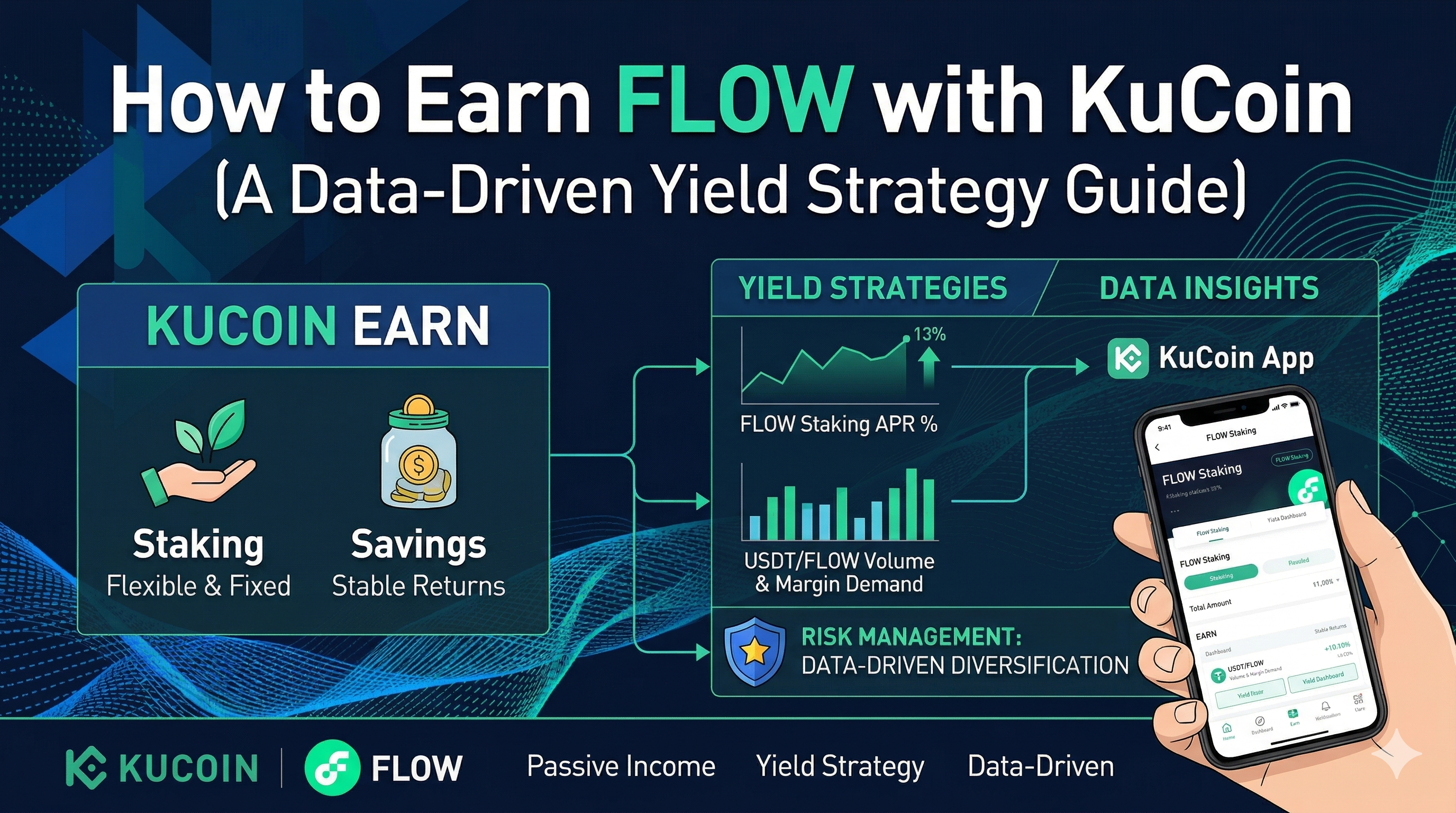
Earning FLOW through KuCoin is no longer just a passive activity but a strategic process that involves understanding yield mechanics, compounding effects, and platform-specific reward structures. By combining flexible staking options, real-time APY adjustments, and disciplined reinvestment strategies, users can optimize their FLOW holdings into a consistent income stream while maintaining liquidity and control.
FLOW and the Shift Toward Yield-Driven Crypto Participation
The rise of yield-focused strategies in crypto has changed how investors interact with assets like FLOW. Instead of relying solely on price appreciation, users are increasingly turning toward structured earning mechanisms that generate consistent returns over time. FLOW, the native token of the Flow blockchain, has gained attention due to its role in powering decentralized applications, NFTs, and digital experiences backed by major global brands. Its utility extends beyond simple transactions, making it a suitable candidate for staking and yield generation.
On platforms like KuCoin, FLOW is integrated into a broader ecosystem of earning tools that allow users to generate returns without active trading. This shift reflects a wider industry trend where passive income strategies are becoming central to portfolio management. According to KuCoin’s Earn platform, FLOW staking currently offers estimated returns ranging roughly between 0.5% and 6% annually, depending on market conditions and product structure.
What makes this approach compelling is the balance between accessibility and efficiency. Users do not need to run validator nodes or manage complex infrastructure. Instead, they can delegate their tokens and begin earning rewards immediately. This democratization of yield opportunities is one of the main reasons staking has become one of the most widely adopted earning methods in crypto today.
Understanding How FLOW Staking Actually Generates Yield
FLOW staking is built on a proof-of-stake mechanism where token holders contribute to network security by delegating their assets to validators. In return, they receive rewards that are distributed based on participation and network activity. These rewards are not arbitrary; they are generated through transaction fees, protocol incentives, and overall network usage.
On KuCoin, this process is simplified into a user-friendly interface. The platform aggregates staking opportunities and distributes rewards proportionally to users who participate through its Earn products. This removes technical barriers while maintaining exposure to staking yields.
The reward structure is dynamic. Returns can fluctuate depending on several variables, including the total amount of FLOW staked across the network and the level of activity within the ecosystem. For instance, higher participation can reduce individual rewards, while increased network usage can boost them.
External platforms show that FLOW staking yields can reach significantly higher levels under certain conditions, with some services advertising rates above 20% when incentives are high. However, centralized platforms like KuCoin typically offer more stable and conservative yields, prioritizing consistency over aggressive returns.
This balance is important. It ensures that users are not exposed to extreme fluctuations while still benefiting from steady income generation. Understanding this mechanism is key to building a sustainable FLOW earning strategy.
KuCoin Earn: Where FLOW Yield Opportunities Live
KuCoin Earn acts as the central hub for all passive income products on the platform. It includes staking, savings, lending, and structured investment tools designed to help users grow their crypto holdings over time. FLOW is part of the staking and flexible earning category, making it accessible to both beginners and experienced users.
The platform divides its products into “Stable” and “Advanced” categories. FLOW staking typically falls under the stable category, which focuses on predictable returns and lower complexity. Users can choose between flexible products, which allow withdrawals at any time, and fixed-term options, which often provide slightly higher returns in exchange for locking funds.
What stands out is the simplicity of participation. Users can subscribe to a staking product with just a few clicks, and rewards are distributed automatically. There is no need for manual calculations or active management once the position is established.
KuCoin’s broader ecosystem also enhances the earning experience. Users can combine staking with other tools such as trading bots or lending products, creating layered strategies that maximize capital efficiency. According to independent analysis, KuCoin Earn supports a wide range of assets and provides flexible entry points, making it accessible even for smaller investors.
This integration of multiple earning tools makes KuCoin a comprehensive platform for yield generation, especially for assets like FLOW.
FLOW Staking APY on KuCoin: Real Numbers and What They Mean
The most critical factor in any earning strategy is the actual return. On KuCoin, FLOW staking typically offers an annual percentage yield (APY) ranging from approximately 0.5% to 6%, depending on whether the user chooses flexible or fixed staking options.
To understand what this means in practice, consider a simple example. If a user stakes 1,000 FLOW tokens at an average APY of 5%, they would earn approximately 50 FLOW per year. This translates to about 4.16 FLOW per month, assuming a steady distribution of rewards.
However, these numbers are not static. APY rates adjust based on market conditions, including supply and demand for staking products. During periods of high demand, yields may decrease as more users participate. Conversely, lower participation can lead to higher rewards.
It is also important to consider the impact of token price. Even if the APY remains constant, the value of rewards can fluctuate significantly depending on market conditions. FLOW’s price is influenced by adoption, partnerships, and overall market sentiment.
This dual dynamic, yield plus price movement, makes staking both an income strategy and a speculative investment. Understanding how these factors interact is essential for making informed decisions and optimizing long-term returns.
The Power of Compounding: Turning FLOW Into a Yield Engine
Compounding is where FLOW staking becomes truly powerful. Instead of withdrawing rewards, users can reinvest them into the staking pool, increasing their total holdings and future earnings. Over time, this creates exponential growth rather than linear returns.
For example, if a user starts with 1,000 FLOW at a 5% APY and compounds monthly, their effective annual return increases slightly above the base rate. After one year, they would hold approximately 1,051 FLOW instead of 1,050. While the difference may seem small initially, it becomes significant over multiple years.
Over a three-year period, compounding can add a meaningful percentage to total returns. This is especially important in crypto, where long-term holding strategies often outperform short-term trading for many participants.
KuCoin’s flexible products make compounding easy. Since users can withdraw and reinvest rewards at any time, they can create a consistent compounding cycle without being locked into rigid structures. This approach transforms staking from a passive activity into an active strategy. By regularly reinvesting rewards, users can significantly increase their exposure to FLOW while maximizing yield efficiency.
Flexible vs Fixed FLOW Strategies on KuCoin
Choosing between flexible and fixed staking is one of the most important decisions when earning FLOW on KuCoin. Each option serves a different purpose and aligns with different investment goals.
Flexible staking allows users to withdraw their funds at any time. This provides maximum liquidity and is ideal for users who want to maintain control over their assets. The trade-off is slightly lower returns, as flexibility comes at the cost of reduced yield.
Fixed staking, on the other hand, requires users to lock their tokens for a specific period. In return, they receive higher APY rates. This option is suitable for users who are confident in holding FLOW long-term and want to maximize returns.
The choice between these options depends on market outlook and personal strategy. In stable or bullish conditions, fixed staking can be more attractive due to higher yields. In uncertain markets, flexible staking provides the ability to react quickly to price changes.
KuCoin’s structure allows users to switch between these strategies, offering a level of adaptability that is essential in the fast-moving crypto market.
A Practical FLOW Earnings Scenario (Full Calculation)
Let’s break down a realistic earning scenario using FLOW on KuCoin. Assume a user deposits 2,000 FLOW into a flexible staking product with a 5% APY.
Annual earnings:
2,000 × 5% = 100 FLOW per year
Monthly earnings:
100 ÷ 12 ≈ 8.33 FLOW
Now introduce compounding. If the user reinvests rewards monthly, the total after one year increases slightly to around 2,102 FLOW. Over two years, this grows further due to cumulative reinvestment.
If the price of FLOW increases during this period, the value of these rewards also rises. This creates a dual return effect, yield plus price appreciation.
This example shows the importance of consistency. Small, steady gains can accumulate into significant returns over time, especially when combined with favorable market conditions.
Hidden Yield Boosters: Timing, Market Cycles, and FLOW Accumulation
One of the most overlooked aspects of earning FLOW on KuCoin is how timing and market cycles can significantly influence total returns. Yield alone does not determine profitability, the entry point and accumulation strategy play an equally important role. When FLOW’s market price is relatively low, staking rewards become more powerful because users are effectively accumulating more tokens at a discounted valuation. Over time, if the asset appreciates, those accumulated rewards can multiply in value far beyond the base APY.
This creates a strategic opportunity. Instead of viewing staking as a static process, experienced users treat it as a dynamic accumulation tool. During bearish or sideways market conditions, they focus on increasing their FLOW holdings through consistent staking and reinvestment. This approach shifts the focus from short-term price movements to long-term asset growth.
Another factor is reward timing. Since staking rewards are distributed periodically, users who actively reinvest at regular intervals benefit more from compounding. Even small differences in timing can lead to noticeable variations in total returns over extended periods.
By aligning staking strategies with these cycles, users can maximize both yield and capital appreciation. This dual-layer strategy, earning and accumulating, transforms FLOW staking into a more calculated and potentially rewarding process.
Liquidity Awareness: When to Hold, When to Exit, and When to Rotate
Earning FLOW is not only about maximizing yield, it also involves understanding when to maintain exposure and when to adjust positions. Liquidity awareness plays a critical role in this decision-making process. While staking provides consistent returns, it can also limit flexibility if funds are locked or if market conditions change rapidly.
In flexible staking products on KuCoin, users retain the ability to withdraw assets at any time. This feature becomes particularly valuable during periods of high volatility. For example, if FLOW experiences a sudden price surge, users may choose to exit their staking position and take profits rather than continue earning a relatively small yield. This decision depends on whether immediate gains outweigh long-term compounding benefits.
Rotation is another important concept. Instead of holding FLOW indefinitely, some users periodically shift capital between different assets or earning products based on yield opportunities and market trends. This strategy requires careful analysis but can improve overall portfolio performance.
At the same time, overreacting to short-term movements can reduce long-term gains. Successful users often balance patience with responsiveness, maintaining their staking positions during stable periods while staying ready to act when clear opportunities arise.
This balance between earning, holding, and adjusting positions is what separates passive participants from strategic ones. Understanding liquidity and timing decisions adds a critical layer of sophistication to any FLOW earning strategy.
Conclusion
Earning FLOW on KuCoin is not just about staking tokens, it is about understanding how yield works, how compounding amplifies returns, and how platform mechanics influence outcomes. By combining flexible strategies, disciplined reinvestment, and awareness of market dynamics, users can turn FLOW into a productive asset rather than a passive holding.
FAQ
-
How much can you earn staking FLOW on KuCoin?
Typically between 0.5% and 6% APY, depending on the product and market conditions.
-
Is FLOW staking profitable?
It can be, especially when combined with compounding and long-term holding strategies.
-
Can you withdraw FLOW anytime on KuCoin?
Yes, if you use flexible staking products.
-
Does APY stay constant?
No, it changes based on market demand and network conditions.
-
Which should I choose from flexible or fixed strategies?
You can choose the one that meets your financial specifications.
Disclaimer
This content is for informational purposes only and does not constitute investment advice. Cryptocurrency investments carry risk. Please do your own research (DYOR).