

What Are AI Model Distillation Attacks? How Anthropic Is Protecting Claude
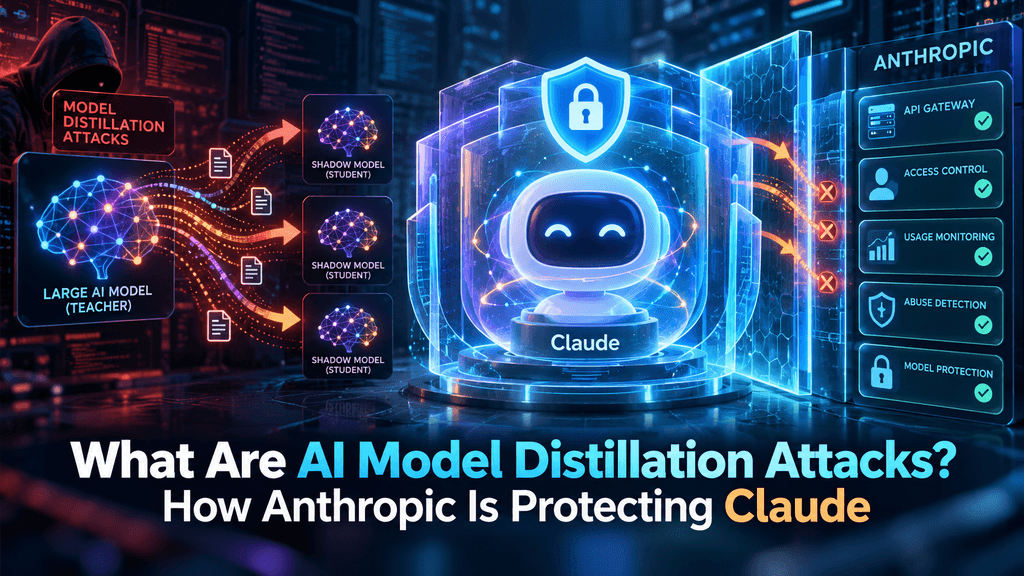
Could millions of dollars in proprietary artificial intelligence research be siphoned away simply by querying a public API? Model distillation attacks allow malicious entities to systematically query frontier systems like Claude to harvest high-density reasoning paths, function schemas, and internal logic to train rival systems at a fraction of standard development budgets. Within decentralized physical infrastructure networks (DePIN) and cryptocurrency ecosystems, this threat directly imperils decentralized compute pools, open-weight intelligence markets, and autonomous agent infrastructure. By cloning frontier capabilities, adversaries undercut tokenized networks and smart contract safety tools without funding foundational research. Anthropic has countered this threat by deploying multi-tiered classification systems, automated behavioral clustering, output watermarking, and dynamic inference adjustments. This analysis examines the mechanics of distillation attacks, their severe ramifications for decentralized AI markets, and Anthropic’s multi-layered defense architecture.
Key Takeaways
-
Core Concept: Model distillation attacks exploit public inference programming interfaces to generate dense synthetic corpora, allowing attackers to clone proprietary reasoning behavior while circumventing underlying research expenses.
-
Web3 Vulnerabilities: Decentralized AI ecosystems, autonomous on-chain bots, and tokenized compute networks face severe structural risks when unauthorized distillation commoditizes unique model capabilities.
-
Anthropic Countermeasures: Defense mechanisms include real-time intent analysis, multi-tenant behavioral telemetry, contextual reasoning protection, and cryptographic token watermarking.
-
Sybil-Driven API Exploitation: Extraction campaigns leverage decentralized proxy rings, rotating virtual payment channels, and pseudonymous cryptocurrency rails to disguise large-scale harvesting as organic user traffic.
-
Shifting Market Economics: Robust defenses eliminate cheap imitation shortcuts, forcing developers across traditional technology and Web3 sectors to invest directly in authentic foundational datasets and verifiable inference.
What are AI Model Distillation Attacks?
The Mechanics: How Extraction Exploits Model Interfaces
Model distillation attacks weaponize routine API access to harvest proprietary intellectual property and duplicate frontier capabilities. Creating frontier models requires hundreds of millions of dollars in dedicated hardware clusters, refined synthetic pipelines, and extensive reinforcement learning. In contrast, an attacker initiates automated query batches across specialized domains, collects the target model’s comprehensive outputs, and uses that structured material to fine-tune smaller, open-weight architectures. This process bypasses the capital and engineering barriers that define modern machine learning development.
The attack targets standard text-generation interfaces. Because advanced systems are designed to provide clear, thorough problem breakdowns when answering programming or mathematical prompts, they inadvertently emit the exact instructional signals needed to train imitation models. The attacker submits complex logical challenges, records the intermediate reasoning steps, and compiles a dense training corpus. When ingested by a smaller recipient model, this curated data enables the imitation system to match benchmark scores while spending less than one percent of the original training capital. Because queries resemble legitimate developer requests, traditional perimeter defenses fail to recognize the extraction.
Synthetic Data Exploitation and Reasoning Extraction
Extracting intermediate reasoning traces dramatically accelerates imitation learning compared to standard unsupervised pretraining. Attackers focus on high-leverage domains such as automated smart contract auditing, game-theoretic negotiation, decentralized exchange arbitrage, and symbolic mathematics. By submitting prompts engineered to force step-by-step logic, the adversary converts the target platform into an automated dataset generator.
-
Chain-of-Thought Harvesting: Scraping intermediate problem-solving steps to distill cognitive workflows into unaligned or unauthorized recipient networks.
-
Tool-Use and Schema Theft: Capturing function call structures, structured JSON outputs, and recovery procedures to train autonomous execution agents.
-
Safety Boundary Probing: Systematically evaluating guardrails to map moderation filters and train secondary models that bypass standard alignment protocols.
Attack Topologies: Distributed Extraction Campaigns
Modern distillation campaigns utilize distributed infrastructure rather than isolated clients to avoid volume-based rate limiting. These operations rely on proxy pools, rotating identity profiles, and multi-tenant hosting to mimic diverse retail interaction patterns.
| Attack Vector | Deployment Mechanism | Target Asset | Detection Complexity |
| Coordinated Query Pools | Distributed botnets rotating client access keys | Deep mathematical proofs, smart contract logic | High |
| Simulated Retail Prompts | Paraphrased variants of standard academic benchmarks | Specialized institutional domain knowledge | Very High |
| Autonomous Agent Loops | Self-prompting pipelines executing multi-step jobs | Execution schemas, real-time error corrections | Extreme |
| Adversarial Border Scans | Automated perturbations testing guardrail boundaries | Operational safety limits, moderation baselines | Moderate |
These distributed networks frequently utilize cryptocurrency rails to maintain anonymity. Attackers fund access keys using virtual payment providers funded by decentralized assets, breaking the identity verification links used by enterprise cloud platforms. Consequently, extraction campaigns blend into normal traffic growth rather than appearing as coordinated operations.
Intersection with Web3 and Cryptocurrency
Threat Vectors Against DePIN and Decentralized Compute
Model distillation presents an immediate economic challenge to Web3 artificial intelligence networks and decentralized physical infrastructure systems. DePIN networks coordinate distributed hardware clusters to train, evaluate, and host models through token incentives. When models hosted across open nodes are systematically scraped via unauthorized distillation, the intrinsic value supporting native utility tokens deteriorates.
If access to decentralized model nodes yields self-hosted local clones, the demand for native staking and utility tokens declines. Distillation commoditizes computational outputs before networks can establish steady fee revenue. For instance, if an ecosystem expends treasury funds to build a specialized blockchain analytics engine, an adversary can extract those reasoning capabilities in days, deploy an identical model on an alternative network, undercut pricing, and dilute the original project's market standing.
Vulnerabilities in Smart Contract Agents and On-Chain Security
Autonomous agents that utilize frontier models for yield optimization, liquidity management, and smart contract evaluation face severe operational duplication. Adversaries monitor agent activities to isolate execution strategies, risk parameters, and validation mechanics.
-
Strategy Replication: Competitors clone autonomous market-making algorithms by capturing the decision frameworks generated by frontier-driven agents.
-
Exploit Acceleration: Cloned models trained on extracted security heuristics allow adversaries to conduct offline vulnerability scans, uncovering contract flaws without broadcasting activity on public ledgers.
-
Sybil Funding Loops: Unregulated entities use privacy-focused wallets and decentralized financial tools to bankroll scraping clusters, bypassing know-your-customer verifications.
Staking Disruption in Decentralized Machine Learning
The economic security of staked AI networks relies on the premise that generating high-grade intelligence requires substantial resource expenditure. In a proof-of-stake machine learning setup, node operators post collateral to guarantee accurate, computationally intensive outputs.
Distillation compromises this incentive balance. A malicious operator can distill a proprietary model into a lightweight imitation architecture, run that clone on cheap consumer hardware, and submit its outputs to the network. Because the imitation matches standard validation criteria, the operator earns full validation rewards while incurring a fraction of legitimate compute costs. This dynamic penalizes honest operators who maintain dedicated enterprise infrastructure, encouraging network centralization and undermining decentralized protocol trust.
How Anthropic Protects Claude
Dynamic Two-Stage Intent Classification
Anthropic applies a two-stage classification framework to intercept extraction queries before they generate training data. Rather than relying on simple keyword blacklists, requests are analyzed across semantic, syntactic, and structural dimensions.
The initial stage conducts structural semantic profiling. The classifier evaluates whether an incoming prompt exhibits hallmarks of programmatic dataset generation—such as repetitive permutations or academic benchmark structures—rather than organic developer usage. The second stage monitors output token emission dynamics in real time to intercept queries designed to extract hidden deliberations. When high-probability extraction is detected, the platform triggers dynamic response adjustments, providing a direct answer while withholding the intermediate reasoning traces that attackers need for fine-tuning.
Multi-Tenant Behavioral Telemetry and Clustering
To expose distributed client rings, Anthropic correlates behavioral telemetry across seemingly independent user accounts. Because distillation requires immense data volumes, harvesting campaigns generate detectable statistical correlations across the network.
When disparate accounts across diverse IP spaces and payment methods demonstrate parallel behavioral rhythms, the platform flags the correlation. The telemetry engine evaluates matching prompt syntax templates, synchronized token requests, and complementary domain explorations. If thousands of independent accounts query permutations of identical programming challenges in staggered sequences, the system attributes them to a coordinated operation. Anthropic then applies coordinated rate adjustments, detailed logging, and simultaneous access revocations to dismantle the network.
Context-Window Protection
An established distillation method involves context manipulation, where attackers paste a model’s prior reasoning steps back into fresh prompts to compel continuous technical disclosure.
Anthropic eliminated this vulnerability by revising context processing mechanics. The system implements strict provenance tracking for all tokens within the context window, distinguishing between external user input, prior generation history, and protected reasoning elements. When a user injects previously generated reasoning traces to force systematic disclosure, the model recognizes the adversarial pattern and terminates the execution path, blocking the use of long-context windows as extraction vectors.
Cryptographic and Statistical Output Watermarking
Anthropic utilizes statistical watermarking to embed verifiable structural patterns within output sequences, providing mathematical evidence of origin without compromising clarity, fluency, or technical accuracy.
The foundational technique utilizes pseudorandom token frequency adjustments. The generation engine subtly prioritizes specific synonymous tokens based on an internal cryptographic key. While output appears natural to human readers, statistical analysis of large datasets generated by a suspected clone model reveals whether it was trained on Claude outputs. This provenance attribution provides actionable evidence to pursue intellectual property claims, remove unauthorized models from open repositories, and invalidate illegitimate services across decentralized networks.
Economic Countermeasures
The most resilient defense against model distillation disrupts the financial calculations of the attacker. Distillation is viable only when querying an API is substantially cheaper than independent model development. Anthropic aligns technical defenses with economic penalties.
| Protective Layer | Operational Focus | Strategic Result |
| Two-Stage Classifier | Real-time semantic analysis | Neutralizes extraction prompts pre-generation |
| Behavioral Clustering | Cross-account pattern correlation | Dismantles distributed scraping botnets |
| Context Protection | Token provenance tracing | Prevents prompt-injection extraction |
| Statistical Watermarks | Cryptographic token frequency adjustments | Provides verifiable attribution of stolen data |
When intent classifiers identify an extraction attempt and switch to concise outputs, the platform processes the request at standard billing rates. Furthermore, when behavioral fingerprinting confirms a distributed extraction ring, associated accounts are terminated and pre-funded balances are forfeited under service violations. Charging for non-viable training data while neutralizing operational accounts renders large-scale extraction economically unfeasible.
Strategic Implications for Crypto and AI Markets
Shifting Economics of Machine Learning
The deployment of effective distillation defenses alters the unit economics of AI development across both traditional computing and decentralized protocols. As frontier platforms restrict synthetic training leaks, building performant models once again demands genuine computational capacity, architectural innovation, and verified datasets.
This transition accelerates capital consolidation across decentralized intelligence protocols. Teams can no longer sustain value propositions by packaging distilled outputs into open wrappers. Decentralized initiatives must invest in primary research, cryptographically verified human feedback, and dedicated infrastructure. Digital asset markets reflect this shift, reallocating capital away from derivative wrappers toward foundational protocols that demonstrate provable training authenticity and sustainable model architectures.
Hardening Open-Weight Ecosystems
The boundary between open-source research and proprietary intelligence is defined by how data provenance is governed. Open-weight models trained on verified, public datasets remain essential for transparent, decentralized systems. However, systems reliant on unauthorized distillation face sudden disruption from platform-level mitigations and regulatory liabilities.
Web3 organizations combining machine learning and blockchain rails must build verifiable data pipelines. Deploying models containing detectable watermarks exposes decentralized protocols to operational and legal risks, including exclusion from major liquidity hubs and institutional decentralized finance integrations. Projects are adopting strict data auditing frameworks to confirm that their training resources do not infringe on proprietary assets.
Verifiable Inference and Zero-Knowledge Proofs
As distillation and model substitution risks expand, cryptocurrency protocols are integrating verifiable inference mechanisms based on zero-knowledge machine learning (zkML). Zero-knowledge proofs permit a decentralized node to mathematically prove that an inference output was computed by a specific, authentic model without revealing underlying parameters or private prompt inputs.
This cryptographic validation ensures that nodes run genuine models rather than lightweight distilled imitations designed to capture rewards dishonestly. By requiring cryptographic execution proofs, decentralized networks guarantee that users receive authentic intelligence. While zkML verifies execution fidelity on-chain, frontier provider defenses safeguard the initial model development, forming an integrated security boundary for the emerging autonomous digital economy.
Conclusion
AI model distillation attacks represent a calculated extraction vector that targets proprietary intelligence, decentralized compute networks, and autonomous Web3 systems. By executing automated, large-scale query campaigns, adversaries attempt to bypass fundamental training costs and reproduce frontier reasoning capabilities at low expense. Anthropic addresses this challenge through an integrated defense architecture combining dynamic intent classification, multi-tenant behavioral clustering, context provenance enforcement, and cryptographic output watermarking. Within decentralized finance and DePIN systems, where autonomous decision-making demands reliable, uncompromised intelligence, these defensive systems preserve protocol sustainability and prevent the devaluation of computational incentive tokens. As the machine learning sector develops throughout 2026, operational focus will center on safeguarding model weights, ensuring verifiable inference, and certifying the provenance of data powering autonomous software networks.
🔥 Beyond the Headlines: What KuCoin 5.0 Means for You
Market news moves fast — but where you act on it matters just as much. This October, KuCoin launches KuCoin 5.0, transforming KuCoin into a rebuilt platform. Here's what actually changes for you:
-
One account for everything. Older platforms split your money across separate "spot," "margin," and "futures" accounts and expected you to understand why. KuCoin 5.0's unified account removes that entirely — deposit once, and everything is simply there (only available to VIPs for now).
-
Stocks, indices, and commodities. KuCoin 5.0 expands beyond crypto into global markets. When crypto chops sideways and equities rally (or the reverse), you rotate in minutes instead of opening a brokerage account and waiting days for fiat rails.
-
Real-world assets (RWA). Tokenized exposure to traditional assets like commodities, right inside your crypto account. One of the fastest-growing segments in global finance is no longer reserved for institutions — you access it from the same balance you trade with.
-
Earn while you learn. Not ready to trade? KCUSD lets your stablecoins earn daily, auto-compounding interest. The lowest-stress way to put your idle deposit to work for 4% yield.
-
An AI assistant in plain language. Ask questions, get market context, understand what you're looking at — built into the platform, no jargon required.
-
An app that doesn't overwhelm. Faster, cleaner, and consistent — intuitive from the first tap, not after a tutorial.
-
Safety you can check, not just trust. A MiCAR-licensed EU entity, Proof of Reserves you can verify yourself, and internationally certified security (SOC 2 Type II, ISO 27001:2022).
Create your account in minutes — and start on the platform built for where crypto is going, not where it's been.
FAQs
What is the technical difference between model fine-tuning and model distillation?
Fine-tuning adjusts the internal parameters of an existing foundational model using targeted datasets to optimize its performance for specific tasks. Distillation transfers the capabilities and reasoning methodologies of a massive teacher model into an entirely separate student model by training the student on outputs produced by the teacher.
Can statistical watermarks in model outputs be removed by adversaries?
Watermarks can be diluted through secondary paraphrasing, semantic scrambling, or combining outputs from multiple distinct architectures. However, completely removing multi-bit statistical watermarks generally degrades reasoning precision and syntactic structure, and the underlying mathematical signatures remain detectable across large training datasets.
Are all forms of synthetic data generation classified as distillation attacks?
No. Synthetic data generation constitutes a distillation attack only when it violates an API provider's binding terms of service, circumvents access controls, or intentionally extracts proprietary reasoning traces without authorization to replicate commercial capabilities in rival models.
How do zero-knowledge proofs relate to model distillation on public blockchains?
Zero-knowledge machine learning verifies that an output was generated by a specific model architecture without exposing model weights or private inputs. While it confirms execution integrity and prevents node operators from secretly substituting distilled clones, it does not prevent an authorized user from using verified outputs to train an off-chain model.
Does excessive distillation degrade the performance of imitation models?
Yes. Distilled systems trained exclusively on synthetic outputs frequently suffer from model collapse and cumulative hallucinations. Without grounding in broad primary training corpora and human validation, distilled clones struggle with novel problem spaces and fail when exposed to complex tasks outside their narrow training examples.
Disclaimer: This article is for informational purposes only and does not constitute financial or investment advice. Cryptocurrency investments carry significant risk. Always conduct your own research before trading.