
What is the Difference Between Liquid Staking and Native Staking?
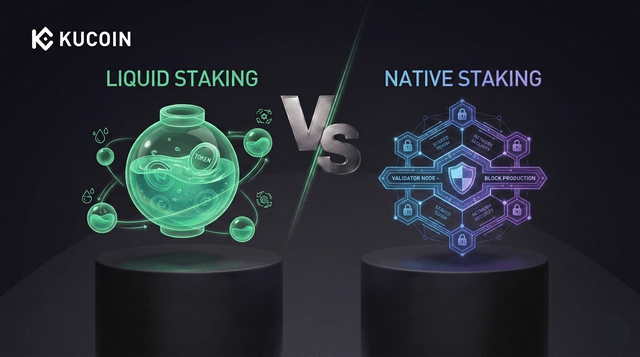
In the evolving landscape of 2026, the Proof of Stake (PoS) economy has shifted from a niche yield-generation tool to the primary infrastructure of the crypto market. For professional traders, the choice is no longer just about "earning rewards"—it is about capital efficiency.
The debate between Liquid Staking and Native Staking represents a strategic choice between absolute asset security and maximum portfolio utility. On KuCoin, these two mechanisms serve different investor profiles, each with its own set of risk-reward parameters.
Key Takeaways
-
Liquidity vs. Lock-up: Liquid Staking provides derivative tokens (LSTs) for immediate trading or DeFi use, while Native Staking requires a mandatory unbonding period.
-
Yield Structure: Native Staking typically offers higher "pure" protocol rewards; Liquid Staking optimizes for "layered" yield (Staking + DeFi).
-
Risk Profile: Native Staking carries protocol-level risks (slashing), whereas Liquid Staking introduces additional smart contract and de-pegging risks.
-
Accessibility: Liquid Staking often has lower entry barriers, allowing users to stake fractions of a token that would otherwise require high minimums (e.g., 32 ETH).
Market Context: The 2026 Staking Infrastructure
As we navigate 2026, staking has matured into a multi-layered financial sector. The total value locked (TVL) in staking protocols has surpassed $100 billion, driven largely by institutional adoption and the rise of "Restaking" ecosystems.
Traders now view their assets as "productive capital." In a high-volatility environment, the ability to exit a position instantly is a premium feature. This has led to a surge in the popularity of Liquid Staking Tokens (LSTs), which allow participants to secure the network without being sidelined during market pivots. Conversely, Native Staking remains the gold standard for conservative, long-term whales who prioritize sovereign control and direct network participation.
Deep Dive: Liquid Staking
Core Value Proposition
Liquid Staking solves the "opportunity cost" problem. When you stake natively, your assets are locked, rendering them useless for active trading. Liquid Staking issues a receipt token (e.g., an LST) that represents your staked principal plus accrued rewards. This token can be traded on the KuCoin Spot Market or used as collateral, ensuring your capital is never truly "idle."
Technical Edge & Economic Model (Tokenomics)
The economic model of Liquid Staking relies on Composability.
-
Feature: Issuance of derivative tokens (e.g., stETH, JitoSOL).
-
Market Behavior: These tokens trade at a price correlated to the underlying asset, plus the value of accumulated rewards.
-
Investor Value: High capital efficiency. Investors can earn a base staking APR of 3–5% while simultaneously deploying the LST in lending protocols for an additional 2–4% yield.
How to Trade/Stake Liquid Assets on KuCoin
Traders can easily access liquid staking exposure through KuCoin Lite or by trading LSTs directly. By holding these tokens in your trading account, you benefit from the price appreciation of the underlying asset and the built-in staking yield. If a sudden market dump occurs, you don't need to wait for a 14-day unbonding period; you simply sell your LST for USDT on the spot market.
Deep Dive: Native Staking
Strategic Advantage
Native Staking is the purest form of network participation. It involves delegating your assets directly to a validator node on the blockchain.
-
Feature: No intermediate smart contract layers.
-
Market Behavior: Direct correlation with network health and inflation schedules.
-
Investor Value: Maximum security. Without the "wrapper" of a liquid staking protocol, you eliminate the risk of a derivative token de-pegging from the underlying asset.
Ecosystem Growth & 2026 Outlook
By 2026, major chains like Ethereum and Solana have refined their native staking modules to be more robust. Native staking is increasingly integrated with "Restaking" layers, allowing native stakers to opt-in to secure additional services for boosted rewards. For institutional-grade security, native staking remains the preferred route for capital that does not require weekly turnover.
Maximizing Returns with KuCoin Earn
KuCoin Earn streamlines the native staking process. Instead of managing complex validator nodes, users can subscribe to various PoS assets.
-
Select Asset: Choose from over 50+ PoS tokens.
-
Lock-up Period: Select "Fixed" terms for higher APR or "Flexible" for shorter unbonding.
-
Compound: Use the "Auto-Staking" feature to automatically reinvest rewards, utilizing the power of compound interest to grow your portfolio over time.
Comparison Analysis: Liquid vs. Native
| Feature | Liquid Staking | Native Staking |
| Liquidity | Instant: Trade LSTs anytime on KuCoin. | Locked: Subject to unbonding (2–21 days). |
| Security | Layered: Protocol + Smart Contract + Network risk. | Primary: Network/Validator risk only. |
| ROI (Yield) | Staking Rewards + DeFi Utility. | Pure Protocol Rewards (usually slightly higher). |
| Complexity | Low (Buying a token). | Moderate (Choosing/Monitoring validators). |
| Min. Stake | Near Zero (0.01 ETH). | Often High (e.g., 32 ETH for solo nodes). |
Trading Insights: Which fits your Portfolio?
-
The Active Day Trader (Liquid Staking)
If you actively rebalance your portfolio based on technical analysis, Liquid Staking is your tool. It allows you to earn rewards while your "sell" button remains live. You can swap your staked exposure for stablecoins in seconds if the KuCoin BTC/USDT pair hits a resistance level.
-
The Wealth Accumulator (Native Staking)
For the "HODL" investor who views crypto as a multi-year savings account, Native Staking via KuCoin Earn is superior. The absence of protocol fees often found in liquid staking means higher net rewards over long durations, and the lack of liquidity prevents "panic selling" during short-term market corrections.
Conclusion & Strategic Guidance
The choice between Liquid and Native staking depends on your liquidity requirements. In the current 2026 market, characterized by rapid shifts in "hot" sectors like AI-crypto and DePIN, Liquid Staking provides the agility required to stay competitive. However, for your core "blue-chip" holdings, Native Staking on KuCoin Earn provides the most secure, high-integrity yield available.
FAQs for Liquid Staking vs. Native Staking
Can the price of a Liquid Staking Token (LST) drop below the native token?
Yes. This is known as "de-pegging." While LSTs are backed 1:1 by staked assets, market panic or liquidity shortages on exchanges can cause the LST to trade at a discount. Native staking avoids this specific market risk.
Is Native Staking safer than Liquid Staking?
Generally, yes. Native staking interacts directly with the blockchain's consensus layer. Liquid staking adds a layer of smart contracts managed by third-party protocols. If those contracts are exploited, the value of your LST could be compromised.
Which method offers higher APR in 2026?
Native Staking usually offers a higher "raw" APR because there are no protocol management fees. However, Liquid Staking can result in a higher total ROI if you use the LST as collateral in other DeFi strategies on the KuCoin ecosystem.
What is the "Unbonding Period" in Native Staking?
This is the mandatory waiting period required by the blockchain (e.g., 7 days for Cosmos, 2–4 days for Solana) before your assets are returned to your wallet. During this time, you usually do not earn rewards and cannot trade the assets.
Do I need to be a technical expert to stake on KuCoin?
No. KuCoin Earn abstracts the technical complexity. For Native Staking, you simply click "Subscribe." For Liquid Staking, you can simply purchase the relevant LST token on the spot market.
Further Reading:


