

Injective Unveils New Whitepaper: Can RWA Tokenization Drive INJ's Next Growth Phase?
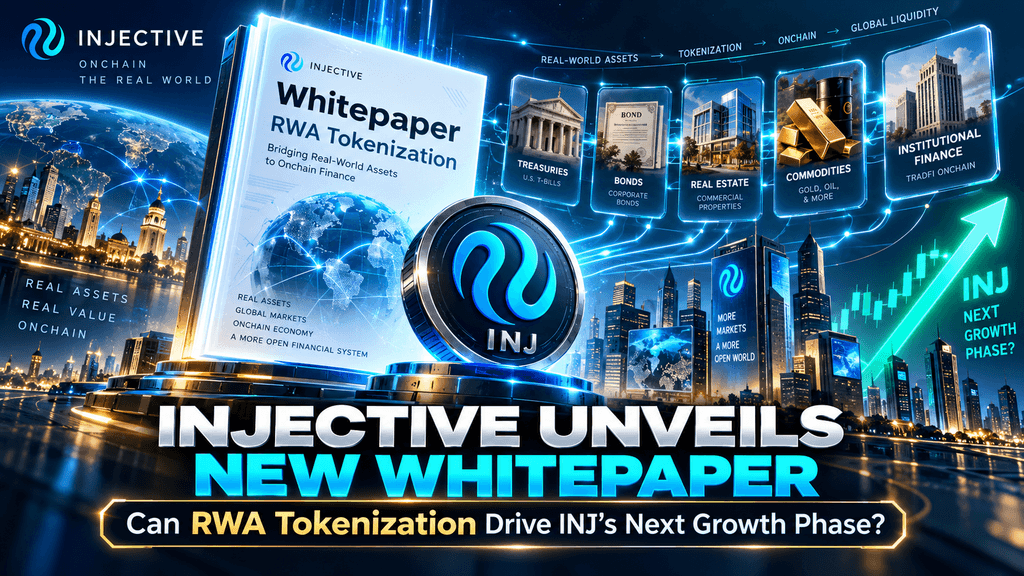
Injective’s Finance-Native Architecture and RWA Growth Thesis
Injective released a comprehensive new whitepaper on October 7, 2026, marking the first complete rewrite of its technical documentation since the original December 2018 paper that outlined a front-running-resistant exchange protocol on Ethereum. The updated document, titled “Injective: A Finance-Native Layer-1 Blockchain,” repositions the network as a sovereign Layer-1 purpose-built for institutional-grade finance and the full lifecycle of tokenized real-world assets. It formalizes native RWA issuance with role-based permissions, iAssets as stablecoin-margined oracle-priced derivatives, a fully on-chain central limit order book operating sealed frequent batch auctions, sub-second BFT finality, MultiVM support for EVM and WASM in a single state, perpetual risk controls, and infrastructure for AI agents. Protocol revenue is directed into recurring Community BuyBacks that permanently remove INJ from circulation.
As of early October 2026, Injective already hosts more than $1 billion in tokenized RWA value, primarily mortgage records, and has processed over $5.3 billion in cumulative RWA perpetual volume since early 2025, according to project disclosures and market trackers. The core thesis of this analysis is that the whitepaper does not merely add features; it codifies an integrated financial state machine in which every protocol layer exists to issue real-world assets and give them utility across markets, applications, and autonomous agents. Whether this architecture can convert existing RWA traction into sustained growth for the INJ token depends on the interplay between native issuance tools, liquidity concentration on the on-chain order book, deterministic settlement, value accrual via buybacks, and the practical adoption of agentic finance, all measured against current market metrics rather than projections.
Native RWA Issuance Controls and Role-Based Permissions Formalized in the 2026 White Paper
The whitepaper elevates real-world asset issuance from an application-layer activity to a protocol-native capability. Issuers receive role-based permissions that govern mint, send, receive, and burn operations, supplemented by programmable receive hooks and sealable namespaces. These controls allow an issuer to restrict who can hold or transfer a tokenized asset while still enabling the asset to participate in the network’s shared liquidity and settlement layer. The MultiVM Token Standard ensures a single bank-module balance per asset that is visible to both EVM and WASM environments through precompiles, eliminating the need for wrapped representations that fragment liquidity. This design addresses a persistent friction in earlier tokenization efforts where compliance requirements forced assets into isolated silos. By embedding permissioning directly in protocol state, Injective aims to support regulated instruments without requiring each issuer to reinvent access controls in custom smart contracts. Market data already shows traction: more than $1 billion in mortgage records have been recorded on-chain, with public statements indicating plans to migrate additional billions in assets. The formalization in the whitepaper provides a stable reference for institutions evaluating whether the permission model meets their operational and audit requirements.
These issuance primitives interact with the broader state machine. Because permissions and balances live in the same canonical state secured by BFT consensus, a tokenized asset can move from issuance to trading to settlement without crossing external bridges or relying on probabilistic finality. The approximately 600-millisecond block times and greater-than-two-thirds commit threshold deliver deterministic finality, a property institutions routinely demand for high-value transfers. The whitepaper’s description of the dynamic issuance controller further allows parameters around minting rates or namespace rules to be adjusted through governance, giving the system adaptability as regulatory or market conditions evolve. Early use cases, including tokenized real-estate mortgages and pilots involving trade receivables with large corporate counterparties, illustrate how the permission model can accommodate both retail-accessible and tightly controlled institutional assets within the same ledger. The architecture therefore positions Injective to serve as shared infrastructure rather than a collection of one-off tokenization deployments.
iAssets Mechanism for Synthetic Exposure Without Wrapping or Pre-Funding
iAssets constitute a second major primitive detailed in the whitepaper. These instruments are stablecoin-margined, oracle-priced derivatives that track external assets without requiring the underlying to be wrapped or pre-funded on-chain. Pricing draws from oracle feeds that update frequently, while margin is held in stablecoins, typically native USDC. Risk checks for initial and maintenance margin, reduce-only liquidations, and insurance funds operate as protocol modules, applying uniformly across markets. This design lowers capital intensity compared with fully collateralized tokenizations and enables continuous exposure to equities, commodities, foreign exchange, and pre-IPO references. As of mid-to-late 2026, Injective supported 135 active RWA perpetual markets, including over 100 equity references, with monthly trading volumes in the RWA segment reaching approximately $210 million in August and cumulative volume exceeding $5.3 billion since early 2025.
The absence of wrapping reduces operational complexity and basis risk that arises when synthetic and physical representations diverge. Because iAssets settle against the same on-chain order book used by spot tokenized assets, liquidity can concentrate rather than fragment across separate venues. Oracle accounting is formalized in the whitepaper so that price updates and funding rates follow transparent, deterministic rules. Time-weighted premium funding for perpetuals further aligns long and short interest over time. For market participants seeking exposure to traditional assets outside conventional market hours, the combination of sub-second settlement and continuous trading creates a practical alternative to traditional derivatives infrastructure. The whitepaper’s emphasis on these mechanisms underscores that iAssets are not an add-on but a core component of the financial state machine, intended to expand the addressable market beyond purely crypto-native instruments.
Sealed Frequent Batch Auctions and Uniform Clearing on the On-Chain CLOB
Trading of both native tokenized assets and iAssets occurs on a fully on-chain central limit order book. Each block executes a sealed frequent batch auction that clears at a uniform price, a design chosen to resist front-running and ordering-based MEV. Orders are collected without revealing their content until the auction closes, after which matching occurs at a single clearing price for the batch. This approach differs from continuous matching models that can expose participants to adverse selection within a block. The whitepaper formalizes the clearing rule, order lifecycle, and interaction with risk modules so that every validator computes identical outcomes. Deterministic finality follows from the BFT consensus threshold, removing the uncertainty of probabilistic confirmation windows that characterize many other chains.
Liquidity concentration on a single protocol-level order book offers advantages for price discovery and capital efficiency. Market makers and takers interact with the same books, whether they arrive via native messages, EVM contracts, or WASM contracts. Fee design allocates a portion of positive trading fees to designated recipients, while the remainder accrues to the protocol revenue pool that funds Community BuyBacks. Empirical activity already demonstrates meaningful volume: RWA perpetuals alone have generated multi-billion-dollar cumulative turnover, and overall network transaction counts have surpassed three billion. The auction mechanism’s resistance to MEV is particularly relevant for institutional order flow that prioritizes execution quality over pure speed. By embedding these rules at the protocol layer, Injective reduces the need for applications to implement their own matching engines or rely on external sequencers, thereby lowering both operational risk and fragmentation of liquidity.
Sub-Second BFT Finality and Its Role in Institutional Settlement Confidence
Settlement rests on Byzantine fault-tolerant consensus with a greater-than-two-thirds voting-power commit threshold. Block times average approximately 600 milliseconds, delivering deterministic finality once the threshold is reached. The whitepaper describes the block lifecycle in detail, including proposal, prevote, and precommit stages, so that participants can reason about latency and finality guarantees. For tokenized real-world assets whose legal and operational value depends on unambiguous ownership transfer, deterministic finality removes a class of settlement risk that exists on chains with probabilistic confirmation. Institutions evaluating on-chain infrastructure frequently cite finality characteristics as a gating factor; Injective’s parameters are explicitly engineered to meet that requirement.
The same consensus underpins all modules, so issuance, trading, risk checks, and buybacks inherit identical security and finality properties. Cross-chain bridges such as IBC, CCTP, and Peggy connect external domains through path-specific verification without becoming sequential bottlenecks for every transaction. Native USDC support further simplifies settlement by providing a canonical stablecoin that can move across connected ecosystems. Measured network activity, more than 42 million transactions in recent 30-day windows and daily peaks exceeding one million, indicates that the consensus layer sustains high throughput while preserving the finality guarantees. For RWA use cases involving large notional values, the combination of speed and determinism lowers the opportunity cost of holding positions and reduces the need for off-chain reconciliation processes.
MultiVM Architecture Unifying EVM and WASM Under One Canonical State
Composability is achieved through native support for both the Ethereum Virtual Machine and a WebAssembly environment that share a single canonical state. The MultiVM Token Standard maintains one bank-module balance per asset, exposed to Solidity via precompiles, so that contracts written in either environment operate on identical asset representations. Developers can therefore choose the execution model best suited to their application without fragmenting liquidity or requiring asset bridges between virtual machines. The whitepaper positions this architecture as a response to the reality that no single virtual machine is optimal for every financial use case. Institutions and builders retain flexibility while benefiting from shared liquidity and settlement.
Because modules for exchange, oracle, insurance, and permissions sit at the protocol layer, both EVM and WASM applications compose against the same financial primitives. An AI agent or institutional application can therefore interact with tokenized assets, place orders, or manage risk without leaving the Injective state domain. This design reduces the surface area for integration errors and eliminates the latency and risk of cross-domain message passing for core financial operations. Early ecosystem activity already includes applications that leverage both environments, demonstrating practical interoperability. As more RWA issuers and agents deploy, the MultiVM foundation is expected to lower the cost of building sophisticated products that combine native modules with custom contract logic.
Perpetual Contract Risk Frameworks and Insurance Infrastructure
Derivatives risk management receives explicit treatment in the whitepaper. Perpetual markets incorporate time-weighted premium funding, initial and maintenance margin checks, reduce-only liquidations, and insurance funds. These controls operate as protocol modules rather than application-specific contracts, ensuring consistent application across all markets. When a position approaches liquidation thresholds, the system enforces reduce-only behavior to prevent further risk accumulation. Insurance funds absorb residual losses after liquidations, protecting the broader market. Oracle feeds that update on the order of seconds supply the price inputs for margin calculations and funding rates.
The formalization of these rules provides transparency for market participants who must model worst-case outcomes. Because the risk state lives in the same replicated ledger as balances and orders, liquidations and insurance adjustments settle with the same deterministic finality as ordinary trades. The presence of more than 100 equity perpetual markets and additional commodity and FX references has already generated substantial volume, indicating that traders find the risk parameters usable. For institutions considering on-chain exposure to traditional assets, the combination of transparent risk engines and insurance backstops reduces the operational burden of running proprietary risk systems. The whitepaper’s detailed accounting of these mechanisms therefore supports both retail accessibility and institutional due diligence.
Agentic Finance Infrastructure for AI-Driven Operation of Tokenized Assets
The whitepaper introduces agentic finance as a first-class capability. AI agents can operate on tokenized assets through MCP servers, policy-bounded signing, and x402 machine payments denominated in USDC. Policy constraints limit the actions an agent may take, while machine payments enable autonomous settlement of fees or transfers. Deterministic module interfaces allow agents to query state, submit orders, or manage positions without human intervention at every step. This infrastructure positions Injective as a venue where human users, institutions, and autonomous software coexist against the same financial state. Practical implications include automated rebalancing of RWA portfolios, continuous market-making within defined risk limits, and programmatic issuance or redemption flows. Because agents inherit the same finality and permissioning rules as human participants, their actions remain auditable and constrained.
The combination of sub-second settlement and machine payments reduces the latency that would otherwise limit high-frequency agent strategies. While adoption of fully autonomous agents remains early, the formalization of the supporting primitives removes a technical barrier. Institutions exploring algorithmic management of tokenized holdings can evaluate the policy and payment mechanisms against their internal control frameworks. The whitepaper’s inclusion of agentic finance signals that Injective views autonomous software as a permanent participant class rather than an experimental overlay.
Community BuyBack Mechanics and Protocol Revenue Flow to INJ Burns
Value accrual centers on the Community BuyBack. On-chain protocol revenue, primarily from trading fees, flows into a recurring process in which participants commit INJ for a pro-rata share of the revenue pool; the committed INJ is then permanently burned. The mechanism replaced an earlier winner-take-all auction and broadens participation while preserving permanent supply reduction. Historical data show that an initial burn auction removed approximately 6.78 million INJ, and subsequent monthly Community BuyBack rounds have burned additional hundreds of thousands of tokens, bringing cumulative burns above 7 million INJ. Participant returns have averaged near 24 percent per round in early cycles.
Governance proposal 617, passed in January 2026, tightened issuance parameters to annual bounds of 2.2 percent to 4.4 percent, reinforcing the deflationary bias when combined with buybacks. The whitepaper documents these parameters as active for the October 2026 edition. Because revenue scales with trading activity, growth in RWA and other markets directly increases the size of future buyback pools. This creates a measurable link between network usage and token supply dynamics. Market participants monitoring circulating supply can observe the effect of each completed round on-chain. The design therefore aligns the interests of active users with long-term holders through transparent, recurring supply reduction.
Current Market Metrics for Tokenized Assets and Perpetual Volume on Injective
As of early October 2026, Injective reports more than $1 billion in tokenized RWA value, with mortgage records constituting the largest component and a leading share of the tokenized real estate segment across chains. Cumulative RWA perpetual volume exceeds $5.3 billion since early 2025, with monthly figures climbing from roughly $60 million in May to over $200 million by August. The network supports 135 active RWA perpetual markets spanning equities, FX, commodities, indices, and pre-IPO references. Overall transaction counts have surpassed three billion, with recent 30-day windows exceeding 42 million transactions.
These figures provide a factual baseline against which the whitepaper’s ambitions can be assessed. The concentration of real estate mortgages demonstrates that the permissioning model can accommodate large, regulated asset classes. The volume direction in perpetuals indicates that traders find the combination of oracle pricing, margin efficiency, and auction-based matching competitive. INJ itself has traded in a recent range near $6.60 to $7.50, with market capitalization fluctuating around $660 million to $740 million on a circulating supply near 100 million tokens. Price discovery for INJ occurs across multiple venues; observers can consult live market data for current INJ trading pairs and order-book depth to contextualize short-term movements against the longer-term fundamentals outlined in the whitepaper. The metrics collectively show that RWA activity is no longer theoretical on the network.
Alignment Between Token Utility, Staking, Governance, and Buyback Dynamics
INJ serves multiple protocol functions: payment of transaction fees, staking for network security and voting power, governance participation, and the asset burned in Community BuyBacks. Dynamic issuance adjusts emission rates according to staking participation targets, with parameters set by governance. The whitepaper and related token-economy documentation describe how these roles interact to create a feedback loop between security, usage, and supply. Higher trading activity increases fee revenue, enlarges buyback pools, and accelerates burns, while staking remains necessary for validators and governance influence.
This multi-utility design means that growth in RWA issuance and trading can translate into both increased demand for INJ as a fee and staking asset and reduced circulating supply through burns. The January 2026 supply-squeeze parameters further tilt the issuance schedule toward lower inflation. Market participants evaluating long-term token dynamics therefore examine not only price charts but also on-chain metrics for staked ratios, fee accumulation, and completed buyback rounds. Because the whitepaper formalizes these linkages, it provides a clearer reference for modeling scenarios under varying levels of network activity. The architecture does not guarantee outcomes; it makes the transmission mechanism from usage to token economics explicit and measurable.
What Institutions Should Consider When Adopting On-Chain RWA Infrastructure
Institutions assessing Injective’s stack examine several concrete factors: the granularity of role-based permissions, the auditability of oracle feeds and risk modules, the finality guarantees of BFT consensus, the availability of native stablecoin settlement, and the existence of transfer-agent registration for ownership records. The whitepaper supplies formal descriptions of each of these elements, reducing reliance on informal documentation. Early pilots involving trade receivables with major corporate groups and the recording of more than $1 billion in mortgage assets provide operational precedents. SEC transfer-agent status for the institutional services entity adds a compliance-oriented capability that few other Layer-1 networks currently possess.
Operational due diligence also considers the MultiVM environment’s ability to host existing Solidity codebases alongside WASM applications and the agentic infrastructure’s potential for automated portfolio management within policy bounds. Liquidity depth on the protocol order book, measured through actual RWA perpetual volume, offers a practical gauge of market readiness. Institutions can further monitor the size and frequency of Community BuyBacks as an indicator of protocol revenue generation. These considerations are grounded in the documented architecture and observed activity rather than speculative roadmaps. The whitepaper’s role is to make the technical and economic foundations sufficiently transparent for such evaluations to proceed based on primary sources.
Interplay of Protocol Modules Creating a Coherent Financial State Machine
The whitepaper’s overarching contribution is the presentation of Injective as an integrated financial state machine rather than a collection of loosely coupled features. Consensus, the exchange module, oracle infrastructure, insurance funds, permissioned issuance, MultiVM execution, and buyback mechanisms all operate against one replicated state. Applications and agents compose against these modules without recreating core financial logic. This modularity allows targeted upgrades while preserving the integrity of shared liquidity and risk controls. The evolution from the 2018 settlement protocol on Ethereum to a sovereign Layer-1 is thereby documented as a continuous refinement of the original insight that market quality depends on the rules governing order admission, sequencing, matching, and settlement.
For market observers, the coherence of the design implies that improvements in any single module, faster oracles, tighter risk parameters, expanded permission options, or more efficient agent interfaces, can benefit the entire system. Existing RWA volume and tokenized value demonstrate that the machine is already processing meaningful activity. Future growth in institutional issuance or agent-driven strategies would leverage the same infrastructure. The whitepaper therefore serves both as a technical specification and as a reference architecture against which subsequent developments can be measured. Readers interested in related market mechanics can examine how crypto futures leverage works or the differences between isolated and cross margin in contemporaneous trading environments to place Injective’s design choices in a broader context.
Measuring Progress Against Documented Architecture and Observed Metrics
Progress can be tracked through a set of observable indicators already present in public data: growth in tokenized RWA notional value, RWA perpetual volume trends, total network transactions, size of Community BuyBack pools and burn amounts, staked INJ ratios, and governance participation rates. The whitepaper supplies the formal definitions needed to interpret these metrics correctly. For example, understanding that iAssets require no pre-funding clarifies why certain volume figures can expand without corresponding increases in locked collateral. Similarly, knowledge of the uniform clearing rule informs expectations around execution quality during periods of high activity.
INJ price and market capitalization remain secondary indicators that reflect a combination of broader market conditions and network-specific fundamentals. Recent trading ranges near $6.60–$7.50 and market capitalizations in the $660–740 million band provide a snapshot; continuous monitoring of order-book depth and trading pairs supplies more granular insight. The whitepaper does not forecast prices; it describes the mechanisms through which increased usage can influence supply and demand for the native token. Analysts and participants can therefore compare future data releases against the architecture formalized in October 2026 to assess whether the intended transmission channels are functioning as designed.
🔥 Beyond the Headlines: What KuCoin 5.0 Means for You
Market news moves fast — but where you act on it matters just as much. This October, KuCoin launches KuCoin 5.0, transforming KuCoin into a rebuilt platform. Here's what actually changes for you:
-
One account for everything. Older platforms split your money across separate "spot," "margin," and "futures" accounts and expected you to understand why. KuCoin 5.0's unified account removes that entirely — deposit once, and everything is simply there (only available to VIPs for now).
-
Stocks, indices, and commodities. KuCoin 5.0 expands beyond crypto into global markets. When crypto chops sideways and equities rally (or the reverse), you rotate in minutes instead of opening a brokerage account and waiting days for fiat rails.
-
Real-world assets (RWA). Tokenized exposure to traditional assets like commodities, right inside your crypto account. One of the fastest-growing segments in global finance is no longer reserved for institutions — you access it from the same balance you trade with.
-
Earn while you learn. Not ready to trade? KCUSD lets your stablecoins earn daily, auto-compounding interest. The lowest-stress way to put your idle deposit to work for 4% yield.
-
An AI assistant in plain language. Ask questions, get market context, understand what you're looking at — built into the platform, no jargon required.
-
An app that doesn't overwhelm. Faster, cleaner, and consistent — intuitive from the first tap, not after a tutorial.
-
Safety you can check, not just trust. A MiCAR-licensed EU entity, Proof of Reserves you can verify yourself, and internationally certified security (SOC 2 Type II, ISO 27001:2022).
Create your account in minutes — and start on the platform built for where crypto is going, not where it's been.
FAQs
How does the native RWA tokenization model described in the whitepaper differ from earlier application-layer approaches in terms of permission control and liquidity access?
The model embeds role-based permissions for mint, send, receive, and burn operations directly into protocol state, along with programmable receive hooks and sealable namespaces. This allows issuers to enforce compliance constraints while still placing the resulting assets into the shared on-chain order book and settlement layer. Earlier approaches often required custom smart contracts that isolated assets from broader liquidity. Because balances and permissions reside in the same canonical state secured by BFT consensus, a permissioned asset can participate in trading and risk modules without additional bridging steps.
What specific advantages do iAssets offer for obtaining exposure to external assets compared with fully collateralized tokenizations?
iAssets are stablecoin-margined, oracle-priced derivatives that track external assets without requiring the underlying to be wrapped or pre-funded on-chain. Margin efficiency is higher because only a fraction of the notional is locked as collateral, and continuous pricing is supplied by frequent oracle updates. Risk controls, including initial and maintenance margin, reduce-only liquidations, and insurance funds, operate as protocol modules applied uniformly. This design enables markets in equities, commodities, FX, and pre-IPO references to run with lower capital requirements than physical tokenizations.
How does the sealed frequent batch auction mechanism aim to improve execution quality for institutional order flow?
Each block collects orders without revealing their content until the auction closes, after which matching occurs at a single uniform clearing price. This structure reduces the opportunity for front-running and ordering-based MEV that can arise in continuous matching systems. The whitepaper formalizes the clearing rule so that every validator produces identical results. Deterministic finality follows from the BFT commit threshold, removing uncertainty about whether a matched trade will settle.
What role does the Community BuyBack play in linking network usage to INJ supply dynamics?
Protocol revenue, primarily trading fees, accrues to a pool that is distributed pro-rata to participants who commit INJ; the committed tokens are then permanently burned. The size of the pool therefore scales with on-chain activity. Historical rounds have burned tens of thousands of INJ each month, contributing to cumulative burns above 7 million tokens when combined with the earlier auction. Participant returns have averaged near 24 percent in early cycles.
How does MultiVM support affect the ability of existing Ethereum-based applications to interact with Injective’s financial modules?
Native EVM support allows Solidity contracts to run against the same canonical state as WASM contracts and native modules. The MultiVM Token Standard maintains a single bank module balance per asset, exposed to Solidity through precompiles. Developers can therefore deploy existing codebases or new contracts that compose directly with the exchange, oracle, insurance, and permission modules without wrapping assets or bridging between virtual machines.
What observable metrics can be used to track whether RWA activity is expanding under the architecture described in the whitepaper?
Key indicators include the notional value of tokenized RWAs recorded on-chain, monthly and cumulative RWA perpetual trading volume, total network transaction counts, the size of successive Community BuyBack pools and resulting burn amounts, and the ratio of staked INJ. Public disclosures have already reported more than $1 billion in tokenized value and over $5.3 billion in RWA perpetual volume. Transaction counts exceeding three billion overall and tens of millions in recent 30-day windows provide additional context.
Disclaimer: This content is for informational purposes only and does not constitute investment advice. Cryptocurrency investments carry risk. Please do your own research (DYOR).