

Why Nvidia Stock Is Holding Up Better Than Other AI Stocks Amid the 2026 Selloff
Introduction
Why has Nvidia stock shown greater resilience than some other AI-related stocks during the latest market selloff? The key difference is its position at the center of AI infrastructure spending, supported by substantial revenue growth, strong demand for data center computing, and an established hardware and software ecosystem. However, Nvidia is not immune to market volatility, and its share price still depends on whether future AI demand can justify the industry's enormous investment commitments.
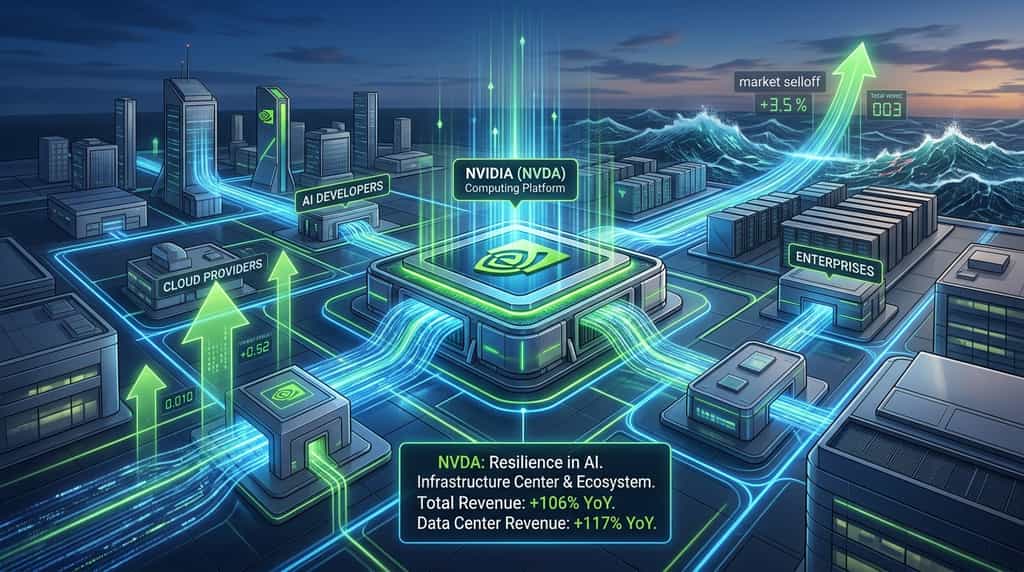
According to Nvidia's official second-quarter fiscal 2027 earnings release, the company generated $96.2 billion in quarterly revenue, up 106% year over year. Data Center revenue reached $89.0 billion, increasing 117% from a year earlier. These results provide a fundamental reason investors may continue to favor Nvidia even as concerns about AI valuations, financing costs, and infrastructure spending pressure other companies.
The central question is whether Nvidia's operating performance can remain strong enough to support its valuation. Understanding its revenue model, competitive advantages, and exposure to the wider AI investment cycle helps explain why NVDA may behave differently from more speculative AI stocks.
Why Is Nvidia Stock Holding Up Better Than Other AI Stocks?
Nvidia may be holding up better because its business has a direct connection to AI computing demand, while some other AI companies depend more heavily on future monetization, external financing, or the success of unproven business models. This distinction does not guarantee that Nvidia will outperform every peer, but it helps explain why investors may assign different levels of confidence to companies associated with the same AI trend.
Nvidia sells computing platforms that power AI model training, inference, and other data-intensive workloads. Its products are already deployed across cloud providers, AI developers, enterprises, and research organizations. This creates a more immediate revenue link between AI infrastructure investment and Nvidia's financial results than exists for many companies whose AI strategies are still developing.
The company's latest quarterly figures reinforce that distinction. Based on Nvidia's August 26, 2026, earnings release, total revenue reached $96.2 billion, while Data Center revenue contributed $89.0 billion. Data Center therefore accounted for approximately 92.5% of quarterly revenue, calculated from the company's reported figures. This concentration makes Nvidia highly exposed to AI infrastructure demand, but it also shows how directly the company participates in that spending.
By comparison, an AI software startup may need to spend heavily on computing capacity, attract customers, and demonstrate that subscription or usage revenue can cover operating costs. A data center operator may have to finance expensive facilities before reaching full utilization. Nvidia can benefit when these businesses purchase its hardware, although it is not insulated from their financial difficulties: if customers reduce spending or delay infrastructure projects, chip demand could weaken.
The distinction is therefore not that Nvidia is risk-free while other AI stocks are risky. Rather, Nvidia has demonstrated significant current revenue generation from AI infrastructure, while the investment cases of some other companies depend more heavily on expectations about future profitability.
What Competitive Advantages Help Nvidia Withstand the AI Selloff?
Nvidia's competitive advantage comes from combining GPUs, networking, software, and a developer ecosystem into an integrated computing platform. Customers evaluating AI infrastructure do not choose hardware based on chip specifications alone; they also consider software compatibility, system performance, deployment time, reliability, and the cost of moving existing workloads.
Nvidia's CUDA software ecosystem is a major part of this advantage. Developers and researchers have spent years building tools and applications around Nvidia's computing architecture. This familiarity can make switching hardware platforms more complicated because customers may need to adapt software, optimize workloads, and retrain technical teams. The ecosystem does not make competitors irrelevant, but it can help Nvidia retain customers even as alternative chips become more capable.
Its integrated approach also matters. Large AI systems require more than individual processors. They need networking, memory, servers, software, and infrastructure designed to operate together. By offering a broader platform, Nvidia can compete on the performance of the complete system rather than only the price of a single chip.
That positioning may provide a buffer during market turbulence. If investors become more selective about AI spending, companies with established products, deep customer relationships, and demonstrated demand may be viewed more favorably than businesses whose future depends on securing new financing or proving their commercial model.
Nevertheless, Nvidia's advantages are not permanent guarantees. Major cloud providers are developing their own chips, competing semiconductor companies are improving their products, and customers have incentives to diversify suppliers. Custom accelerators may become attractive for specific workloads where cost or energy efficiency matters more than compatibility with an existing software stack.
Investors should therefore monitor whether Nvidia continues to deliver performance and total-cost advantages, not simply assume that its current market position will remain unchanged.
Why Are AI Infrastructure and Financing Concerns Pressuring Other Stocks?
The recent AI-related selloff reflects a growing focus on whether spending on computing capacity, data centers, and supporting infrastructure can generate sufficient financial returns. Nvidia benefits from infrastructure purchases, but other companies in the same ecosystem may face heavy upfront costs, high financing needs, or uncertainty about when their investments will become profitable.
AI development requires large amounts of computing power, electricity, networking equipment, cooling capacity, and physical space. Companies building data centers may commit capital well before those facilities generate revenue. If borrowing costs rise, construction takes longer than expected, or customers delay deployments, the financial burden can increase even if long-term demand for AI remains intact.
This creates different risk profiles across the AI supply chain. Nvidia sells critical computing hardware into the buildout, while data center operators may need to fund facilities and equipment before reaching full utilization. AI application companies must convert usage into sustainable revenue, and cloud customers must determine whether the productivity gains from AI justify their spending. These businesses are connected, but their cash-flow timing and financial risks are not identical.
Nvidia is still exposed to the same underlying investment cycle. If major customers slow their capital spending, the effects could eventually reach chip orders. If customers face financing constraints or struggle to earn an adequate return on AI investments, planned projects may be delayed or reduced. Strong current results do not eliminate these downstream risks.
Investors should also distinguish between a temporary share-price correction and a deterioration in business fundamentals. A stock can fall because investors demand a lower valuation multiple even while revenue grows. Conversely, a company can report strong revenue and still face pressure if its costs rise, future orders weaken, or market expectations prove too optimistic.
The key question is whether AI infrastructure spending is becoming more productive and financially sustainable. Nvidia's resilience depends not only on demand for its products today, but also on customers' ability to continue investing in them.
Beyond the Headlines: What KuCoin 5.0 Means for You
Market news moves fast — but where you act on it matters just as much. This October, KuCoin launches KuCoin 5.0, transforming KuCoin into a rebuilt platform. Here's what actually changes for you:
-
One account for everything. Older platforms split your money across separate "spot," "margin," and "futures" accounts and expected you to understand why. KuCoin 5.0's unified account removes that entirely — deposit once, and everything is simply there (only available to VIPs for now).
-
Stocks, indices, and commodities. KuCoin 5.0 expands beyond crypto into global markets. When crypto chops sideways and equities rally (or the reverse), you rotate in minutes instead of opening a brokerage account and waiting days for fiat rails.
-
Real-world assets (RWA). Tokenized exposure to traditional assets like commodities, right inside your crypto account. One of the fastest-growing segments in global finance is no longer reserved for institutions — you access it from the same balance you trade with.
-
Earn while you learn. Not ready to trade? KCUSD lets your stablecoins earn daily, auto-compounding interest. The lowest-stress way to put your idle deposit to work for 4% yield.
-
An AI assistant in plain language. Ask questions, get market context, understand what you're looking at — built into the platform, no jargon required.
-
An app that doesn't overwhelm. Faster, cleaner, and consistent — intuitive from the first tap, not after a tutorial.
-
Safety you can check, not just trust. A MiCAR-licensed EU entity, Proof of Reserves you can verify yourself, and internationally certified security (SOC 2 Type II, ISO 27001:2022).
Create your account in minutes — and start on the platform built for where crypto is going, not where it's been.
Conclusion
Nvidia may be holding up better than some other AI stocks because its business has a direct, measurable connection to AI infrastructure demand. Its second-quarter fiscal 2027 results showed $96.2 billion in revenue, including $89.0 billion from Data Center, demonstrating the scale of its current role in the AI computing market. Its integrated hardware and software ecosystem also gives customers reasons to remain within its platform, even as competition develops.
However, Nvidia is not immune to the risks affecting the wider AI sector. Heavy infrastructure investment, financing costs, customer spending decisions, and competition could all affect future demand. Its strong revenue growth also does not automatically mean its shares are undervalued, particularly when investors already expect substantial future earnings.
For investors, the central issue is whether Nvidia can sustain profitable growth at a pace that supports its market valuation. Quarterly results, customer investment plans, competitive developments, and changes in earnings expectations are more useful indicators than short-term price movements alone. Nvidia may remain a leading AI company without necessarily outperforming the market at every stage. A balanced investment decision should weigh its demonstrated operating strength against valuation risk and the possibility of slower AI infrastructure spending.
FAQs
1. What is the difference between Nvidia GPUs and CPUs?
A central processing unit (CPU) is designed to handle a broad range of general-purpose computing tasks, while a graphics processing unit (GPU) can perform many calculations in parallel. GPUs are particularly useful for many AI workloads, although modern AI infrastructure relies on a combination of processors, memory, networking, and software.
2. Why is Nvidia less affected by the AI stock selloff?
Nvidia may be more resilient because it generates substantial revenue from AI computing hardware and infrastructure. Its established customer base, software ecosystem, and demonstrated demand can support investor confidence, although its stock remains exposed to valuation changes and slower AI spending.
3. Is Nvidia stock a good long-term investment in 2026?
Nvidia may appeal to long-term investors who expect AI infrastructure demand to grow, but its suitability depends on valuation, risk tolerance, and investment horizon. Investors should assess future earnings growth, competition, customer spending, and downside scenarios before making a decision.
Disclaimer:
This article is for informational purposes only and does not constitute financial, legal, or investment advice. Always conduct your own research before interacting with digital assets.