

When Cash is King: Lessons from Warren Buffett's History of Extreme Cash Accumulation for Crypto Investors
2026/06/02 15:35:00
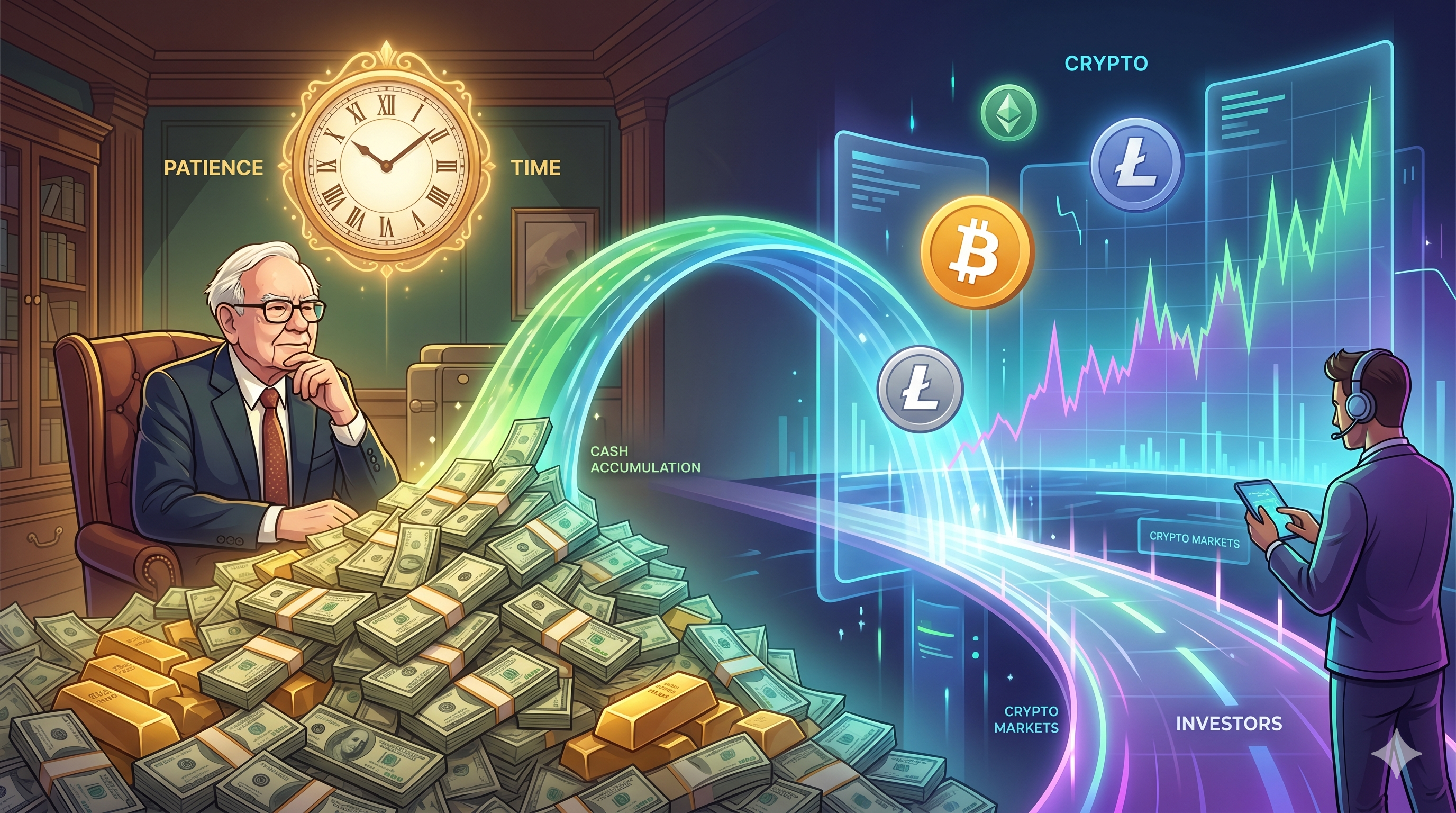
Warren Buffett's cash pile has become the most-watched signal in global markets. As of Q1 2026, Berkshire Hathaway holds a staggering $397.4 billion in cash and short-term Treasuries—a record that surpasses the GDP of Hong Kong and Norway combined. This isn't just a footnote in Berkshire's quarterly report; it's a thunderous warning from the most disciplined capital allocator in modern financial history. Buffett handed the CEO reins to Greg Abel on January 1, 2026, yet the cash hoard continues to swell, growing by $24 billion in Abel's first quarter alone. For cryptocurrency investors navigating the volatile digital asset landscape of 2026, Buffett's extreme cash accumulation offers profound lessons about patience, valuation discipline, and the strategic power of liquidity. In an era where 73% of institutional investors plan to increase crypto holdings this year, understanding when to hold cash versus when to deploy capital could be the difference between generational wealth and catastrophic losses.
💡 Tips: New to crypto? KuCoin's Knowledge Base has everything you need to get started.
Key Takeaways
-
Buffett's $397B cash pile signals extreme valuation discipline—he only deploys when markets offer genuine distress, not marginal dips
-
Historical pattern: Berkshire's cash peaks have preceded major market dislocations (2007, 2019, and now 2026)
-
Crypto investors should adopt "dry powder" strategies—holding stablecoins or cash equivalents during overvalued periods
-
Patience is an active strategy, not passive waiting; Buffett earns 4-5% in T-bills while waiting for the perfect pitch
-
Institutional crypto adoption is accelerating (73% plan to increase holdings in 2026), but timing entry points matters more than FOMO-driven buying
-
KuCoin's trading tools can help investors automate disciplined entry strategies during market volatility
The Anatomy of Buffett's Record Cash Hoard
Berkshire's $397 Billion War Chest Is a Valuation Alarm Bell
Berkshire Hathaway ended Q1 2026 with $397.4 billion in cash and short-term Treasury bills, breaking the previous record of $381.7 billion set in Q3 2025. This represents approximately 59% of Berkshire's investable portfolio—an extraordinarily defensive posture for a company historically known for aggressive capital deployment. The composition reveals Buffett's thinking: roughly $51.5 billion sits in pure cash equivalents, while $339.3 billion is parked in short-term U.S. Treasury bills earning approximately 4-5% annual yields. Buffett treats T-bills as cash-equivalent because they're highly liquid and carry effectively zero credit risk—he can convert them to deployment capital within a single trading day.
This cash accumulation didn't happen overnight. Between 2022 and 2024, Berkshire sold a net $172.93 billion in equities, with $134.1 billion of that coming in 2024 alone. Buffett trimmed his Apple position from nearly 50% of the equity portfolio down to roughly 22%. He cut Bank of America by more than half. Even under new CEO Greg Abel, the selling continued—Berkshire offloaded another $24.1 billion in equities in Q1 2026 against just $16 billion in purchases, creating a net $8.1 billion reduction that pushed cash to its new record.
The Opportunity Cost of Patience
Holding this much cash during a bull market carries real costs. If we average Berkshire's cash position across 2023-2025 at roughly $250 billion, a hypothetical S&P 500 deployment would have produced approximately $155 billion in gains given the index's 26% return in 2023, 25% in 2024, and 16% in 2025. The actual Treasury bill earnings on that cash came to about $34 billion. The forgone gain: roughly $125 billion.
Yet Buffett and Abel accept this cost willingly. Why? Because Berkshire doesn't allocate to index funds—its mandate is to buy entire businesses or substantial equity stakes in great companies at fair prices. By 2024, those opportunities at Berkshire's required hurdle rate had effectively disappeared. The S&P 500's price-to-earnings ratio of 22.5x significantly exceeds historical averages, while many growth stocks trade at multiples assuming years of perfect execution. As Abel told shareholders at the May 2026 annual meeting, Berkshire will not deploy into subpar opportunities, and patience remains a core strength.
Historical Patterns: Why Cash Peaks Matter
Berkshire's Cash Hoards Have Predicted Major Market Dislocations
The current $397 billion cash pile isn't an anomaly—it's part of a recognizable pattern. Historical data shows that Berkshire's cash reserves have peaked before significant market downturns:
|
Period
|
Cash Peak
|
Subsequent Event
|
Time to Crisis
|
|
2007
|
$44 billion
|
Global Financial Crisis
|
~12 months
|
|
2019
|
$128 billion
|
COVID-19 market crash
|
~3 months
|
|
Q3 2025
|
$381.7 billion
|
Market volatility continues
|
Ongoing
|
|
Q1 2026
|
$397.4 billion
|
???
|
TBD
|
Buffett first recognized overvaluation in 1966 and stopped taking money into his partnership, returning capital by 1969. He pivoted into insurance—a structure that gave him low-cost, compounding float. The current accumulation is a variation on that same instinct. As Chris Bloomstran, President of Semper Augustus Investments Group, noted at a post-meeting investor panel: "The ability to deploy capital aggressively in a downturn remains concentrated among only a small number of market participants... Those with exceptional scale, liquidity, underwriting flexibility, and appetite for large or complex risks."
What Buffett Actually Says About Current Conditions
Buffett has characterized recent market volatility as "nothing" compared to historical crashes like the 2008 Financial Crisis or the 2020 pandemic panic. This isn't complacency—it's a calibrated assessment that current conditions represent expensive valuations rather than genuine distress. The distinction matters enormously. Historically, Buffett's largest investments have occurred when quality assets are sold indiscriminately due to liquidity issues. Until such conditions emerge, Berkshire's cash pile serves as a buffer against uncertainty.
At the May 2026 annual meeting, Buffett—now serving as chairman emeritus—struck a cautious tone in a lunchtime interview, stating he does not see an ideal investing environment at present. Abel, leading his first AGM as CEO, emphasized margin of safety as the core lens for capital deployment: taking some risk in return for lower entry valuations and more attractive opportunities. The empty chair beside Abel, set with Buffett's drink of choice (Cherry Coke) and Charlie Munger's favorite candy, symbolized the continuity of this disciplined approach.
Crypto Market Implications: Applying Buffett's Cash Strategy to Digital Assets
Why Crypto Investors Should Study Buffett's Dry Powder Approach
Cryptocurrency markets in 2026 exhibit several characteristics that mirror the overvaluation Buffett sees in traditional equities. Bitcoin trades near all-time highs following its 2024 halving cycle, while altcoins have experienced massive speculative runs. The crypto fear and greed index frequently hovers in "extreme greed" territory. Yet institutional adoption is accelerating—73% of institutional investors plan to increase crypto holdings in 2026, according to Coinbase research, with growing demand for tokenized products and yield strategies.
This creates a paradox: the long-term trajectory for crypto may be overwhelmingly positive, but current entry points may offer poor risk-adjusted returns. Buffett's framework resolves this paradox through temporal arbitrage—maintaining full exposure to the asset class's long-term potential while preserving capital for superior entry points.
Crypto investors can implement this through several mechanisms:
Stablecoin Yield Strategies: Rather than holding volatile assets during overvalued periods, investors can park capital in USDC, USDT, or DAI earning 4-8% in DeFi protocols or centralized lending platforms. This mirrors Buffett's T-bill strategy—earning positive real returns while maintaining deployment optionality.
Systematic Accumulation Plans: Instead of lump-sum purchases at potentially poor valuations, investors can implement dollar-cost averaging (DCA) strategies that automatically deploy capital during predetermined dips (e.g., 10%, 20%, 30% corrections).
Volatility-Triggered Deployment: Setting limit orders at key technical support levels or historical accumulation zones ensures capital deploys only when prices reach predetermined "fair value" thresholds.
The Institutional Crypto Wave Meets Buffett-Style Discipline
The institutional adoption narrative for crypto in 2026 is undeniable. Major financial institutions have launched spot Bitcoin ETFs, tokenized Treasury products, and blockchain-based settlement systems. However, institutional entry doesn't guarantee immediate price appreciation—institutions are sophisticated buyers who, like Buffett, wait for favorable valuations.
Smart crypto investors should differentiate between structural adoption (long-term bullish) and cyclical valuation (short-term neutral to bearish). The former justifies portfolio allocation; the latter dictates entry timing. Buffett's cash strategy teaches us that these two dimensions operate independently.
Consider this framework for crypto capital allocation:
|
Market Condition
|
Buffett-Style Action
|
Crypto Equivalent
|
|
Extreme overvaluation
|
Hold cash/T-bills at 4-5%
|
Hold stablecoins in yield protocols at 4-8%
|
|
Moderate overvaluation
|
Selective trimming of winners
|
Take profits on outperforming altcoins; increase BTC/ETH core
|
|
Fair value
|
Maintain current positions
|
DCA into core positions; maintain dry powder
|
|
Moderate distress
|
Begin selective deployment
|
Aggressive DCA; deploy 25% of dry powder
|
|
Extreme panic/capitulation
|
Massive deployment ("buy when there's blood in the streets")
|
Full deployment; leverage dry powder; accumulate quality projects at 70-90% discounts
|
The Cost of Impatience in Crypto Markets
FOMO Is the Enemy of Compounding
Buffett's cash strategy highlights a psychological trap that devastates crypto investors: the fear of missing out (FOMO). When Bitcoin rallies 50% in a quarter and meme coins generate 10x returns, holding cash feels like a catastrophic error. Yet Buffett's historical performance proves that missing the early stages of a rally is less damaging than participating in the late stages of a bubble.
The math is brutal but clear. An investor who deployed $10,000 into Bitcoin at the November 2021 peak (approximately $69,000) would have watched that investment fall to roughly $3,200 by November 2022—a 70% drawdown. The same $10,000 deployed at the November 2022 bottom (approximately $15,500) would have grown to over $40,000 by early 2026. Timing isn't everything, but valuation-aware timing is the difference between wealth preservation and wealth destruction.
Buffett's approach accepts the psychological discomfort of underperformance during raging bull markets in exchange for asymmetric payoff during crises. When markets collapse, Buffett doesn't just survive—he thrives, deploying billions into distressed assets at once-in-a-generation prices. Crypto investors who maintain stablecoin reserves during euphoria position themselves to acquire quality assets (Bitcoin, Ethereum, Solana, and select DeFi blue chips) when leverage unwinds and weak hands capitulate.
Abel's Inheritance: The New Era of Berkshire Discipline
Greg Abel's first quarter as CEO confirms that Berkshire's cash discipline will outlive Buffett's operational leadership. Abel not only maintained the cash hoard but expanded it, suggesting the strategy reflects institutional conviction rather than one man's idiosyncrasy. For crypto investors, this is a crucial signal: the greatest traditional value investor of all time believes current market prices don't offer adequate margin of safety.
Abel has also ruled out a Berkshire breakup, confirming the conglomerate structure will persist. This matters because Berkshire's ability to shift capital quickly and tax-efficiently across subsidiaries gives it unique deployment flexibility—flexibility that crypto investors can replicate through multi-chain stablecoin strategies and cross-protocol yield farming.
KuCoin Conversion: Your Platform for Strategic Crypto Deployment
KuCoin empowers investors who take Buffett's preparation principle seriously, offering over 800 cryptocurrencies and sophisticated automation tools that enable disciplined deployment strategies. Its free native trading bot suite—including Spot Grid, DCA, and Smart Rebalance—allows you to pre-program accumulation logic, automatically buying dips and taking profits while you maintain stablecoin reserves. With spot trading fees starting at just 0.10% and monthly Proof of Reserves ensuring transparency, KuCoin provides the infrastructure to act decisively when market dislocations arrive. The question isn't whether crypto will offer distressed opportunities—they always do—but whether your platform is ready to execute with Buffett-like precision when others panic-sell.
Conclusion
Warren Buffett's $397.4 billion cash pile is the loudest warning signal in global markets, yet it's simultaneously a masterclass in strategic patience. For cryptocurrency investors navigating the volatile digital asset landscape of 2026, the lessons are unmistakable: cash is not a bearish bet—it's an option on future opportunity. Berkshire's historical pattern of peak cash reserves preceding major dislocations (2007, 2019, and now 2026) suggests that current market valuations across both traditional equities and speculative crypto assets may not offer the margin of safety required for exceptional long-term returns.
The crypto market's institutional adoption trajectory remains powerfully bullish—73% of institutions plan to increase crypto allocations this year—but adoption alone doesn't justify any price. Smart investors must separate structural conviction from cyclical timing, maintaining dry powder in stablecoin yield strategies while waiting for genuine distress. Greg Abel's continuation of Buffett's cash discipline under new leadership confirms this isn't a personality quirk but an institutional framework for superior risk-adjusted returns. As Buffett himself has demonstrated across six decades, the ability to deploy capital aggressively when others are forced to sell is the ultimate competitive advantage. Build your watchlist now, automate your deployment strategies, and remember: in both Omaha and the blockchain, the patient predator eats best.
FAQs
Does Buffett's cash pile mean a market crash is guaranteed in 2026?
No. It signals extreme valuation discipline and a lack of compelling opportunities, not precise market timing. Historically, Berkshire's cash peaks have preceded major dislocations, but the timing varies from 3 months to over a year.
How can crypto investors earn yield on "dry powder" like Berkshire earns on T-bills?
Investors can park stablecoins (USDC, USDT, DAI) in DeFi lending protocols or centralized platforms earning 4-8% APY, or use KuCoin's Earn products and trading bots to generate returns while maintaining liquidity for deployment.
Is Buffett anti-crypto, and does his cash strategy apply to digital assets?
Buffett has historically criticized Bitcoin as non-productive, but his capital allocation principles—patience, margin of safety, and contrarian deployment during distress—are universally applicable to any volatile asset class including crypto.
What percentage of a crypto portfolio should be held in cash/stablecoins during overvalued periods?
While individual risk tolerance varies, a Buffett-inspired approach might hold 30-60% in stablecoin equivalents during periods of extreme overvaluation, scaling into core positions as valuations become more attractive.
Can retail investors really replicate Berkshire's deployment timing without Buffett's resources?
A: Yes, through automation. Platforms like KuCoin offer trading bots that execute pre-programmed accumulation strategies during dips, allowing retail investors to deploy capital systematically without requiring 24/7 market monitoring or billions in assets.
Disclaimer: This article is for informational purposes only and does not constitute financial or investment advice. Cryptocurrency investments carry significant risk. Always conduct your own research before trading.