

US 30-Year Bond Auction Yields 5.06%: What It Means for Markets
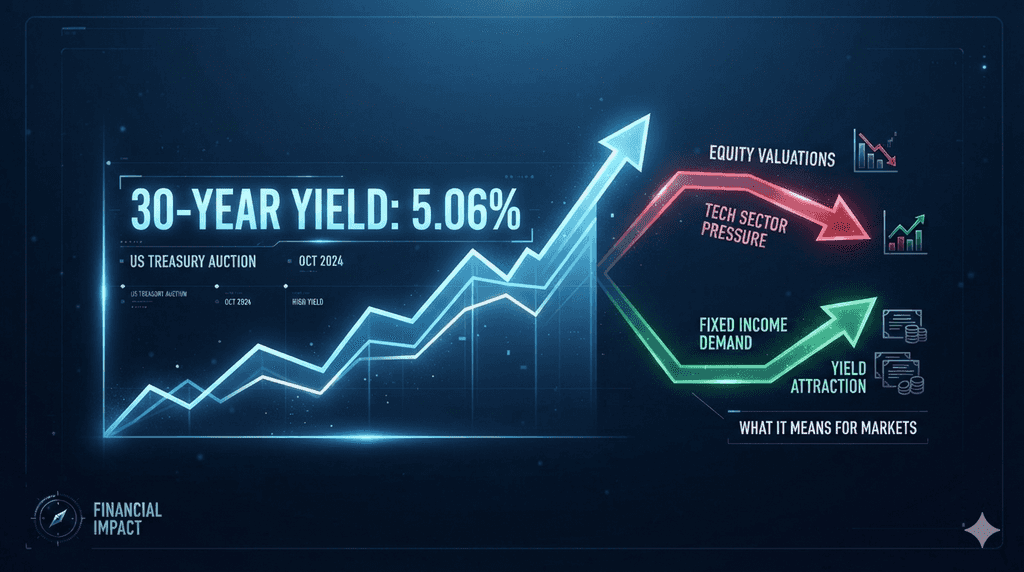
The global financial landscape is adjusting to a notable development in the fixed-income markets. The United States Department of the Treasury has concluded its recent auction of 30-year government bonds with a high yield of 5.06%.
This represents the highest yield demanded by long-term bond investors since 2007, reflecting broader shifts in macroeconomic conditions, inflation expectations, and monetary policy outlooks. When the risk-free rate of the world’s reserve currency reaches this level, asset classes across global markets, including equities, real estate, and decentralized finance (DeFi), experience repricing pressures.
For institutional fund managers, quantitative traders, and digital asset investors, analyzing the mechanics behind this 5.06% bond yield is essential. This macroeconomic shift alters capital allocation models, shifting liquidity dynamics between traditional safe-haven instruments and risk-on assets.
Key Takeaways
-
A 0.3 basis point stop-through and a 2.44x bid-to-cover ratio indicate stable aggregate institutional demand despite expanding fiscal deficits.
-
Elevated risk-free rates raise Discounted Cash Flow (DCF) baselines, compressing valuation multiples for long-duration technology and growth stocks.
-
Rising yields expand unrealized fixed-income losses for commercial banking portfolios and elevate refinancing costs for maturing corporate debt.
-
A 5.06% sovereign return increases capital opportunity costs, dampening institutional inflows into non-yielding crypto assets during uncertain macro periods.
-
The high-yield environment accelerates Web3 integration through tokenized Treasury instruments and programmatic yield-sharing stablecoins like Open USD.
Deconstructing the 30-Year Bond Auction Result
A US Treasury auction serves as a direct, transparent temperature check on global investor confidence regarding the long-term health of the United States economy and fiscal trajectory. When the Treasury issues a 30-year bond, it is essentially asking the market to lock up capital for three decades in exchange for a fixed annualized return.
The latest auction yield of 5.06% indicates that investors are demanding a significantly higher premium to hold long-term US sovereign debt. This surge in yield is primarily driven by three converging macroeconomic factors:
Entrenched Inflationary Pressures: Investors are signaling that they expect inflation to remain sticky over the long term, requiring a higher nominal yield to maintain a positive real rate of return.
Expanding Fiscal Deficits: The accelerating supply of newly issued US government debt means the Treasury must offer more attractive terms to entice sufficient buying demand from global institutions and foreign central banks.
The "Higher for Longer" Monetary Paradigm: The Federal Reserve’s prolonged commitment to maintaining elevated benchmark interest rates has effectively pulled the entire yield curve upward, forcing long-term bonds to adjust accordingly.
Auction Metrics and Demand Dynamics
To evaluate the outcome of a Treasury auction, market analysts analyze aggregate bidding metrics alongside the nominal high yield, with a particular focus on the bidding pricing spread and the bid-to-cover ratio.
The auction pricing spread represents the difference between the pre-auction when-issued yield and the final high yield accepted at bidding conclusion. The recent 30-year auction cleared with a 0.3 basis point stop-through (pricing below when-issued levels), indicating that marginal bidding demand in the final moments allowed the Treasury to clear the book slightly below prevailing market expectations.
Concurrently, the bid-to-cover ratio—a metric for overall demand volume—printed at 2.44x, reflecting stable institutional bidding interest relative to recent auction cycles. The updated allocation distributions among direct, indirect, and dealer accounts outline steady multi-channel participation for long-duration sovereign issuance at these elevated yield thresholds.
| Key Auction Metric | Historical 5-Year Average Baselines | Latest 30-Year Auction Result | Market Implication |
| High Yield | ~3.85% | 5.06% | Long-term capital costs adjusting to structural macro environments |
| Bid-to-Cover Ratio | 2.42x | 2.44x | Stable aggregate institutional demand relative to target issuance size |
| Primary Dealer Award | ~12.40% | 10.05% | Decreased dealer absorption requirements, showing healthy end-user allocation |
| Foreign Buyer (Indirect) Allocation | ~68.50% | 77.74% | Sustained international demand seeking elevated risk-free yields |
Broad Market Implications: Equities and Financial Infrastructure
The expansion of the 30-year Treasury yield to 5.06% alters broader market conditions, introducing systematic repricing pressures across traditional equities and banking balance sheets.
The Equity Valuation Adjustment
Within valuation frameworks, the 30-year Treasury yield provides a primary baseline for the risk-free rate within Discounted Cash Flow (DCF) models. An increase in this benchmark lowers the present value calculation of future corporate earnings. Long-duration asset classes, particularly high-growth technology and artificial intelligence (AI) sectors whose valuations remain heavily weighted on long-term earnings projections, show heightened sensitivity to this rate adjustment. Elevated risk-free yields prompt a compression in equity valuation multiples, reallocating marginal liquidity away from primary equity markets.
Banking Sector Exposures and Corporate Debt Refinancing
The mechanics of commercial banking depend closely on managing structural maturity mismatches. As long-term yields adjust higher, banking institutions experience expansion in unrealized losses within their existing fixed-income portfolios, posing additional duration management challenges for regional financial networks.
Concurrently, corporate borrowers approaching debt maturities face a structurally shifted refinancing environment. The transition from historically lower financing rates to borrowing costs exceeding 6% or 7% increases debt service requirements, acting as a headwind to corporate profit margins and corporate capital expenditure expansion.
The Digital Asset Environment: Adjusting to the High-Yield Environment
Within the digital asset sector, a 5.06% risk-free US Treasury yield introduces a bifurcated market framework. As cryptocurrencies experience deeper institutional integration, their correlation with macroeconomic liquidity has transitioned into a more complex dynamic.
Capital Opportunity Costs for Non-Yielding Assets
The expansion of long-term sovereign yields to 5.06% raises the opportunity cost for risk-on assets. When dollar-denominated portfolios can secure a fixed 5.06% annualized return via sovereign debt, the incentive for traditional wealth managers to allocate marginal capital toward highly volatile assets, such as Bitcoin (BTC) or Ethereum (ETH), diminishes. This yield threshold dampens institutional capital inflows into digital asset exchange-traded funds (ETFs), prompting capital allocators to maintain safe-haven fixed-income positions during periods of macroeconomic uncertainty.
Long-Term Currency Debasement Dynamics
Conversely, the structural factors driving long-term bond yields upward, including persistent fiscal deficits and expanding sovereign debt obligations, underpin the core store-of-value thesis for fixed-supply digital assets. As institutional participants evaluate the expanding fiscal trajectory of the United States, the demand profile for a decentralized, mathematically limited alternative asset strengthens. While short-term trading desks frequently liquidated digital holdings alongside growth equities during yield spikes, long-term capital allocators increasingly view BTC as a potential structural diversifier against systemic fiat debasement and debt expansion.
Stablecoin Models and the Expansion of Real-World Asset (RWA) Tokenization
As digital asset markets adjust to broader valuation adjustments, the stablecoin and decentralized finance sectors are realigning around structurally higher sovereign yields.
The Integration of Sovereign Yield into Stablecoin Infrastructure
For extended periods, organic yields generated within decentralized finance protocols broadly exceeded traditional banking returns. With the risk-free rate established above 5%, native DeFi money markets must realign pricing to maintain capital efficiency.
This macroeconomic backdrop has accelerated the institutional development of next-generation payment stablecoins designed with yield-sharing infrastructure, notably the recently introduced Open USD (OUSD) by the Open Standard consortium. Supported by financial institutions including BlackRock, Visa, and Stripe, the OUSD model captures the yield of short-term Treasury reserves and redistributes the majority of interest income back to its corporate ecosystem partners. Consequently, elevated sovereign yields are shifting from competitive headwinds into underlying capital rails tokenized directly within global payment networks.
The Scale of Real-World Asset (RWA) Tokenization
The elevated yield environment has designated Real-World Asset (RWA) tokenization as a rapidly expanding segment within the digital asset market. Protocols facilitating the on-chain fractionalization of short-term US Treasury instruments provide international market participants, who may lack direct access to onshore brokerage infrastructure, with compliant channels to allocate toward dollar-denominated sovereign debt. This structural convergence facilitates an ongoing merger between traditional fixed-income capital pools and public ledger technology, modifying global liquidity distribution channels.
Asset Allocation Tools and Exchange Infrastructure
As macroeconomic adjustments prompt structural capital reallocations between sovereign fixed-income and digital assets, market participants utilize exchange infrastructure to manage risk exposures and capture transactional inefficiencies. Price volatility in debt markets historically correlates with localized asset dislocations and structural accumulation windows within key digital token categories. Utilizing global trading venues such as KuCoin allows participants to respond to these macroeconomic shifts.
-
Spot and Derivatives Execution Channels: KuCoin maintains high-liquidity order books across spot and futures markets for primary digital assets. Market participants manage macro risk exposures using advanced order routing, customizable leverage profiles, and localized market depth on primary pairs such as BTC/USDT.
-
Yield Generation via KuCoin Earn: To complement or contrast with elevated sovereign yields, the KuCoin Earn module provides programmatic access to interest-bearing stablecoin accounts, flexible staking structures, and dual-investment products designed to capture alternative yield structures within the digital asset ecosystem.
-
Automated Trading Architecture: To manage short-term market drawdowns and consolidation phases following macroeconomic indicators, traders can deploy integrated algorithmic tools. The system supports Grid Trading and Dollar-Cost Averaging (DCA) frameworks, allowing for automated price-bracket execution and disciplined capital deployment without manual intervention.
Centralizing asset custody on unified trading platforms provides the operational efficiency and execution velocity required to rotate capital between distinct segments of the digital economy as structural macroeconomic data develops.
Conclusion
The US 30-year Treasury bond auction clearing at 5.06% underscores a structural adjustment within global financial markets. It signifies a transition away from the historically low borrowing costs of previous cycles toward a regime characterized by structurally elevated capital costs.
While this macroeconomic transition introduces short-term valuation constraints for both equity and digital asset markets, it concurrently accelerates institutional convergence between traditional fixed income and public blockchain networks. Through the expansion of tokenized real-world assets and programmatic yield-sharing stablecoin models such as Open USD, the yield dynamics of traditional sovereign debt are being integrated into decentralized capital infrastructure.
As global liquidity realigns around safety, yield efficiency, and structural diversification, the digital asset ecosystem continues to mature. Navigating this modified financial framework requires rigorous risk management discipline, continuous monitoring of macroeconomic indicators, and systematic portfolio execution across high-liquidity market infrastructure.
FAQs
Why is the 30-year Treasury yield considered the global "risk-free rate"?
Backed by the full credit of the US government, it represents the baseline return investors require for long-term dollar assets. Because of its safety, financial markets utilize this yield as a key benchmark to calculate costs and price risk assets worldwide.
What does a "0.3 basis point stop-through" mean for the auction?
A stop-through indicates the final high yield cleared 0.3 basis points below the pre-auction market expectation. This demonstrates that bidding demand in the final moments was slightly stronger than expected, allowing the Treasury to clear the debt smoothly.
How does a 5.06% yield impact tech and growth stock valuations?
In Discounted Cash Flow (DCF) models, higher yields raise the discount rate. Since tech and AI growth stocks derive their value from long-term future earnings, an elevated denominator directly shrinks the present mathematical value of those future cash flows.
Why do higher bond yields pressure the commercial banking sector?
Banks hold large portfolios of older, low-yielding bonds. As market yields rise, the market value of these existing fixed-income assets drops, leading to expanding unrealized balance-sheet losses and increasing duration management challenges for regional financial networks.
How does the 5.06% yield increase corporate refinancing risks?
Corporations with maturing debt can no longer refinance at low rates. They must issue new debt stacked with credit spreads over the 5.06% risk-free benchmark, driving actual borrowing costs to 6%–7% and compressing corporate profit margins.
What is the direct opportunity cost of high yields for cryptocurrencies?
When dollar-denominated portfolios can secure a guaranteed 5.06% annualized return via sovereign debt, the incentive to allocate capital into highly volatile, non-yielding digital assets like BTC or ETH decreases for traditional wealth managers during uncertain periods.
Why do long-term allocators view Bitcoin as a structural macro hedge?
The underlying drivers of rising yields—expanding fiscal deficits and continuous sovereign debt issuance—underpin the core store-of-value thesis for fixed-supply assets. Institutional allocators increasingly view BTC as a potential mathematical diversifier against structural fiat currency debasement.
Why are elevated yields accelerating the Real-World Asset (RWA) sector?
High risk-free yields make tokenized US Treasury bills highly attractive. RWA protocols fractionalize these instruments on-chain, providing compliant, cross-border access to overseas market participants who lack traditional onshore brokerage infrastructure to capture dollar-denominated sovereign yields.
Disclaimer
The information provided on this page may originate from third-party sources and does not necessarily represent the views or opinions of KuCoin. This content is intended solely for general informational purposes and should not be considered financial, investment, or professional advice. KuCoin does not guarantee the accuracy, completeness, or reliability of the information, and is not responsible for any errors, omissions, or outcomes resulting from its use. Investing in digital assets carries inherent risks. Please carefully evaluate your risk tolerance and financial situation before making any investment decisions. For further details, please consult KuCoin’s Terms of Use and Risk Disclosure.