

Tom Lee’s 10-Year BitMine Vision: Betting on Ethereum as the Dominant Chain for Tokenization and AI
2026/08/25 17:13:00
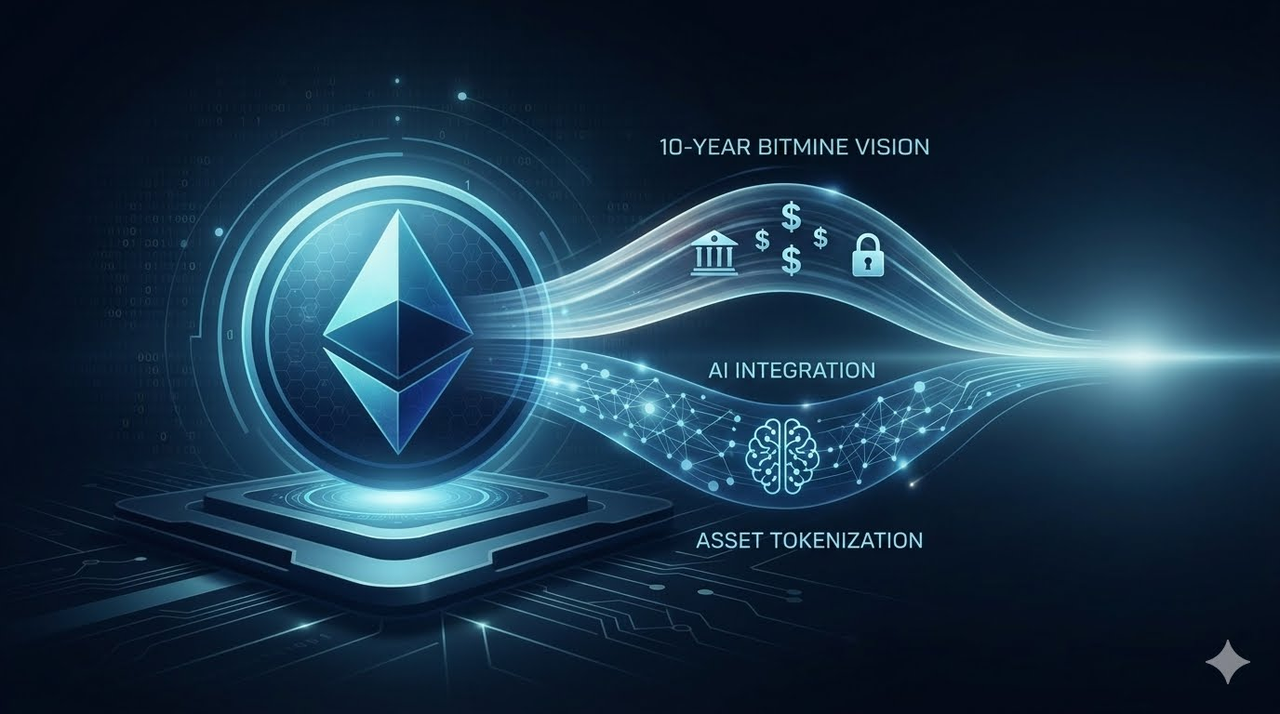
In August 2026, Bitmine Chairman Tom Lee articulated a comprehensive 10-year strategic framework, detailing the company's complete transition from a traditional Bitcoin mining operation to an entity structured around Ethereum capital accumulation. The core thesis of this decade-long vision positions Ethereum not merely as a cryptocurrency, but as the foundational infrastructure for two converging macroeconomic trends: financial asset tokenization and the integration of artificial intelligence (AI) with decentralized networks.
Rather than maintaining a diversified portfolio of digital assets or focusing on Bitcoin as a primary treasury reserve, Bitmine has executed a highly concentrated capital allocation strategy. The objective is to utilize Ethereum as a yield-bearing asset that supports the structural operations of the firm while capturing the value generated by global financial and automated systems. Lee’s projection that Ethereum’s market capitalization could eventually surpass that of Bitcoin—a scenario often referred to as "the flippening"—is based on the premise that productive, yield-generating networks will inherently command higher valuations than pure store-of-value assets.
This article evaluates the mechanics of Bitmine’s corporate treasury restructure, the reliance on Wall Street’s adoption of real-world assets (RWA), the requirements of autonomous AI economies, and the valuation models that underwrite this 10-year outlook.
The Balance Sheet Pivot: From Hashrate to Ethereum Capital Engine
The operational transition of Bitmine represents a departure from capital-intensive hardware cycles typical of Proof-of-Work (PoW) mining. By mid-2025, the firm began divesting its mining infrastructure to accumulate spot Ethereum, transforming its balance sheet into a mechanism driven by Proof-of-Stake (PoS) yields.
The Strategic Accumulation of Supply
Bitmine established a long-term acquisition target of 5% of the total circulating supply of Ethereum. As of August 2026, the company has accumulated approximately 5.82 million ETH. This holding represents roughly 4.8% of the total network supply, placing the firm close to its strategic threshold. This purchasing behavior requires consistent weekly allocations, funded by the reallocation of legacy assets and new capital formation. By securing a measurable percentage of the base layer, Bitmine aims to position itself as a systemic participant in the network's consensus mechanism and governance, moving beyond the role of a passive investor.
Monetizing Proof-of-Stake: The Recurring Yield Mechanism
Unlike Bitcoin, which functions on corporate balance sheets strictly as a zero-yield reserve asset, Ethereum provides native cash flow through network staking. Bitmine has actively deployed approximately 87% of its Ethereum holdings into staking contracts.
Based on network issuance and transaction fee distribution metrics as of mid-2026, this staked capital generates an estimated $250 million to $287 million in annualized revenue. This internal cash flow is un-leveraged, meaning it is derived directly from the protocol rather than external lending markets, thereby mitigating counterparty risk. This revenue stream is utilized to fund ongoing operations, manage corporate liabilities, and execute further asset accumulation.
Corporate Treasury Strategy Comparison: Zero-Yield vs. Productive Assets
| Metric | Traditional BTC Treasury Strategy | Bitmine ETH Treasury Strategy |
| Asset Function | Store of value, inflation hedge | Yield-bearing capital asset, settlement unit |
| Network Participation | Passive holding | Active consensus validation (Staking) |
| Primary Revenue Source | Capital appreciation only | Capital appreciation + Native network yield |
| Annual Yield Generation | 0% (without external lending risk) | ~3% to 5% (Protocol-level staking APY) |
| Operating Cash Flow | Requires asset liquidation or debt issuance | Funded directly by staking rewards ($250M+) |
Pillar I: Wall Street Tokenization and the Global Settlement Layer
The first foundational pillar of Lee’s 10-year vision is the migration of traditional financial instruments onto public blockchain infrastructure, a process defined as tokenization. Bitmine’s strategy assumes that the experimental phases of decentralized finance (DeFi) have concluded, making way for institutional-grade financial integration.
Moving Beyond Experimental DeFi to Institutional Rails
The earlier cycles of the cryptocurrency market were defined by initial coin offerings (ICOs), non-fungible tokens (NFTs), and early-stage decentralized exchanges. The current phase is characterized by the tokenization of sovereign debt, money market funds, and private credit.
Bitmine’s strategy highlights the actions of major asset managers as leading indicators. Firms such as BlackRock, which launched its tokenized fund (BUIDL) on the Ethereum network, demonstrate a preference for Ethereum over alternative Layer-1 blockchains. While competing networks may offer higher transactional throughput or lower immediate fees, institutions prioritize network stability, historical security, and the "Lindy effect"—the concept that the life expectancy of a technology is proportional to its current age. Furthermore, Ethereum hosts the majority of the global stablecoin supply (USDT and USDC), which serves as the primary routing liquidity for these newly tokenized assets.
Ethereum as the Indispensable Financial Base Layer
For tokenization to scale, the underlying ledger must function as a global settlement layer. Bitmine’s thesis argues that Ethereum has achieved a level of economic bandwidth—defined as the total value of liquid assets secured by the network—that makes it difficult for competitors to displace.
-
Composability: Tokenized real-world assets on Ethereum can natively interact with existing smart contracts, allowing a tokenized treasury bill to serve as collateral in a lending protocol without relying on centralized clearinghouses.
-
Legal and Code Certainty: Over a decade of operational history has subjected Ethereum's Ethereum Virtual Machine (EVM) to extensive security auditing and legal scrutiny, lowering the compliance barriers for traditional financial institutions.
-
Value Accrual: Every transaction involving tokenized assets requires the consumption of ETH for computation fees (gas). As Wall Street increases its on-chain activity, the persistent demand for block space directly supports the asset's utility value.
Pillar II: Agentic AI and Autonomous Machine Economics
The second pillar of Bitmine’s valuation model relies on the intersection of artificial intelligence and blockchain technology. Lee suggests that as AI development transitions from responsive language models to autonomous "Agentic AI," these systems will require a decentralized financial infrastructure to operate efficiently.
Autonomous Agents Need Non-Custodial Financial Rails
Agentic AI refers to systems capable of executing multi-step tasks, managing resources, and making decisions with minimal human intervention. However, a structural friction exists in current technological frameworks: autonomous algorithms cannot pass Know Your Customer (KYC) compliance checks, cannot open bank accounts at traditional financial institutions, and cannot be issued corporate credit cards.
Ethereum solves this fundamental friction through smart contracts and cryptographic wallets.
-
Account Abstraction: Through standards like ERC-4337, AI agents can be assigned programmatic wallets that function autonomously.
-
Machine-to-Machine (M2M) Commerce: An AI agent tasked with optimizing a supply chain or aggregating market research will need to purchase data access, pay for cloud computing power, or hire other specialized AI agents. Ethereum allows these systems to transact in stablecoins via micro-payments in real-time, executing financial contracts without human intermediaries.
The Verification and Alignment Mechanism
Beyond payment routing, Ethereum provides a necessary layer of verification for AI outputs. As machine capabilities scale, the ability to verify the authenticity, origin, and constraints of digital actions becomes a critical requirement.
Immutable Audit Trails: When an AI agent executes a trade or modifies a dataset, the action can be recorded on-chain, providing a transparent and permanent log that human operators or regulatory bodies can audit.
Smart Contract Guardrails: Developers can hard-code operational limitations into smart contracts. An AI managing a portfolio of tokenized assets can be cryptographically constrained from transferring funds to unauthorized addresses or exceeding specified risk thresholds.
Bitmine’s positioning assumes that Ethereum will function as the standard registry and control layer for autonomous machine operations, linking physical computing power to verifiable digital actions.
Valuation Models, Staking Cash Flows, and "The Flippening"
The financial projections presented in Tom Lee’s vision involve specific price targets for Ethereum, mapping potential growth to $50,000, $100,000, and $200,000 per asset over the next decade. These targets are derived from specific economic models rather than historical charting.
Deconstructing the Price Targets
The valuation framework utilized by Bitmine applies traditional discounted cash flow (DCF) analysis combined with network utility models. The price targets are predicated on three interacting variables:
-
Fee Generation: As tokenized assets and AI agents increase transaction volume, the total fees paid to the network will rise.
-
Supply Mechanics (EIP-1559): Ethereum’s protocol burns a portion of transaction fees. If network usage remains high, this burn rate removes more ETH from circulation than is issued to stakers, rendering the asset mathematically deflationary.
-
Staking Lock-ups: With entities like Bitmine locking up 5% of the supply, and broader network staking ratios increasing, the available liquid supply of ETH decreases.
This combination of rising demand for block space and a shrinking liquid supply creates structural upward pressure on the asset's unit price.
The Feasibility of Ethereum Flipping Bitcoin
A central tenet of Lee’s presentation is the structural argument that Ethereum's market capitalization can exceed Bitcoin's. The rationale is based on asset classification. Bitcoin functions as a non-productive commodity, similar to digital gold, relying on external demand for price appreciation. Ethereum functions as a decentralized technology platform that produces yield, akin to a digital bond or a technology equity. Historically, in traditional equity markets, platforms that generate recurring revenue and facilitate broad third-party economies command higher aggregate valuations than pure store-of-value commodities.
ETH Valuation and Treasury Impact Scenarios (10-Year Projections)
| Scenario Matrix | Target ETH Price | Implied Network Market Cap | Value of Bitmine Treasury (Base: 5.85M ETH) | Est. Annualized Staking Revenue (at 4.0% Base Yield) |
| Current Baseline (Aug 2026) | $2,450 | ~$295 Billion | ~$14.33 Billion | ~$573 Million (Current Net Yield: ~$330M) |
| Conservative Growth | $50,000 | ~$6.0 Trillion | ~$292.5 Billion | ~$11.70 Billion |
| Aggressive Adoption | $100,000 | ~$12.0 Trillion | ~$585.0 Billion | ~$23.40 Billion |
| Decade Macro Maximum | $200,000 | ~$24.0 Trillion | ~$1.17 Trillion | ~$46.80 Billion |
(Note: Staking cash flow estimates assume a constant 4% protocol yield. Real-world yields fluctuate based on total network participation and transaction volume.)
Strategic Risks, Market Realities
While Bitmine’s capital allocation strategy is systematic, it is exposed to distinct structural and market risks over a ten-year horizon.
The Layer-2 Value Extraction Risk
Ethereum has scaled through Layer-2 (L2) networks (such as Arbitrum, Optimism, and Base). These networks process transactions off-chain and settle in batches on the mainnet. If L2s become excessively efficient, they may retain the majority of transaction fees, potentially starving the Layer-1 network of the revenue required to sustain high staking yields and deflationary pressure.
Regulatory Uncertainty
The classification of staked assets remains a subject of regulatory scrutiny across different global jurisdictions. If financial regulators determine that staked Ethereum constitutes an unregistered security offering, it could force institutional capital out of the network and mandate significant structural changes to Bitmine’s treasury operations.
Concentration and Liquidity Risk
Holding nearly 5% of a global network’s supply poses liquidity challenges. If Bitmine needed to liquidate a substantial portion of its holdings to cover unforeseen liabilities, the market depth might be insufficient to absorb the sell pressure without severe price depreciation.
Conclusion
Tom Lee’s 10-year vision for Bitmine represents a calculated shift from the industrial mechanics of cryptocurrency mining to the financial engineering of base-layer network accumulation. By abandoning hardware constraints and focusing entirely on Ethereum, the company is betting that the asset will serve as the primary clearinghouse for global tokenized finance and the necessary economic infrastructure for autonomous AI. The success of this strategy relies on whether Ethereum can maintain its position as the preeminent smart contract platform in the face of evolving scalability challenges and regulatory frameworks.
KuCoin Offers A More Stable Option in A Volatile Market
If you worry about the frequent ups and downs in the market, and pursue a more stable option to earn money passively, KuCoin is the right place to come:
Simple Earn: Deposit and withdraw tokens anytime, earning stable returns.
Kucoin Earn: Earn stable profits with professional asset management.
Hold to Earn: Earn rewards by holding assets in Funding, Trading, Margin, Futures, Mining, and Unified Accounts.
Staking: Unlock the earning potential of on-chain assets.
Advanced Investments: Advanced Investments offer a variety of structured products to help your money grow in any market.
Shark Fin: Principal Protection and Guaranteed Gains
Dual Investment: Buy low and sell high with transparent return calculations.
Snowball: High yields, with price protection.
Discount Buy: Buy crypto at discount prices.
KCS Loyalty: Level up to enjoy exclusive perks by staking ≥ 1 KCS.
KuCoin Wealth: Discover future value and begin your smart investing journey.
KCS Benefits: Hold and stake KCS to access benefits across the platform.
KCS Staking 2.0: Participate in KCS on-chain governance to earn yield.

FAQs
What is Bitmine’s core 10-year strategy under Tom Lee?
Bitmine (BMNR) shifted from traditional hardware-based crypto mining to an institutional treasury model. The company accumulates Ethereum via equity issuance to capture long-term network growth from global tokenization and autonomous AI economies.
How does Bitmine generate cash flow from its treasury?
Bitmine utilizes its proprietary MAVAN network to stake roughly 87% of its holdings. At current prices, this yields an estimated $330 million to $380 million in annualized revenue, easily covering preferred dividend liabilities.
What macro trends support Tom Lee’s extreme target valuations?
The valuation models rely on exponential network usage driven by Wall Street asset tokenization (e.g., BlackRock's BUIDL) and Agentic AI micro-transactions. High block space demand triggers massive fee burning via EIP-1559, creating mathematical scarcity.
Can Ethereum really surpass Bitcoin's market capitalization?
Yes, via asset classification. Bitcoin acts as a non-productive, store-of-value commodity like gold. Ethereum acts as a productive, yield-generating digital bond or technology index. Productive platforms historically command higher aggregate market valuations than passive commodities.
What is the biggest technology risk to this 10-year model?
Layer-2 value extraction. If Layer-2 scaling solutions (like Base or Arbitrum) retain excessive transaction fees instead of settling heavily on the mainnet, the Ethereum Layer-1 network faces decreased fee burns and diluted staking yields.
Disclaimer
The information provided on this page may originate from third-party sources and does not necessarily represent the views or opinions of KuCoin. This content is intended solely for general informational purposes and should not be considered financial, investment, or professional advice. KuCoin does not guarantee the accuracy, completeness, or reliability of the information, and is not responsible for any errors, omissions, or outcomes resulting from its use. Investing in digital assets carries inherent risks. Please carefully evaluate your risk tolerance and financial situation before making any investment decisions. For further details, please consult KuCoin’s Terms of Use and Risk Disclosure.