

Introduction and Prospect of the Solstice Project: A Deep Dive into Solana’s Native Synthetic Stablecoin USX
2026/04/05 12:33:07
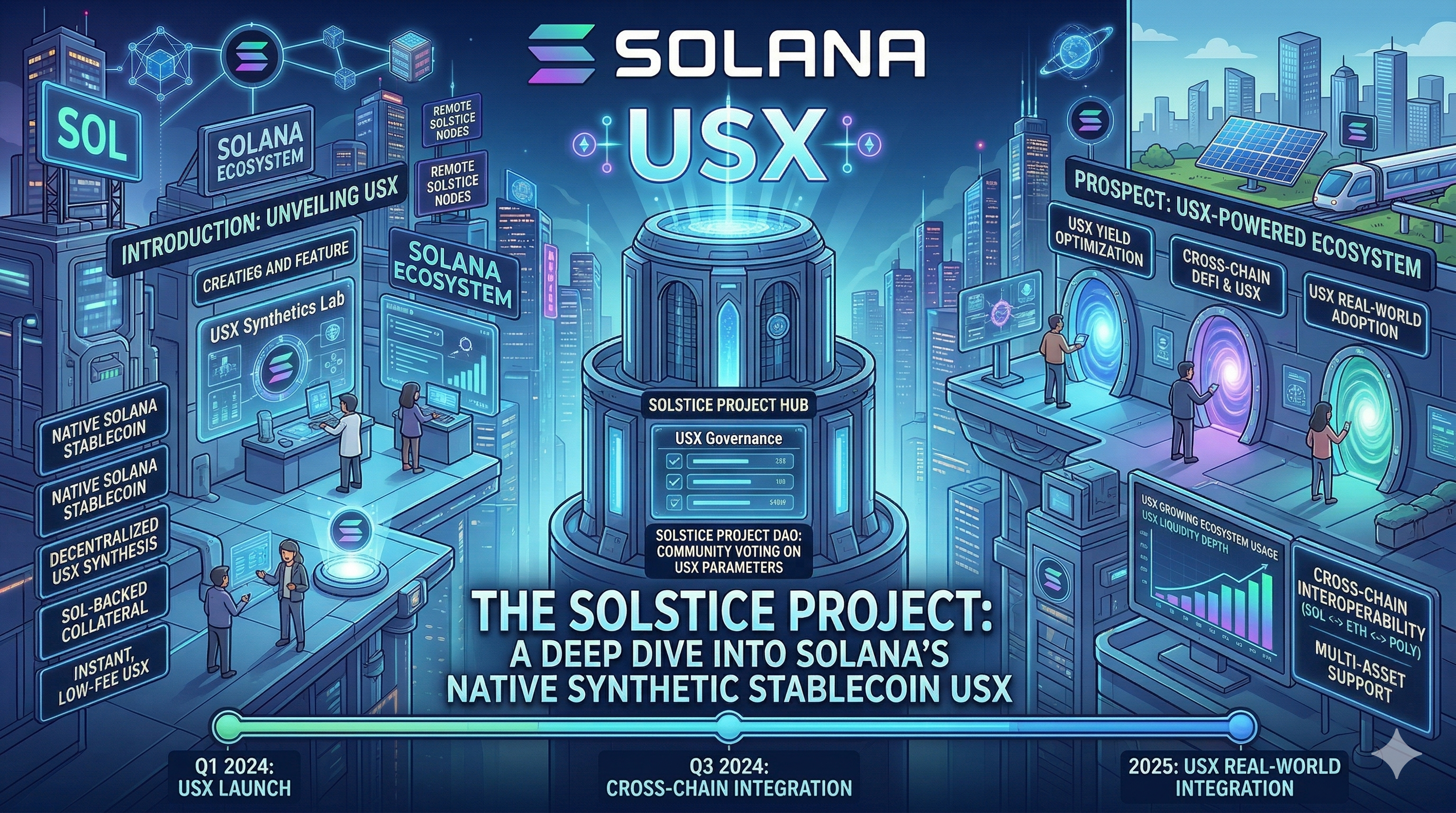
The Solstice project represents a new wave of synthetic stablecoin design on Solana, aiming to combine capital efficiency, decentralization, and scalability into a unified framework through its native asset, USX. As stablecoin innovation shifts beyond overcollateralized models, Solstice positions itself within a competitive landscape shaped by protocols such as MakerDAO and Synthetix, offering a distinct architecture that reflects the growing priorities of DeFi markets.
Here’s a clean, journalistic-style introductory definition you can place right after your title or before the thesis:
Project Definition: What Is the Solstice Protocol?
The Solstice project is a decentralized finance (DeFi) protocol built on the Solana blockchain, designed to issue and manage a native synthetic stablecoin known as USX. At its core, Solstice enables users to mint USX by locking crypto collateral into smart contracts, creating a system where a stable digital asset is generated without relying on traditional fiat reserves or centralized issuers.
This positions Solstice within a growing class of on-chain monetary systems that aim to replicate the stability of the US dollar while preserving decentralization and transparency.
Solstice Enters the Synthetic Stablecoin Race on Solana
The rise of decentralized finance has created an ongoing demand for stable assets that can operate without reliance on centralized issuers. The Solstice project emerges in this context as a protocol focused on issuing USX, a synthetic stablecoin designed specifically for the Solana ecosystem. Its arrival shows a broader shift in DeFi, where developers seek to move beyond traditional fiat-backed models toward algorithmic or collateral-backed synthetic systems.
Solana’s high throughput and low transaction costs make it a natural environment for such experimentation. With block times measured in milliseconds and fees that remain significantly lower than Ethereum during peak congestion, Solana provides the infrastructure needed for real-time financial applications. This technical advantage plays a direct role in Solstice’s design, allowing users to mint, trade, and manage USX positions efficiently.
The protocol’s positioning also highlights a growing interest in native stablecoin solutions tailored to specific ecosystems. While USDC and USDT dominate liquidity across chains, they remain centralized products. Solstice aims to introduce a decentralized alternative that aligns with the ethos of permissionless finance while maintaining stability through collateralization and system design.
Recent discussions around synthetic assets and stablecoin resilience have intensified following market events that exposed weaknesses in undercollateralized systems. Solstice enters the market with these lessons in mind, focusing on sustainability and transparency as key pillars of its architecture.
Understanding USX: The Core Synthetic Stablecoin Mechanism
USX serves as the foundational asset within the Solstice protocol. It is designed to maintain a stable value, typically pegged to the US dollar, while being fully integrated into decentralized financial infrastructure. The concept of synthetic stablecoins involves creating assets that mirror the value of real-world currencies without holding them directly.
Users mint USX by depositing collateral into the protocol. This collateral may include crypto assets native to Solana, which are locked in smart contracts. The value of the collateral must exceed the value of the minted USX, ensuring system stability through overcollateralization. This approach has been widely adopted in DeFi as a safeguard against volatility.
The mechanism behind USX draws inspiration from earlier protocols while introducing refinements aimed at improving efficiency. Collateral ratios, liquidation thresholds, and incentive structures are calibrated to maintain balance within the system. When collateral value drops below required levels, liquidation processes are triggered to protect the peg.
The design also reflects ongoing innovation in stablecoin engineering. Developers are exploring ways to reduce capital inefficiency while maintaining security, a challenge that has defined the evolution of synthetic assets.
For readers looking to explore similar models, MakerDAO’s (which is now SKY) documentation provides a useful reference for understanding collateral-backed stablecoins
Why Solana Matters for Synthetic Stablecoins
The choice of Solana as the base layer for Solstice is more than a technical decision. It reflects a broader shift in DeFi activity toward high-performance blockchains capable of supporting large-scale financial applications.
Solana’s architecture enables thousands of transactions per second, supported by its Proof of History mechanism. This scalability allows protocols like Solstice to operate with minimal latency, which is critical for liquidation systems and real-time price updates.
Transaction costs also play a decisive role. On networks with high fees, maintaining collateral positions can become expensive, especially for smaller users. Solana’s low-cost environment allows for more frequent adjustments, making the system accessible to a wider range of participants.
The ecosystem itself has grown rapidly, with platforms such as Jupiter and Raydium providing liquidity infrastructure that supports stablecoin adoption. USX can potentially integrate into these systems, expanding its utility beyond simple value storage.
This environment creates favorable conditions for experimentation. Developers can iterate quickly, deploy upgrades, and test new economic models without the constraints seen on slower networks. Solstice benefits directly from this flexibility, positioning itself within one of the fastest-growing DeFi ecosystems.
The Architecture Behind Solstice Protocol
Solstice is built around a modular architecture that separates collateral management, minting, and liquidation processes into distinct components. This design enhances both security and scalability, allowing each part of the system to evolve independently.
Smart contracts govern the core operations, ensuring that all transactions are executed according to predefined rules. These contracts handle collateral deposits, USX issuance, and liquidation triggers. By automating these processes, Solstice reduces reliance on intermediaries and increases transparency.
Oracles play a critical role in the system. They provide real-time price feeds that determine collateral value and trigger liquidations when necessary. Reliable oracle data is essential for maintaining the stability of USX, as inaccurate pricing can lead to system imbalances.
The protocol also incorporates incentive mechanisms to encourage participation. Liquidators, for example, are rewarded for maintaining system health by closing undercollateralized positions. This creates a self-sustaining ecosystem where users contribute to stability.
Architectural design remains a defining factor in the success of DeFi protocols. Projects that prioritize modularity and security tend to adapt more effectively to market changes. Solstice’s structure reflects these principles, positioning it for long-term development within the competitive stablecoin landscape.
Capital Efficiency and the Push Beyond Traditional Models
One of the central challenges in DeFi stablecoin design is capital efficiency. Overcollateralized systems require users to lock up more value than they receive, which limits scalability and reduces returns on capital.
Solstice addresses this issue by exploring mechanisms that optimize collateral usage without compromising stability. Adjustments to collateral ratios, dynamic risk parameters, and efficient liquidation processes all contribute to improved capital utilization.
This focus aligns with broader trends in DeFi, where protocols aim to balance security with usability. High collateral requirements can deter participation, especially among smaller users. Improving efficiency makes the system more attractive and competitive.
The evolution of capital efficiency has been shaped by earlier projects. Synthetix, for instance, introduced pooled collateral models that distribute risk across participants. Insights from such systems inform newer designs like Solstice.
For deeper context on synthetic asset models, check here
Comparing Solstice with MakerDAO and Synthetix
Solstice enters a market shaped by established protocols. MakerDAO pioneered decentralized stablecoins with DAI, focusing on overcollateralization and governance. Synthetix expanded the concept by enabling synthetic assets beyond stablecoins.
Solstice shares similarities with these systems but operates within a different ecosystem. Its integration with Solana allows for faster transactions and lower fees, which can enhance user experience.
Differences also emerge in design priorities. MakerDAO emphasizes governance and risk management, while Synthetix focuses on derivatives and synthetic exposure. Solstice positions itself at the intersection of these approaches, targeting stablecoin issuance with improved efficiency.
Each protocol reflects the technological environment in which it was built. Ethereum-based systems often prioritize security and composability, while Solana-based projects emphasize speed and scalability.
Understanding these distinctions helps users evaluate the potential of Solstice relative to its peers.
Liquidity Dynamics and Early Adoption Signals Around USX
Liquidity often determines whether a stablecoin evolves into a core DeFi primitive or fades into obscurity. For Solstice, early traction around USX will likely depend on how effectively it integrates into Solana’s existing liquidity layers. On-chain data from DefiLlama shows that stablecoins on Solana tend to gain momentum when paired with deep liquidity pools and strong trading incentives, especially on aggregators and AMMs. The presence of routing engines like Jupiter allows assets to tap into multiple liquidity sources, making price discovery more efficient and reducing slippage for traders.
Initial liquidity mining campaigns, if structured carefully, can accelerate adoption. Incentives tied to staking, LP participation, or borrowing activity often attract early users who bootstrap network effects. Historical patterns from Solana-based projects suggest that protocols which align incentives with long-term utility tend to retain users beyond the initial reward phase. This becomes especially important for a synthetic stablecoin, where trust and reliability are built over time through consistent performance.
Another perspective shaping liquidity dynamics is composability. USX’s ability to integrate into lending protocols, derivatives platforms, and yield strategies can significantly expand its use cases. The more contexts in which USX can be used, the more demand it generates organically. This network effect creates a feedback loop where liquidity attracts users, and users deepen liquidity, reinforcing the asset’s position within the ecosystem.
Market Sentiment, Narrative Strength, and the Road Ahead
Narrative plays a powerful role in crypto adoption, especially for advancing protocols. Solstice enters the market at a time when interest in decentralized stablecoins is resurging, driven by a desire for transparency and reduced reliance on centralized issuers. Market sentiment often shifts quickly, and projects that align with broader themes tend to gain visibility faster. USX benefits from this environment, particularly as discussions around synthetic assets and capital efficiency continue to grow.
Social platforms and on-chain analytics provide insight into how narratives form and evolve. Activity tracked through dashboards like Dune Analytics shows that spikes in user engagement often correlate with major announcements, integrations, or market events. For Solstice, maintaining momentum will likely depend on consistent development updates and visible ecosystem partnerships.
Community engagement also shapes long-term perception. Protocols that communicate clearly, publish transparent metrics, and respond to user feedback tend to build stronger trust. This trust becomes a key differentiator in a sector where many projects compete for attention.
Looking ahead, the direction of Solstice will depend on execution as much as design. Delivering a stable, efficient, and widely integrated synthetic asset could position USX as a meaningful player within Solana’s DeFi stack. The combination of technical performance, liquidity growth, and narrative strength will ultimately determine whether Solstice becomes a foundational protocol or remains a niche experiment.
Conclusion
Solstice reflects the ongoing evolution of decentralized finance, where stablecoin design continues to adapt to new technological and economic realities. By leveraging Solana’s performance and refining synthetic asset mechanisms, the project introduces a model that seeks to balance efficiency, stability, and accessibility.
Its success will depend on adoption, liquidity, and resilience under market stress. The competitive landscape remains intense, with established protocols maintaining strong positions. Even so, innovation continues to drive the sector forward, creating opportunities for new entrants.
Solstice’s approach highlights a broader shift toward ecosystem-specific financial infrastructure. As DeFi matures, such specialization may play a key role in shaping the next generation of decentralized markets.
FAQs
-
What is the Solstice project?
Solstice is a DeFi protocol on Solana that issues a synthetic stablecoin called USX, backed by crypto collateral.
-
How does USX maintain stability?
It uses overcollateralization, liquidation mechanisms, and price oracles to maintain its peg.
-
Is USX similar to USDC?
No, USDC is centralized and fiat-backed, while USX is decentralized and crypto-collateralized.
-
What makes Solstice different?
Its integration with Solana and focus on capital efficiency distinguish it from older protocols.
-
Does price action affect Solstice?
Solstice is a stablecoin pegged to dollar so it has no or less volatility.
Disclaimer
This content is for informational purposes only and does not constitute investment advice. Cryptocurrency investments carry risk. Please do your own research (DYOR).