

SemiAnalysis: AMD Meta OpenAI Warrant Deals Could Slash GPU Costs Near Zero
2026/08/04 14:48:00
Introduction
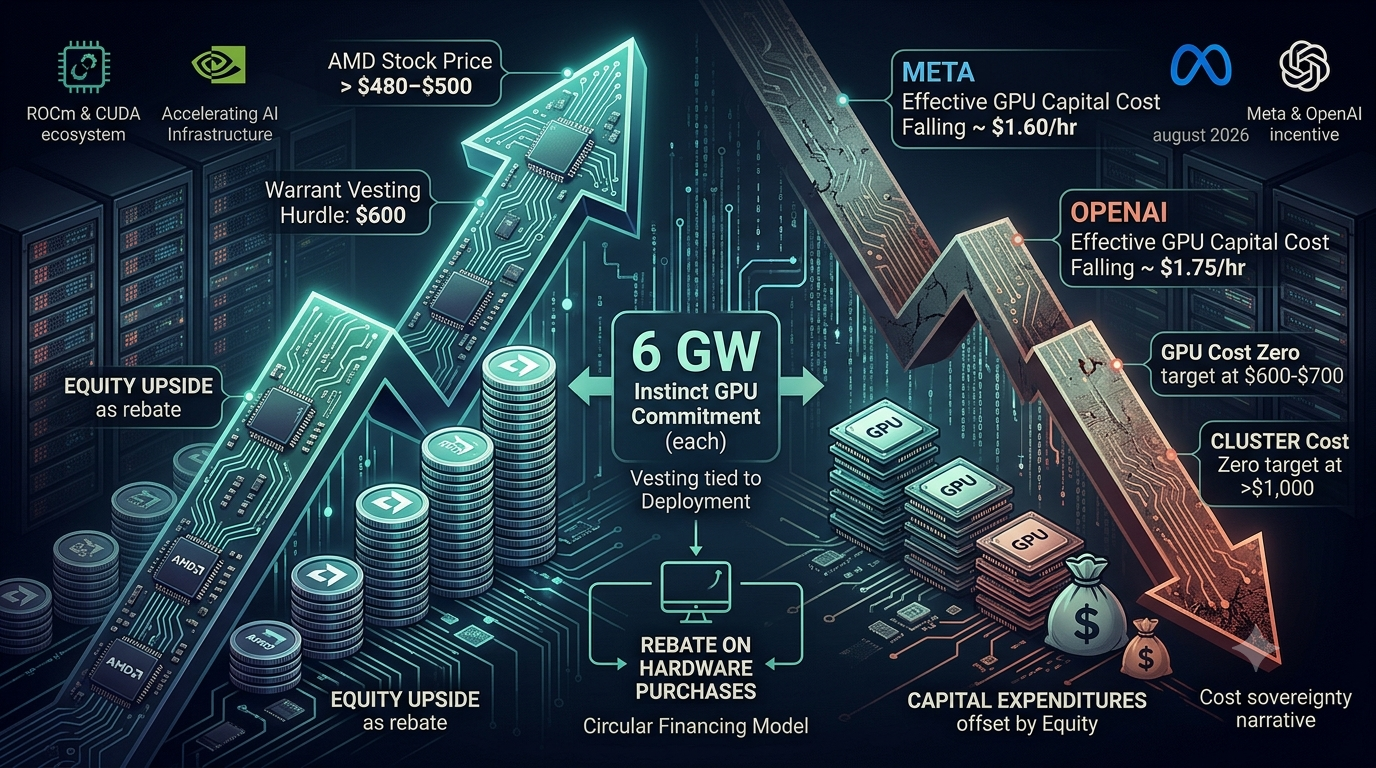
What if the capital cost of the GPUs powering the next wave of AI models approached zero for the biggest buyers? According to a detailed analysis released by SemiAnalysis in early August 2026, performance-based warrant agreements between AMD and both Meta and OpenAI are already driving that outcome. As AMD’s share price has climbed from roughly the $200 range in early 2026 into the $480–$500 zone, the effective hourly capital cost of ownership for Instinct GPUs has fallen sharply for these two customers. Further gains toward $600–$700 could erase the GPU capital cost entirely, and moves above $1,000 could neutralize the full cluster cost.
This structure effectively turns equity upside into a massive rebate on hardware purchases. It gives Meta and OpenAI a powerful economic incentive to deploy large volumes of AMD silicon while aligning AMD’s success with its customers’ cost structure. The deals cover up to 6 GW of Instinct GPU capacity each and represent one of the most aggressive financing innovations in the AI hardware market.
How Do the AMD Meta and OpenAI Warrant Agreements Work?
The warrant agreements function as performance-based equity instruments that vest only when both deployment milestones and AMD stock-price hurdles are met. AMD issued each of Meta and OpenAI warrants covering up to 160 million shares of AMD common stock at an exercise price of just $0.01 per share. Full vesting of each package requires the purchase and deployment of 6 GW of AMD Instinct GPUs. Vesting occurs in tranches tied to progressive gigawatt milestones, beginning with the initial 1 GW of MI450-series product.
Stock-price gates escalate to a final hurdle of $600 per share. Technical and commercial conditions must also be satisfied before exercise. According to AMD’s 8-K filings from October 2025 (OpenAI) and February 2026 (Meta), the first tranche becomes available after shipment of the initial 1 GW, with subsequent tranches unlocking as capacity scales. The warrants remain exercisable for roughly five years from issuance.
Because the strike price is nominal, the economic value transferred equals nearly the full market value of the shares once vested. SemiAnalysis models this value as a direct offset against the capital cost of the GPUs. The more AMD’s stock rises and the more capacity is deployed, the larger the effective rebate becomes.
AMD’s share-price appreciation has already cut the modeled capital cost of ownership for Meta and OpenAI by a meaningful margin. SemiAnalysis calculates that, assuming roughly linear vesting with respect to price level and full 6 GW deployment, Meta’s GPU capital cost has declined from approximately $2.15 per GPU-hour to about $1.60 per GPU-hour. OpenAI’s figure has moved from roughly $2.50 to $1.75 per GPU-hour.
These numbers reflect the value of the warrants as a rebate against the depreciated capital cost of the hardware. Early 2026 pricing sat near $200. By early August 2026, shares traded in the high $400s to low $500s, with recent closes around $484–$495. The upward move has therefore already unlocked a substantial portion of the intended economic benefit.
SemiAnalysis emphasizes that the analysis rests on the linear-vesting assumption and the premise that the full 6 GW will be deployed. Actual vesting schedules and exact tranche details remain partially opaque because the full commercial terms have not been publicly disclosed beyond the 8-K summaries.
Why Did AMD Structure These Deals This Way?
AMD designed the warrants to solve a classic chicken-and-egg problem in competing against Nvidia’s CUDA ecosystem. Large-scale deployments by Meta and OpenAI provide both volume revenue and real-world software optimization feedback that strengthen AMD’s Instinct and ROCm platforms. The equity upside gives the customers a direct financial stake in AMD’s success, encouraging deeper technical collaboration and larger purchase commitments.
Each 6 GW commitment is described by AMD leadership as representing tens of billions of dollars in potential revenue over multi-year periods. The first 1 GW of MI450-based systems for both customers is scheduled to begin shipping in the second half of 2026. By tying vesting to both deployment and stock-price performance, AMD ensures that dilution occurs only if the company itself creates substantial shareholder value.
Critics argue the structure transfers significant wealth from existing shareholders. At a $600 share price, 160 million shares represent roughly $96 billion in value per customer, or nearly $192 billion across both deals. Whether the accompanying revenue and market-share gains justify that transfer remains a central debate among analysts.
What Are the Broader Implications for the AI Hardware Market?
These warrant deals accelerate the shift toward circular financing models in AI infrastructure. Chipmakers increasingly provide capital or equity incentives to secure volume commitments from hyperscalers and model labs. Nvidia has used capacity backstops with neocloud providers; AMD has chosen equity warrants. Both approaches reduce the effective cost of ownership for buyers and help finance the enormous capital expenditures required for frontier AI training and inference.
For the wider market, lower effective GPU costs at Meta and OpenAI could increase competitive pressure on other cloud providers and model developers. It may also encourage AMD to pursue similar structures with additional customers if the initial deployments succeed. At the same time, the potential dilution—up to roughly 20 % of current shares outstanding if both packages fully vest—creates a long-term overhang that investors must monitor.
Software progress remains critical. Even with aggressive pricing incentives, sustained adoption depends on continued improvements in ROCm, kernel quality, and ease of migration from CUDA. SemiAnalysis has highlighted both the architectural advances in Helios/MI455X systems and remaining challenges in software maturity and production ramp.
Should You Trade AI and Semiconductor-Related Assets on KuCoin?
The AMD–Meta–OpenAI warrant structure highlights how closely hardware economics, equity markets, and AI progress are now intertwined. Investors and traders seeking exposure to the broader AI infrastructure theme can access a range of related cryptocurrency and tokenized assets on KuCoin. Platforms like KuCoin offer deep liquidity in AI-focused tokens, decentralized compute projects, and other blockchain assets that stand to benefit from falling effective compute costs and accelerating model development.
KuCoin provides advanced trading tools, competitive fees, and a wide selection of AI and infrastructure-related pairs. Whether you are looking to trade established large-cap tokens tied to AI narratives or explore emerging decentralized GPU and compute protocols, the exchange offers the products and liquidity needed to position around these structural shifts in the AI hardware market. Always conduct your own research and manage risk carefully, as crypto markets remain volatile.
Join KuCoin 9th Anniversary Trading Campaign
KuCoin is celebrating its 9th anniversary with a special platform campaign filled with exclusive rewards, trading activities, and limited-time offers. Don’t miss the chance to participate and enjoy the benefits as the exchange marks nine years of growth and innovation. Visit the official campaign page now:
Conclusion
SemiAnalysis’s August 2026 analysis shows that AMD’s performance-based warrant deals with Meta and OpenAI have already reduced modeled GPU capital costs significantly as the share price has risen from the $200 area into the high $400s and low $500s. Further appreciation toward $600–$700 could drive GPU capital costs near zero, while prices above $1,000 could offset entire cluster costs. The structure—up to 160 million shares per customer at a $0.01 exercise price, vesting on 6 GW deployments and escalating stock-price hurdles—functions as a powerful rebate mechanism that aligns incentives and accelerates AMD’s push into large-scale AI infrastructure.
These agreements illustrate the growing creativity in financing AI hardware at hyperscale. They provide Meta and OpenAI with material cost advantages while giving AMD volume visibility and software co-development partners. Success still hinges on timely delivery of MI450 and subsequent generations, continued software progress, and sustained demand. For market participants, the deals underscore both the opportunity and the dilution risk embedded in AMD’s aggressive strategy to challenge Nvidia’s dominance. Monitoring vesting progress, actual deployment rates, and share-price performance will remain essential as the first systems begin shipping later in 2026.
FAQs
What is the total potential dilution from the Meta and OpenAI warrants?
Each package covers 160 million shares, for a combined 320 million shares. At current share counts this represents potential dilution of roughly 19–20 % if both packages fully vest and are exercised.
When do the first GPUs under these deals ship?
According to AMD disclosures, the initial 1 GW of MI450-series Instinct GPUs for both Meta and OpenAI is scheduled to begin shipping in the second half of 2026.
Are the exact vesting schedules and price hurdles fully public?
The 8-K filings confirm tranche structure tied to gigawatt milestones and stock-price targets escalating to $600, but the precise intermediate price levels and commercial conditions remain only partially disclosed.
How does this compare to Nvidia’s customer financing approaches?
Nvidia has primarily used capacity backstops and other commercial arrangements with neocloud providers rather than large equity warrants of this scale. AMD’s approach is more equity-intensive and directly links customer economics to its own share-price performance.
Could other customers receive similar warrant packages?
AMD has not announced comparable deals with additional parties. Future offerings would depend on strategic importance, volume commitments, and AMD’s willingness to accept further dilution.