

Polymarket Prices Solana at 70% Odds of Hitting $110 Before October Ends
Polymarket Odds Point to a Potential Solana Rally Toward $110
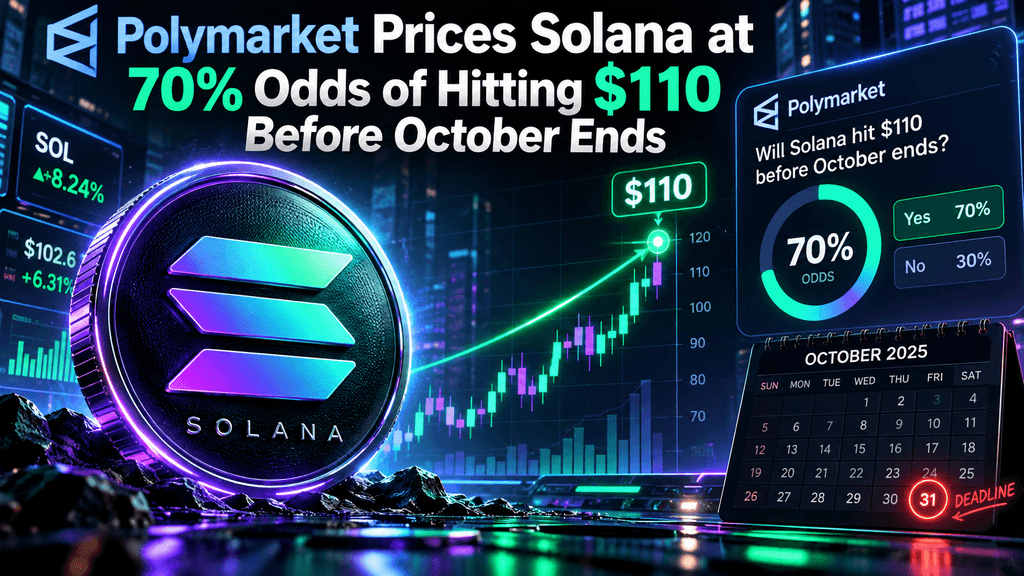
Solana price was observed trading at approximately $104 on October 19, 2026, following a period of fluctuation that saw its price range between roughly $100 and $113 earlier in the month. Participants in the prediction market on Polymarket have assigned a notable 70% probability that SOL will achieve a high of $110 or more on the Binance SOL/USDT trading pair before the conclusion of October. This represents a significant increase of 16 percentage points within just 24 hours, according to the latest monitoring data available. The same platform estimates the likelihood of a price movement to $120 at around 26%. It is important to note that these contracts resolve based on any one-minute candle high that meets or exceeds the specified level from the time of market creation until 11:59 p.m. Eastern Time on October 31.
The recent move in the market shows a combination of factors, including residual volatility stemming from the first half of October, an upcoming network upgrade that is highly anticipated, and ongoing activity from institutional investors as well as on-chain transactions. The current pricing dynamics leave limited room for error: a rally of approximately 5–6% from recent levels would be sufficient to trigger the $110 threshold, while a deeper decline toward the $100 mark remains a competing outcome in related contracts. This article will delve into the structure of the odds, the recent price movements, the technical catalysts influencing the market, the prevailing liquidity conditions, and the practical implications for market participants who are closely monitoring Solana as we approach the final days of the month.
How Polymarket’s October Solana Threshold Markets Actually Resolve
Polymarket’s “What price will Solana hit in October?" suite and the specific remaining-period contracts for $110 and $120 settle exclusively on Binance SOL/USDT one-minute candle highs. A single print at or above the strike at any point after market creation through the end of the month triggers a Yes resolution. Prices from other venues, different pairs, or spot aggregates are disregarded. This design concentrates liquidity and reduces oracle disputes, yet it also means brief liquidity spikes or exchange-specific order-flow events can decide outcomes even if broader market prices lag. Volume on the October Solana ladder has been active enough to produce meaningful probability swings, with the $110 remaining-period contract moving 16 points higher in a single day as traders adjusted to the proximity of the October 21 upgrade window.
The 70% figure does not represent a consensus forecast of a sustained close above $110; it simply prices the chance of at least one qualifying high. Related daily and weekly ladders show the $100–$110 band as the most probable near-term range, with far lower probabilities attached to sustained moves beyond $120 in the immediate sessions. Participants therefore treat the 70% contract as a volatility and catalyst bet rather than a directional endorsement of a new multi-week trend. Settlement rules further specify that pre-creation price action is ignored, so any earlier October prints above $110 do not automatically satisfy the remaining-period markets.
Solana’s Price Path Through Mid-October and the Distance to $110
SOL opened October with prints near $118–$123 before sliding through a series of lower highs and lows. By October 12, the token had tested the low $105 area, then recovered modestly only to revisit levels just above $100 on October 18. On October 19, the price traded in a roughly $100.40–$106.20 band and closed near $104.30–$104.60, depending on the data source. From that zone, a move to $110 requires approximately 5–6% appreciation, a distance Solana has covered multiple times in single sessions during 2026.
The earlier October high near $113 remains the local reference point. That print already satisfied some broader October “reach $110” contracts created at the start of the month, which is why remaining-period markets have become the active focus. Daily Polymarket ladders for October 19–25 continue to cluster probability mass between $100 and $110, with only single-digit odds for closes above $110 on most individual days. The divergence between the monthly threshold probability and the daily range probabilities illustrates how traders separate the chance of a short-lived spike from the chance of sustained higher prices.
Alpenglow Upgrade Timing and Its Potential Influence on Short-Term Volatility
Solana’s Alpenglow consensus upgrade is scheduled for activation around October 21 at approximately 15:00 UTC, corresponding to the start of epoch 1064. The change replaces the existing TowerBFT voting mechanism with Votor, an off-chain certificate system intended to reduce finality from roughly 12.8 seconds to about 150 milliseconds. Validators have been directed to run Agave-based clients meeting specific stake and fee requirements. Successful activation would mark the largest core consensus rewrite in Solana’s history and could improve perceived network reliability for latency-sensitive applications.
Market participants have historically priced major Solana upgrades with elevated short-term volatility. The proximity of the activation date to the October 31 deadline creates a compressed window in which any positive technical reaction or increased trading activity could push the one-minute high through $110. Conversely, any implementation friction or temporary throughput disruption could reinforce the $100 support area already priced at elevated odds in related dip contracts. The upgrade therefore functions as the clearest near-term catalyst capable of resolving the 70% contract in either direction within the remaining twelve days.
On-Chain Activity Metrics Supporting Residual Upside Interest
Solana continued to post strong fundamental activity even as the token price consolidated. Stablecoin supply on the network has hovered near record levels above $16–17 billion, with Circle continuing large USDC mints. Tokenized real-world asset value has expanded more than sixfold over the preceding twelve months to approximately $4.3–4.4 billion. Application revenue figures for the third quarter reached roughly $299 million according to Blockworks data, while certain trading venues recorded weekly volumes exceeding $840 million. These metrics indicate that demand for blockspace and settlement remains intact.
Fidelity’s Center for Applied Technology recently noted two years without major mainnet outages and high validator vote success rates. Such operational consistency reduces one historical source of discount applied to Solana valuations. When combined with the pending finality improvement, the activity data helps explain why prediction-market participants have been willing to lift the $110 remaining-period probability rather than allow it to drift lower alongside the soft price action of mid-October.
ETF Flow Trends and Corporate Treasury Activity as Counterweights
U.S. spot Solana ETF products recorded net outflows of approximately $25–26 million in recent weekly periods, ending a multi-week inflow streak. Combined assets under management remain in the $1.6–1.7 billion range, yet the direction of flows has turned cautious. Separately, SkyAI (formerly Sharps Technology) liquidated its entire Solana treasury of more than two million SOL, converting the position into cash ahead of a planned buyback. The sale added measurable supply into the market at a time when price was already testing support.
These developments do not negate the on-chain growth story, but they introduce tangible near-term selling pressure that prediction-market traders must weigh against the upgrade catalyst. The 70% odds on $110 therefore incorporate both the potential for a technical bounce and the risk that ETF redemptions and treasury distribution keep the price range-bound below the strike. Related contracts pricing a dip to $100 continue to attract meaningful volume, underscoring the two-sided nature of the current setup.
Liquidity Conditions and the Role of Binance as Sole Resolution Source
Because Polymarket resolves exclusively on Binance one-minute highs, order-book depth and temporary liquidity imbalances on that single venue can determine outcomes. Solana’s 24-hour trading volume has remained in the $2–3 billion range across aggregated markets, providing ample capacity for large tickets, yet concentrated flow on Binance during low-liquidity hours can still produce isolated spikes. Traders monitoring the $110 contract therefore watch both the broader market structure and the specific depth available on the resolution exchange.
The same concentration that simplifies settlement also amplifies the impact of any sudden demand surge linked to the Alpenglow activation or positive external news. Historical precedent shows that Solana can travel 5–8% in either direction within a few hours when network or macro catalysts align. With only twelve days remaining after October 19, the probability distribution remains sensitive to relatively modest absolute price moves.
Comparative Positioning Against Broader Crypto Market Levels
Bitcoin and Ethereum have both been observed trading within consolidation ranges throughout the same October timeframe, with Polymarket daily ladders indicating a modest upside bias for both cryptocurrencies. Solana, known for its higher beta, has historically demonstrated a tendency to amplify both gains and losses in comparison to the two larger assets, Bitcoin and Ethereum. The current probability of 70% associated with the $110 strike price incorporates an assumption that any positive movement in Bitcoin or a successful reaction to an upgrade could potentially transmit to SOL with enough momentum to overcome the nearby resistance levels.
Simultaneously, it is important to note that Solana’s performance year-to-date remains significantly negative when measured against the all-time high reached in January 2025, which was approximately in the range of $293 to $295. The considerable distance from that peak continues to influence the longer-dated prediction markets, where the probabilities of revisiting the price range of $140 to $160 by the end of the year remain well below 30% in most market snapshots. Consequently, the October $110 contract is positioned distinctly within a short-term bucket, rather than serving as a reliable proxy for a comprehensive recovery narrative that encompasses the broader market context.
Technical Levels Framing the Path to $110
Latest daily charts indicate that the first significant resistance level is positioned in the range of $106 to $108, while a more substantial supply zone can be found around the $110 to $113 area, which effectively capped the bounce observed in early October. Support levels have been tested multiple times within the $100 to $102 range, demonstrating a critical area for price stability. If the price can sustain a reclaim of the $106 to $108 band, it would bring the $110 strike price into immediate focus for the remaining-period contracts. Conversely, a failure to maintain the $100 level would likely favor the competing dip markets, which are still priced with a non-trivial probability of occurrence.
Volatility readings have notably moderated from the extremes that were observed in previous months; However, realized price movements in the range of 3 to 5 percent continue to be quite common. The combination of a compressed timeline leading up to the month-end and a scheduled network event creates a unique set of conditions. These conditions may lead to technical breakouts or breakdowns that can resolve binary prediction contracts more swiftly than what is typically seen during quieter market periods.
Market-Implied Distribution Beyond the $110 Strike
While the probability of the $110 remaining-period contract currently stands at a notable 70%, the $120 contract is trading at a significantly lower probability of approximately 26%. For higher strike prices such as $130 and above, the odds are even less favorable, often falling into the single-digit percentages or low-teens range within the active October ladders. This particular distribution of probabilities suggests that traders are assigning a meaningful chance for a brief movement through the $110 level, yet they do not anticipate a sustained advance into the $120s before the end of the month.
The skew in these probabilities aligns more closely with a scenario driven by a catalyst that could lead to a sudden spike, rather than a scenario that extends an existing trend. The daily range markets further reinforce this same message: the $100 to $110 price band captures the majority of the probability mass for the upcoming trading sessions. As a result, participants who are seeking pure directional exposure are faced with a critical choice. They must decide between the higher-probability option of the $110 contract, which offers a lower payout, and the lower-probability alternatives that come with higher strike prices. This decision-making process is essential for traders looking to navigate the current market space effectively.
Practical Considerations for Participants Tracking the Contracts
Anyone who is currently holding or contemplating the acquisition of the remaining-period $110 Yes shares must diligently monitor both the Alpenglow activation timeline and the specific order flow associated with Binance. This is crucial because the resolution of the contract is contingent upon the one-minute high from a single trading venue, meaning that even a brief print can be sufficient to trigger a resolution. On the other hand, those who hold No shares stand to benefit from any failure of the upgrade to generate immediate buying interest, or they may gain from the ongoing supply related to ETFs and treasury securities. It is vital for traders to consider their position sizing in relation to the short remaining calendar, especially given the binary nature of the potential payoff.
In terms of liquidity, the Polymarket contracts themselves have shown to be adequate for the volume that has been observed thus far. However, it is important to note that spreads can widen significantly during periods when there is quick adjustment of probabilities. Traders who are adjusting their positions in response to the substantial 16-point overnight move have already illustrated the market’s ability to reprice swiftly when new information becomes available. This highlights the dynamic nature of the market and the importance of staying informed and responsive to changes.
Broader Context of Prediction Markets in Crypto Price Discovery
Polymarket and similar platforms have emerged as significant indicators for short-term outcomes in the cryptocurrency market, frequently reacting more swiftly than traditional analyst targets or the implied volatilities derived from options trading. The current reading of 70% regarding Solana’s $110 threshold provides a clear and transparent view, continuously updated, of a collective aggregation of capital-weighted opinions rather than relying on a singular forecast point. The true value of this mechanism lies in the real-money discipline that is enforced upon participants, along with the clearly defined settlement rules that effectively eliminate many forms of ambiguity that can often cloud decision-making.
As we approach the closing of the October window, the contract in question will ultimately resolve to a Yes if there is a strong catalyst-driven print that supports this outcome, or it will resolve to a No if the price remains constrained and capped below the $110 mark. Each of these potential outcomes will provide valuable insights into how market participants have evaluated a significant network upgrade in relation to the ongoing flow headwinds that are present, all within a compressed timeframe that adds urgency to the situation. This dynamic interaction between market forces and participant sentiment is crucial for understanding the broader implications for Solana and the cryptocurrency landscape as a whole.
🔥 Beyond the Headlines: What KuCoin 5.0 Means for You
Market news moves fast — but where you act on it matters just as much. This October, KuCoin launches KuCoin 5.0, transforming KuCoin into a rebuilt platform. Here's what actually changes for you:
-
One account for everything. Older platforms split your money across separate "spot," "margin," and "futures" accounts and expected you to understand why. KuCoin 5.0's unified account removes that entirely — deposit once, and everything is simply there (only available to VIPs for now).
-
Stocks, indices, and commodities. KuCoin 5.0 expands beyond crypto into global markets. When crypto chops sideways and equities rally (or the reverse), you rotate in minutes instead of opening a brokerage account and waiting days for fiat rails.
-
Real-world assets (RWA). Tokenized exposure to traditional assets like commodities, right inside your crypto account. One of the fastest-growing segments in global finance is no longer reserved for institutions — you access it from the same balance you trade with.
-
Earn while you learn. Not ready to trade? KCUSD lets your stablecoins earn daily, auto-compounding interest. The lowest-stress way to put your idle deposit to work for 4% yield.
-
An AI assistant in plain language. Ask questions, get market context, understand what you're looking at — built into the platform, no jargon required.
-
An app that doesn't overwhelm. Faster, cleaner, and consistent — intuitive from the first tap, not after a tutorial.
-
Safety you can check, not just trust. A MiCAR-licensed EU entity, Proof of Reserves you can verify yourself, and internationally certified security (SOC 2 Type II, ISO 27001:2022).
Create your account in minutes — and start on the platform built for where crypto is going, not where it's been.
FAQs
What exactly does the 70% probability on Polymarket represent for Solana reaching $110?
The figure is the market price of Yes shares on the specific remaining-period contract, expressed as a percentage. It reflects the collective willingness of traders to buy or sell those shares at that level given the information available on October 19. It is not a statistical guarantee or a research-house forecast.
How is the contract resolved if Solana briefly touches $110 on Binance?
Resolution occurs immediately upon any one-minute candle high equal to or greater than $110 after the market’s creation and before 11:59 p.m. Eastern on October 31. The high does not need to be sustained or confirmed by other exchanges.
Does the Alpenglow upgrade have a direct mechanical effect on the Solana price?
No. The upgrade improves consensus finality and may enhance user experience and institutional confidence, but price impact depends on how traders and capital respond to the successful (or unsuccessful) activation.
Why are there separate contracts for reaching $110 and dipping to $100?
Prediction markets allow independent pricing of upside and downside thresholds. The two outcomes are not mutually exclusive within a volatile month; both can theoretically trigger if the price range expands sufficiently.
Have earlier October highs already resolved some of the October markets?
Yes. Prints near $113 earlier in the month satisfied certain broader “reach $110 in October” contracts created at the start of the period. Remaining-period markets focus only on post-creation action.
Disclaimer: This content is for informational purposes only and does not constitute investment advice. Cryptocurrency investments carry risk. Please do your own research (DYOR).