

Is “ETH Is Money” Still a Strong Bullish Narrative for Ethereum Price?
2026/05/29 17:34:00
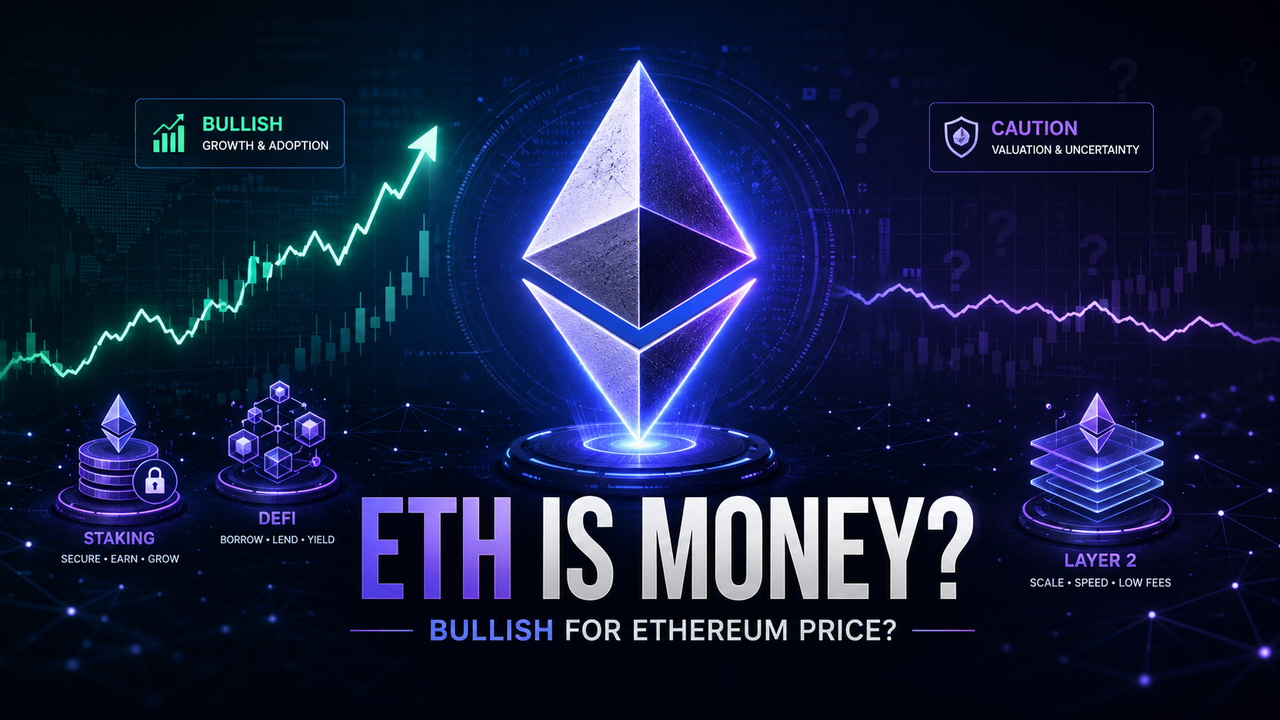
Ethereum has grown into a cornerstone of the blockchain ecosystem, pioneering smart contracts, decentralized applications (dApps), and decentralized finance (DeFi). Unlike Bitcoin, which was created as digital gold with a single purpose acting as a decentralized store of value Ethereum set out to be a programmable platform, capable of supporting complex financial infrastructure on-chain.
Over the years, a narrative emerged among investors and enthusiasts: “ETH is money.” This thesis suggested that Ethereum’s native token, ETH, could evolve beyond its utility role to become a monetary asset, store of value, and central collateral within the growing decentralized economy.
This narrative gained attention because it linked Ethereum’s technological success directly to ETH price appreciation. If Ethereum became the foundation for DeFi, Layer 2 networks, and tokenized real-world assets, ETH itself could see substantial demand and scarcity.
However, in 2026, this narrative has faced scrutiny. Leading voices, like David Hoffman, co-founder of Bankless, argue that the “ETH is money” thesis has largely played out, raising the question: Can this story still drive ETH’s price upward, or is Ethereum’s success decoupled from ETH as an asset?
Understanding the “ETH Is Money” Thesis
The “ETH is money” thesis is based on the idea that Ether is more than just a token used to pay transaction fees on Ethereum. Supporters of this narrative believe ETH has several monetary qualities because it plays a central role in Ethereum’s economy. It is used to pay gas fees, secure the network, support decentralized finance, and settle activity across different parts of the ecosystem.
Unlike many crypto tokens that are mainly connected to a single application or project, ETH is tied to one of the largest smart contract networks in the blockchain industry. For readers new to the topic, this KuCoin guide explains what Ethereum is and how ETH works. Ethereum supports decentralized exchanges, lending platforms, NFT marketplaces, stablecoins, Layer 2 networks, and tokenized asset experiments. Because so much activity has been built around Ethereum, many investors have viewed ETH as the core asset of the network.
The “ETH is money” narrative became popular because it tried to explain why ETH could have long-term value beyond short-term speculation. In this view, ETH is not only useful for transactions. It can also act as a store of value, a staking asset, a form of collateral, and a settlement asset for the broader on-chain economy.
ETH serves several major functions within Ethereum:
-
Gas: ETH is used to pay transaction fees when users send tokens, trade on decentralized exchanges, mint NFTs, interact with DeFi protocols, or execute smart contracts. This gives ETH direct utility because users need it to access the Ethereum network.
-
Collateral: ETH is widely used in decentralized finance. Users can deposit ETH into lending platforms, borrow against it, provide liquidity, or use it in more complex financial strategies. This gives ETH an important role in DeFi markets.
-
Staking asset: After Ethereum moved to proof-of-stake, ETH became the asset used to secure the network. Validators lock ETH to help verify transactions and maintain network security. In return, they can earn staking rewards.
-
Settlement asset: Ethereum acts as a settlement layer for many applications, Layer 2 networks, stablecoins, and tokenized assets. ETH supports this system by remaining the native asset of the base layer.
This combination of utility, security, and ecosystem importance is what made the “ETH is money” thesis attractive. Supporters argued that if Ethereum continued to grow, demand for ETH could also increase. However, critics now question whether Ethereum’s growth always translates directly into ETH price growth.
Ethereum Staking and Scarcity
Ethereum’s transition to proof-of-stake (the Merge) in 2022 changed ETH’s economic role:
-
Staking reduces circulating supply: ETH locked in staking or liquid staking services is temporarily unavailable, limiting short-term supply.
-
Encourages long-term holding: Stakers earn rewards, reducing the likelihood of selling during market fluctuations.
-
Secures the network: Validators’ staked ETH can be penalized if rules are violated, linking ETH ownership directly to Ethereum’s security.
-
Supply control via EIP-1559: A portion of transaction fees is burned, reducing supply during periods of high activity.
ETH is more than a gas token; it has staking yield, scarcity mechanics, and security utility. However, its deflationary effect depends on network activity and fee levels.
Layer 2 Integration
Layer 2 blockchains help Ethereum scale and support the “ETH is money” thesis:
-
Lower fees and faster transactions: L2s reduce congestion, attracting more users and activity.
-
ETH remains central: Many L2s settle proofs back to Ethereum, keeping the base layer relevant.
-
Supports modular ecosystem growth: Ethereum acts as a secure foundation while L2s handle execution at scale.
If most value accrues to L2s or applications, ETH may not capture all economic benefits, making the price impact less direct.
Why “ETH Is Money” Became a Bullish Price Narrative
The “ETH is money” thesis became a powerful narrative because it connected Ethereum’s network growth directly to ETH price potential. Unlike many other tokens, ETH is central to a large and evolving ecosystem, giving it both utility and investment appeal. Several factors contributed to why investors viewed this thesis as bullish:
1. Network Dominance
Ethereum quickly became the leading platform for decentralized applications, including DeFi, NFTs, and tokenized assets. ETH is required for nearly every interaction on the network:
-
Paying gas fees for transactions or smart contract execution.
-
Facilitating trades, lending, and borrowing on decentralized exchanges.
-
Powering NFT minting and marketplaces.
This dominance made ETH the core asset of a growing digital economy. Investors believed that as Ethereum adoption expanded, ETH demand would increase, reinforcing a bullish price outlook.
2. Staking Rewards
After Ethereum transitioned to proof-of-stake, ETH staking introduced a yield-bearing component for holders:
-
Users can lock ETH as validators to help secure the network.
-
Stakers earn rewards, incentivizing long-term holding.
-
Reduced circulating supply from staking creates scarcity, which can support price appreciation.
The staking mechanism gave ETH an additional economic role: it was no longer just a medium of exchange but also a productive asset that rewarded holders while strengthening network security.
3. Fee Burns
EIP-1559 introduced a burn mechanism where a portion of transaction fees is permanently removed from circulation:
-
During high network activity, more ETH is burned, reducing effective supply.
-
Burned ETH creates deflationary pressure, especially during periods of strong adoption or market demand.
-
The combination of staking and burning reinforced ETH’s scarcity narrative.
Investors saw this as a mechanism that could support ETH price over the long term, especially as Ethereum activity increased.
4. Layer 2 Adoption
Scaling solutions, known as Layer 2 networks, further strengthened the ETH narrative:
-
Layer 2s increase throughput, reduce gas fees, and allow Ethereum to support more users and applications.
-
ETH remains the settlement asset for most Layer 2 solutions, keeping it central to the ecosystem.
-
Growing adoption of Layer 2s enhances Ethereum’s network effects, potentially increasing ETH demand indirectly.
Layer 2 adoption allowed Ethereum to expand without overloading the base layer, making ETH more valuable as the foundation of a large, multi-layer ecosystem.
5. Institutional Potential
As Ethereum matured, it became a platform for tokenized assets, stablecoins, and enterprise blockchain solutions:
-
Institutions could use ETH for settlement or as collateral for on-chain products.
-
Growing interest from banks, funds, and fintech companies could increase ETH demand.
-
ETH’s role as both a settlement and staking asset made it attractive for long-term institutional holdings.
Investors saw institutional adoption as a long-term bullish factor, signaling that Ethereum could capture value beyond retail users.
Combined Effect on ETH Price
Taken together, these factors created a compelling story for ETH holders:
-
Ethereum’s network growth drives activity and adoption.
-
Staking incentives encourage long-term holding and reduce supply.
-
Fee burns introduce deflationary pressure during periods of high usage.
-
Layer 2 expansion increases Ethereum’s scalability and utility.
-
Institutional engagement creates new sources of demand and credibility.
This combination of network utility, economic incentives, and scarcity mechanics made the “ETH is money” thesis one of the most influential bullish narratives in the cryptocurrency market. Investors believed that as Ethereum’s ecosystem expanded, ETH would naturally see sustained price appreciation over time.
Historical Price Performance and Adoption
Looking at Ethereum’s price history provides insight into how the narrative influenced markets:
-
2017-2018 ICO Boom: ETH surged from ~$8 to over $1,400 at the height of the ICO craze, when many projects required ETH for smart contract deployment.
-
2020-2021 DeFi Summer: ETH climbed from ~$100 to ~$4,000, correlating with massive DeFi adoption and increased staking interest.
-
Post-Merge 2022-2023: Ethereum’s transition to proof-of-stake further strengthened the scarcity narrative, driving renewed investor interest.
These periods suggest that ETH’s price often responded to both utility and narrative sentiment, reinforcing the perception of ETH as a “monetary” asset within the ecosystem.
David Hoffman’s Critique: A Turning Point
In May 2026, David Hoffman published a post arguing that “ETH is money was always a longshot.” His main points include:
-
Ethereum as a giver, not a taker: While Ethereum creates value across Layer 2s, DeFi, and tokenized applications, much of this value doesn’t flow back to ETH holders.
-
Narrative largely priced in: Markets have already accounted for Ethereum’s potential, reducing future price upside from the “ETH is money” story.
-
Personal investment decision: Hoffman sold his ETH, citing that the narrative has played out, although he remains bullish on Ethereum’s infrastructure and network growth.
This argument introduces a nuanced perspective: Ethereum’s ecosystem can thrive without ETH necessarily seeing massive price gains.
Beyond “ETH Is Money”: New Price Drivers
Investors now consider multiple factors beyond the original narrative:
Institutional Adoption
Ethereum is increasingly used for tokenized assets, stablecoins, and enterprise blockchain solutions. Institutional engagement could create new demand for ETH, particularly for staking and collateral use.
Layer 2 Networks and Scaling
Scaling solutions improve transaction throughput, expand Ethereum’s utility, and potentially strengthen demand for ETH in settlement layers.
DeFi Growth
ETH remains central to decentralized exchanges, lending protocols, liquid staking derivatives, and stablecoin collateral. Increased DeFi activity can indirectly support ETH price.
Macro Crypto Trends
ETH price is influenced by broader cryptocurrency market cycles, Bitcoin performance, liquidity conditions, and investor sentiment. These external factors can amplify or dampen ETH’s value regardless of its “money” narrative.
Alternative Narratives for ETH
As the “ETH is money” thesis faces criticism, several alternative narratives are emerging:
-
Smart Digital Gold: ETH as a productive alternative to Bitcoin, offering staking yield while serving as a long-term store of value.
-
DeFi Infrastructure Token: ETH as the core collateral and medium for the decentralized financial system.
-
Tokenized Real-World Asset Settlement Layer: ETH powering settlement and collateral for tokenized real-world assets, bridging traditional finance with blockchain.
These narratives focus on ETH’s utility and ecosystem role, rather than a single monetary function.
Potential Scenarios for Ethereum Price
1. Bullish Scenario: ETH Demand Strengthens
In a bullish scenario, Ethereum price could benefit from stronger Layer 2 adoption, rising DeFi activity, and growing institutional interest. If more users and applications rely on Ethereum, demand for ETH may increase. At the same time, staking lockups and fee burns could reduce available supply, supporting the “ETH is money” narrative as part of a broader bullish case.
2. Neutral Scenario: Ethereum Grows, but ETH Gains Slowly
In a neutral scenario, Ethereum may continue expanding as a major blockchain network, but ETH may not capture all of that value directly. Layer 2 networks, DeFi apps, and other ecosystem projects could benefit more from Ethereum’s growth. ETH price may still rise gradually, but the upside could remain limited if value capture stays weak.
3. Bearish Scenario: ETH Value Capture Weakens
In a bearish scenario, ETH price could struggle if investors believe Ethereum’s growth does not strongly benefit the token. If most activity shifts to Layer 2 networks or competing blockchains, the “ETH is money” narrative may lose influence. Weak market sentiment, low transaction fees, or regulatory pressure could also reduce demand for ETH.
Conclusion
The “ETH is money” thesis remains an important narrative in Ethereum’s story, highlighting ETH’s central role in DeFi, staking, Layer 2, and settlement. However, it is no longer a standalone bullish argument for ETH price.
Ethereum’s network continues to grow and innovate, but the extent to which ETH itself benefits depends on value capture, institutional adoption, staking dynamics, and macro conditions. Investors should consider a multi-faceted approach, incorporating alternative narratives like ETH as a productive digital asset, DeFi infrastructure, or tokenized settlement layer.
Ethereum’s success is evident, but ETH’s price trajectory will increasingly depend on how well the token captures value from the broader ecosystem, not just the “ETH is money” story.
FAQs
What does “ETH is money” mean?
“ETH is money” means Ether is viewed as a store of value, staking asset, DeFi collateral, and settlement token in the Ethereum ecosystem.
Is “ETH is money” bullish for Ethereum price?
It can support the Ethereum price narrative, but ETH price also depends on staking, Layer 2 adoption, DeFi activity, and market sentiment.
Why is ETH important to Ethereum?
ETH is used for gas fees, staking rewards, smart contracts, DeFi, NFTs, and settlement across the Ethereum network.
How does staking affect ETH price?
Ethereum staking can reduce circulating supply and encourage long-term holding, which may support ETH price if demand remains strong.
How do ETH fee burns work?
Ethereum’s EIP-1559 burns part of transaction fees. Higher network activity can burn more ETH and support the ETH scarcity narrative.
Do Layer 2 networks help ETH?
Layer 2 networks help Ethereum scale with lower fees and faster transactions. They may support ETH demand, but value capture can vary.
What drives Ethereum price?
Ethereum price is driven by ETH demand, DeFi growth, Layer 2 adoption, staking, fee burns, institutional interest, and broader crypto market trends.
Disclaimer
The information provided on this page may originate from third-party sources and does not necessarily represent the views or opinions of KuCoin. This content is intended solely for general informational purposes and should not be considered financial, investment, or professional advice. KuCoin does not guarantee the accuracy, completeness, or reliability of the information, and is not responsible for any errors, omissions, or outcomes resulting from its use. Investing in digital assets carries inherent risks. Please carefully evaluate your risk tolerance and financial situation before making any investment decisions. For further details, please consult KuCoin’s Terms of Use and Risk Disclosure.