

Google Earnings Beat Expectations But Stock Falls After Hours: Why the AI Arms Race Is Raising Concerns
2026/07/23 10:56:00
Introduction
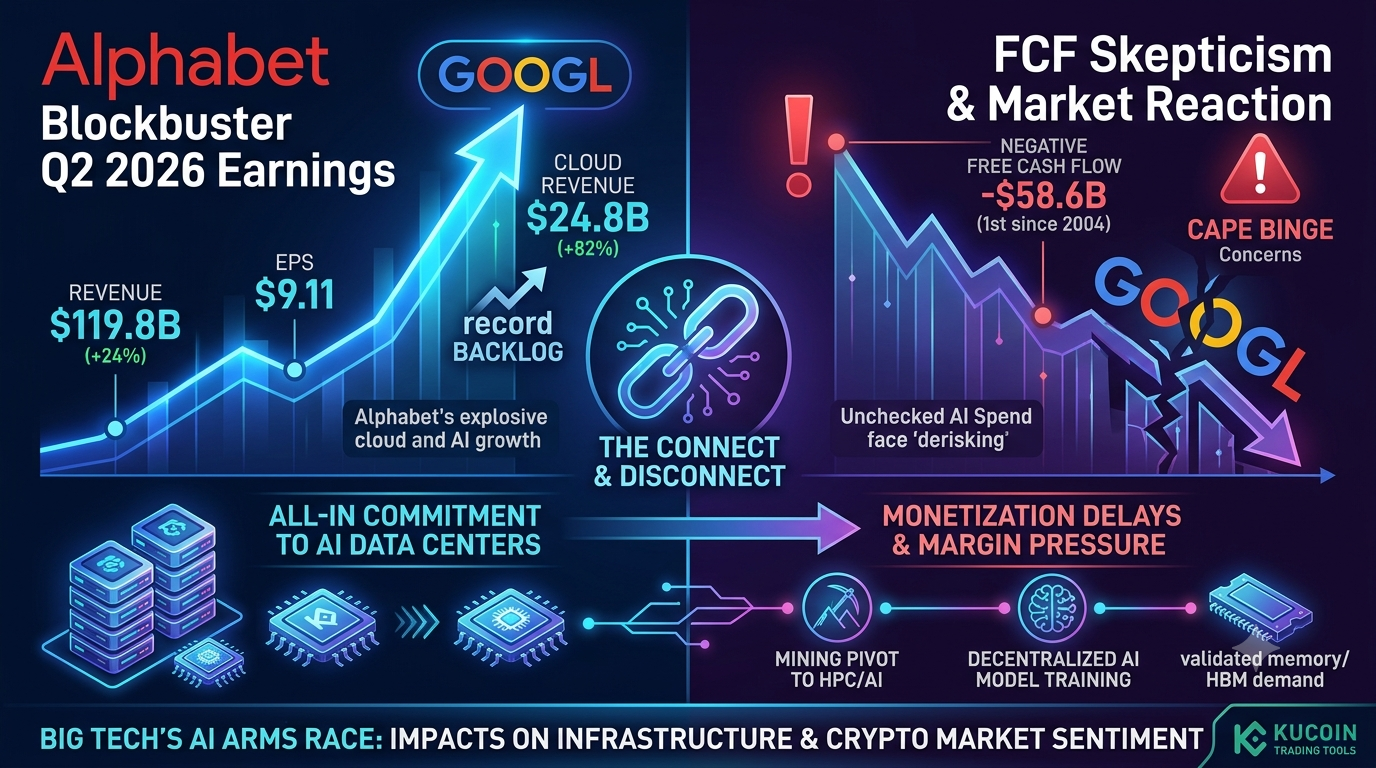
Google parent Alphabet delivered a blockbuster Q2 2026 earnings report on July 22, 2026, smashing revenue and EPS estimates while showing explosive growth in its cloud business. Yet shares fell roughly 2-4% in after-hours trading. This disconnect highlights growing investor skepticism toward unchecked AI capital expenditure amid a broader market “de-risking” of mega-cap tech spending.
The report underscores that Big Tech continues to pour billions into AI infrastructure. This has direct implications for cryptocurrency and blockchain sectors, where energy-intensive computing, data centers, and decentralized AI models intersect with traditional tech spending.
Why Google’s Q2 Results Were Stronger Than Expected
Alphabet reported Q2 revenue of $119.8 billion, up 24% year-over-year and beating consensus estimates of around $117 billion. EPS came in at $9.11, far above expectations, though much of the headline profit stemmed from unrealized gains on equity investments (primarily SpaceX and Anthropic stakes totaling nearly $98-99 billion).
Operating income rose 30% to approximately $408 billion, with margins expanding. The standout performer was Google Cloud, which surged 82% to $24.8 billion, crushing forecasts of $22.4-22.5 billion. Cloud backlog hit a record $514 billion, signaling strong enterprise demand for AI tools like Gemini.
These numbers confirm that AI is no longer just hype — it is driving real revenue acceleration, particularly in cloud services that power generative AI workloads.
The Red Flag: First Negative Free Cash Flow Since 2004
Despite the beats, Alphabet posted negative free cash flow of -$58.6 billion for the quarter — its first since going public in 2004. Analysts had expected only a modest negative figure around -$2.3 billion. Capital expenditures doubled to $44.9 billion, and the company raised full-year 2026 capex guidance to $195-205 billion.
This cash burn reflects an all-in commitment to AI data centers, custom chips, and compute capacity. Similar moves by peers (OpenAI planning $30 billion data centers, SpaceX expansions) create an AI arms race dynamic. Markets cheered such spending months ago but now question sustainability as returns lag and costs inflate.
Why the Stock Dropped Despite the Beat
Investors focused on cash flow and future spending rather than headline numbers. The negative FCF highlighted that aggressive AI bets are pressuring near-term liquidity, even as core advertising and cloud grow. Search ad revenue grew 17% but slightly missed estimates, adding to concerns about funding the capex binge.
Broader market sentiment has shifted. Unrestrained spending no longer guarantees valuation expansion. Concerns over 2027 earnings deceleration, potential dilution from equity raises, and competition in AI models (with some Gemini delays) weighed on sentiment. Shares closed the regular session down modestly before extending losses after hours.
Impact on Memory Chip and AI Infrastructure Stocks
Google’s results provided relief to “picks and shovels” players. SK Hynix, Micron, and Western Digital (including Sandisk) rose 1.5-3% or more in after-hours trading. High-bandwidth memory (HBM) demand for AI servers remains tight, with prices expected to rise further.
This validates ongoing AI infrastructure buildout, benefiting suppliers even as hyperscalers face margin pressure.
How Google’s AI Push Affects Cryptocurrency Markets
The AI infrastructure boom has ripple effects on crypto. Massive data center demand drives electricity consumption, supporting Bitcoin mining profitability in regions with surplus power. Crypto miners increasingly pivot to high-performance computing (HPC) for AI workloads, creating hybrid revenue streams.
Blockchain projects exploring decentralized AI (training models on distributed networks) could benefit from or compete with centralized hyperscaler spending. Tokenized compute resources or AI-related DeFi protocols may see volatility tied to Big Tech capex cycles.
Bitcoin and Ethereum often react to risk sentiment in tech. While Google’s beat reinforces growth narrative, FCF concerns and spending fatigue can trigger short-term crypto selloffs if broader tech rotation accelerates. KuCoin traders monitor these correlations closely for BTC, ETH, and AI-themed tokens.
Market Risks in the AI Arms Race
Surging capex risks creating a feedback loop: higher demand for chips, power, and construction materials inflates costs, requiring even more spending. Memory shortages and power constraints could delay returns on investment.
Misconception: All AI spending immediately translates to profits. Reality: Commercialization (e.g., Gemini adoption at 950 million MAUs) is accelerating, but payback periods for data centers span years. Investors now demand clearer paths to monetization.
How to Trade AI and Crypto-Related Assets on KuCoin?
KuCoin offers deep liquidity and diverse listings for traders seeking exposure to AI infrastructure and crypto intersections. With spot, futures, and margin trading, users can position around volatility from tech earnings.
-
If you worry about the recent volatility, you may resort to KuCoin's copytrading hub or TraderPro campaign, to follow other lead traders' strategies, or register as the lead traders.

Conclusion
Alphabet’s Q2 2026 earnings delivered strong revenue growth of 24% to $119.8 billion and exceptional cloud performance, reinforcing AI’s commercial momentum. However, negative free cash flow of -$58.6 billion and elevated capex guidance triggered after-hours selling, reflecting investor caution toward the escalating AI arms race.
This dynamic benefits memory suppliers and underscores long-term AI infrastructure demand, with spillover effects into cryptocurrency via energy use and compute innovation. For crypto traders on KuCoin, such events highlight the need to monitor tech spending as a leading indicator for market sentiment and sector rotations.
The AI transformation is real and accelerating, yet markets now price in execution risks more skeptically. Balanced exposure across traditional tech winners, infrastructure plays, and blockchain assets remains key in this evolving landscape. Stay informed, trade responsibly, and position for both growth and volatility ahead.
FAQs
1. Did Google’s Q2 2026 EPS really beat estimates significantly?
Yes. Reported EPS was $9.11 versus expectations around $2.9, though adjusted operating EPS was closer to $2.85 after removing one-time investment gains.
2. What caused Alphabet’s first negative free cash flow in over 20 years?
Record capital expenditures of $44.9 billion for AI data centers and infrastructure outpaced operating cash generation in the quarter.
3. How did Google Cloud perform relative to competitors?
It grew 82% year-over-year to $24.8 billion, outpacing growth rates reported by Microsoft Azure and Amazon AWS in recent periods.