

Ethereum Foundation Unveils First Hegota EIP Tier List and 2029 Quantum-Resistant L1 Target
Introduction
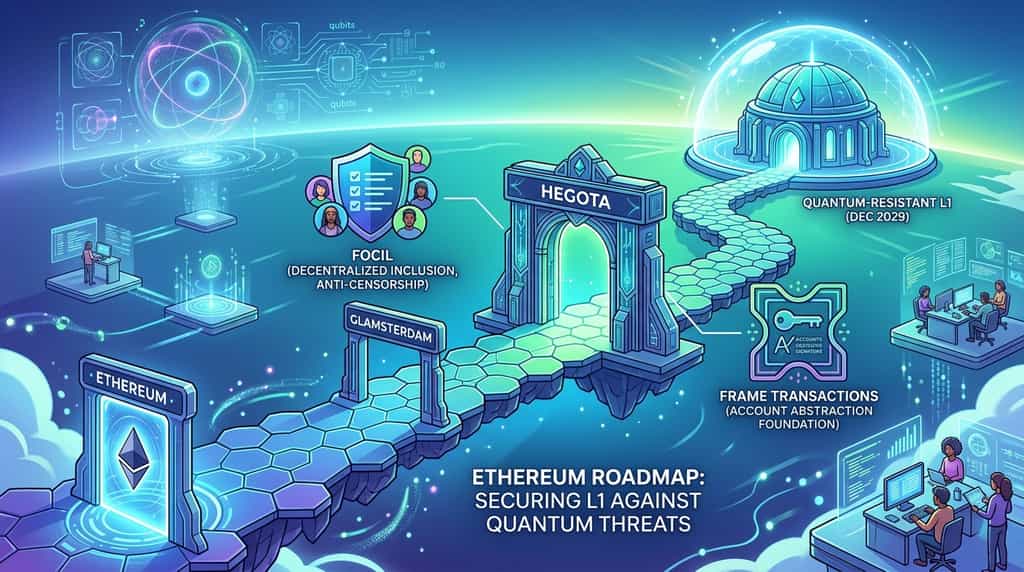
Can a public blockchain stay useful if tomorrow’s computers break today’s cryptography? On September 7, 2026, the Ethereum Foundation Protocol Cluster answered that question with a deadline: Ethereum Layer 1 should be quantum-resistant across execution, consensus, and data by December 2029, according to official posts on the Ethereum Foundation Blog. The same day, the cluster published its first unified Hegota EIP tier list, grading all 62 proposals for the upgrade that follows Glamsterdam.
About 60 researchers, engineers, and domain experts across nine Protocol Cluster teams submitted 397 grades before debating contested items live. Two proposals sit in S-tier as must-ship headliners: EIP-7805 (FOCIL) and EIP-8141 (Frame Transactions). Fifteen more are A-tier and expected to ship. Hegota is not the post-quantum fork. It is the fork that decides whether later quantum-resistant hard forks stay on schedule.
What Is the Hegota EIP Tier List and Why Did the Ethereum Foundation Publish It?
The Hegota EIP tier list is the Protocol Cluster’s first single ranking of every candidate for one network upgrade, rather than separate opinions from each team. According to the Ethereum Foundation Blog post dated September 7, 2026, twelve contribution templates produced grades and several experts graded only EIPs in their specialty, averaging 6.4 grades per proposal.
S means must ship and defines the fork. If an S item slips, the schedule moves before the scope shrinks. A means high priority and expected to ship unless delivery reality forces a cut. B items enter one at a time after S- and A-tier work is stable on devnets. C items sit below the line but are not disqualified. DFI means declined for inclusion, each with a stated reason. Two proposals stayed unranked until mainnet data answers open questions.
The cluster applied lessons from Glamsterdam retrospectives: size an EIP by integration depth, treat testing surface as scarce, and do not let champions underestimate complexity. The published grade is a steelman arrived at after a 90-minute working session, not a raw average. Geth may still publish its own execution-layer list, but that feedback already sits inside the cluster document.
Which EIPs Did Ethereum Rank as Must-Ship for Hegota?
EIP-7805 and EIP-8141 are the only S-tier items and the locked-in headliners for Hegota. FOCIL is the consensus-layer centerpiece. Frame Transactions is the execution-layer centerpiece. The cluster says they must ship together so inclusion lists and the new transaction model can be tested as one engineering lift.
FOCIL, or Fork-choice enforced Inclusion Lists, gives any user a path to include an eligible transaction without relying on centralized block builders. Validators impose inclusion constraints that attesters treat as part of block validity. The official tier note calls FOCIL a unanimous S at full participation and says it should ship with EIP-8369, which defines FOCIL eligibility and validator checks for Frame transactions.
Frame Transactions introduce native account abstraction at the protocol layer. Users can define verification, execution, and gas payment without a hard fork for every new signature scheme. That property is the execution-layer on-ramp to post-quantum signatures, aggregation that can price heavier verification, and a path to retire secp256k1 keys. The official note says Frames should ship with EIP-8250 (Keyed Nonces) and EIP-8272 (Recent Roots).
Keyed nonces let many users share one sender for better anonymity while keeping separate nonces so transactions do not block each other. Recent roots let private transactions use recent onchain state in a form attesters can verify, so those transactions can still benefit from FOCIL. Together, the S-tier pair advances censorship resistance and cryptographic agility without turning Hegota into a full post-quantum migration.
How Did the Protocol Cluster Grade the Remaining 60 Hegota EIPs?
Fifteen proposals received A-tier status and are expected to ship unless testing forces cuts. On the consensus layer, A-tier items include EIP-8369 (VOPS Profiles for FOCIL Eligibility), EIP-8015 (Remove Deposit and eth1data Fields), EIP-8365 (BLS Withdrawal Credential Retirement), EIP-8383 (Reduce CL Block Retention Window), EIP-8334 (Bundled Attestation Propagation), and EIP-8025 (Optional Execution Proofs).
EIP-8365 is the one post-quantum item the cluster says belongs in Hegota. It starts retiring withdrawal credentials tied to vulnerable cryptography now, with no downstream dependency on waiting. EIP-8025 pulls stateless-execution work into canonical specs so zkVM research stops living on divergent branches.
On the execution layer, A-tier items include EIP-3298 (Removal of Refunds), EIP-8250, EIP-5920 (PAY Opcode), EIP-8272, EIP-8279 (Block Access List Byte Floor), and EIP-8131 (Unified Transaction Content Floor). Removal of Refunds deletes metering edge cases that previous forks paid for in complexity. The PAY opcode lets value move without invoking recipient code. The two floor EIPs bound worst-case block construction and calldata pricing.
Eight proposals sit in B-tier and will be considered individually after S- and A-tier devnets are stable. Examples include Block Access List Sidecars, Independent CL/EL Sync, Quick Slots, and Hash-Chain RANDAO. Most B-tier items need a prototype, a settled specification, and an explicit sign-off. Quick Slots drew research support but engineering concern about the retuning cascade behind any slot-time change.
Seven proposals landed in C-tier as first candidates for reconsideration if earlier tiers ship cleanly. Twenty-eight were declined. Issuance and reward-policy items such as EIP-8363 (Tapered Issuance Burn) and EIP-8375 (ePBS Mandatory Burn of Execution Rewards) were rejected as questions for a broader ecosystem process, not a fork scoping exercise. EIP-8142 (Block-in-Blobs) was declined because it deepens dependence on KZG structures against the later J* path. Several staking convenience proposals failed the necessity bar.
Why Is Ethereum Targeting a Quantum-Resistant L1 by December 2029?
The Protocol Cluster’s north star is quantum resistance across execution, consensus, and data by December 2029, according to the companion Ethereum Foundation Blog post published September 7, 2026. That date lines up with 2029 migration targets independently set by Google, Cloudflare, and Microsoft. The cluster is planning for Q-day as early as 2030 and calls that a deliberately aggressive assumption.
Most credible estimates place a cryptographically relevant quantum computer later, and some place it much later. The cluster still set a self-imposed deadline because Q-day cannot be scheduled. Shipping readiness early is framed as the secure and strategically responsible choice, and as a signal that Ethereum intends to last decades. The deadline stays non-negotiable at least until January 2027, when quantum progress will be reassessed with outside experts.
No quantum computer can break Ethereum cryptography today. Preparation still takes years because four surfaces need upgrades: validator consensus signatures (BLS), data-availability commitments (KZG), account signatures (ECDSA), and the ZK-proof systems used by rollups.
Google Quantum AI research published in March 2026 estimated that breaking 256-bit elliptic curve cryptography could require roughly 1,200 logical qubits, about 20 times fewer than earlier estimates. That revised hardware picture is one reason protocol teams refuse to treat post-quantum work as distant research.
Beyond the Headlines: What KuCoin 5.0 Means for You
Market news moves fast — but where you act on it matters just as much. This October, KuCoin launches KuCoin 5.0, transforming KuCoin into a rebuilt platform. Here's what actually changes for you:
-
One account for everything. Older platforms split your money across separate "spot," "margin," and "futures" accounts and expected you to understand why. KuCoin 5.0's unified account removes that entirely — deposit once, and everything is simply there.
-
Stocks, indices, and commodities. KuCoin 5.0 expands beyond crypto into global markets. When crypto chops sideways and equities rally (or the reverse), you rotate in minutes instead of opening a brokerage account and waiting days for fiat rails.
-
Real-world assets (RWA). Tokenized exposure to traditional assets like commodities, right inside your crypto account. One of the fastest-growing segments in global finance is no longer reserved for institutions — you access it from the same balance you trade with.
-
Earn while you learn. Not ready to trade? KCUSD lets your stablecoins earn daily, auto-compounding interest. The lowest-stress way to put your idle deposit to work for 4% yield.
-
An AI assistant in plain language. Ask questions, get market context, understand what you're looking at — built into the platform, no jargon required.
-
An app that doesn't overwhelm. Faster, cleaner, and consistent — intuitive from the first tap, not after a tutorial.
-
Safety you can check, not just trust. A MiCAR-licensed EU entity, Proof of Reserves you can verify yourself, and internationally certified security (SOC 2 Type II, ISO 27001:2022).
Create your account in minutes — and start on the platform built for where crypto is going, not where it's been.
Conclusion
The Ethereum Foundation Protocol Cluster used September 7, 2026, to do two things at once: publish a single Hegota EIP ranking and lock a December 2029 target for quantum-resistant Layer 1. Sixty experts across nine teams graded 62 proposals and produced 397 scores. FOCIL and Frame Transactions are the must-ship headliners. Fifteen A-tier items are expected to follow. Twenty-eight proposals were declined so the fork stays small enough for later post-quantum work to stay on time.
Hegota is the scheduling test, not the cryptography finish line. Glamsterdam still comes first. Client implementation for Hegota can begin in late Q4 2026. Full resistance across execution, consensus, and data is planned for December 2029, with a minimum viable post-quantum safeguard earlier if the cadence slips. The date matches migration targets at Google, Cloudflare, and Microsoft and will be reviewed in January 2027.
For users and traders, the immediate change is clarity. Ethereum now has a public priority ladder, a named pair of Hegota headliners, and a multi-fork sequence that treats quantum readiness as delivery work rather than a research footnote. ETH holders can follow AllCoreDevs, the September 16 Reddit AMA, and client devnets while using regulated venues such as KuCoin to buy, hold, or hedge ETH as that roadmap executes.
FAQs
When is Hegota expected to go live on Ethereum mainnet?
Hegota follows Glamsterdam and is targeted for 2027, with client implementation expected to begin in late Q4 2026 after Glamsterdam mainnet data is available.
Can quantum computers steal ETH today?
No. No quantum computer operating today can break Ethereum’s current cryptography. The December 2029 target is preparation for a future machine, not a response to an existing break.
Does Hegota itself make Ethereum quantum-resistant?
No. Hegota ships the inclusion-list and account-abstraction foundations that later forks need. Full quantum resistance across execution, consensus, and data is scheduled for later forks through December 2029.
Why were issuance EIPs such as EIP-8363 declined?
The Protocol Cluster said issuance and reward policy belong to a broader ecosystem process, not a single-fork scoping exercise, and graded those proposals DFI for that structural reason.
Where can the community ask questions about the tier list?
The Protocol Cluster is hosting a Reddit AMA on r/ethereum on September 16, 2026, at 14:00 UTC, and accepted written questions in advance through an Ethereum Foundation form.
Disclaimer: This article is for informational purposes only and does not constitute financial, legal, or investment advice. Always conduct your own research before interacting with digital assets.