

BTC ETF, Stocks, Cryptocurrencies: Which is Best for You?
2026/05/23 16:57:03
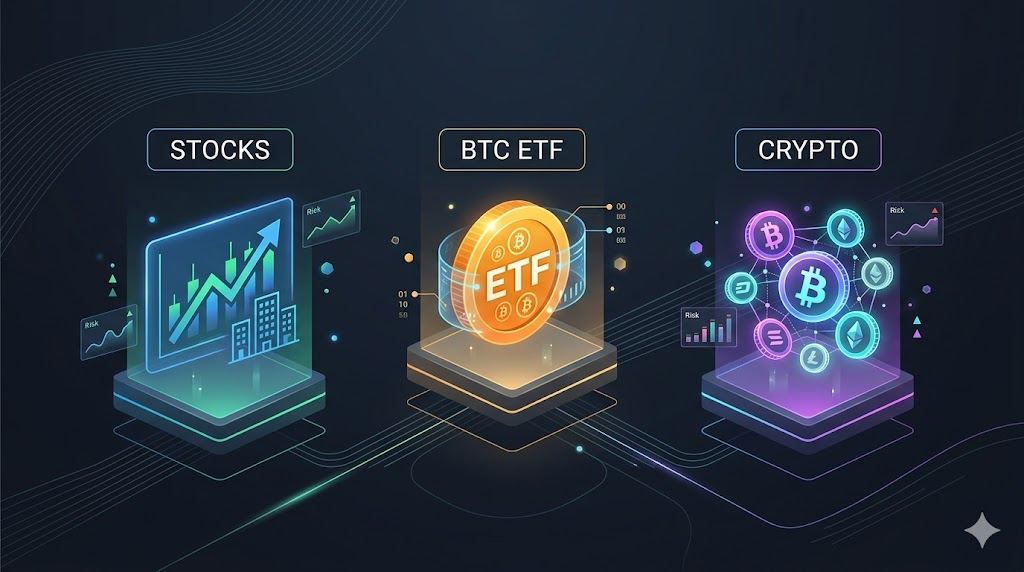
The best asset class for you depends entirely on your specific risk tolerance and operational goals. Spot Bitcoin ETFs suit conservative investors wanting highly regulated exposure. Direct cryptocurrencies perfectly fit those seeking absolute financial control and high-growth potential. Traditional stocks remain the absolute ideal vehicle for long-term, earnings-backed wealth preservation.
Spot Bitcoin ETFs: Regulated investment vehicles trading on traditional stock exchanges holding actual BTC.
Direct crypto ownership: Holding digital assets personally in a secure cryptographic wallet.
Traditional stock equities: Buying fractional ownership shares in publicly traded global corporations.
Understanding the Spot Bitcoin ETF Landscape
Institutional Capital Inflows and Market Growth
Spot Bitcoin ETFs witnessed massive institutional adoption throughout early 2026. According to SoSoValue data from April 2026, US spot Bitcoin ETFs recorded $1.97 billion in net inflows, the highest monthly total of the year. This aggressive surge brought total cumulative net inflows since launch to over $58 billion. Institutional managers clearly prefer the structured, regulated environment that exchange-traded funds consistently provide.
BlackRock’s iShares Bitcoin Trust drove the vast majority of these recent financial gains. In April 2026 alone, this specific fund attracted approximately $2 billion in net new capital. This massive concentration of capital definitively indicates that traditional investors rely heavily on established financial brands. Large-scale wealth managers are aggressively allocating client portfolios into digital assets exclusively through these familiar corporate vehicles.
Despite strong overall market inflows, some older funds experienced significant capital flight. Grayscale's GBTC recorded approximately $280 million in net outflows during April 2026. Investors systematically migrated their capital toward newer competing funds offering substantially lower management fees. This competitive fee war demonstrates precisely how traditional market forces rapidly optimize investment products for retail consumers.
Regulatory Safety and Institutional Custody
Regulatory oversight provides the primary structural advantage of investing in spot ETFs. Investors utilizing these funds completely bypass the severe technical complexities of managing cryptographic private keys. Regulated institutional trust banks handle all underlying digital asset custody within highly secure offline storage facilities. This strict separation of custody entirely protects retail capital from devastating individual operational errors.
Seamless integration into legacy brokerage accounts heavily simplifies personal wealth management. By purchasing Bitcoin through an ETF, you instantly consolidate your digital asset exposure alongside your traditional retirement accounts. This centralized reporting structure completely eliminates the severe tax complications associated with tracking thousands of decentralized blockchain transactions. Wealth managers highly recommend this path for individuals prioritizing administrative simplicity.
Operational Limitations and Management Fees
Trading hour restrictions represent a massive operational disadvantage for traditional ETF investors. These legacy products strictly adhere to standard stock market operating hours and observe all regional banking holidays. Consequently, fund holders cannot react to sudden weekend cryptocurrency market crashes or major Sunday macroeconomic news events. This forced illiquidity creates dangerous weekend pricing gaps that harm reactive traders.
Annual management fees permanently erode your long-term compounding potential. Every exchange-traded fund deducts a recurring percentage from your total invested capital to cover administrative and custodial overhead. While competitive pressure has lowered these baseline fees, they still represent a guaranteed systemic drag on your growing portfolio. Direct asset holders completely avoid these recurring institutional financial deductions.
Furthermore, ETF certificates definitively prohibit investors from generating secondary decentralized yields. Because you merely own a corporate claim rather than the raw digital commodity, you cannot participate in lucrative staking networks or liquidity pools. This limitation forces traditional investors to rely solely on asset price appreciation, entirely missing out on the programmatic yields available within decentralized finance.
Direct Cryptocurrencies: Ownership and High Volatility
Global Adoption and Expanding Market Capitalization
The direct cryptocurrency market now constitutes a full-fledged global financial infrastructure. Based on Fibo Crypto reports from March 2026, the total cryptocurrency market capitalization sits at approximately $2.5 trillion. Furthermore, the worldwide base of active crypto holders now exceeds 560 million people. This massive global adoption metric proves that digital assets have permanently transitioned from niche experiments into mainstream financial networks.
Direct asset ownership provides absolute sovereignty over your personal digital wealth. By utilizing non-custodial hardware wallets, individuals act as their own financial institutions without any centralized oversight. No government agency, commercial bank, or corporate entity can freeze your account or reverse your blockchain transactions. This censorship resistance remains the fundamental technological breakthrough of decentralized peer-to-peer networks.
Stablecoins now process a massive percentage of total global financial volume. By Q1 2026, the combined stablecoin market capitalization exceeded $210 billion, processing trillions in annual transaction volume. Direct cryptocurrency investors frequently utilize these dollar-pegged assets to seamlessly preserve capital during periods of extreme market volatility. This immense utility entirely bypasses the traditional, slow-moving legacy banking system.
Continuous Liquidity and Unrestricted Access
Cryptocurrency markets operate continuously without ever experiencing trading halts or holiday closures. This 24/7 liquidity environment allows sophisticated participants to execute high-frequency algorithmic trading strategies seamlessly around the clock. Investors can instantly react to breaking global news, adjusting their portfolio allocations exactly when market-moving events occur. Traditional equity markets simply cannot match this permanent global accessibility.
Cross-border capital transfers execute instantaneously across decentralized blockchain networks. Direct digital asset holders can transmit millions of dollars in value internationally for fractions of a penny in network fees. This frictionless global movement of capital completely eliminates the multi-day settlement delays inherent in legacy banking wires. International businesses increasingly leverage this exact speed to optimize their global treasury operations.
Smart Contract Platforms and Yield Generation
Smart contract platforms provide additional dimensions for highly aggressive capital growth. By interacting directly with decentralized applications, investors can participate in advanced lending protocols and earn high-yield interest on their digital deposits. This programmability transforms static digital tokens into productive, yield-bearing financial assets. Traditional stock ETFs completely block traditional investors from accessing these lucrative on-chain revenue streams.
Technical Risks and Heightened Volatility
Direct cryptocurrency exposure carries extreme tail-risk and severe short-term price volatility. Decentralized platforms do not utilize the mandatory regulatory circuit breakers found in traditional legacy equity markets. During periods of intense macroeconomic panic, digital asset prices can experience devastating double-digit percentage drops within a single afternoon. Investors must possess exceptional psychological resilience to survive these brutal cyclical drawdowns.
Operational security rests entirely on the shoulders of the individual digital asset holder. Losing your cryptographic seed phrase or falling victim to sophisticated phishing campaigns results in the permanent, irreversible loss of your capital. Unlike traditional centralized banks, blockchain networks offer absolutely no fraud protection or customer service recovery protocols. This unforgiving technical reality permanently deters many conservative institutional investors.
Traditional Stocks: Corporate Backing and Stability
Fundamental Valuation and Tangible Earnings
Traditional equities provide a fundamentally secure investment backed by real-world corporate cash flows. When you purchase a stock, you literally acquire a fractional ownership stake in a functioning enterprise generating physical goods or services. Analysts can accurately calculate an asset's intrinsic value utilizing standardized metrics like price-to-earnings ratios. This tangible financial foundation fundamentally separates stocks from purely speculative digital commodities.
Corporate dividend payouts offer a highly reliable mechanism for passive income generation. Established multinational companies consistently distribute a portion of their quarterly operating profits directly to their loyal shareholders. This predictable cash flow helps offset broader market volatility and heavily accelerates long-term portfolio compounding through automatic reinvestment programs. Cryptocurrencies simply do not offer this type of traditional earnings distribution.
Fractional Divisibility and Accessibility
Fractional shares have entirely democratized access to premium corporate equities for retail investors. Modern brokerage platforms allow users to purchase tiny partial stock certificates of massive technology conglomerates regardless of the underlying share price. This critical innovation enables perfectly balanced portfolio diversification even for individuals deploying minimal starting capital. Cryptocurrency markets have always offered this precise fractional divisibility by default.
Regulatory Protection and Circuit Breakers
Centralized equity markets utilize mandatory circuit breakers to prevent catastrophic systemic panics. If major indices drop by specific predetermined percentages, the exchange automatically halts all trading activity temporarily. This critical pause allows market participants to rationally digest breaking news and entirely prevents emotion-driven cascade liquidations. These vital safeguards drastically reduce the probability of an instantaneous total market collapse.
Rigorous corporate disclosure laws heavily protect traditional retail equity investors. Publicly traded companies must submit highly detailed, heavily audited quarterly financial reports to government regulatory bodies. This strictly mandated transparency severely limits instances of corporate fraud and hidden balance sheet liabilities. Decentralized crypto projects frequently lack this essential layer of standardized, protective institutional oversight.
Zero Commission Compounding and Efficiency
Modern stock brokerages offer incredible capital efficiency through zero-commission trading models. Retail investors can seamlessly accumulate long-term equity positions without paying any upfront transactional friction. This heavily optimized fee environment makes traditional stocks the absolute best vehicle for consistent, multi-decade dollar-cost averaging strategies. Every single deployed dollar goes directly toward acquiring productive corporate financial assets.
Stock portfolios also offer superior protection against sustained fiat currency inflation. As macroeconomic inflation rises, major public corporations successfully pass increased operating costs onto consumers through much higher retail prices. This organic pricing power ensures that corporate profit margins—and consequently, stock prices—continue to rise alongside inflation. Equities remain the premier historical hedge for long-term purchasing power preservation.
Comparative Analysis of Asset Profiles
Understanding the precise structural differences between these distinct investment vehicles is absolutely essential for proper capital allocation. Investors must meticulously weigh custody methods, market operating hours, and baseline financial volatility.
Structural and Operational Mechanics
| Asset Category | Market Operating Hours | Custody Framework | Regulatory Status |
| Spot Bitcoin ETFs | Fixed (Standard Stock Exchange) | Institutional Trust Banks | Highly Regulated (SEC/Global) |
| Direct Cryptocurrencies | Continuous (24/7/365) | Self-Custody (Private Keys) | Varied by Region |
| Traditional Stocks | Fixed (Standard Stock Exchange) | Centralized Brokerages | Highly Regulated |
Evaluating the underlying financial friction and yield opportunities further clarifies the absolute best path for your deployed capital.
Financial Friction and Yield Opportunities
| Asset Category | Ongoing Management Fees | Baseline Market Volatility | Native Yield Generation |
| Spot Bitcoin ETFs | Annual Expense Ratios | High | None (Price Appreciation Only) |
| Direct Cryptocurrencies | Zero Holding Fees | Extreme | High (DeFi Staking/Lending) |
| Traditional Stocks | Zero Holding Fees | Moderate | Dividends and Buybacks |
Blending Asset Classes for Portfolio Optimization
The Hybrid Allocation Strategy
Modern wealth managers strongly advocate for a hybrid portfolio blending traditional stability with exponential digital growth. Allocating eighty percent of your capital to broad market equity indices ensures steady, highly reliable baseline compounding over decades. Placing the remaining twenty percent directly into cryptocurrencies or spot ETFs injects massive asymmetric upside potential into your overall portfolio. This specific balance maximizes risk-adjusted returns perfectly.
Rebalancing your portfolio during extreme market cycles efficiently locks in generated wealth. When a massive cryptocurrency bull market causes your digital allocation to exceed its target percentage, you systematically sell the excess profit. You then immediately deploy those realized financial gains back into stable, dividend-paying traditional stocks. This mathematical rebalancing strategy forces you to buy low and sell high automatically.
Macroeconomic Correlations and Diversification
Cryptocurrencies and traditional stocks occasionally exhibit strong positive correlations during major global liquidity crunches. When central banks aggressively raise baseline interest rates, institutional investors rapidly liquidate both tech stocks and digital assets simultaneously. However, during periods of loose monetary policy, Bitcoin frequently decouples and significantly outperforms traditional equity benchmarks. Understanding these continuously shifting macroeconomic correlations is absolutely vital for proper risk management.
Holding direct assets serves as an ultimate structural hedge against systemic banking failures. While traditional stocks rely entirely on the operational health of legacy financial infrastructure, direct cryptocurrencies operate on entirely independent decentralized networks. If localized banking crises freeze standard brokerage accounts, your self-custodied digital assets remain fully accessible and liquid globally. This unique property provides truly unmatched financial security.
Strategic Tax Optimization
Tax optimization plays a critical role in successfully managing a diversified hybrid financial portfolio. Selling direct cryptocurrencies triggers immediate capital gains events, requiring meticulous daily accounting and complex transaction tracking. By holding standard corporate stocks within tax-advantaged retirement accounts, investors effectively shield a massive portion of their wealth from heavy taxation. Balancing these distinct taxable events strategically preserves your overall long-term portfolio value.
Conclusion
Choosing between spot Bitcoin ETFs, direct cryptocurrencies, and traditional stocks requires a highly careful assessment of your personal risk tolerance. Spot Bitcoin ETFs serve as the absolute perfect bridge for conservative investors demanding institutional custody and heavily simplified tax reporting. Direct cryptocurrencies unlock unparalleled financial sovereignty, continuous global liquidity, and highly lucrative decentralized yields for technologically proficient market operators. Traditional stocks solidly remain the fundamental bedrock of wealth creation, offering tangible corporate earnings, reliable dividends, and extremely robust regulatory protections.
The most highly successful investors rarely restrict themselves to a single isolated financial asset class. Implementing a highly calculated hybrid strategy successfully blends the extreme asymmetric upside of digital assets with the remarkably reliable compounding of traditional corporate equities. By utilizing highly secure trading platforms to expertly manage your direct crypto exposure while strictly maintaining core stock positions, you effectively insulate your portfolio against cyclical macroeconomic volatility. Master the unique structural mechanics of each distinct financial vehicle to build a truly resilient, globally diversified investment portfolio.
FAQs
Are Spot Bitcoin ETFs safer than buying direct Bitcoin?
Spot ETFs entirely eliminate the severe operational risk of losing your private cryptographic keys or seed phrases. Institutional custodians safely secure the underlying digital assets in heavily guarded offline vaults, effectively preventing individual user error or malicious phishing theft. However, they consistently carry the exact same underlying market price volatility risk as holding the raw digital asset directly.
Can I transfer my ETF shares into my personal crypto wallet?
No, you absolutely cannot transfer exchange-traded fund shares directly onto a decentralized blockchain network. These specific financial instruments are strictly regulated corporate securities that must permanently remain within the traditional legacy brokerage ecosystem. To actively utilize digital assets in decentralized finance, you must purchase the actual cryptocurrency on a dedicated digital asset exchange.
Do cryptocurrency markets ever close for trading?
Cryptocurrency networks operate continuously twenty-four hours a day, every single day of the entire calendar year. Unlike traditional corporate stock markets, they never observe weekend closures, regional public holidays, or mandatory regulatory trading halts. This permanent accessibility definitively allows you to react instantly to sudden macroeconomic developments at any given time.
Why do Spot ETFs charge an annual management fee?
Fund issuers strictly charge ongoing expense ratios to adequately cover the massive operational costs of institutional asset custody, regulatory compliance, and daily fund administration. These recurring baseline percentage fees are automatically deducted directly from the net asset value of the exchange-traded fund. Holding direct cryptocurrency entirely avoids these highly persistent corporate administrative costs.
Are cryptocurrencies highly correlated to the traditional stock market?
Cryptocurrencies frequently show a highly positive correlation with technology-heavy stock indices during severe global macroeconomic liquidity crunches. When central interest rates rise rapidly, nervous investors tend to aggressively sell off all risk-on assets simultaneously. However, during highly expansive monetary environments, digital assets often decouple entirely and successfully establish their own highly independent, exponential growth cycles.
Disclaimer:This content is for informational purposes only and does not constitute investment advice. Cryptocurrency investments carry risk. Please do your own research (DYOR).