

The South Korean Digital Asset Landscape: The BOK's Push for Circuit Breakers
2026/04/15 16:30:02
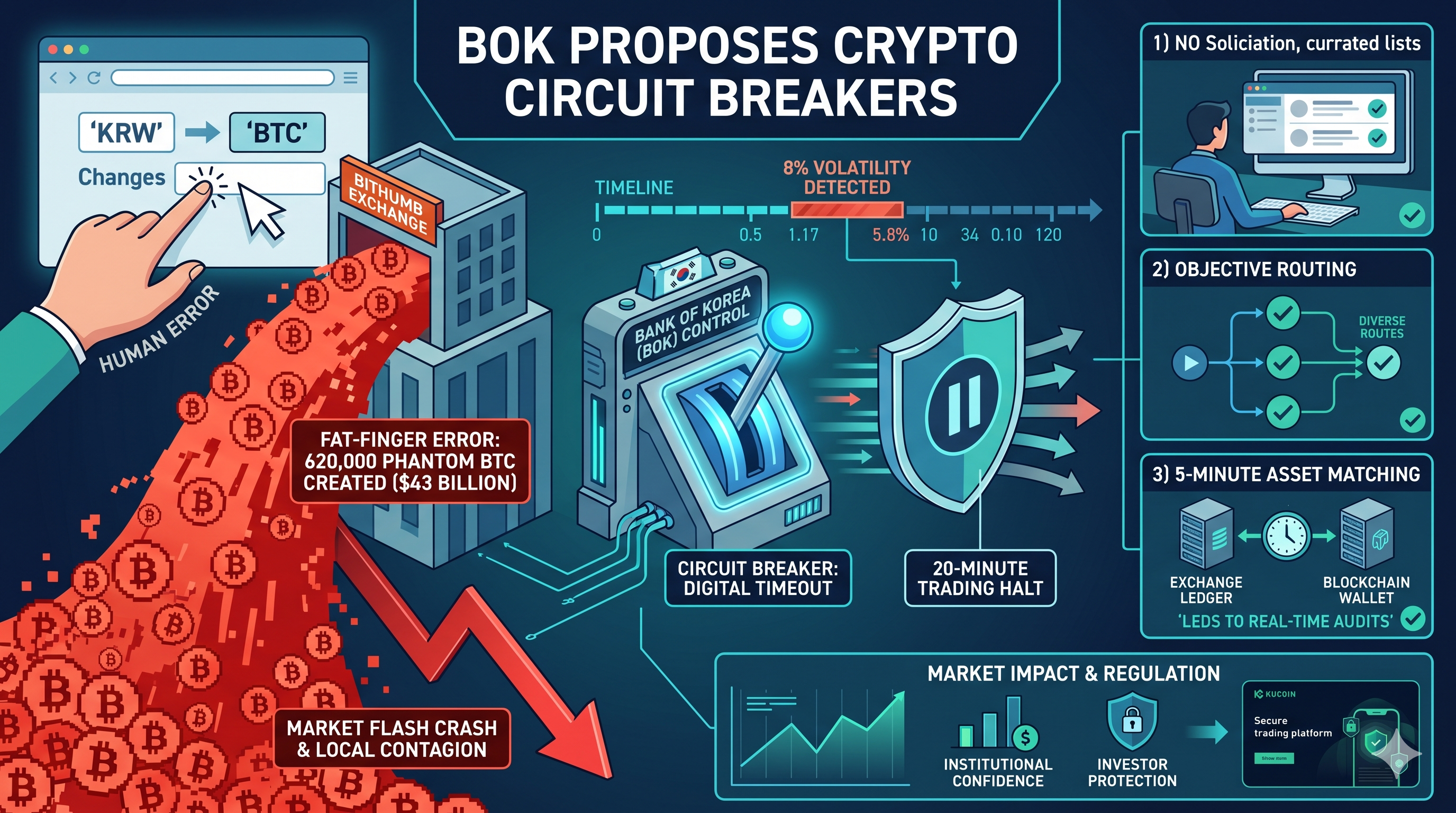
The South Korean digital asset landscape reached a critical inflection point on April 13, 2026, when the Bank of Korea (BOK) officially recommended the implementation of stock-market-style "circuit breakers" for cryptocurrency exchanges. This isn't just a theoretical regulatory adjustment; it is a direct response to a staggering operational failure at Bithumb earlier this year that briefly flooded the market with $43 billion (approximately 60 trillion won) in "phantom" Bitcoin.
For years, the crypto industry has prided itself on 24/7/365 uptime and permissionless trading. However, the Bithumb blunder—where a routine promotional event accidentally distributed 620,000 BTC instead of 620,000 Korean won—revealed a terrifying reality: a single human keystroke could potentially destabilize a national economy. As of today, April 15, 2026, the BOK’s Payment and Settlement Systems Report has become the blueprint for a new era of "protected volatility," where the freedom to trade is secondary to the stability of the financial system.
Key Takeaways
-
The Catalyst: A Bithumb employee's currency unit error created $43 billion in fake Bitcoin, triggering panic selling and forced liquidations.
-
The Fix: The BOK proposes a 20-minute mandatory trading halt whenever prices swing more than 8% within a specific timeframe.
-
Asset Matching: Exchanges will be required to prove internal ledgers match actual blockchain balances in real-time, moving away from once-daily reconciliations.
-
Systemic Risk: The central bank now views large-scale crypto exchange errors as a threat to traditional financial stability, not just "crypto-native" issues.
Anatomy of a $43 Billion Blunder: What Really Happened at Bithumb
On February 6, 2026, a Bithumb staffer preparing a "Random Box" reward event committed what may be the most expensive clerical error in history. In the software field for "Unit of Account," the employee accidentally selected BTC instead of KRW. Within minutes, 695 users were credited with roughly 2,000 BTC each. On paper, Bithumb had just "printed" 620,000 Bitcoin—nearly 3% of the total global supply—out of thin air.
Because Bithumb’s internal ledger was not hard-coded to verify these balances against actual cold wallet reserves in real-time, the system treated these phantom coins as real. Users began dumping their windfalls into the market. Bitcoin’s price on the exchange plunged 17% as the order book was overwhelmed by multi-billion dollar sell orders. The resulting "flash crash" triggered a cascade of liquidations for leveraged traders who had nothing to do with the error but were caught in the crossfire of distorted price data.
It took Bithumb 20 minutes to recognize the incident and another 20 minutes to respond. In the world of high-frequency trading, 40 minutes is an eternity. By the time the "Pause" button was hit, the contagion had spread to other Korean exchanges, highlighting a massive gap in how virtual asset service providers manage operational risk compared to traditional banks. While 99.7% of the funds were eventually recovered or frozen, the psychological damage to the market was done.
The BOK Proposal: Introducing the 20-Minute "Digital Timeout"
The Bank of Korea’s proposal seeks to bridge the gap between "Move Fast and Break Things" and "Bank-Grade Stability." The centerpiece of the recommendation is a 20-minute circuit breaker. Modeled after the Korea Exchange (KRX) system, this mechanism would trigger automatically if a major crypto asset's price moves more than 8% from the previous session's close and sustains that level for one minute.
This "Digital Timeout" serves two essential purposes. First, it halts the "algorithmic panic" where bots respond to a flash crash by selling more, creating a feedback loop of destruction. Second, it gives exchange operators a mandatory window to investigate whether the price move is driven by genuine market news or an internal technical failure. During the Bithumb crisis, such a halt would have frozen the phantom assets before they could be widely liquidated on the open market.
Crucially, the BOK suggests that these circuit breakers should be interconnected. If one major exchange like Bithumb or Upbit triggers a halt due to a suspected system error, the central bank envisions a protocol where other domestic exchanges are alerted. This would prevent "phantom liquidity" from being exploited across the entire Korean ecosystem, protecting the integrity of the "Kimchi Premium."
From Daily Reconciliations to Real-Time Asset Matching
One of the most damning findings in the BOK’s report was that Bithumb reconciled its internal database with its actual blockchain wallets only once every 24 hours. This meant the exchange’s "books" could deviate from reality for an entire day without triggering an alarm. The $43 billion blunder happened in that reconciliation gap, allowing "ghost" assets to enter circulation because the database was not talking to the blockchain.
The new guidance mandates the implementation of Real-Time Asset Matching Systems. By the end of May 2026, all South Korean exchanges will be required to have IT infrastructure that cross-references every internal ledger update with the actual state of the blockchain. If the internal database tries to move 100 BTC but the linked cold wallet only has 50, the transaction must be blocked by the system architecture automatically.
Major international platforms have often championed transparency through voluntary "Proof of Reserves," but the BOK is taking it a step further. They are turning a voluntary best practice into a mandatory, real-time technical constraint. For the industry, this means a significant increase in compute overhead as exchanges must overhaul their back-end systems to handle the massive processing power required for constant, five-minute audits.
Solving the "Human Factor" in Financial Software
The Bithumb incident exposed a lack of "dual-verification" protocols that are standard in the legacy banking world. In a traditional bank, a multi-billion dollar transfer requires several layers of authorization and a "sanity check" by the system (e.g., "Are you sure you want to send 3% of the world's money?"). At Bithumb, a single employee was able to distribute billions in value without a supervisor's approval.
The BOK’s proposed legislation would require crypto exchanges to implement dual-control logic for any administrative action affecting user balances. This includes promotional payouts, fee adjustments, and wallet migrations. Furthermore, the central bank is pushing for "unit-based limiters." For instance, a system would automatically flag and block any single promotional distribution that exceeds a pre-set percentage of the exchange’s total assets or the asset’s daily volume.
This move toward "Safety by Design" aims to remove the possibility of a single tired or distracted employee causing a systemic crash. By treating crypto software as "critical financial infrastructure," the BOK is forcing the industry to outgrow its "startup" phase and adopt the rigorous safety standards of a global financial hub.
Impact on Market Liquidity and Investor Confidence
Critics of the circuit breaker proposal argue that halting trades could actually increase volatility once markets reopen, as orders pile up behind the scenes. In the global, borderless world of crypto, a 20-minute halt on Korean exchanges might simply drive traders to offshore international platforms, potentially leading to "price fragmentation" where Bitcoin trades at vastly different prices in Seoul versus Singapore or Dubai.
However, the BOK argues that the "Premium on Safety" outweighs the "Cost of Interruption." For institutional investors, the lack of circuit breakers has long been a reason to avoid significant exposure to Korean exchanges. A regulated environment with built-in safeguards makes the market more attractive to "big money" that fears catastrophic operational errors. Since the Bithumb error, retail confidence has wobbled; by implementing these circuit breakers, the BOK hopes to restore the image of South Korea as a premier, secure destination for digital asset trading.
The challenge will be the technical implementation of these "stops" across fragmented liquidity pools. If a circuit breaker is too sensitive, it could trigger during healthy market discovery, frustrating traders. If it is too loose, it won't stop the next "phantom Bitcoin" incident. The BOK has indicated it will work with the Financial Services Commission (FSC) to fine-tune these parameters before they become law.
The Road to the Digital Asset Basic Act (DABA)
The circuit breaker proposal is a critical amendment to the upcoming Digital Asset Basic Act (DABA), expected to be fully codified by late 2026. This legislation will finally give the Bank of Korea and the FSC the teeth they need to fine exchanges—or even revoke licenses—for operational negligence. Under DABA, exchanges will no longer be treated as mere IT service providers; they will be classified as Virtual Asset Financial Institutions.
This title brings with it heavy-duty requirements, including mandatory insurance against technical failures and the "BOK-style" circuit breakers. The Bithumb blunder has acted as a "fast-forward" button for this legislation, moving it from a debated draft to a national priority. South Korean lawmakers are now viewing crypto regulation not just as a way to stop scams, but as a way to protect the country's payment and settlement stability.
As we look toward 2027, the era of "anything goes" in Korean crypto is ending. The BOK has made it clear: if you want to facilitate the trading of billions of dollars in value, you must have the safeguards of a multi-billion dollar bank. For the global crypto market, this signals a shift from "decentralized chaos" to "regulated resilience."
Conclusion: Trading Freedom vs. Financial Stability
The Bank of Korea’s proposal for crypto circuit breakers marks the end of an era. The Bithumb blunder proved that the speed of crypto is its greatest asset, but also its most dangerous liability. By mandating trade halts, real-time asset matching, and dual-verification protocols, South Korea is attempting to tame the volatility of the 24/7 market without stifling its innovation.
For the average trader, these changes mean fewer flash crashes and more protection against "phantom" assets. For the exchanges, it means a massive investment in security and compliance. Ultimately, the BOK is betting that a slightly slower, more regulated market will be a more enduring and valuable one. As the digital asset market matures, the "Korean Model" of crypto stability may well become the global gold standard for balancing innovation with safety.
FAQs
Q1: What triggered the BOK's proposal for crypto circuit breakers?
The proposal was triggered by a "fat-finger" error at the Bithumb exchange on February 6, 2026, where an employee mistakenly credited users with 620,000 "phantom" Bitcoin worth $43 billion, causing a massive local market crash.
Q2: How exactly would the crypto circuit breaker work?
If a major cryptocurrency's price fluctuates by more than 8% within a specific timeframe (compared to the previous day's close), all trading on the exchange would be automatically halted for 20 minutes to allow for investigation and to cool off panic selling.
Q3: Is Bithumb the only exchange affected by these new rules?
No. While Bithumb was the catalyst, the Bank of Korea's recommendations are intended to be applied to all licensed cryptocurrency exchanges operating in South Korea as part of the Digital Asset Basic Act.
Q4: What is "Real-Time Asset Matching"?
It is a requirement for exchanges to have IT systems that automatically verify that their internal ledger (what users see in their accounts) matches the actual amount of coins held in the exchange’s blockchain wallets every five minutes.
Q5: Will this slow down crypto trading in Korea?
During normal market conditions, no. However, during periods of extreme volatility or suspected technical errors, the 20-minute halt will temporarily pause all activity. Proponents argue this "slowdown" is a necessary safety feature to prevent total market collapse.
Q6: Can I still trade on international exchanges during a Korean halt?
Yes. Major global platforms operate under different jurisdictions. However, if a major market like Korea halts trading, it often leads to price discrepancies and shifts in global liquidity as traders move to offshore markets that are still open.