

Bitcoin vs. AI Computing 2026: Why Miners are Abandoning BTC for GPU Cloud Profits
2026/05/13 15:48:02
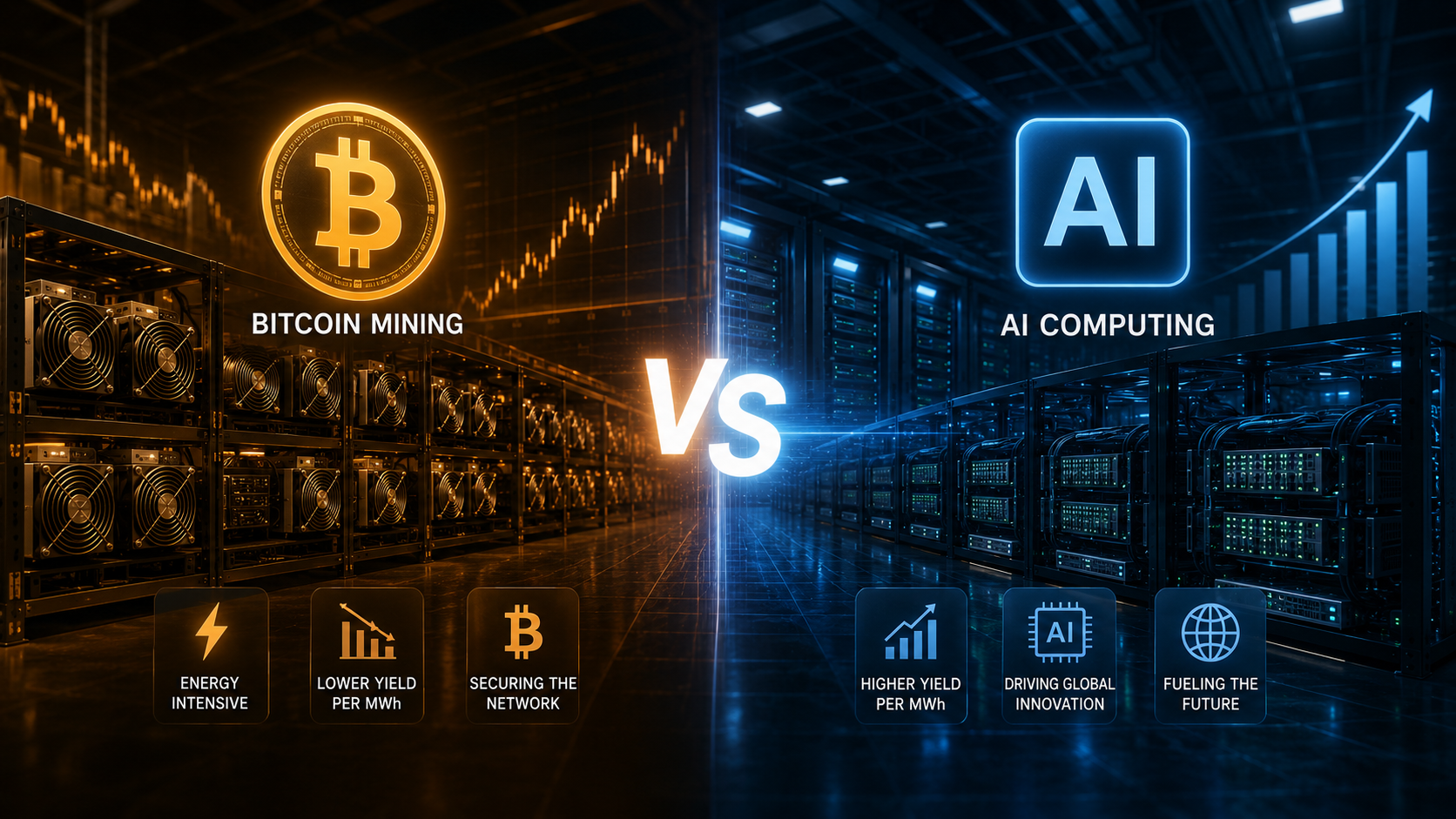
As we navigate the fiscal landscape of mid-2026, the digital asset industry is witnessing a tectonic shift where energy scarcity meets computational demand. The long-standing dominance of SHA-256 hashing is facing an unprecedented challenge from generative intelligence. This evolution represents a fundamental pivot in how global data centers prioritize their power allocations to maximize shareholder value.
This deep dive explores the intensifying economic rivalry of Bitcoin vs. AI Computing 2026, analyzing how current energy pricing and hardware efficiency are reshaping the profitability profiles for modern mining enterprises.
Key Takeaways:
The convergence of blockchain and artificial intelligence has reached a critical inflection point. In 2026, the narrative has shifted from "mining rewards" to "compute yield," with the following pillars defining the current market:
-
Yield Disparity: AI workloads currently generate significantly higher revenue per kilowatt-hour compared to traditional Bitcoin mining at current network difficulties.
-
Asset Transformation: Mining facilities are being revalued not by their hashrate, but by their energized "interconnection points" and cooling capacity.
-
Market Decoupling: Publicly traded mining companies are seeing their stock prices decouple from BTC spot prices as they integrate AI-driven revenue streams.
-
Regulatory Winds: Government entities are increasingly favoring AI infrastructure due to its perceived contribution to national productivity and GDP.
The $80,000 Threshold: Analyzing the Tightening Economics of BTC Mining
The economic reality for Bitcoin miners in 2026 has become increasingly precarious. With the global hashprice hitting historic lows, the cost of production has surged, creating a "squeeze" that only the most efficient operators can survive. This financial pressure is the primary driver behind the mass migration toward GPU-based cloud services.
Post-Halving Reality: Why 2026 Mining Costs Outpace BTC Price
Following the 2024 halving and the subsequent difficulty adjustments in 2025, the average cost to produce one Bitcoin for many mid-tier miners has hit the $80,000 threshold. With Bitcoin trading sideways near $77,000, a significant portion of the network is operating at a net loss on a pure OPEX basis. The 2026 landscape proves that even with the latest S21 Pro miners, the margins are razor-thin, leading many to look at their power contracts as an asset to be sold or repurposed rather than used for SHA-256 hashing.
Revenue per MWh: How AI Computing Offers 20x the Yield of Bitcoin
The disparity in "Revenue per Megawatt Hour" (MWh) is the most compelling argument for the Bitcoin vs. AI Computing 2026 pivot. While Bitcoin mining might yield $80 to $120 per MWh depending on the spot price, AI inference and training workloads on NVIDIA H200 or B200 clusters can generate between $1,500 and $3,500 per MWh. This 20x yield gap makes it fiduciary negligence for public companies to ignore the transition, especially when enterprise demand for LLM training remains insatiable.
Infrastructure Arbitrage: From Mining Farms to High-Performance Data Centers
The physical transition from a "mining farm" to an "AI data center" is the most capital-intensive arbitrage in the history of digital infrastructure. It isn't as simple as swapping chips; it requires a total overhaul of Tier-3 specifications, including enhanced physical security, redundant fiber connectivity, and sophisticated liquid cooling systems.
Repurposing the Grid: Why "Interconnection Points" are 2026’s Most Valuable Asset
In 2026, the bottleneck for AI is not just silicon—it is the grid. Securing a 100MW interconnection point with a local utility can take 5 to 7 years in the United States. Bitcoin miners, who spent the last decade securing these permits, are now sitting on a goldmine. These power hooks are being "flipped" to AI developers who are willing to pay a massive premium to bypass the utility queue. The "Interconnection Arbitrage" has become a more profitable business model than the mining process itself.
Case Studies: Top Public Miners Transitioning to AI Infrastructure Providers
Several industry leaders have already signaled the end of the "pure-play" mining era:
-
Core Scientific: Since its emergence from restructuring, it has pivoted heavily toward hosting agreements with AI firms like CoreWeave, securing multi-billion dollar long-term contracts.
-
Iris Energy: Leveraging its high-spec data centers in Canada, it has successfully integrated NVIDIA clusters alongside its ASIC fleets, diversifying its revenue.
-
HIVE Digital Technologies: An early mover in the GPU space, HIVE has utilized its green energy hydro-plants to provide low-cost compute for 2026's booming AI startup ecosystem.
Bitcoin vs. AI Computing 2026: The Battle for Global Energy Dominance
The struggle for energy dominance is no longer just between miners and residential consumers; it is a battle between two different visions of the digital future. As power grids around the world struggle to keep up with the electrification of everything, the "Proof of Work" model is being scrutinized against the "Intelligence Generation" model.
The Social Utility Debate: How Regulators Favor AI Productivity over PoW
Regulators in 2026 have taken a distinct stance. While Bitcoin is often viewed through the lens of financial speculation or "useless" energy consumption by skeptics, AI is framed as a national security priority. This perception shift has led to preferential power rates and faster permitting for data centers that dedicate at least 50% of their capacity to AI workloads. Bitcoin miners are finding that "rebranding" as AI compute hubs is the only way to maintain their social license to operate in many jurisdictions.
Stranded Energy: Why Bitcoin Remains the "Buyer of Last Resort" for Remote Power
Despite the AI surge, Bitcoin holds a unique edge: Portability. AI computing requires high-bandwidth fiber optics and low latency, meaning it must stay near urban hubs. Bitcoin mining, however, can thrive on "stranded" energy—flared gas in West Texas, remote hydro in Ethiopia, or volcanic energy in El Salvador. In the Bitcoin vs. AI Computing 2026 showdown, Bitcoin is being pushed to the "geographical fringe," becoming a tool for energy monetization in places where AI simply cannot go.
Investment Implications: Re-Evaluating Mining Stocks in an AI-First World
For investors on our exchange, the traditional "mining stock" is dead. In its place is a new hybrid asset class that combines the volatility of crypto with the secular growth of AI infrastructure. Analyzing these companies now requires a deep dive into their CAPEX strategy for GPU procurement rather than just their monthly BTC production reports.
From Beta-Play to Infrastructure Play: The Decoupling of Miner Stocks and BTC
Historically, buying a mining stock like MARA or RIOT was a "high-beta" play on Bitcoin's price. If BTC went up 10%, miners went up 20%. In 2026, that correlation is breaking. We are seeing "Miner-AI" stocks stay green even when Bitcoin dips, because their valuation is increasingly tied to their AI hosting contracts and GPU fleet value. This decoupling offers a unique diversification opportunity for crypto-native investors who want exposure to both the future of money and the future of thought.
Conclusion: Will Bitcoin Mining Survive the AI Computing Surge?
The conclusion of the Bitcoin vs. AI Computing 2026 showdown is not the death of mining, but its radical specialization. While AI has undoubtedly captured the "premium" grid space due to its massive revenue-per-watt advantage, Bitcoin mining is successfully retreating to the energy frontiers. The industry is bifurcating: Tier-1 facilities are becoming AI hubs, while Tier-4 facilities and stranded energy projects remain dedicated to securing the Bitcoin network. Ultimately, Bitcoin remains the ultimate "load balancer" for the global energy grid, but its days as the primary tenant of urban data centers are over.
FAQ:
Is Bitcoin mining still profitable in 2026?
Profitability is highly localized. With mining costs hitting $80,000 per BTC, only those with power rates below $0.03/kWh or those utilizing stranded energy remain profitable. Many are switching to Bitcoin vs. AI Computing 2026 hybrid models to sustain margins.
Why are miners switching to AI?
The primary reason is the revenue gap. AI compute can generate 20x more revenue per megawatt than Bitcoin mining. Additionally, AI contracts offer 10-year stability, whereas Bitcoin revenue fluctuates daily based on price and network difficulty.
Can all Bitcoin miners switch to AI?
No. AI requires Tier-3 data center standards, including high-speed fiber, extreme redundancy, and advanced cooling. Most "warehouse" style mining farms lack the infrastructure and would require massive CAPEX to make the Bitcoin vs. AI Computing 2026 transition.
How does this affect the Bitcoin network security?
While some hashrate is leaving for AI, the "Difficulty Adjustment" ensures the network remains stable. Furthermore, as SHA-256 chips become more efficient, the network remains secure even if it uses fewer, more specialized energy sites.
What should investors look for in mining stocks now?
Investors should prioritize companies with "HPC" (High-Performance Computing) strategies. The winners of Bitcoin vs. AI Computing 2026 are those who have secured GPU supply chains and long-term enterprise AI hosting contracts.