

Bitcoin Miners Pivot to AI Infrastructure, Outperforming Bitcoin
2026/07/12 12:12:00
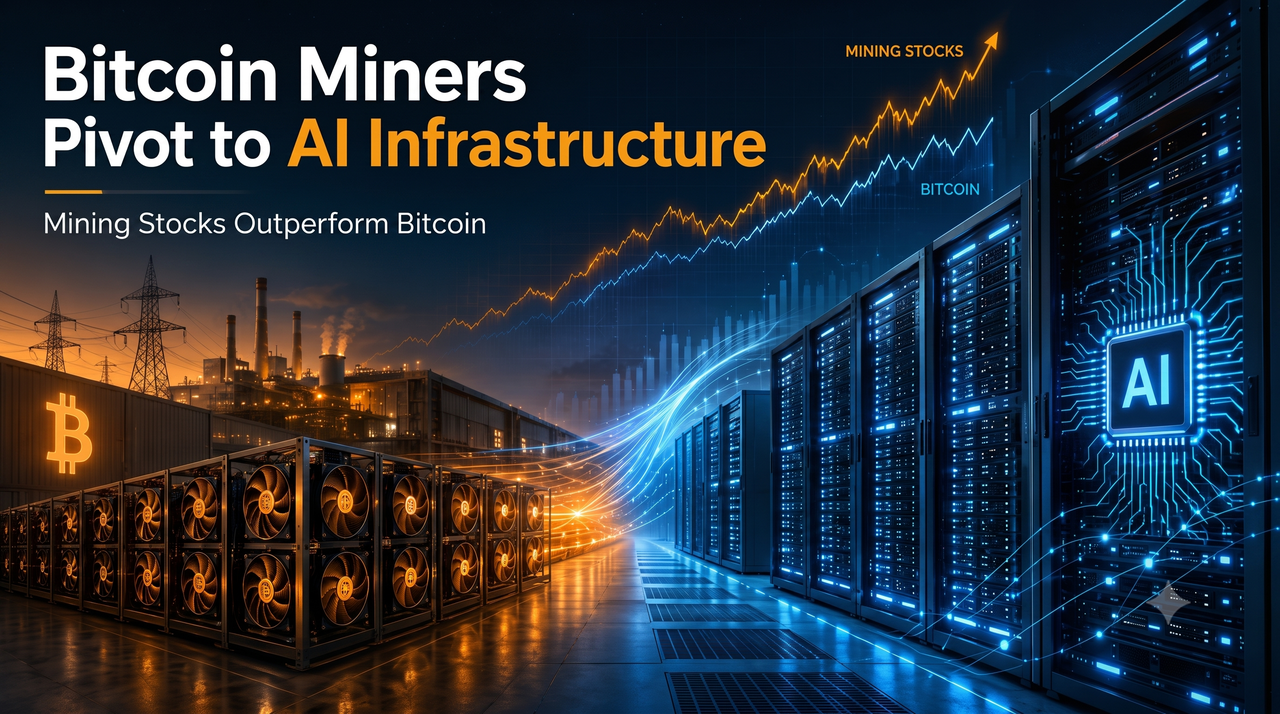
Bitcoin mining stocks are beginning to tell a different story from Bitcoin itself. In past market cycles, publicly traded miners were usually treated as high-beta Bitcoin proxies. When BTC moved higher, mining stocks often moved harder because stronger Bitcoin prices could quickly improve miner margins. When BTC weakened, miner stocks usually came under heavier pressure because revenue, balance sheets, and investor sentiment were all tied closely to Bitcoin’s price cycle. In 2026, that relationship is becoming more complicated as more miners pivot toward AI infrastructure, high-performance computing, and data-center leasing.
Bitcoin mining stocks have risen 167% since the start of 2025, while Bitcoin has fallen 35% over the same period. The report says this divergence became more visible from the third quarter and now looks more like a structural shift than a short-term fluctuation. That performance gap is important because it suggests investors are no longer valuing every miner only by hash rate, Bitcoin production, or BTC price exposure. Some miners are being re-rated as power-backed infrastructure companies with exposure to AI data-center demand, even as investors continue watching the Bitcoin live price and market overview for signs of broader crypto market direction.
The main reason behind this shift is power. AI companies need huge amounts of electricity, land, cooling capacity, grid access, and data-center infrastructure to support model training, inference, enterprise AI workloads, and cloud computing. Many Bitcoin miners already control power-heavy sites, substations, industrial land, and large-scale computing facilities. That gives stronger operators a chance to reposition themselves as AI infrastructure providers instead of relying only on Bitcoin mining revenue.
Why Bitcoin Miners Are Pivoting to AI Infrastructure in 2026
Bitcoin miners are moving into AI infrastructure because the business model of mining has become more difficult, while demand for power-backed data centers is rising quickly. In 2026, investors are no longer looking only at hash rate and Bitcoin production. They are also watching which miners can turn energy access, land, grid connections, and data-center sites into long-term AI and high-performance computing revenue.
-
Bitcoin Mining Margins Are Under More Pressure
Bitcoin mining remains a core part of the crypto economy, but it is also a cyclical and cost-sensitive business. Miner revenue depends on several moving parts at the same time, including Bitcoin price, network difficulty, block rewards, transaction fees, machine efficiency, and electricity costs. When BTC weakens or mining difficulty rises, profit margins can narrow quickly. After the 2024 halving reduced block rewards, miners had even more pressure to improve efficiency, manage power costs, and find ways to protect cash flow during weaker market conditions. This is one reason the AI pivot has become attractive. Mining revenue can be volatile because it depends heavily on market conditions that miners cannot fully control. A miner may run efficient machines and secure low-cost electricity, but it can still face pressure if Bitcoin price falls, network hash rate rises, or transaction-fee revenue disappoints. By contrast, AI infrastructure, data-center leasing, and high-performance computing contracts may provide more predictable revenue if the company can secure strong customers and deliver capacity on schedule.
Charles Schwab noted in May 2026 that every major publicly traded Bitcoin miner had announced some type of pivot toward AI data centers over the past few years. Schwab also argued that AI does not necessarily replace Bitcoin mining; instead, it may reframe mining sites as baseload infrastructure that can support different compute uses depending on demand, economics, and power utilization. This is an important point because the strongest model may not be “mining or AI,” but a hybrid approach where miners use their power assets across multiple revenue streams. The margin-pressure story is also about investor confidence. When a miner depends only on BTC production, its valuation can fall quickly during weak crypto markets because investors may worry about cash burn, debt, machine upgrades, and forced Bitcoin sales. When a miner can show credible AI contracts or HPC revenue potential, investors may begin to see a more diversified business. That does not remove risk, but it can reduce the perception that the company’s future depends only on the next Bitcoin rally.
-
AI Data Centers Need the Power Assets Miners Already Control
The biggest reason Bitcoin miners are attractive to AI companies is electricity. AI model training, inference, cloud computing, and high-performance computing require large amounts of reliable power. The International Energy Agency estimates that global data-center electricity consumption was around 415 TWh in 2024, or about 1.5% of global electricity consumption. In its base case, the IEA expects global data-center electricity consumption to double to around 945 TWh by 2030, with data-center power demand growing by about 15% per year from 2024 to 2030. This gives miners a possible advantage because many of them already control large-scale energy infrastructure. Over the past several years, miners have spent significant capital securing power contracts, developing industrial sites, building substations, managing high-load facilities, and negotiating with utilities. These are not small advantages in an AI market where electricity access can become a major bottleneck. A new AI data center cannot run on GPUs alone; it also needs power delivery, cooling, backup systems, land, permitting, networking, and reliable operations.
The IEA also notes that data centers can often become operational in two to three years, while the broader energy system requires longer lead times because grid infrastructure, generation capacity, and energy planning involve high upfront investment and long construction periods. That timing gap helps explain why existing power-heavy sites are becoming more valuable. If an AI company can partner with or lease from a miner that already has power access and industrial infrastructure, it may reduce part of the deployment timeline compared with building everything from scratch.
While Bitcoin ASIC machines are not suitable for AI workloads, the surrounding infrastructure can sometimes be converted or expanded for GPU-based AI data centers. This distinction is important. The value is not that miners can simply switch Bitcoin machines into AI machines. ASICs are designed for Bitcoin’s SHA-256 hashing process, while AI workloads usually depend on GPUs or specialized accelerators. The real value is the site, the power pipeline, the operating experience, and the ability to manage power-dense computing environments.
Key assets that can make some miners attractive to AI infrastructure customers include:
-
Large-scale power agreements and grid connections that may be difficult to secure quickly
-
Industrial land with room for data-center expansion and supporting infrastructure
-
Substation access, power-management experience, and relationships with utilities
-
Existing facility operations, physical security, and experience running high-load compute sites
-
Potentially faster conversion timelines compared with undeveloped land or early-stage data-center projects
This is why the AI pivot is not only a crypto story. It is also an energy and infrastructure story. In 2026, the market is increasingly rewarding companies that can control scarce power capacity, because AI demand has turned electricity access into a strategic asset.
-
Long-Term AI Contracts Can Create More Predictable Revenue
Another reason miners are pivoting to AI infrastructure is the possibility of long-term contracted revenue. Bitcoin mining revenue can change sharply with market conditions, but AI hosting, data-center leasing, and HPC contracts may provide more visibility if the customer base is strong and the project is properly financed. For public companies, this visibility matters because investors often value predictable contracted revenue more highly than revenue that depends heavily on volatile commodity-like market conditions.
TeraWulf is one of the clearest examples. In July 2026, the company announced a 20-year lease agreement with Anthropic for AI data-center infrastructure at its Justified Data campus in Hawesville, Kentucky. TeraWulf said the lease is expected to generate approximately $19 billion of contracted revenue over the initial term and support about 401 MW of critical IT load. The company said the first phase is expected in the second half of 2027, with full capacity targeted by early 2028. This kind of agreement helps explain why the market is revaluing some Bitcoin miners. A miner with a credible AI customer, a large power site, and a long-term lease may be viewed less like a pure crypto mining business and more like a digital infrastructure company. Reuters reported that TeraWulf shares rose more than 10% in early trading after the Anthropic lease announcement, showing how strongly investors can react when a miner converts its AI strategy into a major commercial deal.
However, long-term contracts do not eliminate execution risk. A $19 billion lease headline is powerful, but the company still needs to deliver infrastructure on schedule, manage financing, complete construction, maintain uptime, and meet customer requirements. AI customers may demand higher reliability, stronger cooling, better networking, and more sophisticated operating standards than typical Bitcoin mining facilities. For this reason, investors may reward signed contracts at first, but later they will likely judge miners by delivery milestones, capital discipline, and actual revenue ramp.
The difference between a strong AI pivot and a weak AI pivot may come down to several practical factors:
-
Whether the customer is credible and financially strong
-
Whether the site already has reliable power access
-
Whether the development timeline is realistic
-
Whether the company has enough capital to finish the project
-
Whether the miner can manage both AI infrastructure and Bitcoin mining without weakening its balance sheet
This is why long-term AI contracts can support higher valuations, but they should still be viewed carefully. The market may price in future growth quickly, while the actual infrastructure buildout can take years.
-
The Market Is Re-Rating Miners With AI and HPC Exposure
The AI pivot is also changing how analysts look at miner revenue mixes. S&P Global Market Intelligence reported in February 2026 that consensus projections showed HPC revenue could become a much larger share of revenue for several public miners, including IREN, Core Scientific, TeraWulf, Cipher Mining, HIVE, and Riot. The report noted that projected HPC revenue shares could rise sharply for some companies, including IREN and Core Scientific moving from low single-digit levels in 2024 to much larger contributions by 2026.
This matters because valuation models can change when revenue quality changes. If a miner is valued only as a Bitcoin producer, investors may focus mainly on hash rate, cost per coin mined, BTC holdings, and mining margins. But if a miner can generate a meaningful portion of revenue from AI hosting or data-center leasing, investors may also consider contracted backlog, customer quality, power pipeline, utilization, site expansion potential, and infrastructure multiples. In simple terms, the company may start to look less like a volatile mining operator and more like a digital infrastructure platform.
Core Scientific also shows why power capacity has become a premium asset. CoreWeave announced in July 2025 that it would acquire Core Scientific in an all-stock transaction with an implied equity value of about $9 billion. CoreWeave said the acquisition would give it approximately 1.3 GW of gross power across Core Scientific’s national data-center footprint, with more than 1 GW of additional potential gross power available for expansion. This deal sends an important signal to the market. AI companies are not only buying chips or software talent; they are also competing for electricity, physical infrastructure, and ready-to-scale locations. CoreWeave said the acquisition would help it deploy AI and HPC workloads at scale while gaining more control over a critical power footprint. For Bitcoin miners, that shows why power-heavy mining sites can become strategically valuable even if Bitcoin mining margins are under pressure.
The re-rating does not mean every miner deserves the same premium. Companies with clear customers, contracted revenue, large power pipelines, and credible delivery plans may attract stronger investor interest. Companies that only announce AI ambitions without signed agreements or realistic development paths may face more skepticism. In 2026, the market is becoming more selective, and that selectivity could become stronger as investors separate real infrastructure execution from simple AI marketing.
-
The AI Pivot Is Promising, but Not Risk-Free
The AI infrastructure pivot could help stronger Bitcoin miners diversify beyond BTC price cycles, but it is not risk-free. AI-ready data centers require major capital spending, advanced cooling, reliable power, strong networking, and strict execution. If miners face construction delays, rising debt, customer concentration, or weak AI contract delivery, the market may quickly separate real infrastructure winners from companies only benefiting from AI-related hype.
How AI Data Center Demand Is Helping Bitcoin Mining Stocks Outperform Bitcoin
AI data-center demand is changing how investors value Bitcoin mining companies. Instead of looking only at hash rate, BTC production, and mining efficiency, the market is increasingly focused on power access, land, grid connections, data-center pipelines, and the ability to serve AI and high-performance computing customers. This shift helps explain why some Bitcoin mining stocks have outperformed Bitcoin even during periods when BTC itself has been weak.
-
AI Power Demand Is Repricing Bitcoin Mining Assets
AI data centers require enormous amounts of reliable electricity to support GPU clusters, advanced cooling systems, backup power, and large-scale compute workloads. This has made power access one of the most important bottlenecks in the AI infrastructure race. For Bitcoin miners, that creates a potential advantage because many public mining companies already spent years securing large-scale power contracts, building industrial sites, developing utility relationships, and operating energy-intensive facilities.
The market is now repricing these same assets through a new lens. A mining site that was once valued mainly for Bitcoin production may now be valued for its ability to support AI compute capacity. Substations, power-purchase agreements, and large industrial sites can become strategic assets when AI companies are competing for electricity and ready-to-scale infrastructure. This is why some miners can outperform Bitcoin even when BTC itself is not rising: their equity story is increasingly tied to power capacity and AI infrastructure optionality, not only current Bitcoin price.
-
Long-Term AI Deals Can Support a Higher Valuation Narrative
Bitcoin mining revenue can change quickly because it depends on BTC price, network difficulty, block rewards, transaction fees, and electricity costs. AI infrastructure contracts may offer a different revenue profile because long-term leases or hosting agreements can give investors more visibility into future cash flow. When a miner signs a major AI customer, the market may begin valuing the company based on contracted infrastructure revenue rather than only near-term Bitcoin production. TeraWulf is a clear example of this shift. In July 2026, the company announced a 20-year data-center lease with Anthropic expected to generate about $19 billion in contracted revenue over the initial term. The scale of the deal gave investors a clearer framework for valuing TeraWulf’s power assets, customer quality, and future AI infrastructure role. However, these deals still require strong execution, including financing, construction, cooling systems, uptime reliability, and customer delivery. The AI narrative can lift valuations, but long-term performance will depend on whether miners can actually deliver the infrastructure on time.
-
Power Capacity Is Becoming More Important Than Hash Rate Alone
In the traditional mining model, investors focused heavily on hash rate, mining efficiency, Bitcoin production, and cost per coin mined. Those metrics still matter because they show whether a miner can compete within the Bitcoin network. However, AI data-center demand has added a new set of valuation drivers. Investors now want to know how many megawatts a miner controls, whether those megawatts are connected to the grid, whether sites can support GPUs, and whether the company has strong AI or HPC counterparties.
Core Scientific shows why power capacity has become so valuable. In July 2025, CoreWeave announced a deal to acquire Core Scientific, saying the transaction would give it around 1.3 GW of gross power across Core Scientific’s national data-center footprint, with more than 1 GW of additional potential expansion capacity. That kind of deal signals that AI companies are not only buying chips; they are also competing for electricity, land, and ready-to-scale infrastructure.
Key factors investors may now track include:
-
Available megawatts and future power pipeline
-
Quality of grid connections and long-term energy contracts
-
Suitability of sites for AI, HPC, and high-density GPU workloads
-
Signed AI hosting, colocation, or data-center lease agreements
-
Financing ability and construction timeline credibility
-
Customer quality, contract duration, and concentration risk
-
AI Exposure Can Help Miner Stocks Decouple From Bitcoin
Bitcoin mining stocks have historically traded like high-beta Bitcoin assets. When Bitcoin rallies, miners often rise more aggressively because margins can expand quickly. When Bitcoin falls, miners usually face more pressure because weaker BTC prices reduce mining revenue and investor appetite. The AI pivot is changing this relationship by creating a second source of investor interest that is not directly tied to BTC price. For traders comparing spot exposure with leveraged market tools, understanding how crypto futures trading works can also provide useful context for why miner stocks often behave differently from Bitcoin itself.
According to the referenced market data, Bitcoin mining stocks have risen 167% since the start of 2025, while Bitcoin has fallen 35% over the same period. The key takeaway is not simply that miners rose while BTC fell. The bigger point is that investors may now be using a different valuation framework for miners with AI infrastructure exposure. Still, this decoupling is conditional, not guaranteed. Miner stocks remain operating companies with debt, expenses, dilution risk, construction risk, and execution risk, so AI exposure may support outperformance only when backed by real contracts, visible revenue backlog, and credible project delivery.
-
The Strongest Outperformers Still Need Real Execution
The AI infrastructure story is powerful, but it should not be treated as a guaranteed bullish signal for every Bitcoin miner. A company cannot become an AI data-center winner simply by mentioning AI in investor materials. AI facilities require higher uptime, stronger cooling, advanced networking, customer-grade reliability, complex facility design, and major capital investment. This makes execution the most important test for miners trying to become AI infrastructure companies.
The strongest outperformers will likely be miners that can prove their AI pivot with real commercial progress, not only market narrative. A miner may have power agreements but still face grid interconnection delays, financing pressure, cooling upgrades, or customer concentration risk. Investors may therefore reward companies with signed contracts and realistic timelines while becoming more cautious toward miners with vague AI plans.
For the strongest outperformers, several signs may matter:
-
Signed contracts with credible AI or cloud customers
-
Clear project timelines with realistic capacity delivery dates
-
Funding plans that do not rely too heavily on shareholder dilution
-
Demonstrated ability to convert mining sites into high-density data centers
-
Balanced revenue exposure between Bitcoin mining and AI/HPC services
-
Transparent disclosure around power costs, capex, and customer commitments
The main takeaway is that AI data-center demand is helping some Bitcoin mining stocks outperform Bitcoin because it gives them a new growth story beyond BTC production. Power access, infrastructure control, and long-term AI contracts can make certain miners look more like digital infrastructure companies. Still, the outperformance may only last for companies that can prove they have real customers, strong sites, enough capital, and the ability to deliver capacity on time.
Key Risks Investors Should Watch
The Bitcoin miner AI pivot is a powerful market theme, but investors should also understand the main risks behind the shift from BTC mining to AI infrastructure.
-
High capital spending: AI data centers require major investment in construction, cooling systems, electrical infrastructure, networking, backup power, and long-term site reliability. Miners built mainly for ASIC mining may need expensive upgrades before their sites can support advanced AI or HPC workloads.
-
Financing and dilution risk: If borrowing costs rise or equity markets weaken, some miners may struggle to fund AI infrastructure projects. Companies could be forced to issue new shares, take on more debt, or sell assets, which may pressure existing shareholders.
-
Customer concentration risk: Long-term AI contracts can improve revenue visibility, but they can also make miners dependent on a small number of major customers. If a key AI customer delays deployment, changes its compute strategy, or renegotiates terms, the miner’s expected revenue growth could be affected.
-
Execution and construction delays: Converting Bitcoin mining sites into AI-ready data centers is complex. Delays in grid connections, permitting, cooling upgrades, equipment delivery, or facility construction could slow the transition and weaken investor confidence.
-
Market overvaluation: The AI infrastructure narrative may push mining stocks higher before revenue is fully realized. If companies miss milestones or fail to turn AI plans into real cash flow, investors may quickly separate miners with actual execution from those mainly benefiting from AI-related sentiment.
Conclusion
Bitcoin miners are outperforming Bitcoin because the market is increasingly valuing some miners as AI infrastructure and power-backed data-center businesses, not only as BTC production companies. The AI pivot could help stronger miners diversify beyond Bitcoin’s price cycle through long-term contracts, HPC services, and large energy-site monetization, but the trend still depends on real execution. In 2026, the key question is whether miners can turn power-heavy assets into durable AI infrastructure businesses or whether the market eventually treats the pivot as another speculative theme.
FAQs
Are Bitcoin miners becoming AI companies?
Some Bitcoin miners are becoming hybrid infrastructure companies rather than pure AI companies. Many still mine Bitcoin, but they are also using their power sites, land, grid access, and data-center experience to serve AI and high-performance computing customers. This shift is more about monetizing power-heavy infrastructure than completely abandoning Bitcoin mining.
Which Bitcoin miners are most exposed to the AI data center trend?
Public miners often mentioned in the AI infrastructure pivot include TeraWulf, Core Scientific, IREN, Cipher Mining, Hut 8, HIVE, Riot, and Applied Digital. The level of AI exposure varies by company, so investors usually look for signed contracts, available megawatts, data-center development progress, and how much future revenue may come from AI or HPC services. MarketWise and S&P Global have both highlighted several of these names in coverage of the miner-to-AI transition.
What does HPC mean in Bitcoin mining stocks?
HPC means high-performance computing. In this context, it refers to using large-scale data-center infrastructure for workloads such as AI model training, AI inference, cloud computing, scientific computing, and enterprise compute services. For miners, HPC revenue can be different from Bitcoin mining revenue because it may come from hosting agreements, colocation contracts, or long-term data-center leases.
Will AI data centers replace Bitcoin mining completely?
AI data centers are unlikely to replace Bitcoin mining across the whole sector, but they may reduce how dependent some public miners are on BTC production. The more likely outcome is a mixed model where stronger miners continue mining Bitcoin while also leasing power capacity or facilities to AI and HPC customers. Some companies may shift more aggressively toward AI, while others may remain primarily Bitcoin miners.
Can the AI pivot reduce miner selling pressure on Bitcoin?
It could reduce selling pressure for some miners if AI or HPC contracts create more predictable cash flow. In a pure mining model, companies may need to sell mined BTC to cover power bills, debt, equipment upgrades, or operating costs. If AI infrastructure revenue becomes meaningful, some miners may rely less on Bitcoin sales for liquidity. However, this depends on execution, contract timing, financing needs, and actual cash flow.
Are Bitcoin mining stocks still a good proxy for Bitcoin price?
Not always. Mining stocks used to behave more like leveraged Bitcoin proxies, but AI exposure can make some of them trade differently from BTC. A miner with strong AI contracts may rise because of data-center demand even if Bitcoin is weak, while a miner without AI progress may remain more closely tied to BTC price. This means investors may need to analyze miner stocks as operating businesses, not only as Bitcoin price bets.
Disclaimer:This content is for informational purposes only and does not constitute investment advice. Cryptocurrency investments carry risk. Please do your own research (DYOR).