

What Is MegaETH's MEGA TGE? High-Performance L2 Token Launch Explained
Introduction
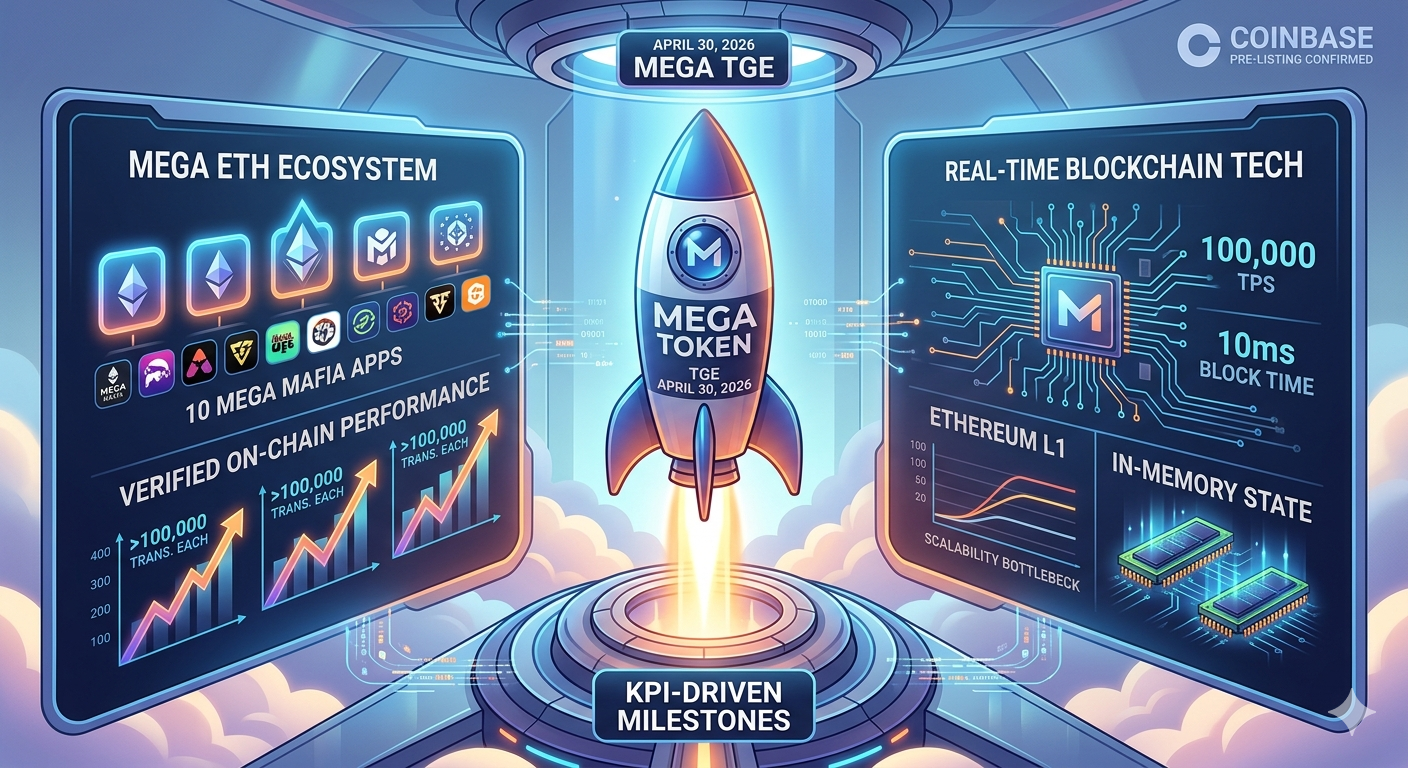
MegaETH will launch its native MEGA token on April 30, 2026, through a token generation event tied to verified on-chain performance milestones rather than arbitrary calendar dates. The TGE was triggered on April 23 after 10 Mega Mafia-incubated applications met strict transaction thresholds, starting a mandatory seven-day countdown.
The MEGA TGE introduces a KPI-driven tokenomics model where 53.3% of supply unlocks only as the network hits measurable growth targets. With a fixed supply of 10 billion tokens and a Coinbase pre-listing confirmed, MegaETH is positioning MEGA as the utility and governance token for its "real-time blockchain."
For readers who want to learn more background information, the below are the recommended sub-topics:
-
MegaETH L2 — differentiates MegaETH through real-time execution and specialized node architecture.
-
Layer 2 for Ethereum scalability — explains why Layer 2 networks remain essential for blockchain mass adoption.
What Is the MEGA Token Generation Event?
The MEGA token generation event is scheduled for April 30, 2026, following the completion of MegaETH's first key performance indicator on April 23. Unlike conventional token launches that follow fixed vesting schedules, MegaETH's TGE is gated by measurable on-chain milestones. The first KPI required at least 10 live applications from the Mega Mafia incubator to generate more than 100,000 transactions each over a 30-day period. Once this threshold was crossed, a seven-day countdown began automatically, setting the TGE for April 30.
This milestone-based approach is rare in the blockchain industry. According to CoinDesk, the announcement pushed Polymarket prediction odds for an April 30 launch from 22% to over 97% within 24 hours. The market confidence reflects both the transparency of MegaETH's KPI model and the substantial backing behind the project.
The MEGA token serves multiple functions within the ecosystem. It powers gas fees, enables staking for network security, and grants governance rights. Additionally, MEGA acts as the bidding currency for proximity markets, where applications and market makers pay to colocate near the sequencer for faster execution. Based on data from Hyperliquid, pre-market perpetuals have traded at an implied valuation between $1.5 billion and $2 billion in recent weeks.
With a fixed total supply of 10 billion tokens, the distribution allocates 53.3% to staking rewards tied to four KPI goals, 14.7% to investors, 7.5% to ecosystem reserves, 5% to a public auction, and 9.5% to the team and advisors. According to Blockonomi, MegaLabs has raised $470 million in total funding, including a $450 million oversubscribed token sale in October 2025 that drew over 14,000 participants.
How Did MegaETH Trigger the TGE Countdown?
MegaETH triggered the TGE countdown by meeting its first self-imposed KPI milestone on April 23, 2026. The requirement was specific: at least 10 Mega Mafia-incubated applications had to be live on mainnet with verified contracts, functioning core loops, and over 100,000 total transactions recorded across a 30-day window. All 10 apps cleared this threshold simultaneously, proving that real user activity existed on the network rather than bot-generated volume.
The qualifying applications include Cap, a stablecoin payments protocol; Brix, a yield tokenization platform; Avon, an on-chain lending market; Kumbaya, a decentralized exchange; Ubitel, a decentralized telecom protocol; and five additional projects including Showdown, World, Stomp, HitOne, and Nectar AI. According to Unchained Crypto, each app had to demonstrate a functioning core loop supported by traceable user activity, not merely deployment status.
MegaETH established three possible conditions to trigger the TGE countdown, and only one needed to be met. The alternative pathways included achieving a $500 million circulating supply of the native stablecoin USDM with at least 25% deposited into smart contracts, or three apps generating $50,000 in daily fees for 30 consecutive days. As of late April 2026, USDM circulation stands at approximately $62.9 million, roughly 13% of the $500 million target, according to data from Unchained Crypto.
The Mega Mafia accelerator program incubated more than 30 applications in total. Financial backers of the program include Anagram, GSR, Kraken Ventures, Maven11, Robot Ventures, and Wintermute. Angel investors such as Vitalik Buterin and Kain Warwick also supported the early-stage projects. This incubator structure ensures that apps launching on MegaETH have passed rigorous performance standards before they contribute to token unlock events.
What Makes MegaETH Technically Different?
MegaETH differentiates itself from other Ethereum Layer 2 networks through real-time execution capabilities that target 100,000 transactions per second with 10-millisecond block times. While established L2s like Arbitrum and Base have brought meaningful scalability improvements, MegaETH pushes performance into a category that enables entirely new application types, including high-frequency trading, fully on-chain gaming, and AI-powered applications.
The architecture relies on four specialized node types to maximize hardware efficiency. Sequencer nodes handle transaction ordering using high-performance hardware with over 10,000 cores and terabytes of RAM. Full nodes maintain network state. Replica nodes serve read requests. Prover nodes generate cryptographic proofs asynchronously, decoupling execution from verification. According to Messari, this design eliminates consensus overhead during execution and enables the network to process over 100,000 TPS in live conditions.
A critical innovation is the in-memory state execution model. Unlike traditional blockchains that read and write state to disk, MegaETH maintains full state in RAM, removing input-output bottlenecks that typically limit throughput. The system also uses a proprietary Small Authentication Large Trie (SALT) structure to minimize latency, alongside Just-In-Time compilation for near-native EVM bytecode execution.
The performance gap between MegaETH and existing L2s is substantial. Based on April 2026 data from Messari, the comparison breaks down as follows:
|
Metric
|
MegaETH
|
Arbitrum
|
Base
|
Ethereum L1
|
|
TPS
|
100,000+
|
40-100
|
50-120
|
15-30
|
|
Block Time
|
10ms
|
250ms
|
2s
|
12s
|
|
Finality
|
1s
|
5-15 min
|
1-2 min
|
12-18 min
|
|
Comp. Throughput
|
1,700 MGas/s
|
50 MGas/s
|
60 MGas/s
|
1 MGas/s
|
This performance profile enables use cases that were previously impossible on-chain. Order book decentralized exchanges can execute with sub-second finality competitive with centralized venues. Real-time multiplayer games can update blockchain state at 100 Hz. Derivatives protocols can process liquidations without the latency gaps that plague existing L2s. The network also supports AI-powered applications that require millisecond inference on live blockchain data.
However, the design involves tradeoffs. MegaETH currently operates with a single active sequencer, which has raised decentralization and censorship risk concerns among analysts. The project argues that this centralization is a temporary launch configuration and that future upgrades will distribute sequencer duties across a broader validator set. Despite this concern, the technical achievement of sustained 100,000 TPS with EVM compatibility represents a significant leap forward for Ethereum scaling.
What Is the Current MegaETH Ecosystem?
MegaETH's mainnet launched on February 9, 2026, and has already accumulated $89 million in total value locked while processing over 2.26 million transactions in a 24-hour period. The network went live with blue-chip DeFi protocols including Aave V3, GMX, and Chainlink Scale, giving it immediate access to established liquidity and security infrastructure.
The ecosystem is concentrated but growing. Kumbaya XYZ, a native decentralized exchange, holds $51 million of the network's $89 million TVL. The stablecoin market is dominated by USDM, which captures 74% of the $84 million stablecoin market cap on MegaETH. According to MEXC News, the iTRY stablecoin — a Turkish Lira-backed asset offering approximately 45% APY through real-time yield loops — recently launched to expand regional access.
Perpetuals trading activity has accelerated rapidly. Weekly perpetuals volume climbed 900% to reach $45 million over a seven-day period in April 2026. The sequencer operates at cost, keeping transaction fees among the lowest in the industry. Active addresses reached 3,230 in 24 hours, reflecting genuine user engagement rather than artificial incentive farming.
Beyond DeFi, MegaETH has integrated with deBridge, OpenSea, Infinex, and Wormhole. FastBridge, powered by Avail Nexus, allows users to transfer assets from over 14 EVM ecosystems to MegaETH in seconds. BTC.b is now live as the canonical Bitcoin asset on the network, expanding cross-chain collateral options. These integrations position MegaETH as a settlement layer that can absorb liquidity from across the Ethereum ecosystem and beyond.
How Does MEGA Tokenomics Work?
MEGA tokenomics are built around a performance-gated emission schedule that ties the majority of supply unlocks to verifiable network growth. A total of 53.3% of the fixed 10 billion token supply is allocated to staking rewards, but these rewards release only as MegaETH achieves four predefined KPI goals. This structure fundamentally separates MEGA from tokens that rely on time-based vesting alone.
The first KPI, now completed, required 10 live Mega Mafia apps with verified transaction activity. The remaining three milestones include requirements that at least three MegaETH apps generate $50,000 or more in daily fees for 30 consecutive days, and that USDM reaches specific circulation and smart contract deposit targets. According to Blockonomi, this model ensures that token emissions accelerate only when real economic activity justifies them.
Foundation revenue from USDM activity already funds direct MEGA buybacks. This mechanism creates consistent demand pressure independent of speculative trading cycles. The MegaETH Foundation has committed to using stablecoin yield for ongoing token repurchases, a practice that remains uncommon among early-stage L2 networks. The buyback program is already active, meaning protocol revenue is flowing into token support before the TGE has even occurred.
Investors were allocated 14.7% of supply, while 9.5% vests to the team and advisors. The public auction allocated 5%, and 7.5% remains reserved for ecosystem development. Notably, MegaETH has opted against traditional airdrops and points programs, focusing instead on organic user acquisition and builder incentives. This approach reduces the risk of mercenary capital flooding the network for short-term rewards and then exiting.
What Are the Market Expectations for April 30?
Market expectations for the April 30 TGE are extremely bullish, with prediction market data showing 97.8% confidence that the launch will proceed as scheduled. According to CryptoBriefing, Polymarket odds for an April 30 launch jumped from 19% to 97.8% within 24 hours of the official announcement. The June 30 contract sits at 100% YES, indicating near-universal certainty that the token will launch by mid-year regardless of any short-term delays.
Trading volume across MegaETH TGE prediction markets reached $498,430 in USDC during the 24 hours following the confirmation. The Coinbase pre-listing signals institutional exchange confidence in the launch timeline and compliance standards. At 97 cents, a YES share on the April 30 contract pays $1, offering minimal upside but reflecting market certainty.
Pre-market perpetuals on Hyperliquid have traded at an implied fully diluted valuation between $1.5 billion and $2 billion. This represents a significant discount from the October 2025 peak of over $6 billion, when the Sonar token auction drew $1.39 billion in commitments for a $50 million allocation. According to CoinDesk, the October 2025 sale was nearly nine times oversubscribed, with backing from Vitalik Buterin, Joe Lubin, Dragonfly, and other major investors.
The thin liquidity in prediction markets means that single large orders can still move pricing meaningfully. Traders should watch for official announcements from the MegaETH Foundation regarding additional exchange listings, as these could further compress uncertainty and drive volume into the TGE. The geopolitical backdrop and broader macro conditions around the April 30 Federal Reserve meeting may also influence short-term sentiment.
Should You Trade MEGA on KuCoin?
The MEGA TGE on April 30, 2026, presents a unique entry point into one of the most technically ambitious Layer 2 ecosystems in the market. KuCoin offers a robust trading environment for new token listings, with deep liquidity pools and advanced order types that support both spot and derivatives strategies. As MEGA begins trading across centralized exchanges, KuCoin users can access the token alongside comprehensive charting tools and portfolio tracking features.
Registering on KuCoin positions you to participate in the initial price discovery phase while benefiting from competitive trading fees and 24/7 customer support. Whether you are evaluating MEGA for its staking rewards, governance utility, or speculative potential, KuCoin provides the infrastructure to execute your strategy efficiently. Create your KuCoin account today and win KuCoin's new user rewards up to 11,000 USDT.

Conclusion
The MegaETH MEGA token generation event on April 30, 2026, represents a structural innovation in blockchain launches. By tying the TGE to verified on-chain performance milestones, MegaETH introduced a KPI-driven model that aligns token emissions with real network growth. The completion of the first milestone — 10 live Mega Mafia applications with over 100,000 transactions each — triggered a seven-day countdown that removes typical launch uncertainty.
Technically, MegaETH stands apart through real-time execution architecture. With 100,000 TPS capability, 10-millisecond block times, and in-memory state processing, the network targets use cases impossible on slower chains. The $89 million in TVL and 900% weekly growth in perpetuals volume demonstrate early traction.
The tokenomics reinforce long-term thinking. Over half the supply remains locked behind performance gates, while USDM revenue funds active buybacks. Combined with backing from Vitalik Buterin, a $470 million funding base, and Coinbase pre-listing support, MegaETH enters its TGE phase with stronger fundamentals than most new L2 tokens. The April 30 launch marks the beginning of a measurable, performance-linked token economy rather than another speculative unlock cycle.
FAQs
What is the exact date of the MEGA token generation event?
The MEGA token generation event is scheduled for April 30, 2026. MegaETH confirmed the date on April 23 after 10 Mega Mafia-incubated applications met the first KPI milestone of 100,000 transactions each over a 30-day period, which triggered a mandatory seven-day countdown.
How does MegaETH's KPI-based token release differ from traditional vesting?
Traditional token vesting follows fixed calendar schedules that unlock supply regardless of network health. MegaETH ties 53.3% of MEGA supply to four measurable KPI goals, including app transaction volumes, fee generation, and stablecoin circulation targets. Tokens unlock only when the network proves real usage and economic activity.
What are the technical performance metrics of MegaETH mainnet?
MegaETH targets 100,000 transactions per second with 10-millisecond block times and one-second finality. In live mainnet conditions during April 2026, the network has sustained throughput that positions it roughly 5,000 times faster than Ethereum mainnet. Computational throughput reaches 1,700 MGas/s compared to 1 MGas/s on Ethereum L1.
Who are the main backers and investors behind MegaETH?
MegaLabs has raised $470 million in total funding. Major backers include Dragonfly, Kraken Ventures, Maven11, Robot Ventures, Wintermute, Anagram, and GSR. Angel investors include Ethereum co-founder Vitalik Buterin, ConsenSys founder Joe Lubin, and Synthetix founder Kain Warwick.
What are the primary risks of investing in MEGA at launch?
The primary risks include TVL concentration, with Kumbaya XYZ holding $51 million of the $89 million total. Single-sequencer architecture creates temporary centralization and censorship concerns. Pre-market valuation volatility remains high, with implied FDV ranging from $1.5 billion to $2 billion. Additionally, three remaining KPI milestones must be hit before the majority of staking rewards unlock.