

U.S. CBDC Debate Intensifies in 2026 as Senator Hagerty Warns of Threats to Financial Freedom
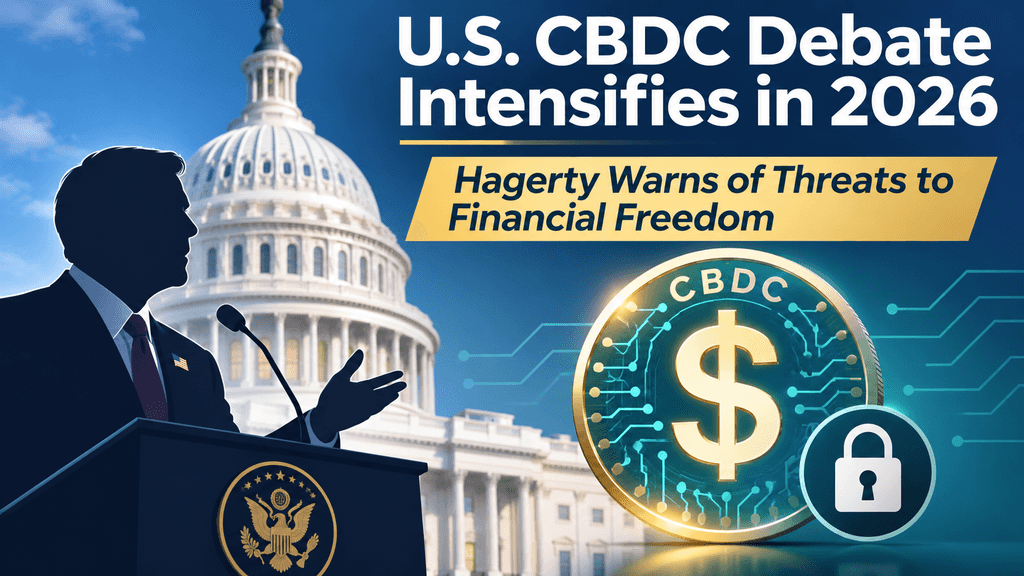
The U.S. central bank digital currency (CBDC) debate returned to the spotlight after Senator Bill Hagerty warned that a government-issued digital dollar could conflict with financial freedom. In an interview published on October 29, 2026, the Tennessee Republican challenged the role of government in future digital payments. Yet federal law already restricts the Federal Reserve from issuing a covered CBDC through December 31, 2030. At the same time, the United States is preparing new rules for privately issued stablecoins, while a broader cryptocurrency market-structure bill remains stalled in the Senate. These developments raise questions about financial privacy, regulatory authority, and how digital dollars may operate in the years ahead.
Senator Hagerty Warns of CBDC Financial Privacy Risks as U.S. Digital Dollar Debate Intensifies
Hagerty's October 29 comments were part of a wider Bitcoin Magazine interview about cryptocurrency policy, stablecoins, and the U.S. Strategic Bitcoin Reserve. His criticism of CBDCs focused on the possibility that a government-issued digital payment instrument could expand official influence over everyday financial activity. The remarks did not announce a new law, Federal Reserve proposal, or launch date. Instead, they showed why disagreements over the longer-term role of central bank money remain relevant even after Congress enacted a temporary issuance restriction.
Hagerty's October 2026 Warning on CBDCs and Financial Freedom
During the interview, Hagerty described a central bank digital currency as "absolutely not consistent with freedom and liberty." That is his policy assessment, not an established finding about a functioning U.S. digital dollar. A retail CBDC would generally be money issued by a central bank and made available to the public, potentially through banks or payment companies. It differs from a conventional bank deposit because the underlying obligation would rest with the central bank rather than a commercial lender. The details of access, account management, and transaction records would depend on the system's design.
His position fits into a longer sequence of federal actions. President Donald Trump signed Executive Order 14178 on January 23, 2025, directing agencies not to establish, issue, or promote CBDCs, subject to applicable law. Congress later enacted a statutory restriction on July 11, 2026. In the same October interview, Hagerty addressed cryptocurrency market rules and an estimated 200,000 Bitcoin in federal holdings. That figure was discussed in the interview, but should not be treated as a newly audited balance of the Strategic Bitcoin Reserve. Those related topics explain his broader digital asset agenda without changing the legal status of a CBDC.
Financial Privacy Concerns and Potential Safeguards in a Digital Dollar System
A major concern is whether a digital dollar might allow greater access to transaction information than cash provides. Depending on its architecture, a CBDC could involve identity checks, payment intermediaries, digital wallets, or centralized transaction records. Critics worry about misuse of sensitive information or restrictions on permitted payments. Supporters of further research point to potential improvements in payment efficiency and access, while arguing that protective rules and technical safeguards could be built into a system. Neither surveillance nor strong anonymity is an unavoidable feature of every conceivable CBDC.
The Federal Reserve's January 20, 2022, discussion paper examined a possible system that would be privacy-protected, intermediated, widely transferable, and identity-verified. An intermediated model could use private financial institutions to provide wallets or customer services while keeping the currency itself a central bank liability. Identity verification would still need to meet applicable financial crime requirements, making the balance between confidentiality and lawful oversight central to any design. The paper was exploratory and did not authorize issuance. As of November 2, 2026, the Federal Reserve has not announced a decision to launch a retail CBDC.
U.S. CBDC Ban in 2026 and Federal Reserve Restrictions Through 2030
The current U.S. CBDC restriction comes from the 21st Century ROAD to Housing Act, enacted as Public Law 119-101 on July 11, 2026. Although the legislation primarily addresses housing and financial matters, Title XI added Section 423 to Title 12 of the U.S. Code. The provision restricts the Federal Reserve Board and Federal Reserve Banks from creating or issuing a covered CBDC, subject to a specific exception. Its inclusion in an enacted statute matters because an executive order and a congressional prohibition have different legal foundations and can be changed through different processes.
How Public Law 119-101 Restricts Federal Reserve CBDC Issuance
Under 12 U.S.C. § 423, a CBDC is defined by four attributes: it is denominated in U.S. dollars, constitutes U.S. currency, is a direct Federal Reserve liability, and is widely available to the general public. The prohibition covers issuance directly or indirectly through a financial institution or other intermediary, as well as digital assets substantially similar to a CBDC. Consequently, distributing central bank money through commercial banks would not automatically place it outside the restriction. The provision targets the nature of the instrument, not merely the technology or delivery channel used to transfer it.
The law includes an exception for dollar-denominated currency that is open, permissionless, private, and fully preserves privacy protections associated with physical U.S. money. This carefully worded exception should not be interpreted as blanket authorization for any proposed digital currency. Section 423 also states that it does not grant the Federal Reserve CBDC issuance authority absent an act of Congress. Ordinary online banking, commercial-bank deposits, and privately issued crypto assets are not automatically covered by the CBDC definition. The difference between sovereign digital money and privately issued instruments is also explained in KuCoin's educational CBDC and stablecoin comparison.
Why the 2030 CBDC Ban Expiration Does Not Guarantee a Digital Dollar Launch
The statutory prohibition is scheduled to cease being effective on December 31, 2030, but its expiration would not itself authorize a U.S. digital dollar on January 1, 2031. A separate congressional authorization requirement remains important to any future issuance decision. Lawmakers have also considered additional legislation: the House approved the Anti-CBDC Surveillance State Act, H.R. 1919, by 219 votes to 210 on July 17, 2025, but House passage did not make that bill law. Another frequent source of confusion is FedNow. The Federal Reserve describes it as a payment service for participating banks and credit unions, not a CBDC, a consumer wallet, or a replacement for cash. For policy observers, the relevant questions are whether Congress changes the existing provision and what legal authority, if any, it establishes afterward.
CBDC vs Stablecoins and the Impact of GENIUS Act Regulations on Digital Assets
Federal policy treats CBDCs and payment stablecoins differently because they represent different legal claims and operating models. A retail CBDC would be central bank money; a payment stablecoin is typically issued by a private entity that promises redemption under specified conditions. The GENIUS Act, signed into law on July 18, 2025, established a national framework for qualifying payment stablecoins. On October 21, 2026, the Office of the Comptroller of the Currency (OCC) announced final implementation rules, published in the Federal Register on October 23. The law and OCC rules take effect on January 18, 2027, creating an important compliance milestone rather than evidence of immediate market growth.
How CBDCs and Stablecoins Differ Under U.S. Digital Currency Regulations
A privately issued dollar stablecoin is intended to track the value of the U.S. dollar, typically using an identifiable reserve pool and redemption arrangements. The wider category of stablecoins also includes instruments linked to other reference assets or employing different stabilization mechanisms. The GENIUS Act principally addresses qualifying payment stablecoins, not every token described as stable. Unlike a potential Federal Reserve CBDC, holders generally have a claim connected to a private issuer, not a direct claim against the central bank. Neither structure should be confused with Bitcoin, whose market price is not linked to a fixed dollar redemption promise.
Under the GENIUS Act, permitted payment stablecoin issuers must maintain at least one dollar of eligible reserve assets for every dollar of outstanding payment stablecoins. Eligible assets include cash, qualifying deposits, and specified short-term government securities, subject to statutory requirements. Issuers must disclose reserve composition monthly and publish clear redemption policies, including applicable fees. The law also limits the reuse of required reserves and bars issuers from paying interest or yield solely because a user holds, uses, or retains the stablecoin. These protections aim to improve confidence in redemption, but they cannot rule out issuer failures, temporary price deviations, cybersecurity incidents, or liquidity stress.
A practical example is USDC, a dollar-referenced stablecoin issued by Circle through supported blockchain networks. On-chain transfers can make settlement available outside conventional banking hours, but that does not make a token identical to insured bank money. Public blockchains also generally expose wallet addresses and transaction histories, although addresses do not inherently reveal real-world identities. Certain issuers can restrict designated addresses in compliance with legal requirements. These features demonstrate why the relevant privacy questions concern actual governance, disclosure, and operational controls rather than a simple division between public and private digital currencies.
GENIUS Act Implementation, Stablecoin Market Implications, and Upcoming Regulatory Milestones
The OCC's October 21 final rule covers issuers and activities under its jurisdiction, including reserve management, redemptions, custody, risk controls, examinations, and registration. Not every part of the federal framework was finalized simultaneously. The OCC said financial crime-related requirements would be addressed separately with the Treasury Department. The Federal Reserve, meanwhile, proposed its own capital, reserve, risk-management, and application requirements for Board-supervised issuers on September 24, 2026. Those Federal Reserve proposals were not final rules as of November 2. The OCC also indicated it would announce when it begins accepting applications and waiver requests, rather than treating publication of its rule as automatic authorization for individual firms.
These milestones may influence business planning for banks, nonbank issuers, exchanges, payment processors, and blockchain service providers. Stablecoin growth could increase demand for short-term U.S. Treasury securities because qualifying issuers must hold eligible liquid reserves. That outcome depends on actual issuance, redemptions, and asset composition; it is not a guaranteed increase in government-debt demand. Issuers must also budget for custody, compliance, reporting, technology, and supervision. The GENIUS Act permits qualifying state-regulated issuers with no more than $10 billion in outstanding payment stablecoins to use substantially similar state regimes, while crossing that threshold generally triggers a transition or issuance limitations, subject to possible waivers. These arrangements could affect the economics of both large and emerging providers.
The market implications extend beyond token prices. Stablecoins may support cross-border transfers, digital asset settlement, and round-the-clock payments, but adoption depends on customer demand, reliable redemptions, and integration with established financial services. Issuer-paid yield restrictions could influence competition with bank deposits, while uneven rules across jurisdictions may complicate cross-border operations. There is no reliable basis for claiming that the OCC announcement alone will lift Bitcoin prices or cryptocurrency trading volumes. The important indicators are licensed issuer participation, reserve disclosures, transaction usage, operational performance, and whether the 2027 rules function as intended.
Future of U.S. CBDC Policy Amid CLARITY Act Developments and Regulatory Uncertainty
Beyond CBDCs and stablecoins, Congress has been debating how to allocate regulatory authority over the wider cryptocurrency market. The Digital Asset Market Clarity Act, commonly called the CLARITY Act, seeks more specific rules for digital assets and trading intermediaries. Its progress matters to companies assessing long-term U.S. compliance obligations, but the measure is distinct from the statutory CBDC restriction. Developments in one area should therefore not be mistaken for automatic changes in another.
CLARITY Act Senate Setback Leaves Cryptocurrency Market Structure Unresolved
The CLARITY Act would clarify responsibilities between the Securities and Exchange Commission (SEC) and the Commodity Futures Trading Commission (CFTC), particularly for certain digital commodities, securities-related activities, exchanges, and intermediaries. The House passed a version of the legislation in July 2025. On September 15, 2026, a Senate procedural motion received 50 votes in favor and 49 against, below the 60 votes needed to advance. The setback followed disputes over political ethics provisions, protections for users, decentralized finance, and stablecoin-related competition. Hagerty has supported advancing cryptocurrency market rules, but his preference does not determine the outcome of future congressional negotiations. Neither the stalled bill nor his interview granted the Federal Reserve authority to issue a CBDC.
SEC and CFTC Regulatory Actions Shape Digital Asset Policy Without New Legislation
Following the failed Senate vote, attention shifted toward actions the SEC and CFTC could take using their existing powers. Regulatory agencies may develop rules, issue guidance, and enforce laws within their assigned jurisdictions, including requirements affecting market conduct, disclosures, custody, and trading platforms. Such steps may provide practical clarity for some businesses but cannot replace powers that Congress has not granted. Agency actions also face administrative procedures, potential court challenges, and possible revision by future officials. Market participants therefore need to distinguish binding requirements from proposals, speeches, and informal policy expectations when planning products or investing in compliance systems.
Key CBDC Policy Milestones, Regulatory Risks, and Market Outlook Beyond 2026
The next confirmed major date is January 18, 2027, when the GENIUS Act and OCC's final stablecoin regulations are scheduled to take effect. Subsequent developments may include issuer applications, additional regulatory rules, and legislative negotiations over digital asset market structure. Farther ahead, the federal CBDC prohibition is scheduled to expire on December 31, 2030, without automatically authorizing a retail digital dollar. Congress could extend restrictions, amend the law, or consider a different approach, but those possibilities are not established outcomes. For investors and financial firms, regulatory clarity could improve planning while compliance costs, unresolved legal definitions, and operational risks may constrain adoption. None of these policy possibilities establishes a dependable price forecast for Bitcoin or stablecoins.
Conclusion
Senator Hagerty's October 29 warning highlights an ongoing disagreement over how much influence government should have over future digital payments. The immediate legal position is clearer than some headlines suggest: federal law restricts covered CBDC issuance through the end of 2030, while privately issued payment stablecoins are moving toward a separate regulatory framework. The GENIUS Act's January 2027 implementation date and the unresolved CLARITY Act are important developments for digital asset businesses. Future decisions will determine how consumer protections, payment innovation, and financial privacy fit together. Readers should distinguish enacted restrictions from political proposals and market expectations.
FAQs
Can the Federal Reserve Continue CBDC Research Under the 2026 Ban?
The restriction addresses creating or issuing a covered CBDC rather than prohibiting every discussion of digital currency design. Research does not itself authorize a launch, however, and a practical test that involves actual issuance would need to satisfy applicable law. Proposed research arrangements should be evaluated on their specific activities rather than their labels.
Are U.S. Dollar Stablecoins Protected by FDIC Insurance?
No. Holding a payment stablecoin does not provide Federal Deposit Insurance Corporation coverage for the token, even if part of the issuer's reserves is deposited at an insured bank. Deposit insurance protects qualifying deposits under its own rules. Stablecoin holders instead rely on the issuer's obligations, applicable reserve requirements, and redemption arrangements.
What Happens to Stablecoin Holders if an Issuer Goes Bankrupt?
The GENIUS Act gives qualifying payment stablecoin holders priority claims against required reserves in insolvency proceedings involving permitted issuers. Relevant provisions also address shortfalls. Priority affects the order of payment but cannot guarantee an immediate or complete recovery, particularly if assets are missing, valuations change, or proceedings take time.
Can U.S. Banks and Nonbank Companies Issue Stablecoins Under the GENIUS Act?
Yes, subject to the relevant authorization and supervisory requirements. Eligible banks may operate through approved subsidiaries, while qualifying nonbank companies may seek federal or state authorization where available. Requirements cover reserves, redemption, risk controls, and reporting. Publication of the law does not mean every applicant automatically qualifies to issue payment stablecoins.
How Does the $10 Billion Threshold Affect State-Regulated Stablecoin Issuers?
A qualifying state-regulated issuer with no more than $10 billion in outstanding payment stablecoins may operate under a substantially similar state framework. Crossing that level generally requires a transition to coordinated federal oversight within 360 days or a halt to additional issuance under specified conditions. Regulators can grant qualifying waivers, so the threshold is not an unconditional licensing cutoff.
Disclaimer: This general market information, possibly from third-party, commercial, or sponsored sources, is provided for reference and educational purposes only and does not constitute financial or investment advice, an offer, solicitation, or guarantee. We disclaim liability for its accuracy, completeness, reliability, and any resulting losses. Investments/trading are risky; past performance doesn’t guarantee future results. Users should research, judge prudently, and take full responsibility. For further details, please consult KuCoin’s Terms of Use and Risk Disclosure.