
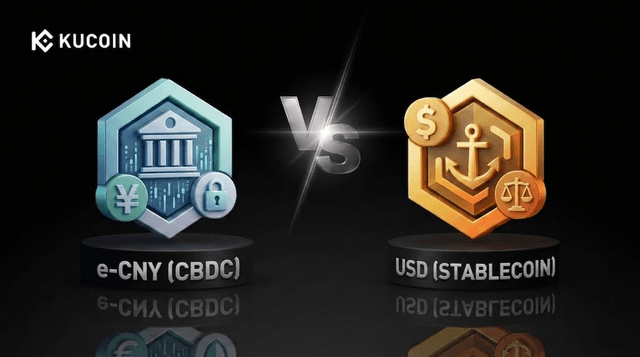
What is the Difference Between CBDC vs. Stablecoin? (e-CNY vs. USD)
Key Takeaways
-
Issuance Authority: The Digital Yuan (e-CNY) is a Central Bank Digital Currency (CBDC) issued by the People’s Bank of China, whereas USD Stablecoins are liabilities issued by private entities.
-
Legal Status: e-CNY is classified as sovereign legal tender (M0), while USD Stablecoins are digital assets pegged to the dollar, typically functioning as private-sector instruments.
-
Ledger Architecture: CBDCs like the e-CNY operate on centralized or permitted private ledgers; most USD Stablecoins utilize public, decentralized blockchain networks.
-
Financial Integration: e-CNY is integrated into the national banking tier of its home jurisdiction, whereas USD Stablecoins serve as the primary liquidity layer for the global decentralized finance ecosystem.
The evolution of digital finance has introduced two distinct models for digitizing fiat currency: Central Bank Digital Currencies (CBDCs) and Stablecoins. Within the global cryptocurrency industry, these models are most prominently represented by the Digital Yuan (e-CNY) and various USD-pegged stablecoins. While both function as digital representations of a national currency, they possess fundamental differences in their regulatory frameworks, technical foundations, and operational objectives.
The comparison of "Digital Yuan (e-CNY) vs. USD Stablecoins" highlights the divergence between state-controlled monetary systems and market-driven private innovation. Understanding these differences is essential for participants in the crypto markets, as the choice of digital instrument impacts transaction finality, privacy, and regulatory oversight.
The Digital Yuan (e-CNY): A Sovereign CBDC
The e-CNY is the digital version of China's national currency, the renminbi (RMB). It is issued and managed by the People’s Bank of China (PBOC), representing a direct liability of the central bank.
-
Two-Tiered Operational System
The e-CNY utilizes a two-tiered distribution system. The central bank issues digital currency to commercial banks and authorized non-bank payment institutions, which then distribute it to the public. This model ensures that the e-CNY is integrated into the existing financial infrastructure while maintaining the central bank’s control over the total money supply.
-
Legal Tender and Managed Anonymity
As legal tender, the e-CNY carries the same legal status as physical cash. A key technical feature is "managed anonymity," which allows for a degree of privacy for small-value retail transactions while maintaining the central bank's ability to track larger movements to prevent money laundering and illicit activities. Unlike public blockchain assets, the ledger for the e-CNY is permissioned and centralized under sovereign control.
USD Stablecoins: Private Digital Assets
USD Stablecoins are digital tokens designed to maintain a stable value relative to the United States dollar. These are typically issued by private organizations and are utilized extensively for trading and cross-border settlements.
-
Reserve Backing and Asset Management
Private issuers maintain reserves of liquid assets—such as physical dollars, short-term Treasury bills, or commercial paper to back every token in circulation. The stability of these assets depends on the transparency of the issuer's reserve audits and the quality of the underlying collateral.
-
Public Blockchain Infrastructure
Unlike the e-CNY, most USD Stablecoins are deployed on public blockchains like Ethereum, Solana, or Polygon. This allows for permissionless interaction, enabling anyone with a digital wallet to send or receive tokens globally without an intermediary. This infrastructure supports the decentralized finance (DeFi) ecosystem, where stablecoins serve as the primary unit of account and collateral for lending and borrowing.
Comparative Analysis: Technical and Structural Differences
The following table summarizes the core distinctions between the Digital Yuan and USD Stablecoins:
| Feature | Digital Yuan (e-CNY) | USD Stablecoins |
| Issuer Type | Central Bank (Sovereign) | Private Corporations |
| Liability | Central Bank Liability | Private Issuer Liability |
| Legal Status | Sovereign Legal Tender | Private Digital Asset |
| Ledger Type | Permissioned / Centralized | Public / Decentralized |
| Yield/Interest | May be interest-bearing | Generally non-interest-bearing |
| Primary Goal | Domestic Payments/Monetary Control | Global Liquidity/Trading |
Monitoring official announcements is critical for tracking the integration of these different digital formats into global exchange platforms and payment gateways.
Operational Roles in Global Finance
The functional roles of these digital currencies differ based on their design and the jurisdictional requirements of their users.
-
Domestic Retail and State Governance
The e-CNY is primarily optimized for domestic retail payments and improving the efficiency of the national payment system. Its programmability allows the state to implement smart contract functions for specific fiscal policies, such as targeted subsidies or designated consumption periods.
-
Global Trading and Decentralized Liquidity
USD Stablecoins function as the "liquidity engine" of the global blockchain economy. Within the KuCoin ecosystem, stablecoins are the most frequently traded assets, providing a bridge between fiat currency and volatile digital assets. For users of the KuCoin lite version, stablecoins offer a stable medium for monitoring value and executing basic market entry and exit strategies.
Privacy and Regulatory Oversight
Privacy architecture is a major point of divergence between the two models.
-
CBDC Privacy: The e-CNY provides the state with visibility into transaction data to ensure compliance with national financial laws. While it offers "anonymity" toward third parties and commercial banks, it is not anonymous toward the issuing central bank.
-
Stablecoin Privacy: USD Stablecoins on public blockchains provide pseudonymity. While transaction history is public on the ledger, the real-world identity of the wallet owner is not immediately visible unless linked through a KYC-compliant exchange or service provider. However, private issuers maintain the technical ability to "freeze" specific wallet addresses if required by law enforcement.
Conclusion
The distinction between the Digital Yuan (e-CNY) and USD Stablecoins represents the two paths of digital currency development. The e-CNY is a centralized, state-backed instrument designed to modernize the traditional monetary system and enhance sovereign control over digital payments. USD Stablecoins are market-driven assets that leverage public blockchain technology to provide global, permissionless liquidity and interoperability within the decentralized economy.
As these technologies continue to develop, the global financial system is increasingly accommodating both models. CBDCs are focused on domestic efficiency and sovereign policy, while stablecoins remain the standard for cross-border digital asset trading and decentralized financial innovation.
FAQs
Can the Digital Yuan be used on public blockchains?
No. The e-CNY operates on a permissioned ledger controlled by the People’s Bank of China. It is not natively compatible with decentralized public blockchains like Ethereum or Solana.
What happens if a stablecoin issuer loses its reserves?
If a private issuer cannot maintain the 1:1 reserve ratio, the stablecoin may "de-peg," meaning its market value could drop below one dollar. This is a primary risk factor for stablecoin holders.
Does e-CNY compete with USD Stablecoins?
They serve different primary markets. The e-CNY is a domestic payment tool for China, while USD Stablecoins are primarily used for global crypto trading and decentralized finance.
Are stablecoins regulated by the government?
The regulatory status of stablecoins varies by jurisdiction. Many regions are introducing frameworks that require issuers to maintain full reserves and undergo regular third-party audits.
Where can I find data on stablecoin market caps?
Real-time market data, including supply and trading volume for major USD Stablecoins, is available through the KuCoin market page.
Create a free KuCoin account to discover the next crypto gems and trade over 1,000 global digital assets today. Create Now!
Further reading:


