

NVIDIA FY 2027 Q2 Earnings Beat Expectations and Reignite the AI Investment Rally
2026/08/27 10:59:00
Introduction
Markets woke up thanking NVIDIA again. The chipmaker’s fiscal second-quarter 2027 results, released August 26, 2026, beat Wall Street on almost every line and then flipped after-hours sentiment when management pushed growth visibility into fiscal 2028.
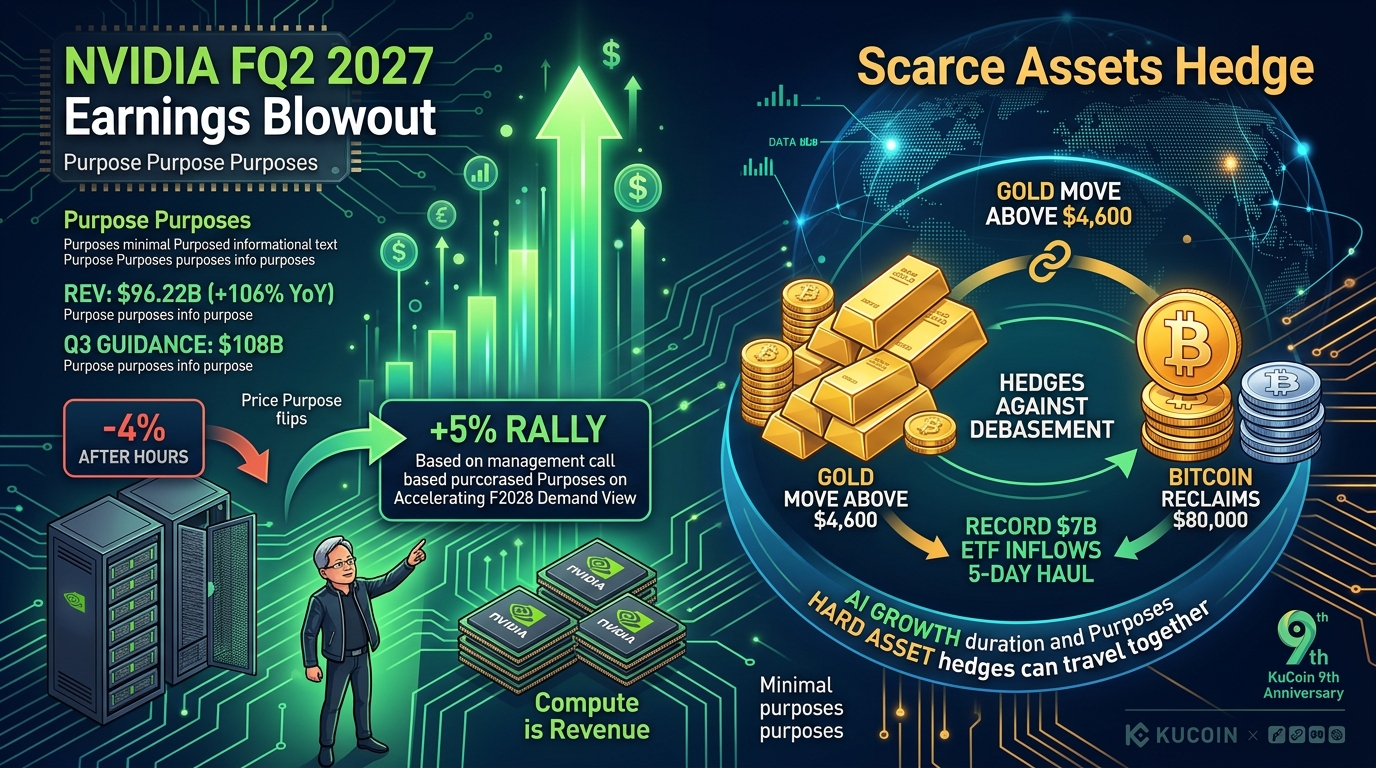
Revenue reached $96.22 billion, above the roughly $92.17 billion consensus and up 106% year over year, according to NVIDIA’s official release and CNBC’s live coverage. Adjusted EPS was $2.22 versus about $2.09–$2.10 expected, up 120% from a year earlier. GAAP net income of $59.69 billion implied a net margin near 62% — about $62 of profit on every $100 of sales. Q3 guidance of $108 billion also topped estimates.
The print first met “AI fatigue,” with shares dipping about 4% after hours, then reversed to a gain of more than 5% after CFO Colette Kress and CEO Jensen Huang framed demand as still accelerating.
What Did NVIDIA Report in Its Latest Quarter?
NVIDIA beat on revenue, earnings, and the data-center line that now dominates the company. Official results for the quarter ended July 26, 2026 showed $96.221 billion in sales, up 18% sequentially and 106% year over year, according to the NVIDIA Newsroom release dated August 26, 2026. Data-center revenue was $89.0 billion, up 117% year over year and 18% quarter over quarter, or about 92% of total sales.
Hyperscale customers contributed $48.71 billion. AI clouds, industrial, and enterprise (ACIE) customers spent $40.31 billion, up 138% year over year, according to company commentary compiled by SiliconANGLE and MarketScreener. Gross margin held at 75.0% on both a GAAP and non-GAAP basis. GAAP EPS was $2.46; non-GAAP EPS was $2.22.
The margin story is why the beat still matters at this scale. A business that converts more than 60% of revenue into net income can fund capacity, buybacks, and customer financing without looking stretched on a single quarter. That does not remove later margin risk. It does explain why a “tired” AI tape still treats NVIDIA as the reference price for compute.
Why Did NVIDIA Stock Fall After Hours Before Rallying?
The first reaction was a fade because the market had already priced another blowout and wanted proof that the AI cycle was not peaking. Shares slipped around 4% after the numbers hit, then flipped to a gain of more than 5% once the call began, according to CNN Business, Reuters, and Axios coverage from August 26, 2026.
Kress said fiscal 2028 revenue growth should be about 70%, versus Street estimates near 44%–45%. She added that customer forecasts “point to our growth doubling next year,” but guidance reflects supply limits, not weak demand. Huang went further: demand growth is “much larger than 70%” and closer to 100%, and without supply constraints the number would be “much higher.” He said AI has reached an inflection point — no longer experimental, now productive and able to generate revenue — and that “compute is revenue.”
That language changed what traders were buying. The tape stopped treating a single-quarter beat as the story and started trading a one- to two-year earnings upgrade. Memory and optical-communications names moved with NVIDIA as the supply-chain read-through improved.
What Risks Remain After NVIDIA’s Blowout Earnings?
The rally does not erase the risks that caused the first dip. A large part of the after-hours jump came from Huang and Kress pushing the “AI growth bottleneck” fear out by a year. That supports the stock now and also pulls future good news into today’s multiple.
Gross-margin pressure is explicit. Kress said soaring memory prices and higher component costs will keep weighing on margins, with a trough near 71%–72% in the fourth quarter, according to Reuters. Supply stays tight at least through fiscal 2028. Customer financing and circular-deal concerns have not disappeared; NVIDIA again defended capital solutions that help data-center builds get funded.
The next tests are mechanical: deliver $108 billion in Q3, then show that the 70% fiscal 2028 framework is not just a supply-constrained talking point. Until those prints land, NVIDIA’s share price will keep discounting both the upgrade and the risk that expectations were pulled forward.
Why Are Investors Buying Gold and Bitcoin Alongside the AI Rally?
Wall Street is no longer forcing a strict “AI or scarce assets” choice. Over the past five trading days, gold and Bitcoin ETFs attracted a combined about $7 billion, a record for that window, according to Bloomberg data cited on August 26, 2026 by Eric Balchunas and multiple market reports. State Street’s SPDR Gold Shares (GLD) took in about $3.4 billion. BlackRock’s iShares Bitcoin Trust (IBIT) took in about $1.5 billion. Both ranked among the top U.S. ETF inflow names for the week.
The driver is fiscal pressure in U.S. Treasuries, not a rejection of AI. After officials signaled larger long-term Treasury buybacks, long yields and the dollar eased while gold and Bitcoin rose. Gold gained about 13% in August and moved above $4,600 an ounce in recent trade; Bitcoin reclaimed the $80,000 area, according to contemporaneous market wrap-ups.
That pairing is the return of the debasement trade: when fiscal deficits rise and financial conditions ease, assets with constrained supply that sit outside the government money system attract more capital. Investors can hold NVIDIA for AI cash-flow duration and still add gold and Bitcoin as hedges against currency dilution. The two books are not mutually exclusive.
KuCoin Offers A More Stable Option in A Volatile Market
If you worry about the frequent ups and downs in the market, and pursue a more stable option to earn money passively, KuCoin is the right place to come:
-
Simple Earn: Deposit and withdraw tokens anytime, earning stable returns.
-
Kucoin Earn: Earn stable profits with professional asset management.
-
Hold to Earn: Earn rewards by holding assets in Funding, Trading, Margin, Futures, Mining, and Unified Accounts.
-
Staking: Unlock the earning potential of on-chain assets.
-
Advanced Investments: Advanced Investments offer a variety of structured products to help your money grow in any market.
-
Shark Fin: Principal Protection and Guaranteed Gains
-
Dual Investment: Buy low and sell high with transparent return calculations.
-
Snowball: High yields, with price protection.
-
Discount Buy: Buy crypto at discount prices.
-
KCS Loyalty: Level up to enjoy exclusive perks by staking ≥ 1 KCS.
-
KuCoin Wealth: Discover future value and begin your smart investing journey.
-
KCS Benefits: Hold and stake KCS to access benefits across the platform.
-
KCS Staking 2.0: Participate in KCS on-chain governance to earn yield.

Conclusion
NVIDIA’s fiscal Q2 2027 results were a beat on revenue, EPS, data-center sales, and near-term guidance. Sales of $96.22 billion, up 106%, a net margin near 62%, and $108 billion Q3 guidance would have been enough in a less crowded tape. The market still needed the call. Kress’s roughly 70% fiscal 2028 growth view — versus about 44%–45% on the Street — and Huang’s claim that unconstrained demand is closer to 100% turned a 4% after-hours drop into a gain of more than 5% and pulled memory and optical names higher.
That reversal also pulled expectations forward. Margin compression from memory costs, supply bottlenecks through fiscal 2028, and customer-financing questions remain on the checklist. The next proof points are the $108 billion quarter and whether the 70% framework holds as Vera Rubin ramps.
At the same time, a record $7 billion five-day haul into gold and Bitcoin ETFs shows allocators running a second book: scarce assets against fiscal debasement. AI duration and hard-asset hedges can travel together. Traders who want to express the crypto side of that mix can do so on KuCoin with clear risk limits, while treating NVIDIA’s print as information — not a guarantee — about the next twelve to twenty-four months.
FAQs
Did NVIDIA miss any major line item this quarter?
No. Revenue, adjusted EPS, data-center sales, and Q3 revenue guidance all cleared consensus, according to NVIDIA’s August 26, 2026 release and LSEG/FactSet figures cited by major outlets.
What fiscal year is NVIDIA talking about when it says 70% growth?
Fiscal 2028, which runs from February 2027 through January 2028. That is one full year beyond the current fiscal 2027 period.
Why does NVIDIA exclude China from Q3 guidance?
The company stated it is not assuming any data-center compute revenue from China in the $108 billion outlook, reflecting ongoing export and market-access limits.
Is a 62% net margin sustainable if memory costs keep rising?
Not at the same level. Management already guided Q3 gross margin near 74% and flagged a possible Q4 trough around 71%–72% as memory and component costs rise.
Does the gold-and-Bitcoin inflow mean investors are leaving AI stocks?
No. The $7 billion five-day ETF haul shows a parallel allocation into scarce assets. Many desks are adding hedges while still trading the AI infrastructure cycle.
Disclaimer: This article is for informational purposes only and does not constitute financial, legal, or investment advice. Always conduct your own research before interacting with digital assets.