

What Is Layer 2, and What Is the Current Development Status of Layer 2 on the Ethereum Blockchain?
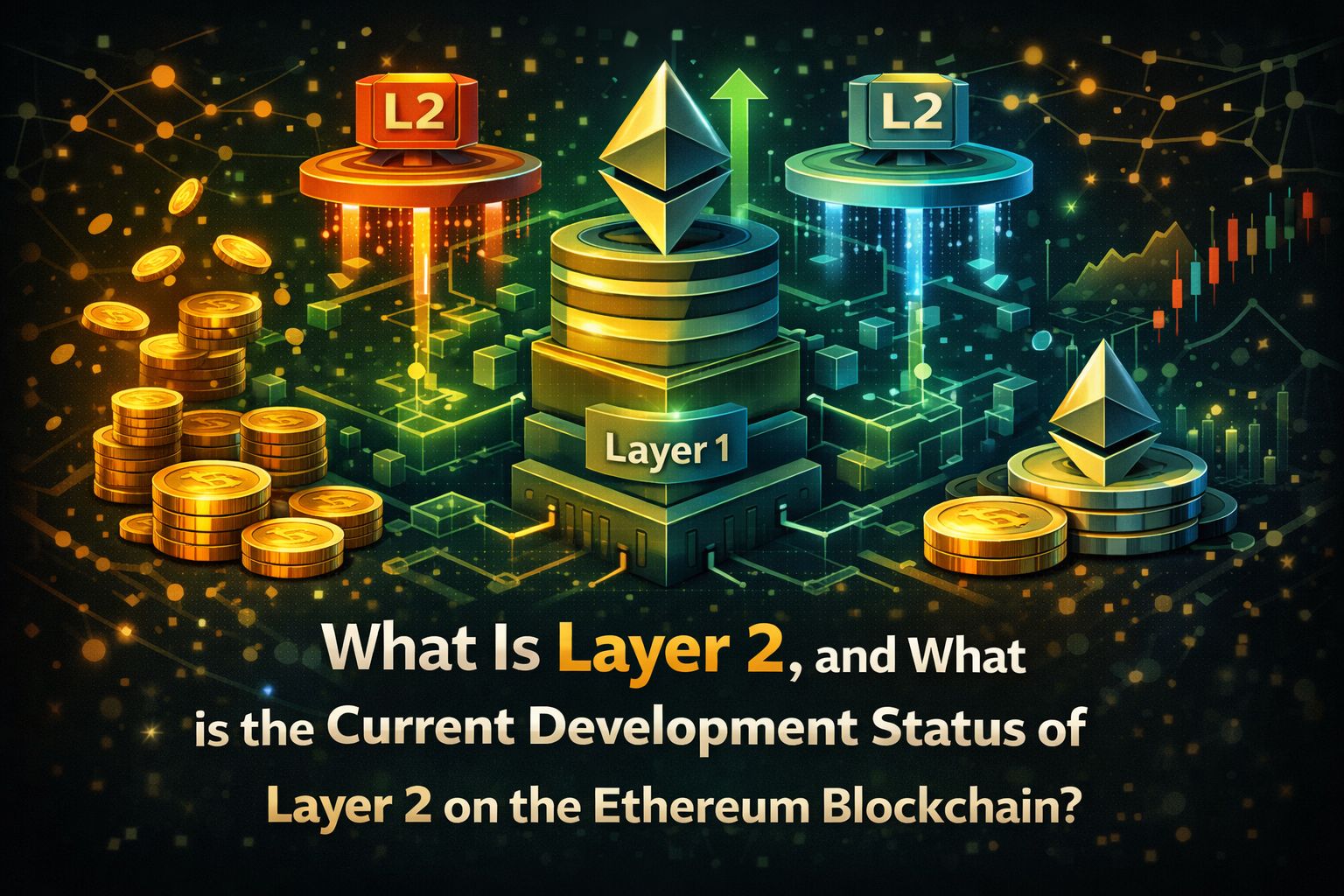
Discover what Layer 2 solutions are, how they improve Ethereum scalability, and the latest developments in rollups, zk-proofs, and other Layer 2 technologies driving mainstream adoption.
Abstract
Layer 2 solutions are essential for scaling Ethereum by enabling faster, cheaper transactions while maintaining security inherited from Layer 1. Innovations like rollups, state channels, and zero-knowledge proofs are not just technical enhancements, they represent a paradigm shift in how decentralized applications handle congestion, cost, and efficiency, positioning Ethereum for global adoption in finance, gaming, and beyond.
Introduction to Ethereum’s Scalability Problem
Ethereum’s core network, also known as Layer 1, has long been criticized for scalability limitations. During periods of high demand, such as popular NFT launches or DeFi token migrations, network congestion spikes, leading to slower transaction confirmations and soaring gas fees. At peak congestion in 2021, users sometimes paid over $100 for a single transaction. This situation creates friction for everyday users and businesses, restricting Ethereum’s adoption as a global platform.
The Ethereum blockchain is secured by decentralized validators and uses smart contracts to manage complex financial instruments, games, and other dApps. While this decentralization is crucial for security and censorship-resistance, it comes at the cost of throughput: Ethereum can handle roughly 15–30 transactions per second (TPS), which is far below centralized alternatives like Visa, which processes thousands of TPS.
Layer 2 solutions emerged to address this fundamental bottleneck. By moving some computation and transaction activity off the main chain while still anchoring to Layer 1 for security, Layer 2 networks reduce congestion and gas costs. This enables Ethereum to support larger-scale applications, such as mass-market DeFi protocols, NFT marketplaces, and microtransactions, which would otherwise be prohibitively expensive or slow.
What Is Layer 2? A Simple Explanation
Layer 2 refers to a secondary framework built on top of a blockchain (Layer 1) to improve its performance. It handles transactions off-chain or partially off-chain, reducing congestion and lowering costs while still relying on the security of the underlying Layer 1 blockchain.
A simple analogy is public transit: Ethereum’s Layer 1 is like a busy main highway. If every car must travel on this highway, traffic jams occur. Layer 2 solutions act like parallel roads or express lanes, where cars can travel faster but eventually merge back safely into the main route, ensuring security and accuracy.
Layer 2 is critical for enabling microtransactions, real-time gaming, and scalable DeFi applications, which would otherwise struggle with high gas fees and slow confirmations. The main promise of Layer 2 is to preserve Ethereum’s decentralization and security while massively improving throughput and usability.
How Layer 2 Works on Ethereum
Layer 2 works by executing transactions off the Ethereum main chain and then settling the final results on Layer 1. The key principle is security inheritance: even though computations occur off-chain, the Ethereum base layer ensures that data and state transitions are valid.
There are multiple mechanisms:
-
Transaction aggregation: Layer 2 combines multiple transactions into one batch and commits it to Ethereum, reducing gas fees.
-
Fraud proofs and zk-proofs: These cryptographic methods verify that off-chain computations are valid without needing each transaction to occur on-chain.
-
Bridges and smart contracts: Layer 2 networks often use smart contracts to lock assets on Layer 1, enabling seamless token transfers between layers.
By doing this, Ethereum achieves scalability without sacrificing decentralization. Users experience lower fees and faster confirmations while the main Ethereum chain remains the ultimate source of truth.
Types of Layer 2 Solutions
Ethereum supports several Layer 2 mechanisms, each optimized for different use cases:
-
Rollups: Aggregate transactions off-chain and submit proofs to Ethereum. Two main types: Optimistic and Zero-Knowledge (ZK).
-
State Channels: Enable two parties to transact privately off-chain and settle the final state on-chain. Common for gaming and micropayments.
-
Sidechains: Independent chains connected to Ethereum, handling transactions separately but syncing assets. Example: Polygon.
Each method balances trade-offs between speed, security, and complexity. For instance, state channels are extremely fast but limited to pre-agreed participants, while rollups scale globally but require more sophisticated cryptography.
Optimistic Rollups Explained
Optimistic rollups, as the name suggests, optimistically assume transactions are valid by default. Fraud proofs are used to challenge incorrect transactions within a dispute window.
Key features:
-
Scalability: Handle thousands of TPS.
-
Cost efficiency: Fees are significantly lower than Layer 1.
Examples: Optimism and Arbitrum.
The main trade-off is the delay in finality. Because there’s a dispute window (usually 1–2 weeks), funds may be temporarily illiquid. However, for most DeFi applications and large-scale deployments, this is an acceptable compromise for scalability.
Zero-Knowledge Rollups (ZK Rollups)
ZK Rollups use zero-knowledge proofs to validate transactions instantly, without requiring a long dispute period. They are highly secure, privacy-preserving, and extremely fast.
-
How it works: ZK proofs mathematically prove that off-chain transactions are valid.
-
Examples: zkSync and StarkNet.
-
Advantages: Near-instant finality, reduced gas fees, better privacy.
ZK Rollups are considered the future of Ethereum Layer 2 due to their speed, security, and compatibility with complex smart contracts.
Layer 2 vs Layer 1: Key Differences
Layer 1 and Layer 2 on the Ethereum blockchain serve distinct but complementary roles, each with its own advantages and limitations. Layer 1 refers to the Ethereum mainnet itself, which is fully decentralized and secured by thousands of validators through its proof-of-stake consensus mechanism. This ensures a high level of security and censorship resistance, making it the ultimate source of truth for all transactions and smart contract executions.
However, this decentralization comes with significant trade-offs: Layer 1 can only handle approximately 15–30 transactions per second (TPS), and during periods of high network demand, gas fees can spike dramatically, sometimes reaching hundreds of dollars per transaction. These limitations create bottlenecks for applications that require frequent or microtransactions, such as gaming platforms, NFT marketplaces, and mass-market DeFi protocols. Layer 2 solutions, by contrast, are secondary networks built on top of Ethereum that aim to address these constraints. By executing transactions off-chain or aggregating multiple transactions before settling them on Layer 1, Layer 2 networks can achieve thousands of TPS, drastically reducing congestion and gas costs.
Users benefit from faster transaction confirmations and significantly lower fees while still relying on Ethereum’s security for final settlement. Importantly, Layer 2 is not a replacement for Layer 1; it complements the mainnet by offloading high-volume activity while maintaining the integrity and decentralization of Ethereum.
This layered approach allows developers to design applications that are scalable, cost-efficient, and secure, supporting both high-frequency use cases and broader adoption. In practice, Layer 1 serves as the backbone and ultimate validator of the system, while Layer 2 acts as a high-performance extension, enabling Ethereum to meet the demands of global users without compromising its core security and decentralization principles.
The Role of Layer 2 in Ethereum’s Roadmap
Ethereum’s roadmap places Layer 2 at the center of its scaling strategy, reflecting a fundamental shift in how the network plans to handle growing demand while maintaining security and decentralization. Rather than attempting to increase Layer 1 throughput directly, which would require significant trade-offs in decentralization, Ethereum is adopting a rollup-centric approach, where most transactions are executed on Layer 2 networks and only the final data or proofs are settled on Layer 1.
This modular structure allows Layer 2 solutions to handle high-volume transactions, reduce gas fees, and provide faster confirmations, while Layer 1 continues to act as the ultimate settlement layer, ensuring that security and the integrity of the blockchain are never compromised. A key component of this vision is proto-danksharding, an upgrade designed to enhance data availability for rollups by allowing Layer 1 to efficiently store and share large volumes of transaction data. This ensures that Layer 2 networks can scale without sacrificing security or decentralization. Complementing this, various Ethereum Improvement Proposals (EIPs) focus on making Layer 1 more efficient in validating and settling transactions from Layer 2 networks, reducing costs and latency for users and developers. Layer 2 adoption is also accelerating within the decentralized finance (DeFi) ecosystem, as leading protocols such as Uniswap, Synthetix, and Aave increasingly integrate with rollups like Optimism, Arbitrum, and zkSync, enabling users to access faster and cheaper transactions.
Together, these developments represent a deliberate move toward a modular Ethereum, where Layer 1 provides the foundational security guarantees while Layer 2 networks scale transaction capacity and enhance usability. By offloading the majority of activity to Layer 2, Ethereum can accommodate global-scale applications and mass adoption without compromising the decentralization principles that form the core of its network design.
Current Adoption of Layer 2 Solutions
The adoption of Layer 2 solutions on the Ethereum blockchain has accelerated significantly in recent years, signaling a change from experimental use cases to mainstream application across decentralized finance (DeFi), non-fungible tokens (NFTs), and other blockchain-driven ecosystems.
Total Value Locked (TVL) in Layer 2 protocols has surpassed 39$ billion, with networks like Arbitrum, Optimism, and zkSync leading the market by providing high-throughput, low-cost transaction environments that alleviate congestion on the Ethereum mainnet. This growth in TVL reflects strong institutional and retail confidence, demonstrating that users are willing to lock substantial assets into Layer 2 ecosystems for staking, trading, and liquidity provisioning.
Beyond capital, user engagement has also expanded rapidly, with tens of thousands of daily active users participating in DeFi protocols, NFT marketplaces, and gaming applications that leverage Layer 2 for faster confirmations and reduced fees. Major platforms, including Uniswap, Synthetix, and OpenSea, have integrated Layer 2 solutions, bridging liquidity and offering users more scalable experiences without compromising security.
These integrations underscore the growing maturity of Layer 2 networks, as developers increasingly prioritize usability and seamless interaction between Layer 1 and Layer 2 environments. Collectively, these trends indicate that Layer 2 is moving beyond its experimental phase, establishing itself as a fundamental component of Ethereum’s scalability roadmap.
The combination of substantial capital, rising user activity, and cross-platform adoption illustrates the ecosystem’s readiness for wider deployment, ultimately enabling Ethereum to achieve higher transaction throughput, lower fees, and greater accessibility while preserving the decentralized security model that underpins the network.
Challenges Facing Layer 2 Today
Despite the tremendous promise of Layer 2 solutions for scaling Ethereum, the ecosystem still faces several critical challenges that must be addressed to achieve widespread adoption. One major issue is fragmentation: with multiple competing Layer 2 networks such as Arbitrum, Optimism, zkSync, and StarkNet, users often encounter a confusing landscape where assets, protocols, and interfaces are inconsistent across platforms.
This complexity can lead to a steep learning curve and a disjointed user experience, discouraging casual participants. Closely tied to this is the problem of liquidity fragmentation. Since assets are distributed across multiple rollups and Layer 2 chains, each network may have limited liquidity, which can hinder trading efficiency, increase slippage, and reduce the overall attractiveness of the platform for decentralized finance (DeFi) applications. Another significant concern is bridging risk.
Moving assets between Layer 1 and Layer 2, or even between separate Layer 2 networks, relies on smart contract bridges that, while innovative, are not immune to bugs, exploits, or misconfigurations. Any vulnerability in these bridges can result in substantial asset losses, undermining user confidence. Finally, user education remains a substantial barrier. Many Ethereum users are still unfamiliar with the mechanics of Layer 2, including wallet management, bridging assets, understanding gas costs on rollups, and interacting with smart contracts on secondary networks. This knowledge gap can lead to errors, lost funds, or hesitation to participate in Layer 2 ecosystems.
Addressing these challenges, through improved interoperability, robust bridging solutions, user-friendly interfaces, and educational initiatives, is essential for fostering sustainable growth. Solving fragmentation, enhancing liquidity, reducing risks, and empowering users with knowledge will be pivotal in realizing the full potential of Layer 2 solutions, enabling Ethereum to scale securely and efficiently for mainstream adoption.
Recent Developments and Innovations in Layer 2
Recent developments in Layer 2 (L2) solutions on Ethereum have significantly advanced the scalability, security, and usability of the network, bringing it closer to mainstream adoption.
One of the most notable innovations is the rise of zkEVMs, which are zero-knowledge rollups compatible with Ethereum’s existing EVM (Ethereum Virtual Machine). This compatibility allows developers to deploy full-featured smart contracts on L2 while benefiting from the cryptographic efficiency of zero-knowledge proofs, reducing transaction costs and confirmation times without compromising security. Alongside zkEVMs, interoperability bridges have emerged as a critical component of the L2 ecosystem.
These bridges enable seamless asset transfers and communication between different Layer 2 networks, such as Optimism, Arbitrum, and StarkNet, addressing fragmentation and allowing users and developers to move funds and data efficiently across platforms.
Additionally, Optimistic Rollups, one of the earliest widely adopted L2 solutions, have undergone important enhancements. Improvements such as faster withdrawal periods and shorter fraud-proof windows have addressed previous limitations that slowed access to funds or created uncertainty, making these networks more practical for day-to-day DeFi and NFT usage.
Collectively, these innovations reflect a maturing L2 ecosystem that balances scalability, security, and user experience. By combining zkEVMs for advanced cryptographic efficiency, interoperability bridges for cross-network fluidity, and optimized Optimistic Rollup protocols for faster and more reliable operations, Ethereum’s Layer 2 solutions are evolving from experimental tools into robust infrastructures capable of supporting high-volume, low-cost, real-time decentralized applications.
This evolution demonstrates that L2 networks are not only addressing Ethereum’s scalability bottlenecks but are also shaping the foundation for a modular, multi-layered blockchain ecosystem, where efficiency, user accessibility, and security coexist to support the next generation of Ethereum-powered applications.
Use Cases of Layer 2 Beyond DeFi
Layer 2 enables new applications:
-
Gaming: Microtransactions with low latency.
-
NFTs: Reduced minting costs and faster trades.
-
Payments: Micropayments for content or services.
-
Enterprise adoption: Companies exploring blockchain without high fees.
This demonstrates that L2 isn’t just a financial tool, it’s foundational for Ethereum’s ecosystem expansion.
The Future of Layer 2 on Ethereum
The long-term vision:
-
Scalable, modular Ethereum: L1 for security, L2 for mass adoption.
-
Mainstream adoption: Payments, NFTs, gaming, social apps.
-
Competition: Layer 2 vs other smart contract chains like Solana, Avalanche.
Ethereum’s Layer 2 ecosystem is rapidly growing, and by 2026–2027, it may be fully capable of supporting global-scale applications with minimal fees.
FAQ Section
Q: What is Layer 2 in simple terms?
A: It’s a secondary network built on Ethereum to make transactions faster and cheaper while inheriting Ethereum’s security.
Q: Is Layer 2 safe?
A: Yes, but bridges and smart contracts can have vulnerabilities. Always use audited solutions.
Q: Difference between Optimism and Arbitrum?
A: Both are Optimistic Rollups, but they have slightly different protocols, governance, and user interfaces.
Q: Can Layer 2 fully replace Ethereum L1?
A: No, Layer 2 relies on L1 for settlement and security.
Q: Are Layer 2 fees lower?
A: Yes, significantly lower, sometimes 10–100x cheaper than L1 fees.
Conclusion
Layer 2 solutions are a transformative layer for Ethereum, addressing its scalability, speed, and cost challenges. From Optimistic Rollups like Arbitrum and Optimism to ZK Rollups like zkSync and StarkNet, Ethereum is evolving toward a modular ecosystem where Layer 2 handles high-volume activity and Layer 1 provides robust security.
Despite challenges such as fragmentation, liquidity, and bridging risks, adoption is accelerating. Layer 2 solutions are expanding Ethereum’s ecosystem beyond finance to gaming, social apps, and enterprise solutions, marking a new phase in blockchain usability.
As Layer 2 technology matures and interoperability improves, Ethereum could achieve global-scale adoption, proving that scaling via Layer 2 is not just a temporary solution but the foundation for the next generation of decentralized applications.